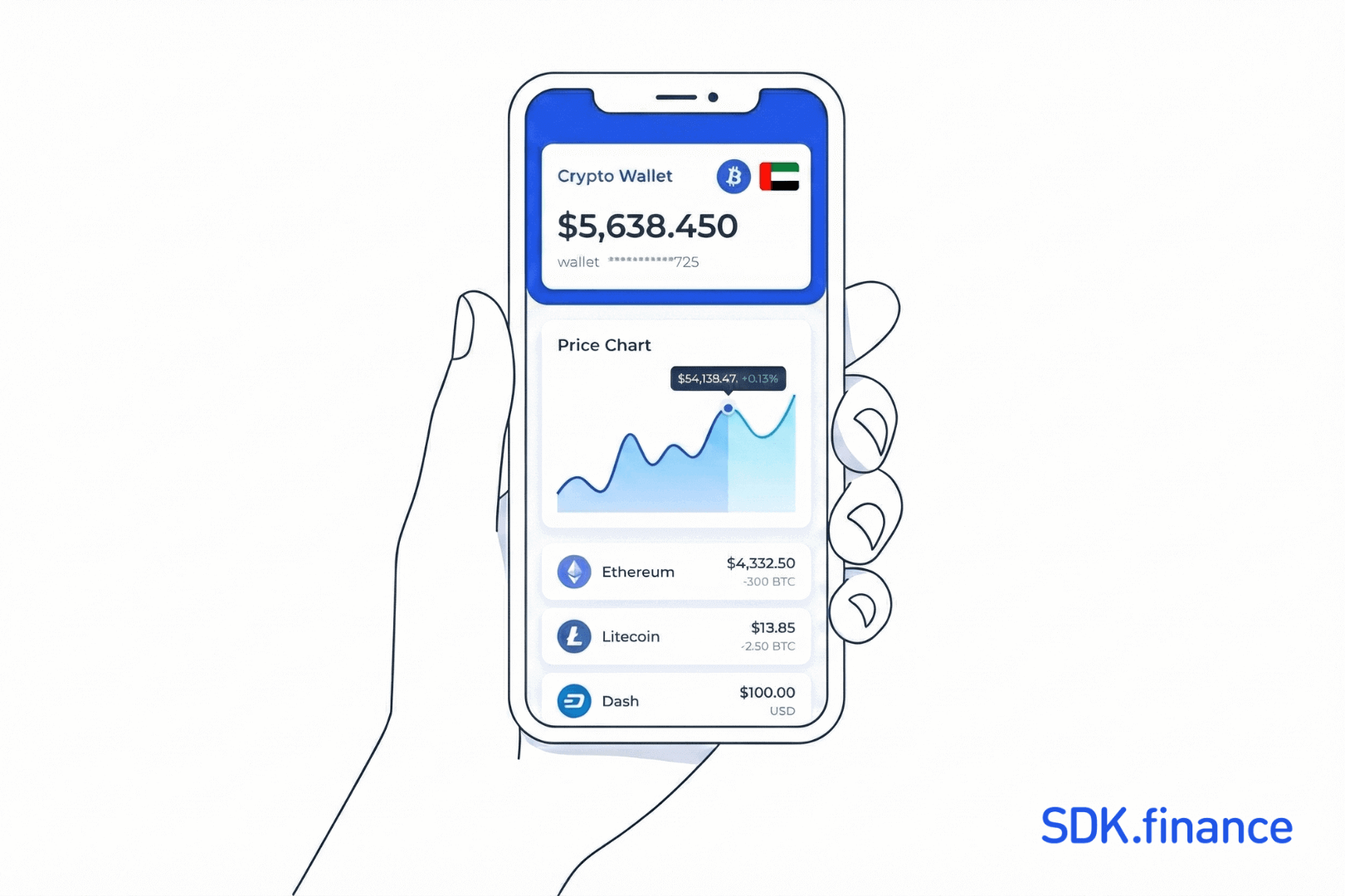
Over roughly the last decade, the UAE has quietly established itself as one of the most practically advanced environments for crypto-enabled financial services. In contrast to regions where crypto adoption is still largely tied to speculative trading or exchange-driven activity, the UAE market has taken a more functional direction. Digital assets are increasingly treated as part of the broader financial stack, expected to operate alongside fiat balances, payment instruments, cards, and account-based products.
This shift has influenced how crypto products are designed and delivered. Rather than focusing on isolated trading experiences, many UAE-based projects prioritise infrastructure that supports everyday financial operations. As a result, wallet technology in the region has evolved to support secure, compliant, and scalable management of digital assets within regulated financial contexts.
For founders, CTOs, and product leaders working in this environment, the core question is no longer whether crypto should be included. That decision has largely been settled. The real challenge lies in determining how crypto functionality fits into a wider digital finance platform without weakening control over operations, compliance, or future growth. Within this framework, the white label crypto wallet has become a foundational component. Instead of acting as an add-on, it serves as the primary interface through which users interact with digital assets as part of a unified financial experience.
Everything you need to launch crypto wallets, payments, and custody
Learn moreThis article examines white label cryptocurrency wallets in the UAE from a practical and technical standpoint. It looks at how these wallets are deployed in real products, what experienced teams expect from them, how architectural and compliance choices influence long-term outcomes, and why the underlying platform plays such a critical role in the Middle East market.
The UAE’s position as a leading market for wallet-centric crypto products is the result of long-term structural development rather than short-term experimentation.
As banks, fintech companies, payment providers, and crypto businesses in the region expand their offerings to include crypto-related services, demand has grown for wallet solutions that can be reused, extended, and adapted without repeated redesign. A cryptocurrency wallet development company plays a crucial role in delivering secure, scalable, and customizable wallet platforms to meet these evolving needs. At the same time, support for multiple blockchain networks within a single wallet environment – along with multi asset support and multi currency support – has become increasingly important, particularly for companies planning to scale across several jurisdictions.
A crypto wallet, often referred to as a digital wallet, is a software application that enables users to securely store, send, and receive digital assets such as cryptocurrencies and NFTs. At its core, a crypto wallet app serves as a digital gateway, allowing individuals and businesses to interact with blockchain networks, manage their crypto assets, and access a growing ecosystem of decentralized apps (dApps) and services.
The primary purpose of a crypto wallet is to provide a secure and convenient way to manage digital assets while ensuring complete ownership and control over private keys. As the adoption of cryptocurrencies and decentralized finance (DeFi) accelerates, the need for robust, user-friendly crypto wallet solutions has never been greater. This demand has driven innovation in crypto wallet development, resulting in a wide range of wallet types – including mobile wallets, desktop wallets, web wallets, and hardware wallets – each designed to balance accessibility, security, and flexibility.
For businesses and individuals seeking to create their own crypto wallet, custom crypto wallet development offers the ability to tailor wallet features, security measures, and user experience to specific requirements. A custom crypto wallet can be designed to support:
These robust security measures are essential for protecting private keys and digital assets, building user trust, and ensuring regulatory compliance.
White label crypto wallet solutions have emerged as a popular choice for organizations aiming to launch a branded crypto wallet quickly and efficiently. By leveraging a white label crypto wallet, businesses can deploy a fully branded wallet app with their own features, security protocols, and user interface – without the need for extensive in-house development. This approach not only accelerates time-to-market but also allows companies to focus on user engagement, customer experience, and business growth, while relying on proven security and blockchain integration.
Ultimately, successful crypto wallet development requires a careful balance of security, usability, and seamless blockchain integration. By understanding the essential features and development options available, businesses and individuals can make informed decisions – whether building a custom crypto wallet from the ground up or choosing a white label solution – to create a secure, user-centric digital tool that meets the evolving needs of the digital asset economy.
Everything you need to launch crypto wallets, payments, and custody
Learn moreThe UAE adopted digital payments and wallet-based services earlier than many other regions. Cards, mobile wallets, and online payment flows are now routine for both consumers and businesses. This level of maturity creates favourable conditions for introducing crypto functionality that builds on existing habits rather than replacing them.
From a product perspective, this allows crypto services to be embedded into familiar wallet and account-based interfaces, lowering the barrier to use and speeding up adoption. Hot wallets enable quick and convenient access to crypto funds for everyday transactions, supporting active use. Seamless interaction between traditional and crypto payment methods is essential to enhance user experience and streamline payment flows.
In the UAE market, crypto is rarely presented as a standalone experience. Users typically expect a single environment where they can:
Some wallets also support the management and trading of digital collectibles such as NFTs, further expanding their Web3 capabilities.
For many fintech companies, Dubai serves as the initial entry point into the Middle East. Products launched in the UAE are often intended to expand into neighbouring markets. This makes architectural flexibility more important than local optimisation.
Wallet platforms that cannot be extended across jurisdictions without major structural changes quickly limit growth. Multi-chain support also becomes essential, allowing a single wallet architecture to operate across different blockchain ecosystems as regional coverage expands. As platforms scale regionally, secure key management becomes essential for protecting assets, while regular security audits and robust key management practices are necessary to ensure secure operations and compliance across multiple jurisdictions.
With these factors in mind, it is important to clarify what a white label crypto wallet represents within the UAE context.
In the UAE market, a white label crypto wallet is not simply a branded user interface or an auxiliary crypto feature. It is a wallet-led financial product in which the operating company retains full control over the customer relationship and the underlying financial logic. A white label wallet is a pre-built, customizable solution that enables rapid deployment and scaling for enterprises seeking to launch secure, compliant crypto wallet services.
In practice, this means the company:
Crypto and fiat balances typically exist within the same wallet framework, supported by a real-time ledger that acts as the system of record. This ledger tracks every balance change and transaction, ensuring consistency, traceability, and accurate reporting. Secure handling of cryptographic keys – specifically, the management of private and public keys – is essential for transaction signing and asset protection. Public keys play a critical role in enabling secure transactions and interactions with blockchain networks, ensuring that only authorized parties can access and transfer digital assets.
In this model, the wallet functions as the primary financial account rather than an additional crypto layer attached to another system.
Although implementations vary, most UAE-based wallet projects follow a small number of established patterns. Crypto wallet development services are tailored to meet the specific needs of each use case, ensuring secure, scalable, and feature-rich solutions for enterprises and startups alike.
One of the most common models involves wallets where users hold crypto assets, convert them into fiat, and spend funds using cards or local payment methods. In this setup:
Users expect a complete transaction history covering both crypto and fiat activity. These wallets often rely on online wallets for active use, which increases the importance of strong security controls. For enhanced security, large or long-term crypto holdings are typically safeguarded using cold storage, such as hardware wallets kept offline. Additionally, some users may opt for a watch-only wallet to monitor balances and transactions without exposing private keys.
Another significant category includes wallets used by companies to manage operational funds held in both crypto and fiat. These solutions usually require:
In these cases, auditability and operational reliability take precedence over consumer-facing features. Development quality and system stability are critical.
Many UAE products connect card issuing directly to wallet balances. Users can spend funds without interacting explicitly with crypto interfaces. This requires close alignment between wallet logic, card processing, and ledger accounting to ensure consistency.
Some fintechs and payment providers use white label wallets as infrastructure rather than end-user products. Wallet functionality is embedded into broader platforms and accessed through APIs.
In these scenarios, the wallet acts as a backend financial layer that supports other services. An API-first design is essential to enable integration with internal systems, partners, and external providers.
Everything you need to launch crypto wallets, payments, and custody
Learn moreAcross these use cases, experienced teams tend to focus on the same foundational requirements. In particular, unmatched security is essential in the design and implementation of any white label crypto wallet to ensure robust protection of user assets and data.
A production-ready wallet must support multiple accounts per user or organisation, manage crypto and fiat balances within a unified structure, and calculate balances accurately at ledger level. Support for multiple asset types is essential for long-term flexibility.
Card issuing is increasingly treated as a standard requirement. Cards should connect directly to wallet balances, allowing seamless spending and funding flows with real-time ledger updates.
Payments and transfers should be implemented as native wallet operations. Externalising these flows complicates reconciliation and reporting. Unified processing simplifies monitoring and reduces operational risk.
Modern fintech products depend on integrations. Wallet platforms must expose all functionality through APIs to connect with banks, payment processors, custody providers, compliance tools, and internal systems.
A real-time, double-entry ledger underpins the entire wallet. It ensures accurate balances, complete traceability, and audit-ready reporting. For many technical leaders, ledger quality is the deciding factor when selecting a platform.
Early architectural decisions tend to persist. Successful UAE wallet platforms typically follow a few consistent principles.
A ledger-centric design ensures that all financial activity flows through a single accounting engine. Decoupling the wallet core from external providers reduces dependency risk and simplifies future changes. Built-in regional scalability allows the same platform to be reused across multiple jurisdictions through configuration rather than rewrites.
Non-custodial wallet models are gaining traction across the Middle East as users become more aware of asset ownership and risk exposure. In these models, users retain control of private keys rather than relying on third parties.
Strong security measures, including biometric authentication, multi-factor authentication, and encryption, are increasingly expected. These features protect sensitive data and help build trust in regulated environments like the UAE.
Compliance in the UAE is an operational requirement. Wallet platforms must support unified audit trails, transaction monitoring across crypto and fiat flows, and role-based governance. Fragmented systems increase risk and slow response times.
Choosing between SaaS and source code licensing has long-term implications. SaaS models prioritise speed and lower upfront cost, while source code access provides deeper control, customisation, and predictable scaling as transaction volumes grow. Many UAE fintechs adopt a phased approach, starting with SaaS and transitioning later.
In the UAE and Middle East, white label crypto wallet software is rarely evaluated as a standalone product. For most fintech teams in the region, the wallet is expected to operate as part of a wider financial system, where crypto assets, fiat money, payments, and cards are managed within a single operational framework.
This is the context in which SDK.finance positions its white-label crypto wallet. Rather than treating crypto as a separate vertical, the platform supports digital assets as one component of a broader, wallet-based financial architecture. This approach is grounded in more than fifteen years of hands-on experience building wallet, payment, and digital banking infrastructure, including successful crypto-enabled products where digital assets are integrated with fiat accounts, cards, and payments.
SDK.finance has delivered such solutions for fintech and payment companies across the MENA region, including the UAE, reflecting how crypto is actually used locally: embedded into everyday financial flows as a baseline requirement rather than an optional feature.
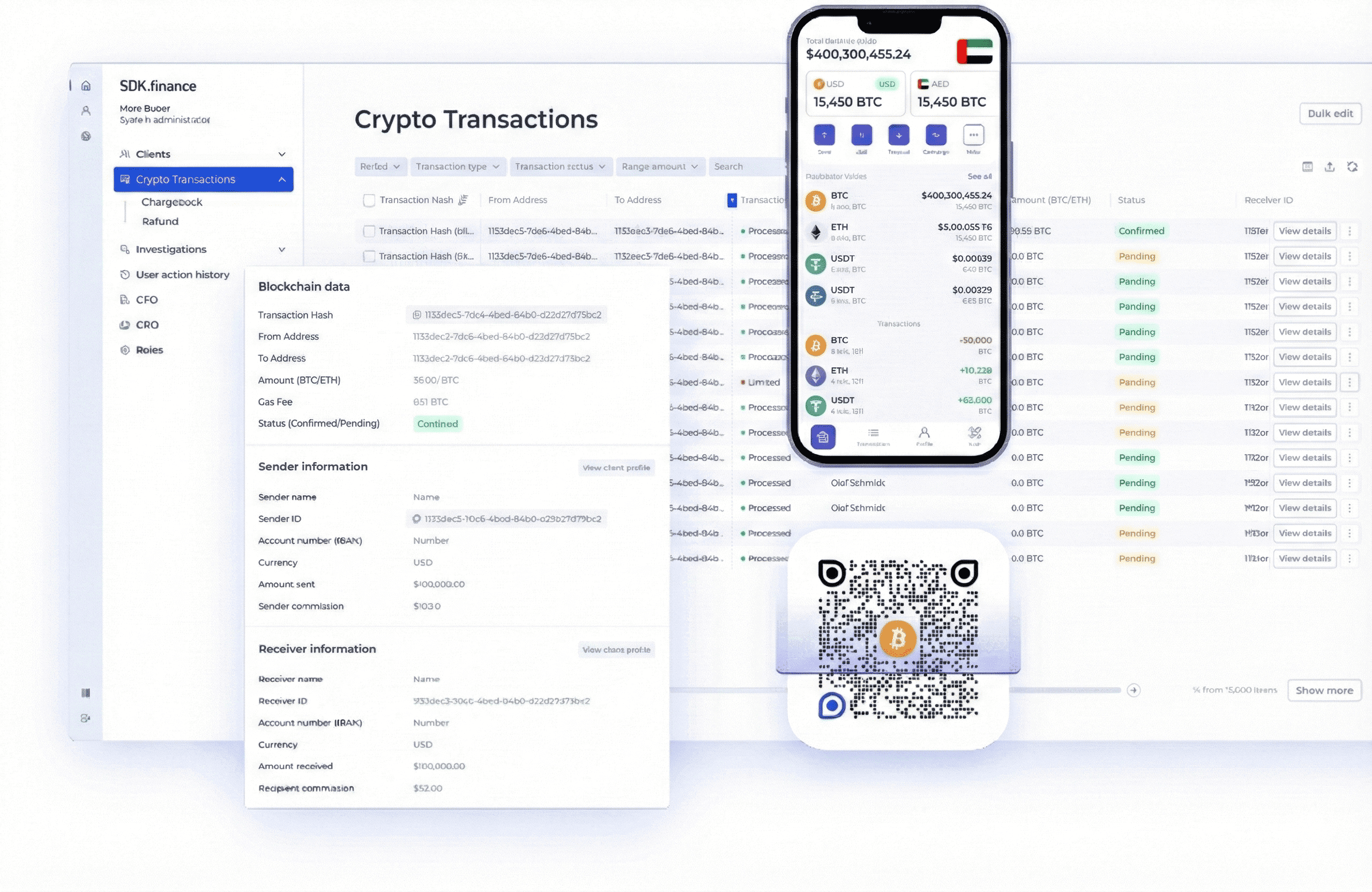
At the centre of the SDK.finance white label crypto wallet solution is a real-time, double-entry ledger that records all wallet activity. Crypto and fiat balances are maintained within the same accounting structure, allowing transactions, conversions, and transfers to be tracked consistently across asset types.
For fintechs operating in regulated environments, this ledger-led design reduces complexity. There is no need to reconcile parallel systems for crypto and fiat, and reporting logic remains uniform regardless of how funds move through the wallet. This is particularly relevant in markets like the UAE, where operational transparency and traceability are core requirements.
Unified wallet accounts
The platform supports multi-currency and multi-asset wallets, with balances calculated at ledger level. This enables accurate handling of crypto holdings, fiat funds, and conversions without duplicated logic.
Crypto integrated into everyday flows
Users can hold and convert assets within the same wallet environment. Crypto does not sit outside the main product experience but is embedded into standard financial interactions.
Payments and transfers as core functionality
Transfers, payouts, and internal movements are implemented as native wallet operations. This simplifies reconciliation and provides a clear audit trail across all transaction types.
Card-linked wallet balances
Wallet accounts can be connected to card issuing programmes, allowing users to spend fiat funds derived from crypto while preserving consistent accounting and control.
API-driven integration
All wallet functionality is exposed through APIs, making it possible to integrate custody services, liquidity providers, banks, payment processors, and compliance tools without locking the platform to specific vendors.
SDK.finance offers both SaaS deployment and source code licence models. SaaS is typically chosen by teams that prioritise faster launch and managed infrastructure. Source code licensing is more common among fintechs and enterprises that require deeper control over architecture, integrations, and long-term operating costs.
This flexibility is important in the Middle East, where products often start in one regulatory environment and then evolve as they expand into neighbouring markets.
In the UAE, compliance is embedded into daily operations rather than treated as a later-stage concern. The SDK.finance wallet includes built-in audit trails, role-based access controls, and transaction monitoring across crypto, fiat, and card activity.
The underlying infrastructure is certified to PCI DSS Level 1 and ISO 27001 standards, supporting payment and data security requirements commonly encountered by regulated fintechs in the region.
Many wallet products launched in the UAE are expected to scale regionally. The SDK.finance platform is structured to reuse the same wallet and ledger core across multiple jurisdictions. New currencies, blockchain networks, providers, and compliance workflows can be introduced through configuration and integration rather than architectural changes.
This reduces technical debt and shortens the path to expansion across the Middle East and beyond.
Within the broader landscape of white label crypto wallet software, SDK.finance represents an infrastructure-first model. The wallet is not positioned as a crypto application in isolation, but as a financial component designed to support digital assets alongside payments, cards, and account-based services.
For fintech teams that view crypto as part of a long-term financial product strategy, this approach aligns more closely with the operational realities of the UAE and Middle East markets.
Everything you need to launch crypto wallets, payments, and custody
Learn moreProud to announce that SDK.finance is the best FinTech startup 2015! Central European Startups Awards has… Read More
On November 10, SDK.finance was presenting demo at Bank Innovation Israel 2015 DEMOvation challenge. Bank Innovation… Read More
Great news! SDK.finance is selected for the €20.000 cash prize pitch competition at Execfintech! After… Read More
On March 8, CTO SDK.finance Pavlo Sidelov and CEO Alex Malyshev were attending one of the… Read More
On March 30, SDK.finance has been selected as a finalist for Red Herring's Top 100 Europe award,… Read More
Money 20/20, the cutting-edge FinTech conference, was held April 4 – 8 in beautiful Copenhagen… Read More