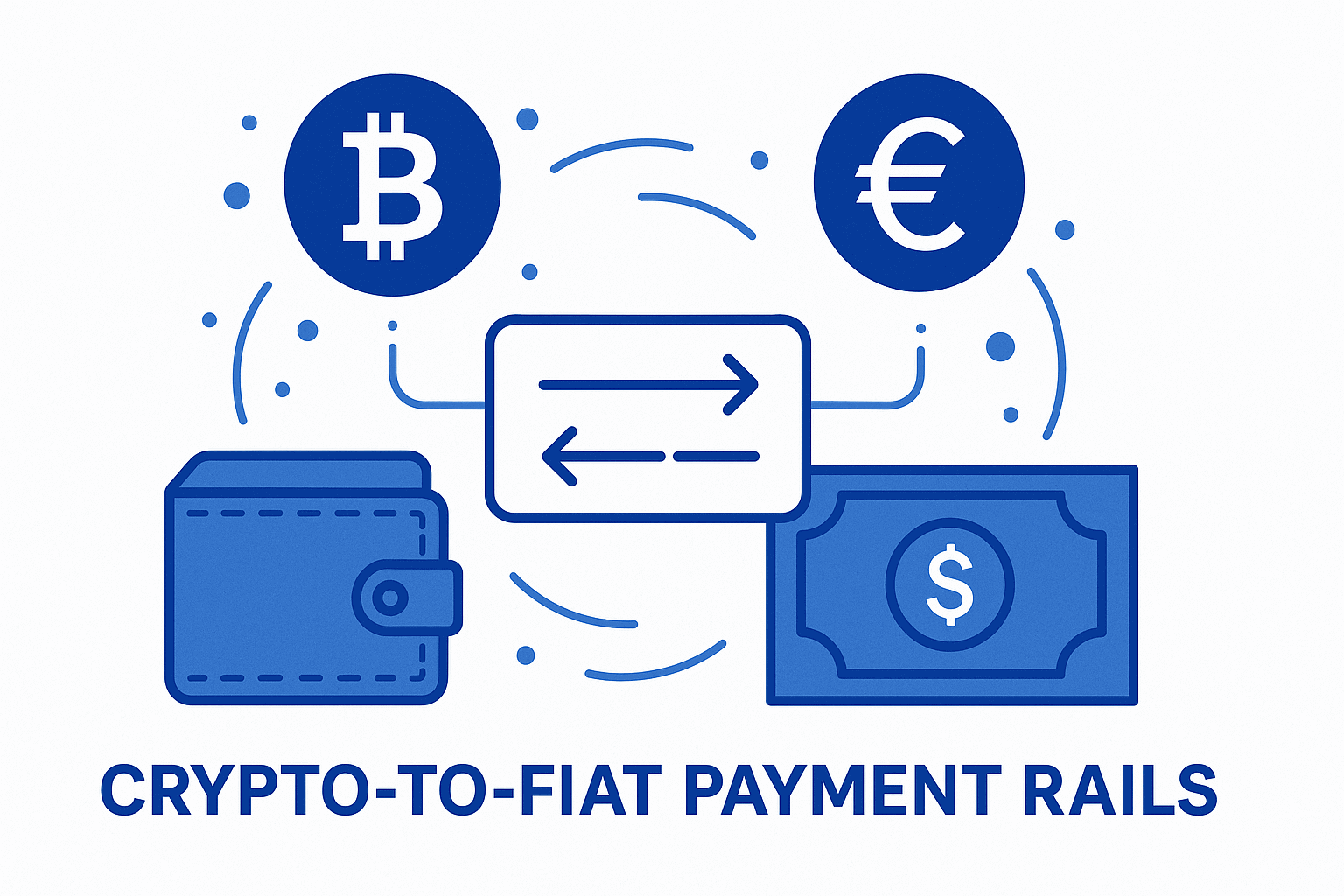
As cryptocurrencies gain a stable foothold in mainstream finance, the ability to move money seamlessly between digital and traditional systems has become essential. Behind this connection lies a complex infrastructure known as crypto-to-fiat payment rails – the technological and operational bridge that enables the exchange of cryptocurrencies for fiat currencies and vice versa. Crypto-to-fiat payment rails are transforming digital payments by improving transaction speed and cost efficiency, making them a key component in the evolution of modern payment infrastructures.
For FinTech companies, electronic money institutions (EMIs), and payment service providers (PSPs), these rails are the backbone of any product that involves digital assets. Payment service providers (PSPs) act as platforms that consolidate multiple payment rails – such as ACH, card networks, and wire transfers – to facilitate easier and centralized payment processing for users. Yet, building and maintaining such a system internally can be a lengthy and expensive process.
This article explores how crypto-to-fiat payment rails work, the challenges of developing them from scratch, and how the white-label crypto-to-fiat solution by SDK.finance offers a faster and enterprise-grade alternative.
Everything you need to launch crypto wallets, payments, and custody
Learn morePayment rails are the underlying systems that move money between parties – from traditional ones such as SEPA, SWIFT, ACH, and card networks to blockchain-based systems processing digital assets.
Crypto-to-fiat payment rails are a hybrid layer connecting these two worlds. They allow cryptocurrencies like Bitcoin, Ether, or stablecoins (USDT, USDC, etc.) to be converted into traditional currencies such as USD, EUR, or GBP, and transferred to standard bank accounts or cards. Some platforms may rely on one payment rail, while others use a multi-rail approach to provide greater flexibility and reliability.
In practical terms, they enable scenarios like:
These rails underpin on-ramp (fiat-to-crypto) and off-ramp (crypto-to-fiat) services, essential for reducing the gap between decentralised assets and regulated financial systems.
Payment rails come in several distinct forms, each designed to support specific types of financial transactions and business needs. Understanding the differences between these payment rails is essential for businesses looking to optimize their payment processing and offer a variety of payment methods to their customers.
Automated Clearing House (ACH) payments are widely used in the United States for high-volume, low-value transactions such as payroll direct deposits, bill payments, and recurring transfers. ACH payments move funds electronically between bank accounts through a centralized clearing house, making them cost-effective for everyday payments, though settlement can take one to three business days.
Single Euro Payments Area (SEPA) payments streamline euro-denominated transfers across participating European countries. SEPA enables individuals and businesses to send and receive payments from one bank account to another within the Eurozone, simplifying cross border transactions and reducing costs for both domestic and international payments.
Society for Worldwide Interbank Financial Telecommunication (SWIFT) payments are the backbone of international wire transfers. SWIFT acts as a secure communication platform, transmitting payment instructions and transaction details between financial institutions worldwide. While SWIFT enables global reach, settlement times can vary from a few hours to several days, depending on intermediary banks and time zones.
Card networks such as Visa and Mastercard facilitate credit, debit, and prepaid card transactions. These payment rails offer near-instant settlement and are widely accepted for both in-person and online transactions, making them a preferred choice for merchants and consumers seeking speed and convenience.
Real-Time Payments (RTP) represent the latest evolution in payment rails. RTP systems enable instant payment processing and settlement, allowing funds to move between accounts in seconds, 24/7—even on weekends and bank holidays. This rail supports a variety of payment methods and is increasingly used for urgent bill payments, account-to-account transfers, and business disbursements.
By leveraging different payment rails, businesses can tailor their payment infrastructure to meet the needs of various markets, transaction types, and customer preferences.
A crypto-to-fiat transaction involves multiple steps, actors, and systems working together to make the process near-instant for the user. Let’s break down the core stages.
The user starts a transaction – for example, selling 0.1 BTC for euros.
At this stage, the transaction initiation process often involves generating a payment request, which formally notifies the system to begin the conversion and transfer process. The platform calculates the exchange rate in real time, typically using aggregated market data from liquidity providers or exchanges.
Many platforms offer a locked rate window (30-60 seconds) to protect users against crypto volatility while the transaction is processed.
The user sends the crypto to a specific wallet address managed by the provider. Once the transaction receives the required number of confirmations on the blockchain, the system moves to the conversion stage. The blockchain creates secure, immutable transaction records for each crypto transfer, ensuring transparency and auditability.
For fiat-to-crypto flows, this is the moment when the fiat payment (via card or bank transfer) is verified.
The provider converts the crypto to fiat or vice versa using one of two approaches:
After conversion, fiat is typically moved between bank accounts using credit transfers, which are often employed to transfer funds securely and efficiently across different payment platforms. Efficient liquidity management is vital – it ensures there’s always enough crypto and fiat available to complete conversions without delays or slippage.
Because crypto-to-fiat transactions connect regulated and pseudonymous systems, providers must comply with Know Your Customer (KYC) and Anti-Money Laundering (AML) regulations.
This compliance framework builds trust with banks and regulators – essential for sustaining crypto-fiat operations.
Finally, the converted fiat is sent through traditional payment rails such as SEPA, Faster Payments, SWIFT, ACH transactions (for electronic fund transfers within the US banking system), or card networks (e.g., Visa Direct, Mastercard Send), which also support debit card payouts for instant access to funds.
Depending on the integration, payouts can reach a user’s account within minutes, as the recipient’s bank receives and posts the funds after processing the transaction. The payer’s bank and issuing bank play key roles in authorizing and processing the payment, ensuring that funds are available and the transaction is valid.
In reverse, on-ramps accept payments from cards or accounts to purchase crypto, completing the cycle.
In essence, crypto-to-fiat payment rails blend blockchain speed with banking compliance, ensuring users can move between the two financial systems with minimal friction.
Many FinTech companies initially consider developing their own crypto-fiat system to retain full control. However, what seems straightforward at first often becomes a multi-year engineering and compliance challenge.
Developing such a system internally can take 12-24 months and cost millions in software development, licensing, and compliance management. Even after launch, ongoing maintenance, security audits, and regulator reporting remain major cost drivers.
Choosing a white-label solution can significantly improve cost efficiency by reducing development and compliance expenses, making it a more economical option for fintechs seeking to optimize their crypto payment rails.
That’s why many fintechs turn to white-label crypto-to-fiat software providers – ready platforms that already handle the complex technical and compliance layers, allowing them to focus on branding, customer experience, and growth.
Everything you need to launch crypto wallets, payments, and custody
Learn moreSDK.finance offers a white-label, API-first crypto-to-fiat software platform built for FinTechs, EMIs, and financial institutions aiming to integrate digital assets into their products without building the entire infrastructure from scratch.
With PCI DSS Level 1 and ISO 27001:2022 certifications, it meets enterprise security and compliance requirements out of the box.
Compliance and auditability are built into the SDK.finance system from day one.
Each transaction is automatically logged, categorised, and available for AML checks and reporting. The platform also supports role-based access controls for compliance officers, auditors, and finance managers.
The SDK.finance white-label mobile app for iOS and Android allows end-users to manage their crypto and fiat funds, perform conversions, and send payments – all under your brand.
Its fully customisable design lets fintechs and EMIs tailor UI elements, add new services, and localise the app for different markets.
A practical example of SDK.finance’s crypto-fiat capabilities is Nebeus, a European crypto-fiat financial app.
By adopting the SDK.finance ledger and transaction engine, Nebeus built a hybrid platform where users can:
The implementation allowed Nebeus to accelerate its time-to-market and achieve enterprise-level reliability without building its own core from scratch. The SDK.finance foundation handled the complex accounting and compliance logic, allowing Nebeus to focus on product innovation and user experience.
SDK.finance’s crypto-to-fiat solution is ideal for:
Whether you’re adding crypto payment acceptance, launching a new wallet, or building a neobank with digital asset support, the SDK.finance platform provides the flexibility and control needed at enterprise scale.
Crypto-to-fiat payment rails are no longer optional for fintechs and EMIs – they’re a competitive necessity. The ability to bridge digital and traditional currencies opens the door to new products, broader user bases, and faster growth.
However, building such infrastructure in-house involves regulatory, operational, and technological hurdles that few organisations can tackle efficiently.
By leveraging the white-label crypto-to-fiat platform by SDK.finance, businesses gain access to an enterprise-grade system that combines reliability, flexibility, and speed to market. It’s a proven foundation for any company looking to connect the worlds of crypto and fiat securely and compliantly.
Learn more about SDK.finance crypto-to-fiat software here.
Everything you need to launch crypto wallets, payments, and custody
Learn moreProud to announce that SDK.finance is the best FinTech startup 2015! Central European Startups Awards has… Read More
On November 10, SDK.finance was presenting demo at Bank Innovation Israel 2015 DEMOvation challenge. Bank Innovation… Read More
Great news! SDK.finance is selected for the €20.000 cash prize pitch competition at Execfintech! After… Read More
On March 8, CTO SDK.finance Pavlo Sidelov and CEO Alex Malyshev were attending one of the… Read More
On March 30, SDK.finance has been selected as a finalist for Red Herring's Top 100 Europe award,… Read More
Money 20/20, the cutting-edge FinTech conference, was held April 4 – 8 in beautiful Copenhagen… Read More