


Government-Issued Social Benefit Card System
A government-backed programme in Central Asia selected the SDK.finance Platform to build a secure and scalable system for issuing and managing social benefit cards.
Contact us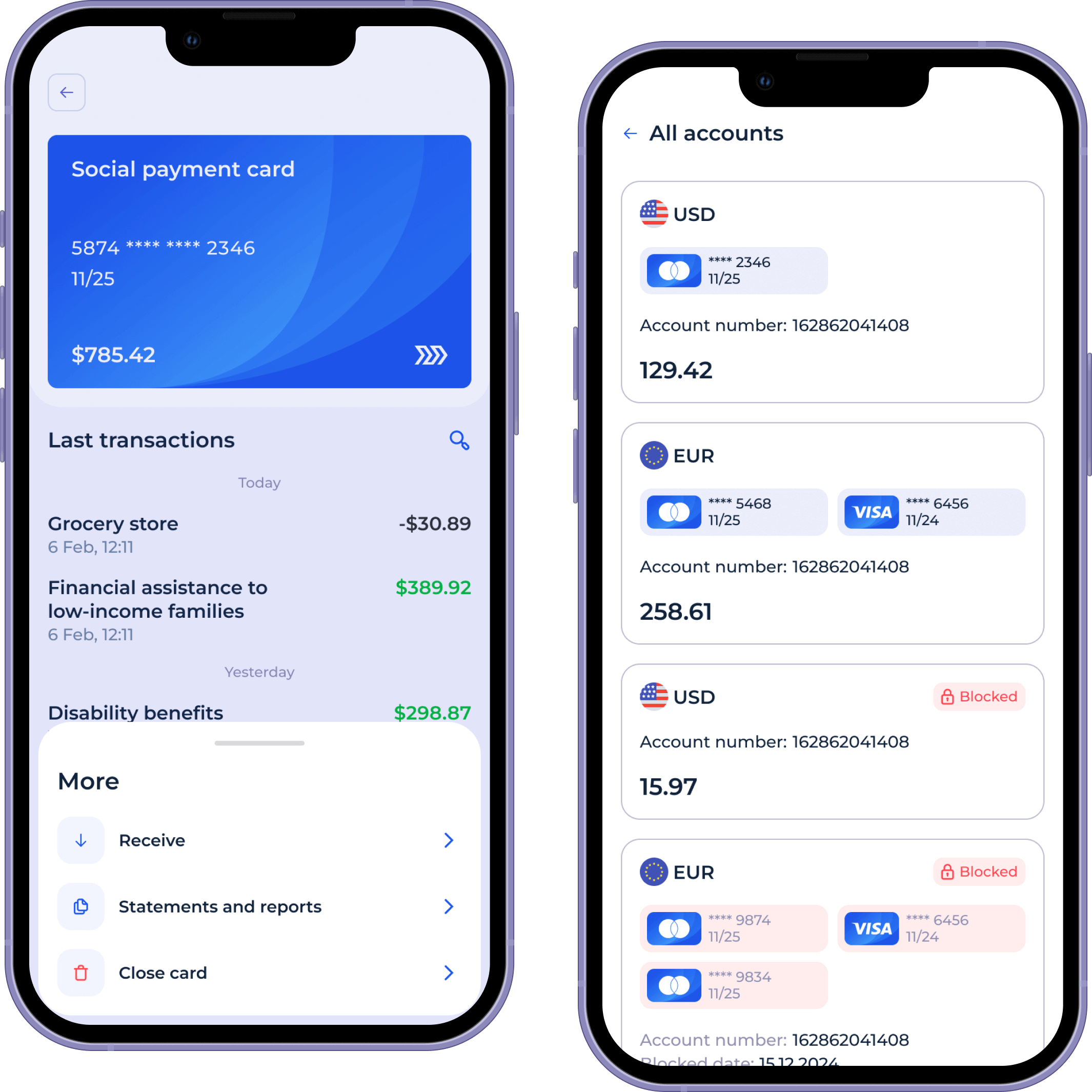
Project Overview
A government entity in Central Asia selected the SDK.finance Platform to power its nationwide social benefit card issuance and management system.
Core requirements included a six-month implementation timeline, support for nine distinct categories of social benefits, and adherence to PCI DSS Level 1 standards to ensure maximum security. The platform needed to accommodate high-volume card issuance and provide multi-bank support for flexible fund distribution and settlement.

How Social Payment Cards Work?
Social cards give citizens direct access to their government-assigned benefits, enabling them to pay for goods and services, withdraw funds, and manage balances through a secure digital environment built on the SDK.finance Platform.

Card Issuance
Secure card issuance of social payment cards through government service centers with full KYC verification

Benefit Distribution
Citizens receive various social benefits directly on their cards, including disability allowances, child support, elderly care assistance, and unemployment benefits.

Payment Processing
Citizens can make payments at stores, online, and for public services with secure transaction processing
The Solution: SDK.finance Payment Card Issuing Module
Below is a breakdown of the core functionality that met their requirements:

Card issuing
Secure card issuance and management
PCI DSS level 1 certifiсation
Customisable source code access
Multi-bank integration
High-volume performance
User identity verification (KYC)

Advanced Features
Multi-category benefit support
Audit and reporting tools
Role-based access control
Interoperable API layer
Auto-scaling capabilities
Why did the government entity choose SDK.finance software?
The SDK.finance Platform met all the key requirements thanks to its security, high scalability, and proven fintech capabilities. Here’s why it stood out:

No vendor lock-in
SDK.finance’s source code license ensures full autonomy, allowing the government's technical team to customise and maintain the system in-house without vendor dependency or licensing restrictions.

Government-grade security and compliance
Delivers public-sector-grade security with PCI DSS Level 1 certification and a robust architecture designed to meet the demands of nationwide government programmes.

Modular and API-first architecture
Its flexible, component-based design and extensive API set allowed seamless integration with existing government systems, banking infrastructure, and mobile services.

Built for high-volume public systems
Proven at scale, with capacity for millions of transactions and 2,700+ per second, ensuring reliable performance for nationwide programmes.
Progressive technology, built by experts
Flexible infrastructure options





High code quality
Security certifications
Proven expertise, backing your venture
Modern tech stack
APIs
Backend
Data management
Backoffice
Mobile app
Version control and CI/CD
Ready to transform your government's financial services?
Frequently asked questions
A government-issued social benefit card gives recipients access to public assistance payments. Depending on the programme, recipients can use it to pay for goods and services, withdraw funds and check their balance.
SDK.finance provides software for card issuance and management, benefit distribution and transaction processing, with identity verification, role-based access and reporting tools.
Yes. SDK.finance supports API-based integration with government systems and banking infrastructure. The project described here required multiple bank connections for benefit distribution and settlement.
Yes. The programme described in this case study required support for nine benefit categories, including disability allowances, child support, elderly care assistance and unemployment benefits.
Yes. A source code licence allows the government’s technical team to customise and maintain the software in-house, including adapting integrations and programme-specific workflows.
SDK.finance can be adapted for social benefit card programmes in any country. Customisation and localisation allow the platform to accommodate local languages, currencies, banking integrations and programme requirements. Each implementation is tailored to the country’s regulatory and operational needs.