A government benefit is useful when the recipient can actually use the money. Getting there takes more than approving an application or releasing a mobile app. The programme needs funded payments, reliable records, financial partners and practical ways for people to access their funds.
For teams developing government payment solutions, the first decision is the financial model: who pays, where the money is held and how recipients spend or withdraw it. This model helps identify which ready-made software components to buy to shorten development time and accelerate launch, and which programme-specific features and integrations the team needs to build.
This guide explains the main payment types, follows a benefit from approval to spending, and shows how to plan a card or wallet product. It also looks at SDK.finance, a FinTech software provider that can supply the foundation for building your government payment solution.
Discover how the SDK.finance TPS can power high-speed, secure operations across banking, fintech, and retail
Talk to Our TeamWhat are government payments?
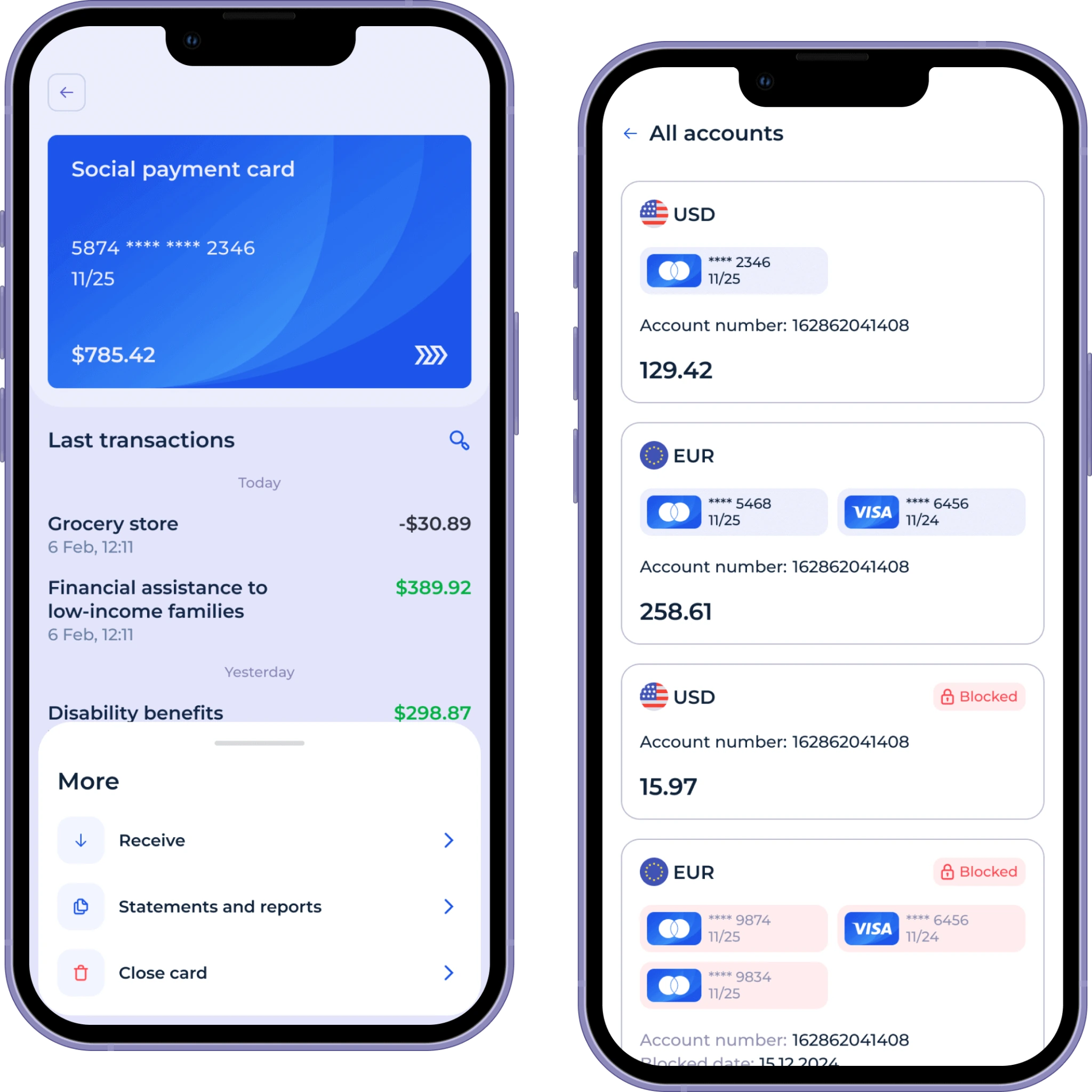
Government payments are transactions in which a public body pays or receives money, including benefits, supplier payments, taxes and transfers between public bodies.
Several systems contribute to a benefit payment:
- A social registry holds recipient information.
- A programme system determines the award.
- A bank or payment service provider executes the payment.
- A government payment platform coordinates instructions, statuses and records.
The card or wallet app is the recipient’s access point. It does not replace the institutions holding funds or the rules governing the benefit. Keeping these roles separate helps buyers avoid commissioning an attractive interface before deciding how the service will work.
The government payments landscape
Government disbursements operate at substantial scale. In the United States, SSA OIG reports that more than $1.5 trillion was paid through the Old-Age, Survivors, and Disability Insurance (OASDI) and Supplemental Security Income (SSI) programmes in fiscal year 2024. This is one country’s benefit expenditure, not a global software-market estimate.
Digital government payments sit within a broader shift towards financial accounts and mobile access. The World Bank’s Global Findex 2025, using 2024 data, reports that 79% of adults worldwide have a financial account. Yet 1.3 billion adults remain without one, and smartphone ownership reaches 68% of adults globally.
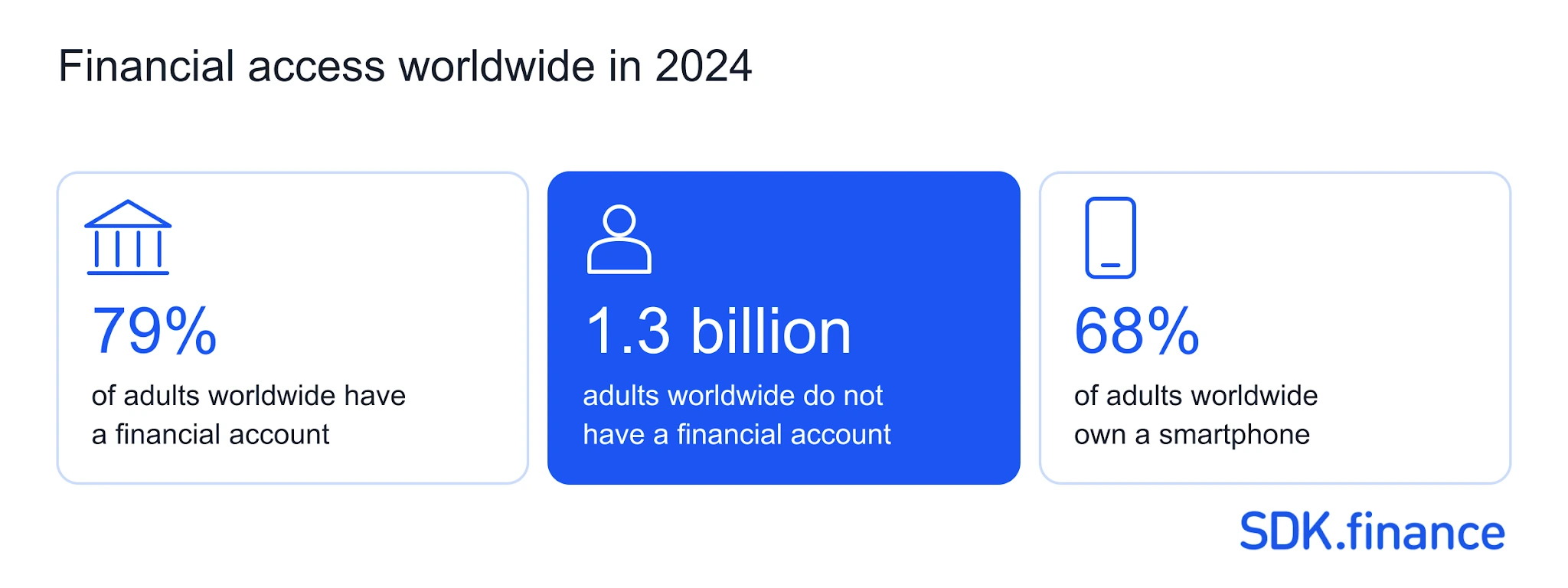
These global figures describe financial access, not the size of the government payments market. Translate them into local requirements by checking recipients’ account ownership, connectivity, merchant acceptance and cash-access coverage. Digital financial inclusion means people can use their benefits and resolve payment problems through available channels, including those that work without a smartphone.
What types of government payments are there?
The clearest starting point is the relationship between the payer and the recipient.
| Type | Direction | Common examples |
|---|---|---|
| Government to person (G2P) | Public body → individual | Social benefits, pensions, public-sector salaries and emergency assistance |
| Government to business (G2B) | Public body → business | Supplier invoices, business subsidies and tax refunds |
| Person or business to government (P2G/B2G) | Individual or business → public body | Taxes, licence fees and public-service charges |
| Government to government (G2G) | Public body → another public body | Transfers between ministries, agencies or levels of government |
These categories describe who pays whom. They do not specify the technology. G2P payments might reach an existing bank account, a card-linked account or a wallet offered through an authorised financial provider.
Two programme choices also shape the requirements:
- Payment frequency: pensions may be recurring, while emergency assistance may be a one-off payment.
- Spending rules: some benefits allow general spending; others restrict where or how funds can be used.
A restricted education allowance needs different controls from an unrestricted cash transfer. Define restrictions precisely: limiting merchant categories differs from checking individual basket items. Confirm what data payment partners can supply before committing to either control.
How government disbursements move money
A benefit payment has two connected flows: money moves between financial accounts, while instructions and confirmations move between systems. Confusing them can make a programme show “paid” before the recipient has usable funds.
From approval to available funds
- Approve the award. Identify the recipient and destination. Approval creates a payment obligation; it does not credit an account.
- Make funding available. The treasury or responsible body provides funds through the agreed banking arrangement. Budget allocation alone does not establish cash availability.
- Send the instruction. The paying bank or PSP processes the authorised payment through the relevant payment infrastructure, or internally where both accounts are with one bank.
- Confirm the credit. The receiving institution credits the account, or the wallet operator records the entitlement under its financial model. Programme records update from the agreed confirmation.
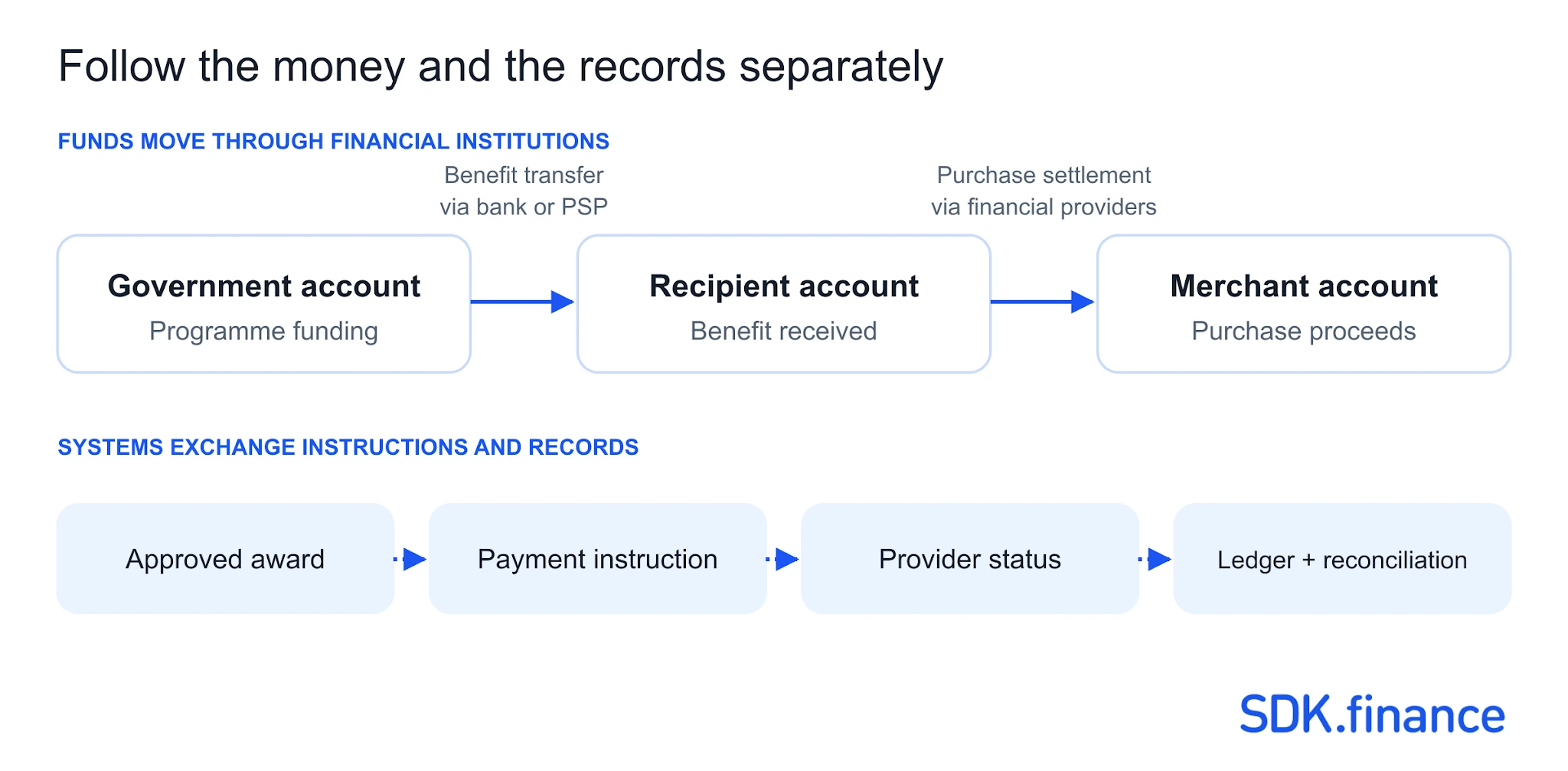
With an individual bank account, the recipient holds a balance with the bank. In a pooled-funds or electronic-money model, the provider may hold backing funds in designated accounts while its ledger records individual balances. The legal structure and protection depend on the jurisdiction and provider arrangement. A software balance alone proves neither cash funding nor a separate bank account.
From spending to settlement
When a recipient pays by card, the card provides access to the linked funds. Authorisation checks the transaction and may reserve an amount. Clearing supplies the transaction details used to determine obligations, and settlement moves funds between the relevant financial participants. The merchant receives payment through its acquiring arrangement.
Consider a simplified example with no fees. A programme pays 100 units to a recipient. A purchase of 30 may create a reservation, leaving 70 available. When the purchase completes, the records must reflect the completed debit and the reservation must be resolved. If it fails, the reserved amount may need to be released. The original government disbursement remains 100; the purchase does not make it 130.
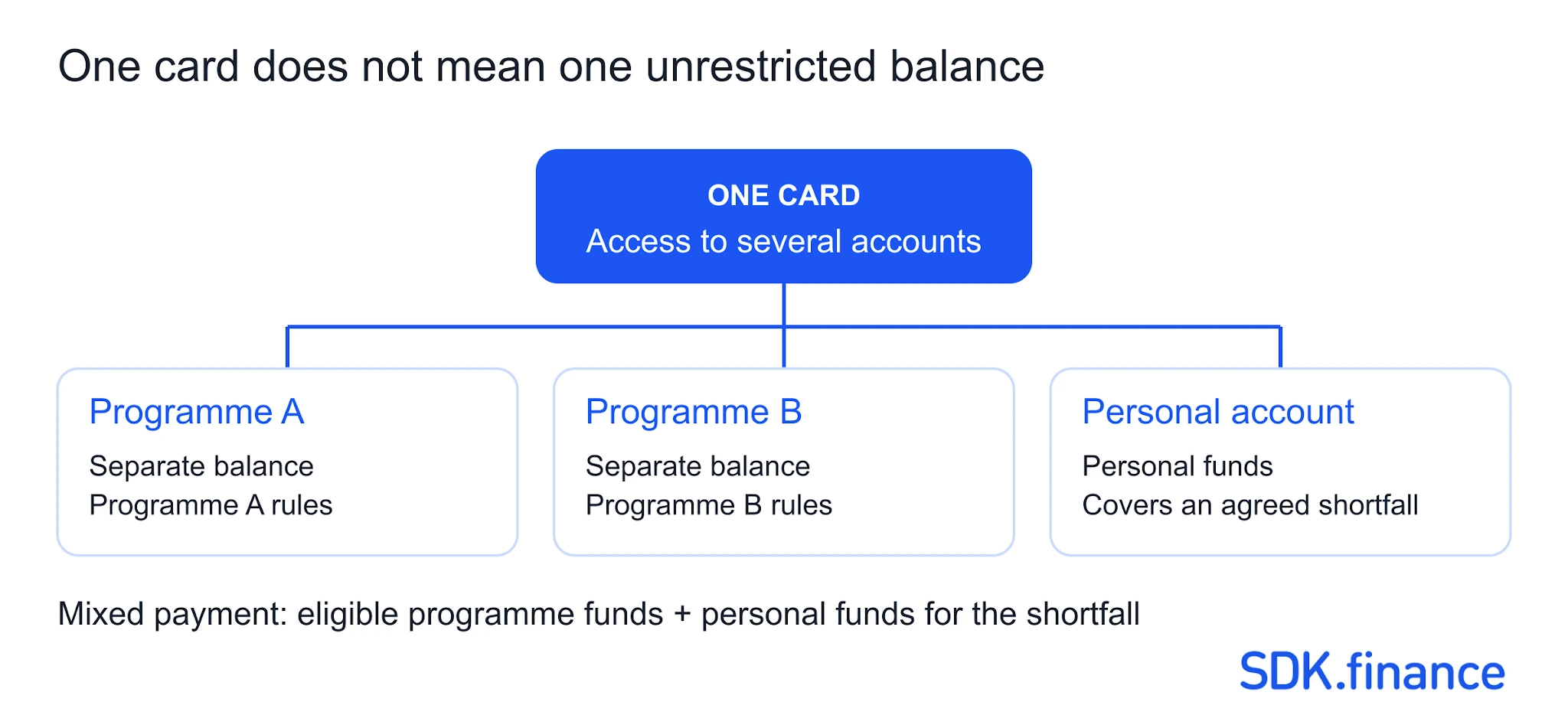
Where one card accesses several funding sources, records must preserve each source’s contribution. The Diia.Card example below shows why this matters for spending rules and refunds.
Finally, reconciliation compares platform records with bank or processor evidence. It identifies missing confirmations, returned payments and mismatched amounts; it does not move money. Each disbursement needs a traceable reference, and repeat instructions must not create duplicate payments. A timeout should trigger a status check or investigation before an uncontrolled retry.
Bank transfers, benefit cards and national payment wallets
The right delivery model depends on how recipients already access financial services and what the programme needs to control. These options can coexist within one programme.
| Model | Where funds are held and recorded | Recipient access | Software and partner requirements |
|---|---|---|---|
| Transfer to an existing account | At the recipient’s bank or authorised provider | Existing banking channels | Payment instructions, provider connectivity, status tracking and reconciliation |
| Benefit card programme | In the account or funding arrangement behind the card | Physical or virtual card; cash access where permitted | Issuer, processor, card lifecycle management and programme rules |
| National payment wallet | According to its bank-account or electronic-money model | App and any linked cards or assisted channels | Account or wallet records, financial partners, payment integrations and service operations |
- Existing accounts: a new wallet is unnecessary if recipients’ current accounts meet the programme’s access and payment needs.
- Benefit cards: government prepaid cards are one option. Confirm the underlying product before treating every benefit card as prepaid.
- Access channels: plan for lost cards, limited connectivity and assisted support alongside the app. The Brazil example shows why these alternatives matter.
Government payment programmes in practice
Ukraine, Uzbekistan and Brazil show three ways to connect public benefits with financial services. Each offers a useful lesson for teams designing their own programme.
Ukraine: Diia.Card connects several programmes through one card
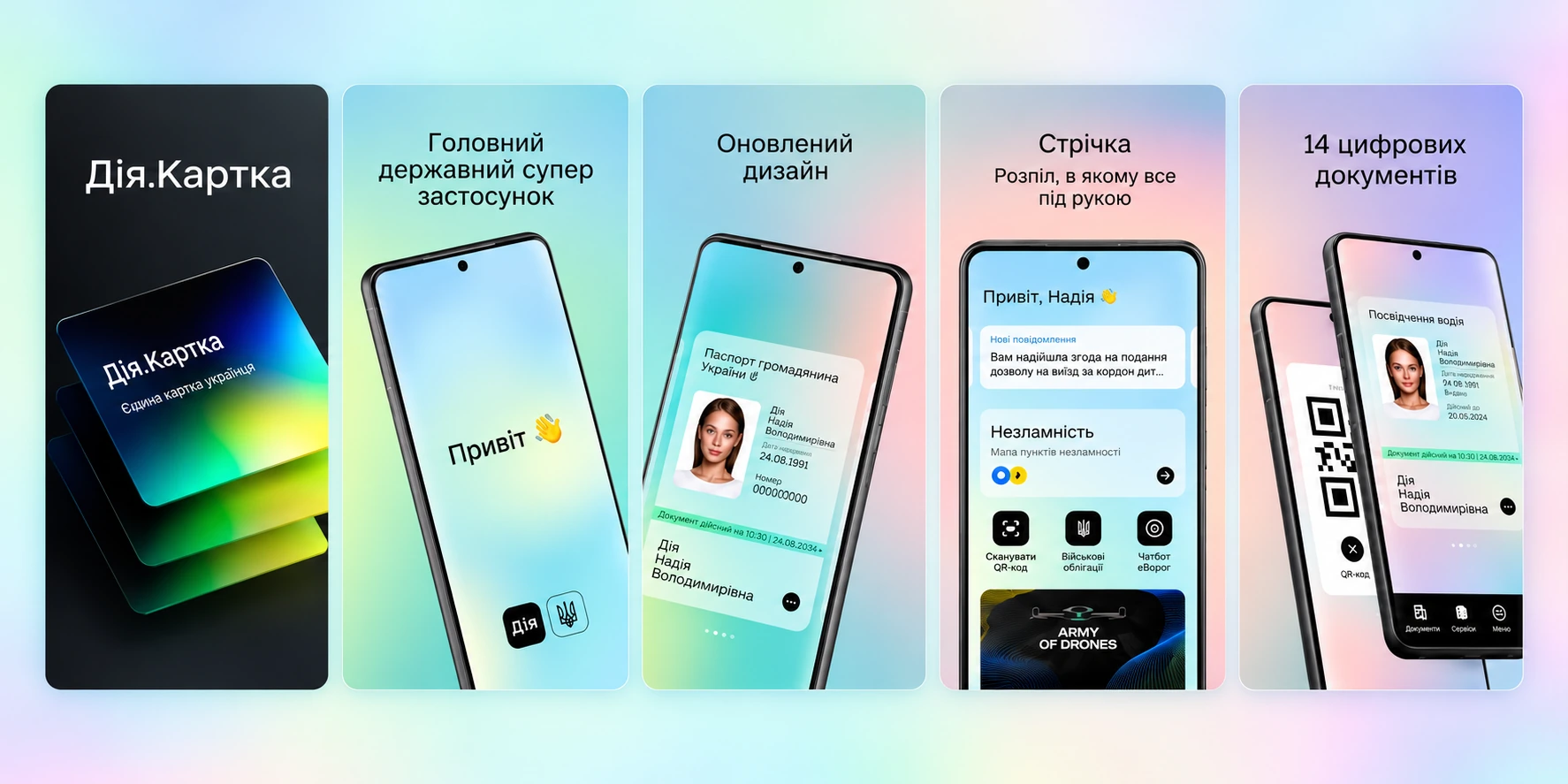
Diia.Card gives recipients one card for personal funds and separate accounts linked to targeted government programmes. Those accounts retain their own purposes and spending conditions. The card simplifies access without turning the funds into one unrestricted balance.
Mixed payment is an important part of that experience. If the relevant programme account cannot cover an eligible purchase, the remainder can come from the personal account. First-year programmes included єКнига for books, Ветеранський спорт for veterans’ sport and Пакунок школяра for school supplies. In its August 2026 update, Diia reported more than 5.8 million cards opened.
For a buyer, this model raises specific software requirements: separate balances, rules for selecting the funding source and an agreed way to cover a shortfall. The implementation scope should also define how a refund is allocated when a purchase uses more than one source.
Uzbekistan: Baraka links benefit approval with payment access
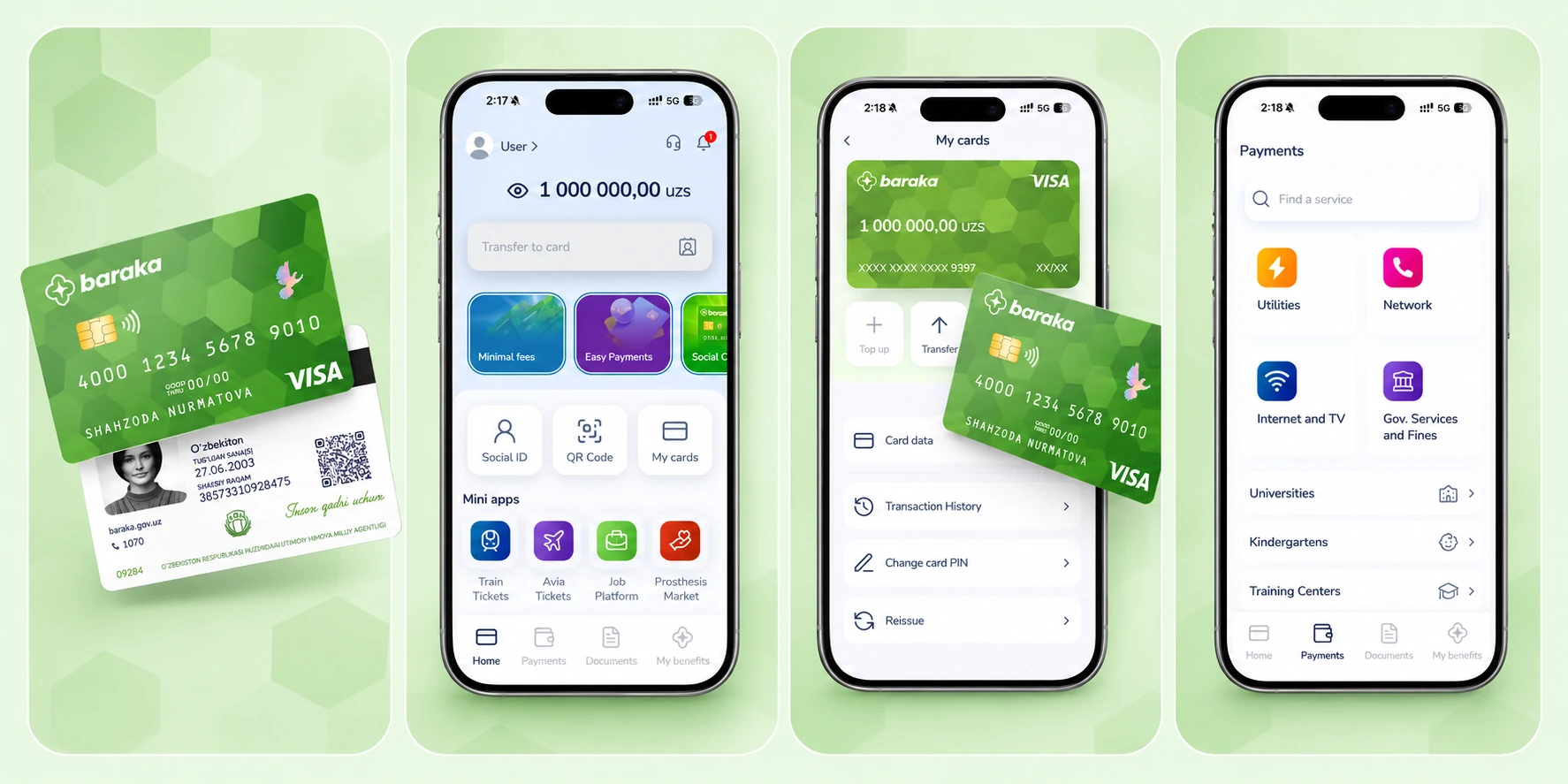
Baraka combines a Visa social card, issued by Aloqabank or Xalq Bank, with a mobile app. People can apply for assistance and track application status in the app, connecting the administrative service with access to payments.
An August 2026 ministry explanation describes the route for approved maternity and temporary-incapacity benefits. Payments go to the Baraka card. Where a recipient has no card, the process provides for automatic virtual-card opening through the app, followed by crediting. Payment information then becomes visible to the recipient.
The value of this example is the connected journey: approval leads to a payment instrument and then to usable funds. To implement a similar service, the programme system, issuing bank and payment software need to exchange reliable references and statuses. Testing should cover a failed card-opening request, a delayed credit and an app that has not yet received the latest confirmation.
Brazil: Bolsa Família combines digital accounts with physical access
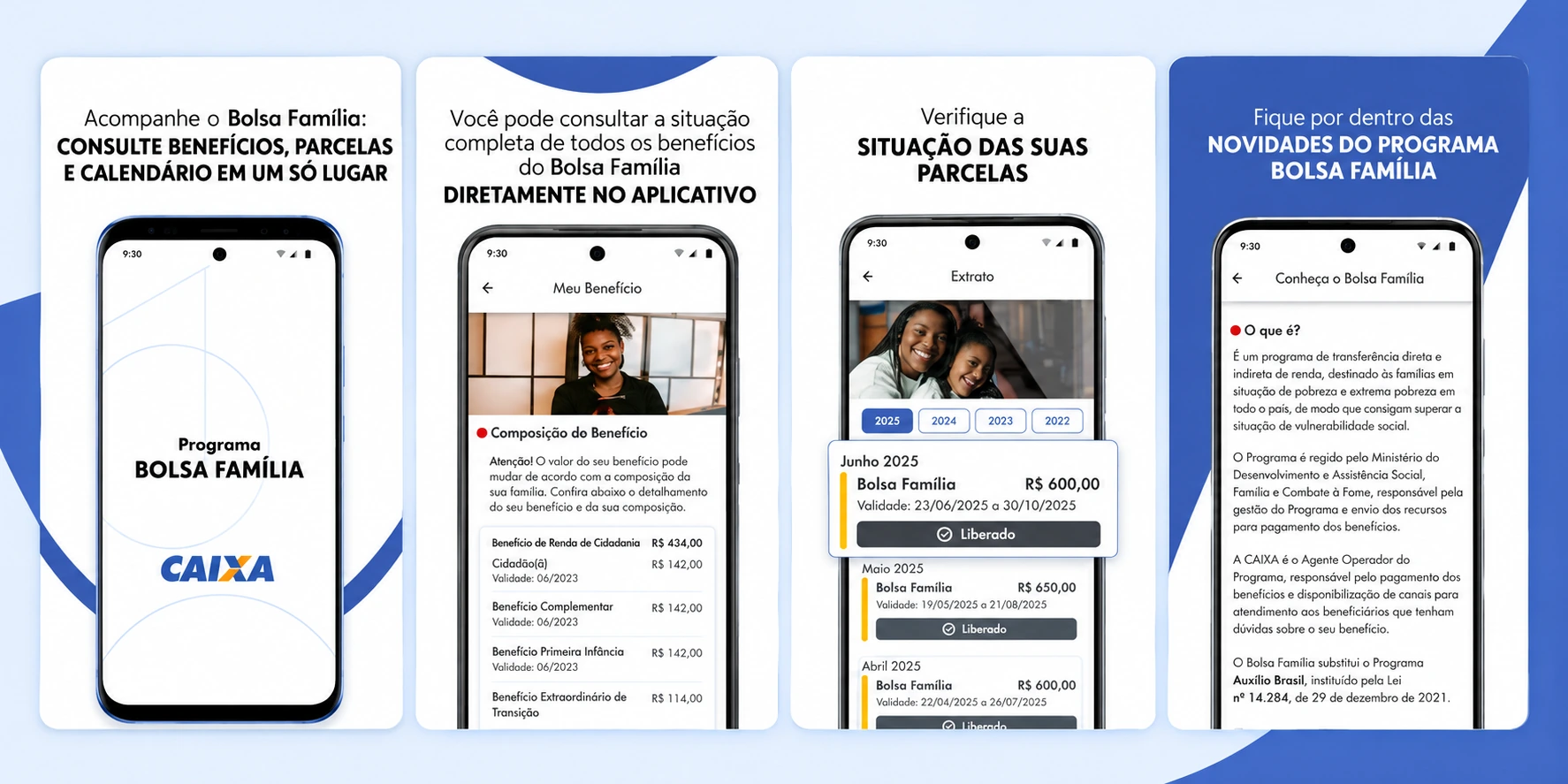
Bolsa Família illustrates how a benefit programme can support digital payments while keeping physical access available. According to CAIXA, a digital social savings account is opened automatically when registration details are complete and the responsible family member’s CPF identifier is correct.
The Bolsa Família app shown above provides benefit information; CAIXA Tem enables account transactions, including transfers, bill payments and Pix. Cards provide cash access, and CAIXA describes alternatives when an account cannot be opened or a card is unavailable. Access therefore extends beyond either app.
For programme owners, the lesson is to design digital and physical channels together. Account opening, card access, cash availability and assisted support all affect whether people can use a benefit. Procurement should therefore cover the service network and exception handling alongside the software, especially where recipients lack smartphones or reliable connectivity.
What software does a government payment programme need?
Start with what you can retain. If existing systems meet the account, payment and control requirements, integrate the missing workflows. Buy a configurable foundation when you need those core capabilities and can adapt them to the programme. Consider development from scratch when essential requirements cannot be met by suitable products and your team can fund long-term maintenance. Map the remaining work by component:
| Component | Its role | What to buy, configure or develop |
|---|---|---|
| Programme and registry interface | Pass approved awards and recipient details into the payment process | Integrate existing government systems; define data checks and error handling |
| Transaction core | Manage account or wallet logic, payment instructions and statuses | Buy a proven foundation; assess programme-specific rules separately |
| Ledger | Record financial events, balances and adjustments | Buy the accounting engine; configure accounts and posting rules |
| Financial integrations | Connect banks, PSPs and card processors | Reuse suitable connectors; develop and test missing connections |
| Channels and backoffice | Show payment information and support operations | Adapt interfaces, permissions, reporting and exception workflows |
Benefit eligibility and financial onboarding are different checks. The authority’s decision to award assistance does not necessarily satisfy the financial provider’s customer-verification requirements. Their systems need an agreed handover.
Discover how the SDK.finance TPS can power high-speed, secure operations across banking, fintech, and retail
Talk to Our Team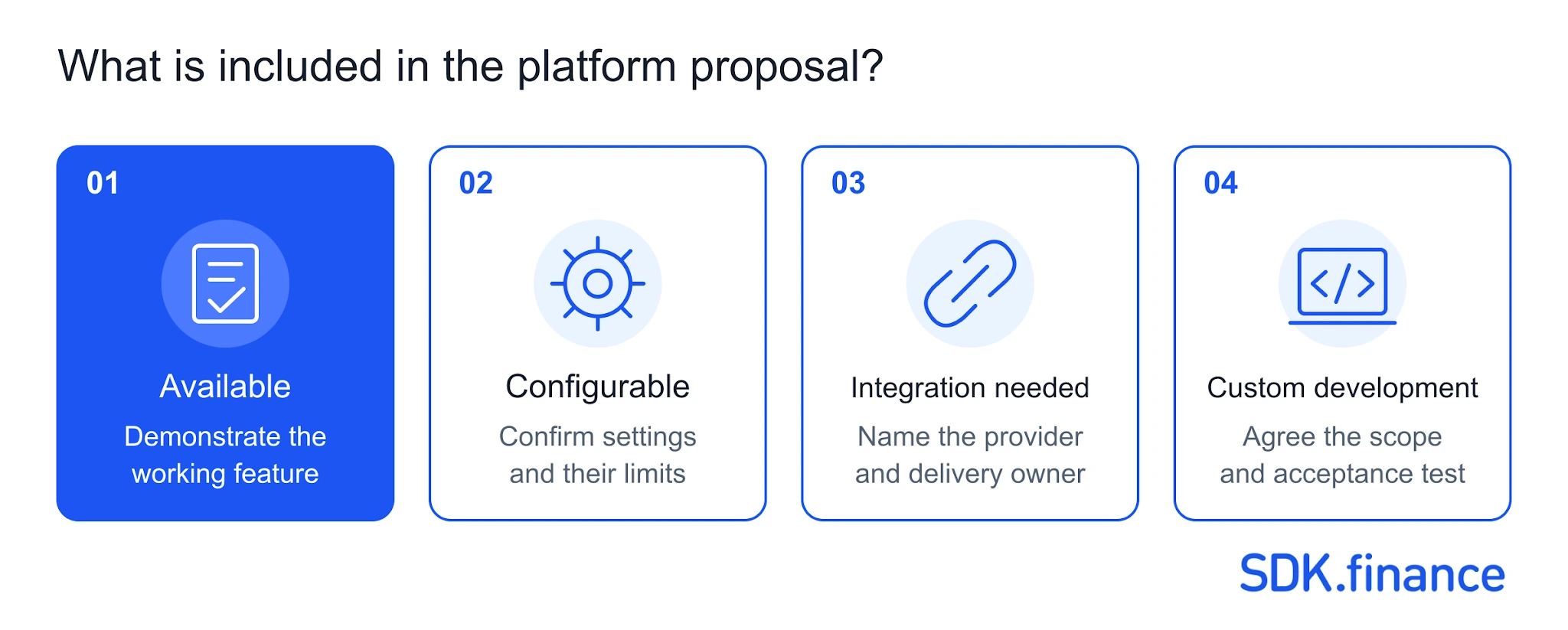
How to choose government payment software and an implementation partner
Compare proposals against the same programme requirements. The software vendor supplies the foundation; the implementation partner adapts, integrates and tests it. Confirm which organisation owns each deliverable and the service after launch.
Evaluate the platform and delivery team
Use the proposal categories above to request evidence for each requirement, identify limits and assign an owner. Test suppliers against the following checks:
- Programme fit: ask for a demonstration of restricted spending, automatic account creation and mixed funding where required. A generic wallet demonstration does not prove these workflows exist.
- Integrations: identify reusable connectors, missing connections and the team responsible for bank or processor testing. Include data quality checks and error handling in the scope.
- Controls and audit: demonstrate separate approval and execution roles, access restrictions and traceable financial changes. Request evidence that records can be exported for investigation.
- Data and deployment: confirm hosting locations, administrative access, record-export options, retention requirements and responsibility for backups and recovery.
- Reliability: request load-test results with stated volumes and a documented recovery demonstration. Compare that evidence with your programme’s peak demand.
- Delivery capability: review comparable projects and the named team. Ask it to investigate a sample mismatch between platform records and a bank statement, then explain escalation and handover.
Check source code terms and total cost
For a source code licence, confirm what code is included, modification and hosting rights, third-party dependencies, update terms and support after changes to the core. Source code access does not mean open-source licensing. Establish who will maintain the software and how another qualified team could take over.
Compare costs over the same operating period and transaction assumptions:
- Initial delivery: licence, custom workflows, integrations, migration, testing and staff training.
- Ongoing operations: infrastructure, monitoring, maintenance, security updates and support.
- Financial services: bank or PSP charges, processing, card issuance and replacement, and cash-access fees where applicable. Identify who pays each fee, including any recipient charges.
Require exclusions, change-request rates and acceptance criteria in writing. This makes the proposal a delivery commitment that buyers can evaluate rather than a list of broad feature claims.
What it takes to launch a government payment product
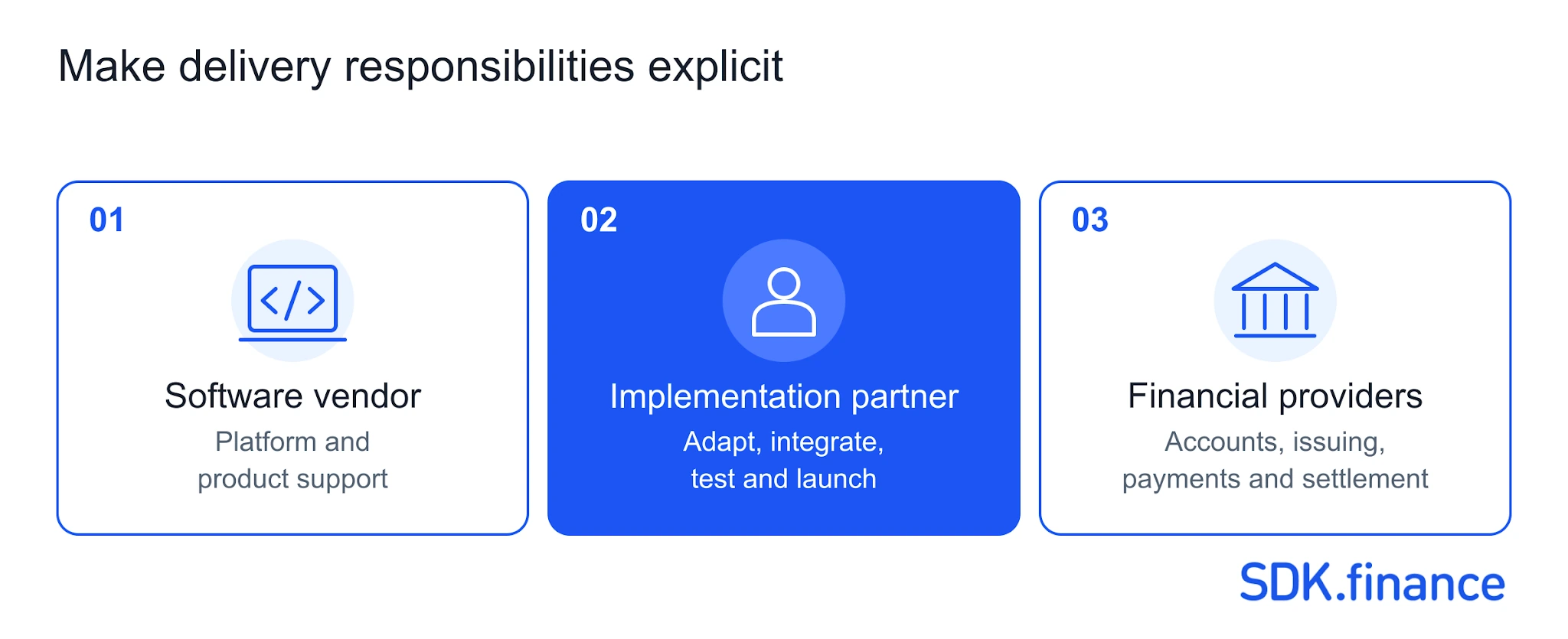
Once the delivery scope is agreed, turn it into an operational plan with named owners and acceptance criteria.
- Confirm the operating model. Agree funding, settlement and payment-status definitions with the treasury, bank or PSP, issuer, processor and service operator. Name one coordinator for incidents that cross organisational boundaries.
- Plan migration and cutover. If replacing an existing service, map recipient identifiers, balances and pending payments. Reconcile transferred data, test a limited cohort and agree how to return to the previous service if cutover fails. Prevent both systems from paying the same award.
- Integrate and test. Connect registries, financial providers and recipient channels using shared references and statuses. Test incorrect account details, failed account opening and delayed confirmations, with an owner and recovery action for each exception.
- Prepare daily operations. Assign monitoring, security updates, reconciliation and recipient support. Document who investigates missing funds, authorises corrections and escalates incidents to financial providers; rehearse this handover before launch.
- Run a controlled pilot. Test duplicates, insufficient funding, bank outages, returned payments and lost cards under realistic peak loads. Verify that recovery protects completed payments, then measure:
- Successful credits: the share of funded instructions credited within the agreed service window.
- Reconciliation exceptions: unmatched records remaining after each payment cycle, with age and owner.
- Resolution time: how long failed or uncertain payments take to investigate and resolve.
- Recipient access: completed withdrawals or purchases through the intended channels, alongside support requests per 1,000 payments.
Set programme-specific thresholds and measurement methods. Expand only when the pilot meets them and support teams can manage remaining exceptions. External dependencies and delivery scope determine the schedule.
SDK.finance as a software foundation for government payment solutions
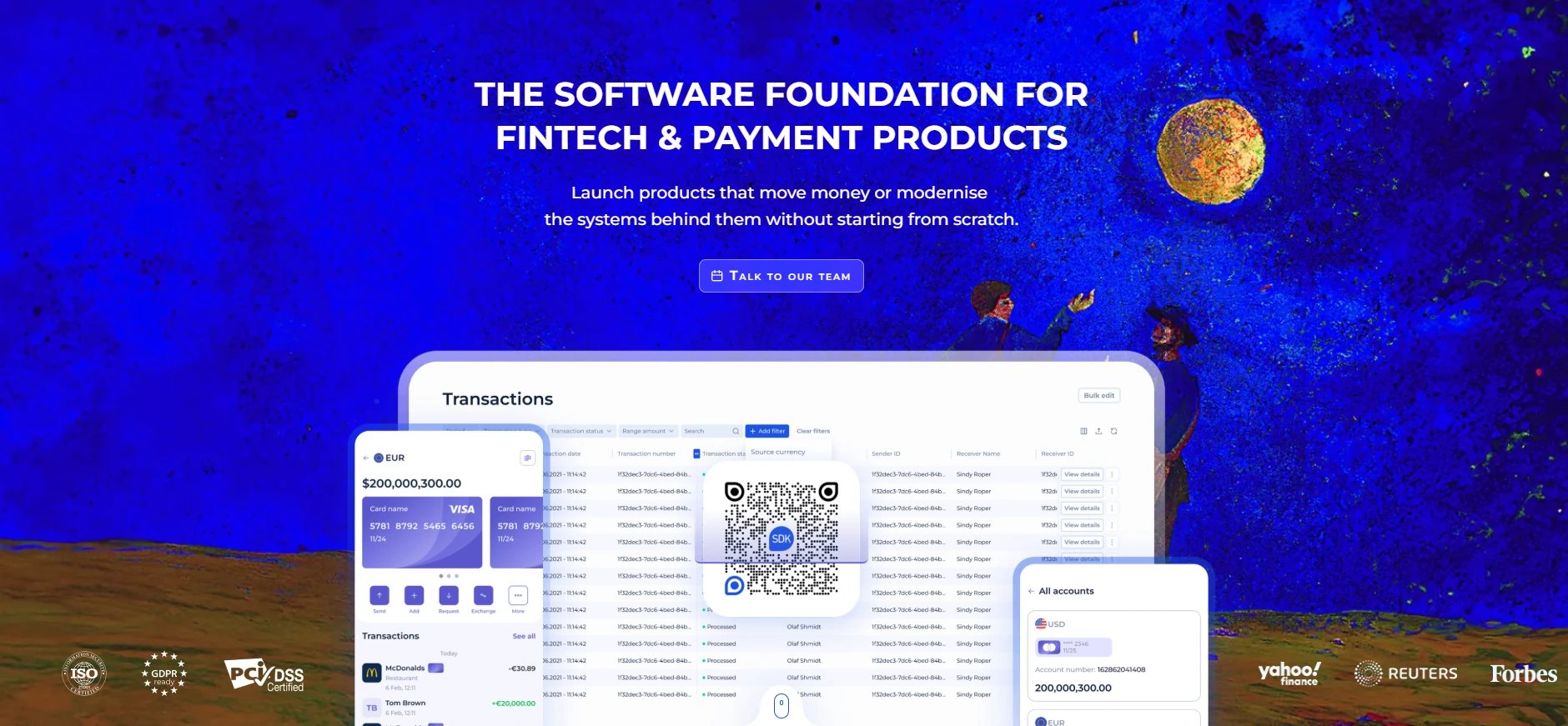
SDK.finance provides a ready-made software foundation for developing and launching government payment solutions. Its Transaction Platform supplies the financial technology core, allowing government teams, development companies, and systems integrators to build on an existing backend and focus on programme-specific requirements.
Start with the core financial components
The Platform brings together the building blocks needed to develop a payment system:
- Account and wallet management to maintain recipient accounts and balances.
- Money transfers and transaction processing to support payment operations and track their status.
- Backoffice tools to manage accounts, investigate transactions, and control staff access.
- 650+ APIs to build applications and connect government systems and financial providers.
- An accounting layer through SDK.finance General Ledger to convert payment events into balanced debit and credit entries under configurable rules.
Adapt the foundation to your programme and local market
Development teams can build programme-specific functionality around these components, including:
- Benefit categories, payment schedules, and recipient journeys.
- Connections to benefit registries and government services.
- Integrations with local banks, card issuers, processors, and payment rails.
- Local languages, currencies, and operational processes.
- Recipient interfaces built using a customisable client-interface template or separately licensed mobile app source code.
Available integrations provide a starting point, while APIs, webhooks, and middleware support connections to additional providers. Each implementation includes the configuration, development, and testing required for its local operating environment.
Retain long-term control through source code licensing
Source code licensing is particularly well suited to government programmes that require control over infrastructure and future development. It enables the programme owner and its appointed technical team to:
- Deploy the licensed software within their own infrastructure.
- Control their databases and deployment environment.
- Modify and extend the software for programme-specific workflows.
- Develop additional integrations and recipient interfaces.
- Manage maintenance and future development internally or through a selected delivery partner.
Modification rights and ownership of custom deliverables are defined in the licence and implementation agreements.
Reduce the work between concept and launch
An existing backend reduces the foundational engineering required before programme-specific development can begin. The delivery team can concentrate on:
- Configuring and extending the available components.
- Connecting government systems and financial providers.
- Adapting the user experience.
- Testing payment flows, operational controls, and recovery procedures.
- Preparing a pilot and production rollout.
This can shorten development compared with building the same financial infrastructure from scratch. The actual delivery advantage depends on functional fit, integration complexity, and provider readiness.
Case study: a government social benefit card programme in Central Asia
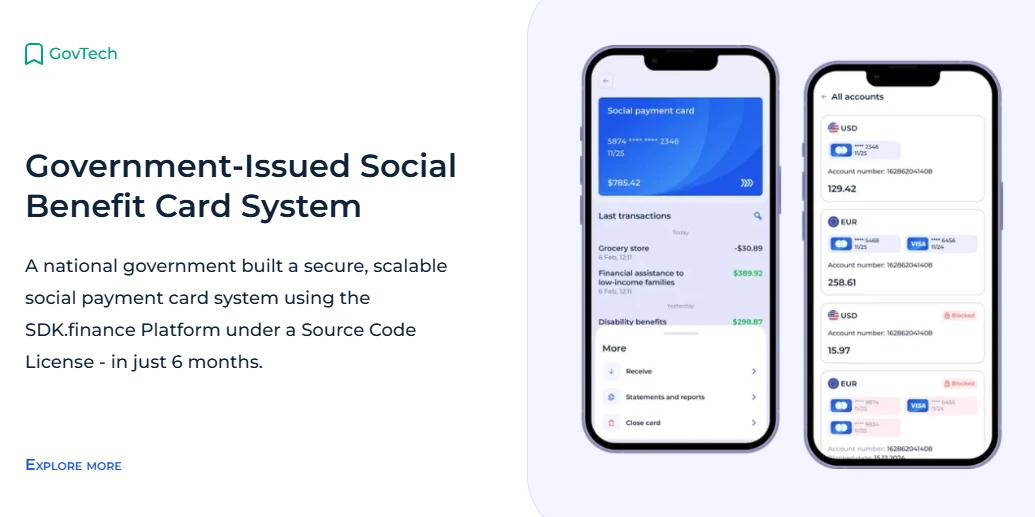
A government entity in Central Asia selected SDK.finance for a nationwide social benefit card system. Its requirements included:
- Nine categories of social benefits.
- Multiple bank connections for fund distribution and settlement.
- Card management, access controls, audit records, and reporting.
- Source code licensing for in-house customisation and maintenance.
The project demonstrates how the Platform can serve as the foundation for a government payment product tailored to a specific programme.
Build the programme around a clear money flow
Start with a clear service model: who pays, where funds are held and how recipients use them. Use it to define the required components, compare supplier evidence and assign delivery responsibilities. A strong proposal connects each promise to a demonstrated capability, a scoped integration or a development task. A successful pilot then proves that the programme can deliver usable funds, reconcile records and resolve exceptions before it expands.
Discover how the SDK.finance TPS can power high-speed, secure operations across banking, fintech, and retail
Talk to Our Team