Real-Time Ledger Software for Banks, PSPs & Fintechs
Track balances, record transactions, and maintain a consistent system of record for money movement in real time using double-entry accounting logic.
Built for financial products operating across multiple currencies and payment rails, where balance accuracy, auditability, and reconciliation are critical.
Book a demo
Real-time balances | Double-entry accounting | Multi-currency support | High-throughput processing
What is real-time ledger software?
Real-time ledger software records financial events, updates balances instantly, maintains a complete audit trail, and keeps reconciliation aligned across systems. It acts as the operational layer that ensures every transaction is accurately reflected in balances and financial records.

One place to track balances, transactions, and reconciliation
Financial systems often distribute transaction logic, balances, and reconciliation across multiple services. This creates inconsistencies, delays, and operational overhead.
A real-time ledger brings these components together into a single system:

Single source of truth
For all balances and transactions

Real-time visibility
Into financial state across accounts and currencies

Consistent transaction logic
Across multiple payment rails

Aligned reconciliation
With external systems such as banks and payment providers
SDK.finance core ledger
capabilities

Real-time balance updates
Balances are updated instantly after each transaction across all accounts and currencies.

Double-entry accounting logic
Every transaction is recorded as balanced debit and credit entries to ensure financial consistency.

Sub-accounts and account hierarchies
Structure accounts for users, merchants, and internal operations within a unified system.

Multi-currency balances
Manage balances across multiple currencies and support cross-currency transaction flows and settlement tracking.

Audit trails and transaction history
Maintain a complete, immutable history of all financial events.

Reconciliation-ready records
Ensure that internal records can be matched with external systems across multiple payment rails and providers.
Built for financial products that move money
Payment service providers
AvailableManage high-volume transactions across multiple payment rails and currencies with consistent ledger logic.

Neobanks and EMIs
AvailableTrack customer balances, transactions, and financial flows in real time.

Digital wallets
AvailableMaintain instant user balances and support real-time transfers.

Remittance and payout apps
AvailableHandle cross-border payments, FX flows, and settlement tracking.

Embedded finance platforms
AvailableIntegrate financial functionality into existing products with structured money movement.

Marketplaces and merchant flows
AvailableSplit payments, route funds, and manage commissions across multiple participants.
How SDK.finance Ledger works
Accounts and balances
The system maintains structured accounts and continuously updated balances across currencies.
Transaction posting
Each financial event is converted into ledger entries that update balances and reflect money movement across systems.

Fees, settlements, and internal transfers
All financial flows are recorded consistently, regardless of payment rail or transaction type.

Cross-rail and multi-currency consistency
Transactions are recorded consistently across different payment rails and currencies, ensuring unified balance tracking and reconciliation.

Reversals and refunds
Adjustments are handled through structured operations that preserve transaction history and balance integrity.
Reporting and audit visibility
All transactions are traceable, enabling financial reporting, monitoring, and reconciliation.
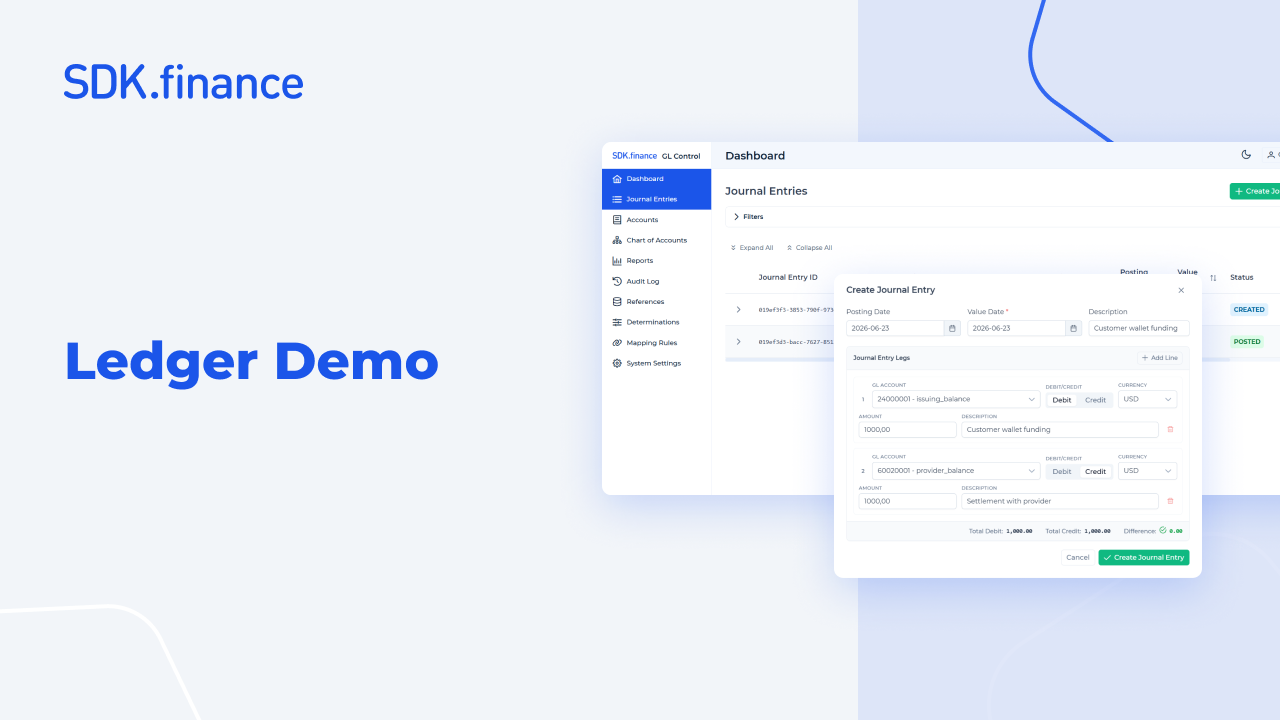
See SDK.finance Real-Time Ledger in Action
Watch how business events are transformed into balanced journal entries through configurable accounting rules, account determination, and double-entry logic.
Easy to integrate into your existing stack
No changes to your core product are required. SDK.finance Ledger integrates as an additional accounting layer, consuming business events and generating real-time journal entries alongside your existing transaction platform:

APIs and real-time events
Interact with the ledger through APIs and receive real-time updates via webhooks for all transaction and balance changes.
Payment rails and financial infrastructure
Integrate with payment processors, banking systems, and card networks to support transactions across multiple rails.
Compliance and ecosystem integrations
Connect with KYC/KYB providers and other financial services to support compliant and scalable product operations.
Success stories from our Clients

See how SDK.finance Ledger fits your architecture
SDK.finance Real-Time Ledger Software? FAQs
What is real-time ledger software?
Real-time ledger software records every financial event as it happens and updates balances instantly. It gives banks, PSPs, and fintechs one system to track accounts, transactions, fees, settlements, and audit trails without relying on delayed batch processes.
How is SDK.finance Ledger different from a traditional general ledger?
Does SDK.finance support double-entry accounting?
Yes. SDK.finance Ledger uses double-entry accounting logic to keep every transaction balanced, traceable, and consistent across accounts. This helps improve data integrity, audit readiness, and operational control.
Can SDK.finance handle multi-currency balances and settlements?
Yes. The platform supports multi-currency accounts, balance tracking, fees, and settlement flows across different products and customer segments. This makes it suitable for wallets, PSPs, remittance apps, and other cross-border financial services.
How does reconciliation work in SDK.finance Ledger?
SDK.finance Ledger records transactions and balance updates in one place, making it easier to match internal records with external payment and banking data. Real-time visibility helps teams reduce manual work, identify discrepancies faster, and keep reporting aligned.
Can it support wallets, PSPs, and neobanks?
Yes. SDK.finance Ledger is built for financial products that need accurate balance management and transaction tracking at scale. Typical use cases include digital wallets, payment service providers, EMIs, neobanks, remittance apps, and embedded finance platforms.
How does SDK.finance handle reversals, refunds, and corrections?
The platform supports reversals, refunds, cancellations, and correction flows while preserving a clear transaction history. This helps teams resolve operational issues without losing visibility into the original financial event.
Can SDK.finance integrate with payment processors, card systems, and banking infrastructure?
Yes. SDK.finance Ledger is designed to integrate with payment processors, card systems, banking infrastructure, and other financial services through APIs and related integration tools. This helps teams connect ledger operations to the rest of their payments stack.
Does SDK.finance support double-entry accounting?
Yes, all transactions are recorded using double-entry accounting logic. Each operation creates balanced debit and credit entries, ensuring that balances remain consistent and financial data stays accurate across all accounts and transactions.
Do I need to replace my existing platform to use SDK.finance Ledger?
No. SDK.finance Ledger is designed to integrate as an additional accounting layer rather than replace your existing transaction platform. It consumes business events from your core system, payment platform, wallet, or banking application and automatically transforms them into balanced double-entry journal entries. This allows you to introduce real-time accounting without rebuilding your existing product or changing your transaction processing logic.