


SDK.finance provides a ready foundation for building a digital wallet, payment service, money transfer, mobile banking app, neobank or another financial product without developing the core financial functionality from scratch. Customers can configure the Platform around their business model, integrate the services they need and prepare the product for launch.
During the software evaluation and selection stage, potential customers often ask us how SDK.finance is implemented and whether the Platform can be integrated with their existing software and technology infrastructure. The short answer is that the implementation approach depends on the product requirements, existing systems, available technical resources and the level of customisation involved. In this guide, we explain the process in detail – from initial Platform assessment and integration planning to configuration, development, testing and production launch.
SDK.finance implementation can be organised in several ways:
- A customer can use its own development team;
- Engage a specialised SDK.finance software development partner;
- Choose a hybrid model in which the customer’s team and the development partner work together.
The best model depends on whether the customer has an internal development team, the team’s size and payments expertise, the amount of customisation required, the launch schedule and how the customer wants to manage the product after go-live.
Whichever model is selected, implementing a financial platform is not the same as installing an ordinary business application. A fintech product has to move money correctly, maintain accurate balances, connect to external providers, protect sensitive data and give operational teams enough control to investigate and resolve problems.
This guide explains the SDK.finance implementation approach, implementation requirements, the technical team involved, typical timeline and cost drivers, and how the customer, SDK.finance and a specialised development partner can work together from initial configuration to production handover.
What SDK.finance Implementation Actually Means
SDK.finance implementation is the process of adapting, deploying and connecting the SDK.finance Platform to support a specific financial product and operating model.
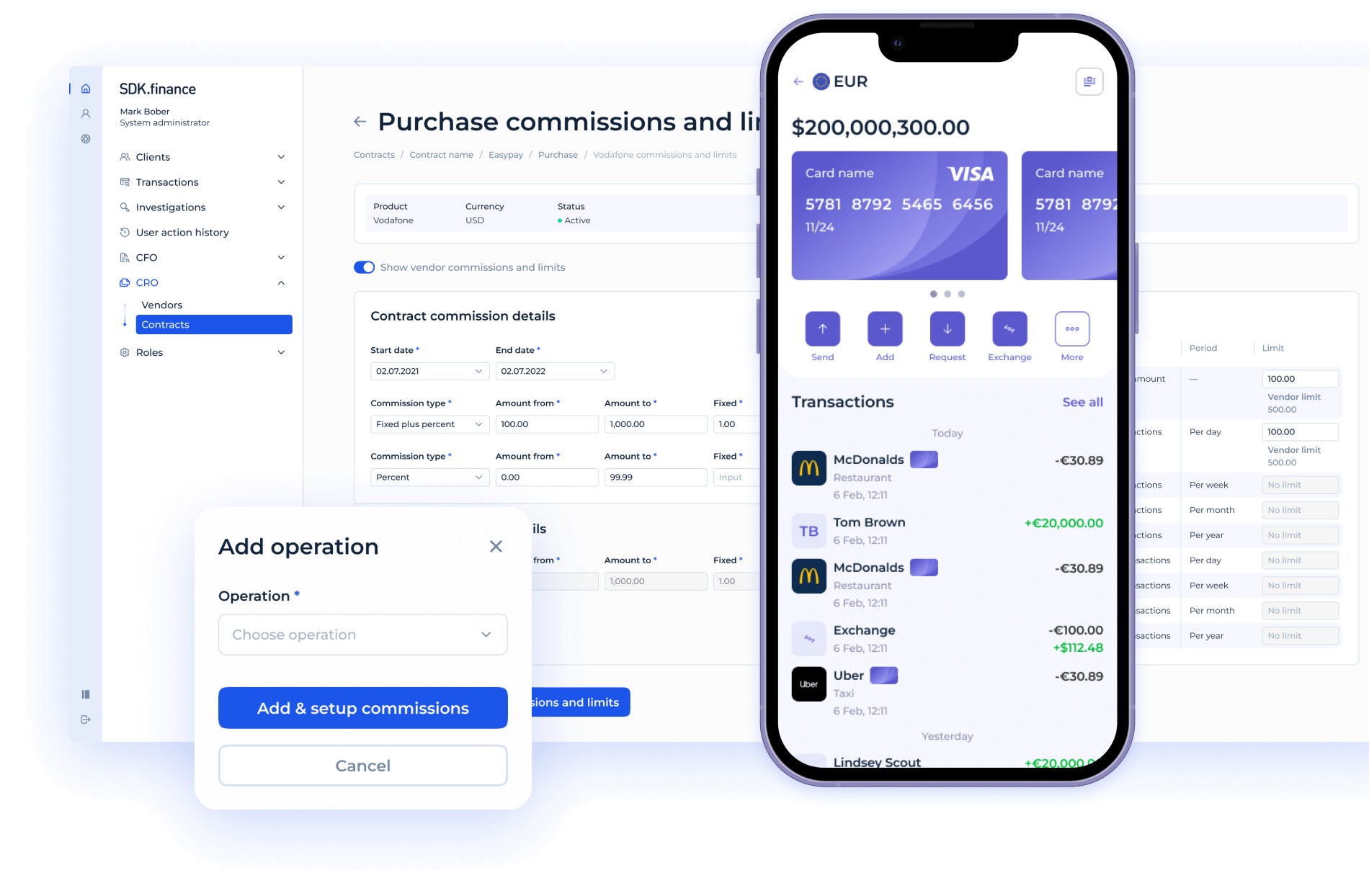
The Platform provides a ready financial foundation rather than a finished product designed for one particular company. It includes a transaction engine, account and wallet functionality, fees and limits, customer and merchant management, back-office tools, reconciliation capabilities and 650+ APIs.
The implementation project turns that foundation into a working product such as a digital wallet, payment platform, neobank, merchant payment service, loyalty system or embedded finance solution.
In practice, this work may include:
- selecting the required Platform modules and workflows;
- configuring currencies, accounts, contracts, commissions and limits;
- adapting the customer and back-office experience;
- connecting KYC, banking, payment, card or other providers;
- preparing infrastructure and databases;
- migrating data from existing systems, if required;
- testing business flows, accounting results, security and performance;
- preparing operational teams and launching the product.
Not every project needs every item on this list. A company launching a closed-loop wallet may have a much simpler provider landscape than a business offering cards, bank transfers and cross-border currency exchange. The implementation plan should follow the product, not a generic checklist.
Who Can Implement SDK.finance?
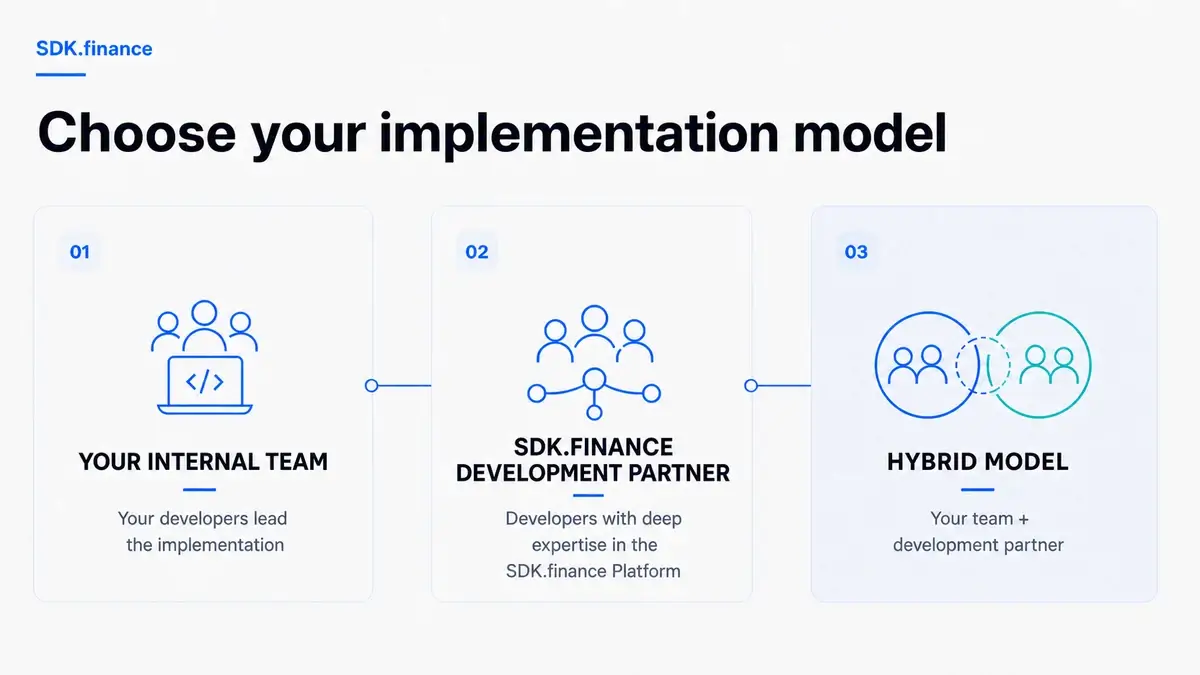
SDK.finance provides the Platform, source code or SaaS delivery models, product documentation and knowledge needed to understand its standard capabilities. The implementation and further product development can then be handled through one of three delivery models.
- The Customer’s Internal Development Team
The customer’s engineers can take full responsibility for deployment, configuration, integrations, customisation and future releases. This model offers direct control over priorities, architecture and the product roadmap.
It is most suitable when the organisation already has a mature delivery process and specialists who can work confidently with the SDK.finance stack and financial transaction logic. The internal team should also have hands-on experience with payment products, as payment flows, transaction states, reconciliation and provider integrations require specific domain knowledge and skills. Source code access makes this independence possible, but the customer must be ready to maintain the codebase, infrastructure, databases, security and integrations over the long term.
- A Specialised SDK.finance Implementation and Development Partner
SDK.finance works with several specialised implementation and development partners. Unlike a general outsourcing team approaching the Platform for the first time, these partners already have hands-on experience with its architecture, financial workflows, extension points, APIs and common integration patterns.
They have completed numerous SDK.finance customisations for customers and can support work across the implementation lifecycle, depending on the agreed scope. This may include requirements analysis, architecture review, installation and configuration, backend and frontend development, API and core banking integrations, testing, troubleshooting, release preparation, training and knowledge transfer.
The main advantage is not simply access to more developers. It is the opportunity to work with a team that already knows how the Platform behaves and where project-specific logic should be implemented.
This can help the customer:
- spend less time onboarding engineers to the Platform;
- obtain estimates informed by previous SDK.finance projects;
- identify common customisation and integration risks earlier;
- avoid rebuilding functionality that the Platform already provides;
- work more confidently with transaction states and accounting logic;
- extend delivery capacity without hiring every required specialist internally.
Experience with SDK.finance does not remove the need for discovery or testing. Every implementation still has its own product, regulatory, provider and infrastructure requirements. It does, however, reduce the amount of Platform-specific learning that must happen during the project.
Contact the SDK.finance team and tell us about your product vision, planned functionality, integrations and internal development resources. We will review your requirements and help match you with the specialised partner best suited to your project.
- A Hybrid Team
The two approaches are not mutually exclusive. A specialised partner can work alongside the customer’s engineers, deliver the initial customisations and then transfer knowledge, or remain responsible for selected technical areas while the customer retains product and architecture ownership.
A hybrid model is often useful when the customer wants to build internal capability without delaying the initial implementation. Responsibilities should be explicit: who owns the architecture, who builds and supports integrations, who manages releases and who responds to production incidents.
The right option depends on the customer’s team, scope and long-term operating model.
The SDK.finance Implementation Approach: A Practical Roadmap
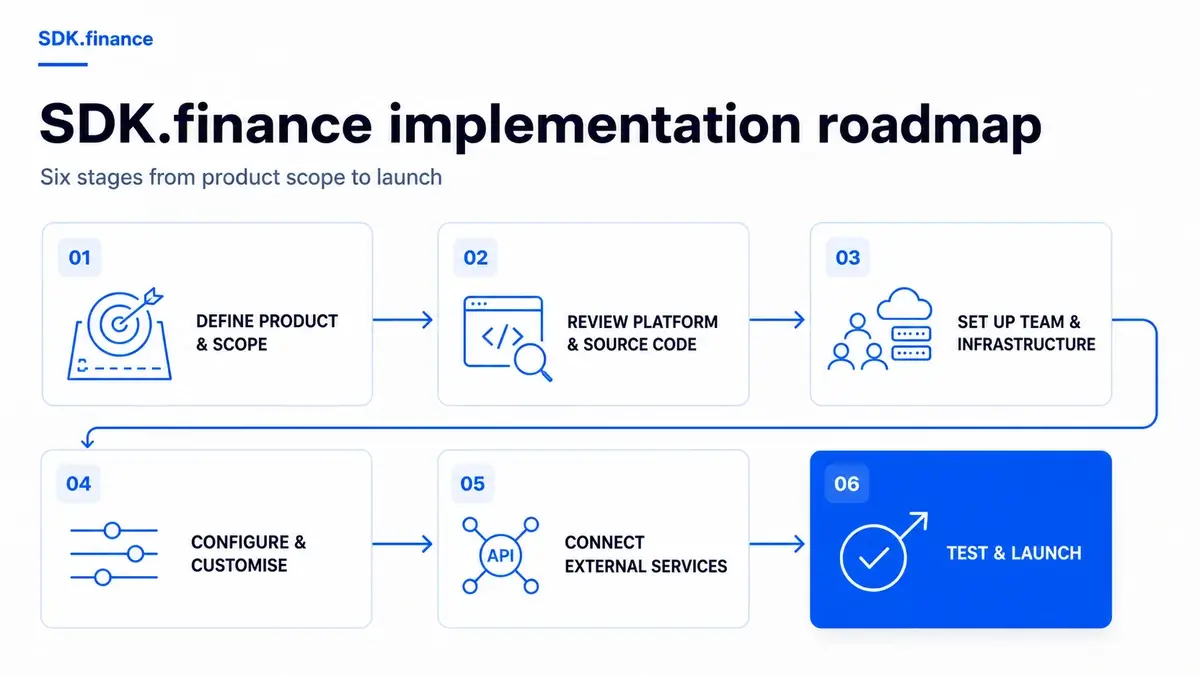
The following six stages provide a practical planning outline. The exact scope and sequence depend on the product and the agreed delivery model.
1. Define the Product and Scope
Start with the financial product, target users, markets, currencies and transaction flows. For each core journey – such as onboarding, top-up, transfer or withdrawal – define the fees, limits, transaction states, provider involvement and operational handling.
A gap analysis then separates requirements into three groups: functionality available through Platform configuration, functionality delivered through an external integration and functionality that requires custom development. This gives the team a clearer basis for estimating time, cost and responsibilities.
Use the FinTech discovery checklist to organise requirements, dependencies, and the evidence needed before committing to delivery.
2. Review the Platform and Source Code
For the source code licence, SDK.finance provides technical documentation, a product demonstration and a structured audit stage. The standard audit period is 45 days, during which the customer’s specialists can review the architecture, code, scalability and fit with the planned product. Regular Q&A sessions help the team understand configuration, development and testing before the final source code transfer.
The review should confirm what the Platform already covers, what must be integrated or customised and whether the selected delivery team has the required technical skills.
3. Set Up the Team and Infrastructure
The implementation team typically needs business analysis, Java and Spring backend development, DevOps, QA and relevant frontend expertise. Depending on the scope, the project may also involve project management, UI/UX, security, database and automated testing specialists.
SDK.finance can be deployed in cloud infrastructure, a dedicated data centre or on premises. The team prepares development, testing and production environments together with databases, access controls, monitoring, backups and release processes. These responsibilities may sit with the customer, a specialised development partner or both.
4. Configure and Customise the Product
The team configures the Platform around the required currencies, account structure, customer groups, fees, limits, roles and permissions. It can then adapt customer-facing applications and back-office workflows to the required branding and user journeys.
Any custom development should focus on functionality specific to the customer’s product. The Platform already provides the core financial foundation, back-office capabilities and 650+ APIs, allowing the team to concentrate on the features and experience that differentiate the business.
5. Connect External Services
Most financial products connect to banks, KYC/KYB and AML services, payment gateways, card issuers, currency exchange providers or other third parties. SDK.finance offers available integrations and API-based options for connecting additional providers.
This stage includes both commercial onboarding and technical integration. The customer normally signs the provider agreement, while the implementation team connects the systems, maps data and transaction statuses, handles callbacks and errors and prepares reconciliation. Starting provider onboarding early helps avoid delays outside the development team’s control.
6. Test and Launch
Testing covers complete customer and operational flows rather than isolated API calls. It should include successful and failed transactions, permissions, accounting results, reconciliation, security, performance and recovery scenarios.
A gradual rollout can begin with limited users, transaction types or limits. During and after launch, the team monitors failed or delayed transactions, reconciliation differences, provider responses, security events and infrastructure capacity. Clear support ownership and escalation procedures make the transition to production smoother.
For a broader delivery framework, review the FinTech SDLC stages and handover checks that connect implementation with acceptance and ongoing operations.
How to Choose an Experienced SDK.finance Implementation Team
A team can be technically strong and still require significant time to learn a complex financial platform. When implementation speed and risk are important, evaluate both general engineering capability and direct SDK.finance experience.
Useful questions for an implementation specialist or company include:
- Has the team worked with the current SDK.finance architecture and source code?
- Which SDK.finance customisations and integrations has it completed?
- Can it explain how it approaches transaction states, accounting and reconciliation?
- Does it cover backend, frontend, DevOps, QA and integration work?
- How will responsibilities be divided between the partner and internal engineers?
- Who owns the resulting code, documentation and deployment pipelines?
- What knowledge-transfer process is included?
- Who supports the customised components after launch?
- Does the proposed scope include installation, configuration, testing, training and operational handover?
The best implementation partner is not simply the vendor promising the shortest timeline. It is the team that can explain the scope, dependencies, assumptions and operational risks clearly before development begins.
The source code licence is therefore best suited to companies that want long-term control and have the resources to exercise it. Access to code reduces vendor dependency, but it does not remove the need for software ownership.
SDK.finance Implementation Timeline and Cost Drivers
Customers commonly request an estimated implementation timeline together with licence, implementation and integration costs. There is no responsible universal figure: both time and cost depend on the product scope and on work that may sit outside the Platform itself.
The largest schedule drivers are usually:
- completeness of business and accounting requirements;
- number and complexity of transaction journeys;
- number of external providers;
- provider commercial onboarding and certification;
- amount of custom development;
- readiness of the customer’s engineering team;
- infrastructure and security approval processes;
- data migration scope and quality;
- regulatory and operational readiness;
- testing and remediation effort.
The standard source code audit period is 45 days, but this is only one stage of the overall programme. A bounded product based mainly on existing capabilities will generally move faster than a multi-country platform with several providers, a custom user experience and migration from legacy systems.
The best way to create a credible timeline and commercial estimate is to complete the gap analysis, identify external dependencies, define the division of responsibilities and estimate each end-to-end journey. A date or implementation cost chosen before this work is a target, not yet a plan.
Conclusion
SDK.finance implementation is a joint product, engineering and operational programme. It starts with clear customer journeys and financial rules, continues through source code evaluation, architecture, configuration, customisation, integrations and testing, and reaches production only when the organisation is ready to operate the product safely.
The delivery team is therefore part of the implementation decision, not an administrative detail to address after acquiring the software. Customers with the necessary skills can implement and extend the Platform internally. Those that need additional Platform knowledge or delivery capacity can work with a specialised SDK.finance development partner. A hybrid model can combine external implementation experience with long-term internal ownership.
SDK.finance supplies the financial Platform foundation, source code, documentation and implementation guidance. The customer brings the business model, regulated relationships and product ownership. The development partner, where selected, brings hands-on Platform experience and the engineering capacity to deliver the agreed customisations and integrations.
The strongest arrangement is the one that makes these responsibilities explicit from the start. Contact the SDK.finance team and tell us about your product, required integrations, deployment model, implementation timeline and current technical team. We will explain the available options and help you determine whether an internal, specialised partner or hybrid delivery model is the best fit for your case.

