Launching a FinTech product means making customer experience, financial records and external providers work together – even when transactions fail or responses arrive late.
The FinTech software development life cycle (SDLC) is a repeatable process for planning, building, verifying and operating financial software. From initial discovery to ongoing improvement, it helps CTOs and product owners define the work, its owner and the conditions for release.
This guide covers seven delivery stages, practical checks and the factors that shape time and cost. A withdrawal-fee example connects requirements to testing and support. We also look at SDK.finance, a software development company providing custom FinTech development and a transaction platform, and how it supports the lifecycle.
Talk to our team and get a development approach tailored to your business model.
Get a FinTech development estimateWhat is the FinTech software development life cycle?
The FinTech software development lifecycle (SDLC) is the process of taking financial software from an initial idea through planning, design, development, testing and launch, then maintaining and improving it. It helps teams build products that handle money and financial data accurately, with security, applicable regulatory requirements and connections to banks and payment providers considered throughout.
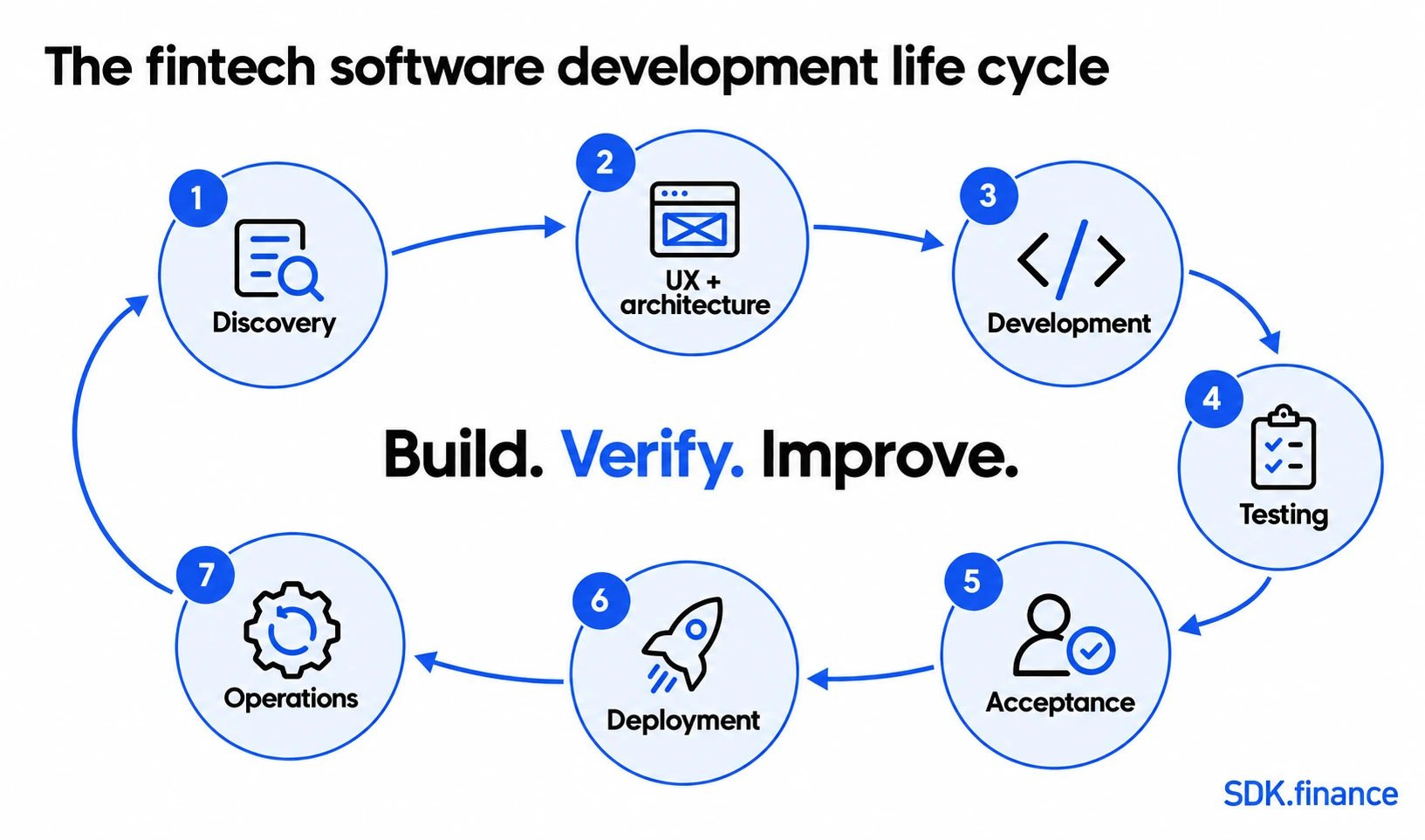
The seven stages are:
- Discovery, feasibility and requirements.
- UX design, architecture and implementation planning.
- Development, integrations and code review.
- Testing and financial verification.
- Business acceptance and release approval.
- Deployment and operational handover.
- Monitoring, maintenance and continuous improvement.
Apply the cycle to a first launch, a new feature or a platform migration. The scope changes: a migration needs data mapping and reconciliation, while a fee change may affect a narrower set of journeys.
These stages describe the work; Agile, Waterfall and hybrid approaches organise its delivery. Security and compliance span the cycle, and operational feedback informs the next iteration.
What makes the FinTech SDLC different?
Financial software connects customer actions to records and, through banks or payment providers, the movement of money. A delivery process needs to account for all three.
Financial correctness and provider dependencies
Consider a withdrawal. The app might show that the request was accepted while the provider is still processing it. An internal transaction status, a ledger entry and confirmation that funds reached their destination describe different events. Treating them as interchangeable can produce misleading balances, incorrect fees or duplicate payments.
The process also spans organisational boundaries. Your developers may control the application, while a provider controls its payment interface and a bank controls the external account. Each handover needs a defined response when information is delayed, inconsistent or unavailable. Reconciliation-the comparison of internal records with external reports-helps teams identify differences that an application status alone may miss.
Security and regulatory requirements
Security belongs throughout this work. The NIST Secure Software Development Framework describes secure-development practices that can be incorporated into an SDLC. For a delivery team, the implication is to define security requirements early and verify them as the product changes, rather than reserve security for a final review.
Applicable obligations also depend on the product, jurisdiction, data and partner arrangements. Bring the relevant security, compliance and legal stakeholders into scoping so their requirements become implementation and acceptance criteria. A software checklist does not establish regulatory approval.
A running example: a withdrawal fee
Our hypothetical requirement, WD-01, adds a $2 fee to a $100 bank withdrawal: the customer confirms a $102 total. The fee becomes final only when the withdrawal completes.
The seven stages of the FinTech software development life cycle
A useful FinTech software development process makes the next decision visible. The following seven stages provide a practical framework; the role assignments should be adapted to your organisation and delivery contract.
1. Discovery, feasibility and requirements
Start with the customer and the problem. For a new wallet, identify who will use it, why existing options fall short and which journey the first release must complete. Interview prospective users and operations staff, then define an outcome you can test, such as whether customers can complete a transfer and understand its status.
Set the minimum viable product (MVP) scope around a complete journey: onboarding, funding, a useful transaction and support when something fails. Separate essential features from later enhancements. Assess feasibility with engineering and relevant compliance stakeholders, including provider availability, data needs, contractual dependencies and operational capacity. If a critical integration or financial rule is still unproven, a FinTech proof of concept can test that assumption before the team commits to an MVP.
The product owner turns these decisions into acceptance criteria: observable conditions that the finished product must meet. For an existing product, discovery is narrower, but the team still assesses customer impact, affected systems and dependencies.
For WD-01, that means testing fee and failure-handling rules before treating the design as settled.
Example: define the withdrawal-fee rule
For WD-01, show the $100 withdrawal, $2 fee and $102 total before confirmation. Define any temporary balance hold while processing. An initial rejection must leave no final withdrawal debit or fee, with any hold released once the outcome is confirmed. A later returned payment needs a separate rule.
Link WD-01 to its design and tests. Assign owners to confirm provider status meanings and accounting treatment.
The deliverable is an agreed scope with testable criteria and a feasible route to launch. Resolve conflicting interpretations of terms such as “completed” before implementation.
2. UX design, architecture and implementation planning
Design the customer journey and system behaviour together. Prototype onboarding, confirmation and transaction-history screens before building them. Test whether representative users understand fees, pending states and errors, including what to do when a response is delayed. Include accessibility and support needs in the acceptance criteria. For mobile products, the mobile banking app development guide explores these design and architecture decisions in more detail.
Map the architecture and financial records
The technical lead maps the journey to application components, provider APIs and financial records. Document each API contract, transaction state and relevant accounting event. Finance should validate the intended postings: a balanced entry can still represent the wrong business event.
Choose the technology stack against transaction consistency, expected load, security, integration needs and your team’s ability to maintain it. Record why the design fits those constraints. A fashionable framework or microservices architecture does not by itself establish reliability.
Example: design for retries and uncertain outcomes
For WD-01, link the withdrawal to its fee, provider reference and accounting records. Design idempotency so repeating the same instruction does not create another financial effect. A local duplicate check cannot establish an uncertain provider outcome; define how that outcome is investigated before resubmission.
Use a short design-decision record to explain the approach and alternatives considered. The broader FinTech architecture decisions can inform this work, but the project needs its own contracts and responsibilities.
The deliverables are tested prototypes, interface contracts and documented design decisions. Progress when customer behaviour, failure handling and ownership are clear enough to implement and verify.
3. Development, integrations and code review
Developers implement the agreed design through code, configuration and provider integrations. Keep each change linked to its requirement and use version control for application code, deployment settings and database changes.
Development priorities
- Build a small end-to-end journey early. A provider sandbox can reveal missing fields, inconsistent status meanings or authentication problems before the interface is complete. Track differences from production and assign unresolved integration questions to named owners.
- Run automated checks through continuous integration (CI), which checks changes as they enter the shared codebase. Include focused calculation tests, integration checks and relevant dependency or secret scanning. For WD-01, verify rounding and repeated requests as well as the successful path.
- Peer review should cover financial rules, access controls, errors and logging. Stable transaction references help support teams investigate failures without exposing unnecessary customer data.
The deliverable is a reviewed, versioned build with reproducible checks. Code review establishes readiness for broader testing, not business acceptance.
4. Testing and financial verification
The QA lead coordinates verification across realistic conditions, with finance, security and operations contributing their expertise.
Unit tests check individual rules; integration tests check component and provider interactions; regression tests protect existing behaviour. Add relevant security, performance and recovery tests. For a new product, test the complete customer journey; for a change, assess both its direct effects and affected existing flows.
For WD-01, include scenarios such as:
- Successful withdrawal: record the $100 withdrawal and $2 fee once, with a $102 total customer debit.
- Insufficient funds: an available balance below $102 prevents this withdrawal under the example rule.
- Duplicate request or provider notification: no second withdrawal or additional $2 fee is created.
- Missing provider response: keep the outcome pending investigation; do not assume failure or submit a new payment blindly.
- Confirmed initial rejection: no final withdrawal debit or $2 fee remains; any associated hold is released.
- Internal records can be compared with the provider’s report to explain differences.
For application-security requirements, the OWASP Application Security Verification Standard provides a reference for designing and testing controls. Select a released version and relevant requirements; security verification must be accompanied by the project’s financial and business tests.
Tie results to the build, configuration and test data. Record sandbox limitations and how untestable provider failures will be addressed. Measure expected load and response behaviour against agreed requirements.
Release-blocking defects must be resolved. A high pass rate cannot compensate for an untested duplicate withdrawal or incorrect customer balance.
5. Business acceptance and release approval
User acceptance testing, or UAT, asks whether the implemented change supports the agreed business outcome. It brings business users into the decision alongside the technical evidence.
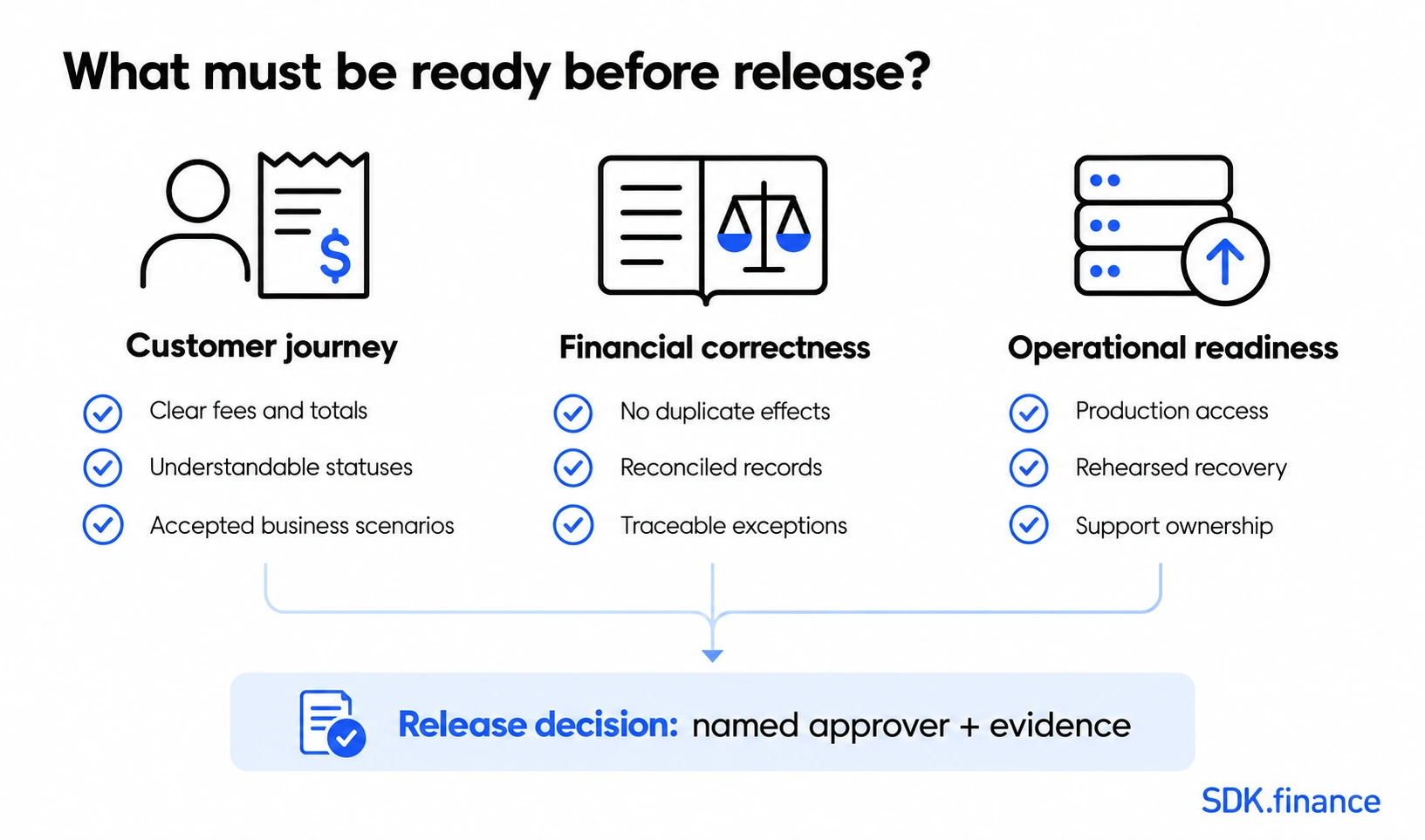
Product and operations representatives should walk through the complete journey, including exceptions. In WD-01, customers must understand the total, finance must explain the fee records and support must investigate a pending withdrawal.
Use scenarios agreed during discovery. If the fee policy changes during UAT, update the requirement and affected tests before accepting the result.
Agree who can approve the release
The business owner accepts the outcome; engineering and operations assess readiness. A designated release authority records the go/no-go decision for the specific version.
Agree blockers in advance, such as duplicate financial effects, unexplained balance differences or a critical access-control flaw. Other defects need an explicit decision, an owner and a remediation plan.
Separate UAT from software acquisition
Also distinguish project UAT from source-code acquisition acceptance. Reviewing licensed software before transfer does not demonstrate that a later customised product is ready for customers.
6. Deployment and operational handover
Deployment puts the approved change into its intended environment. Operational handover ensures that someone can support it once real customers begin using it.
Confirm configuration, production provider access, monitoring and support coverage. Rehearse migrations where applicable, and verify that the deployed version matches the accepted build. Review environment differences, particularly credentials and fee rules.
For WD-01, define how the fee applies to withdrawals already in progress when deployment occurs. A later provider response must not silently change the terms the customer accepted.
Plan recovery and support
Prepare a recovery plan that distinguishes software recovery from financial correction. Rolling back an application does not reverse a settled payment. Restoring a database without accounting for subsequent financial activity can also create inconsistencies. Recovery must preserve the ability to identify completed, pending and uncertain operations and reconcile them with external records.
The support runbook should explain how to investigate delayed transactions, find references and escalate. Assign customer communication as well as technical resolution.
Use a staged rollout where feasible. Define pause conditions, such as duplicate fees or unexpected growth in pending transactions, and ensure named responders are available.
7. Monitoring, maintenance and continuous improvement
After launch, the service owner monitors technical performance alongside customer and financial outcomes.
Monitor service availability, latency and errors alongside pending transactions, duplicate records and reconciliation discrepancies. Agree alert thresholds using provider behaviour and the product’s baseline. Every alert needs an owner and a response.
Customer feedback can reveal problems even when calculations are correct. Repeated support questions about a fee may indicate unclear confirmation wording or transaction history. Feed that evidence into the backlog.
Turn issues into verified improvements
When reconciliation exposes an incorrect fee, follow the authorised correction process. Preserve original records and link corrections so the outcome remains explainable, then address the underlying cause.
Maintain dependencies, apply relevant security fixes and rehearse incident response. Assess changes to providers, business rules and applicable obligations. Urgent fixes may follow an expedited route, but still need verification and traceable decisions.
The deliverable is an owned service and a prioritised improvement backlog. Assign preventive actions after incidents and check that they address the cause.
Talk to our team and get a development approach tailored to your business model.
Get a FinTech development estimateAgile, Waterfall or hybrid: choosing a delivery approach
Choose the approach around uncertainty, dependencies and approval needs. The seven stages can repeat within iterations; they do not require seven separate departments.
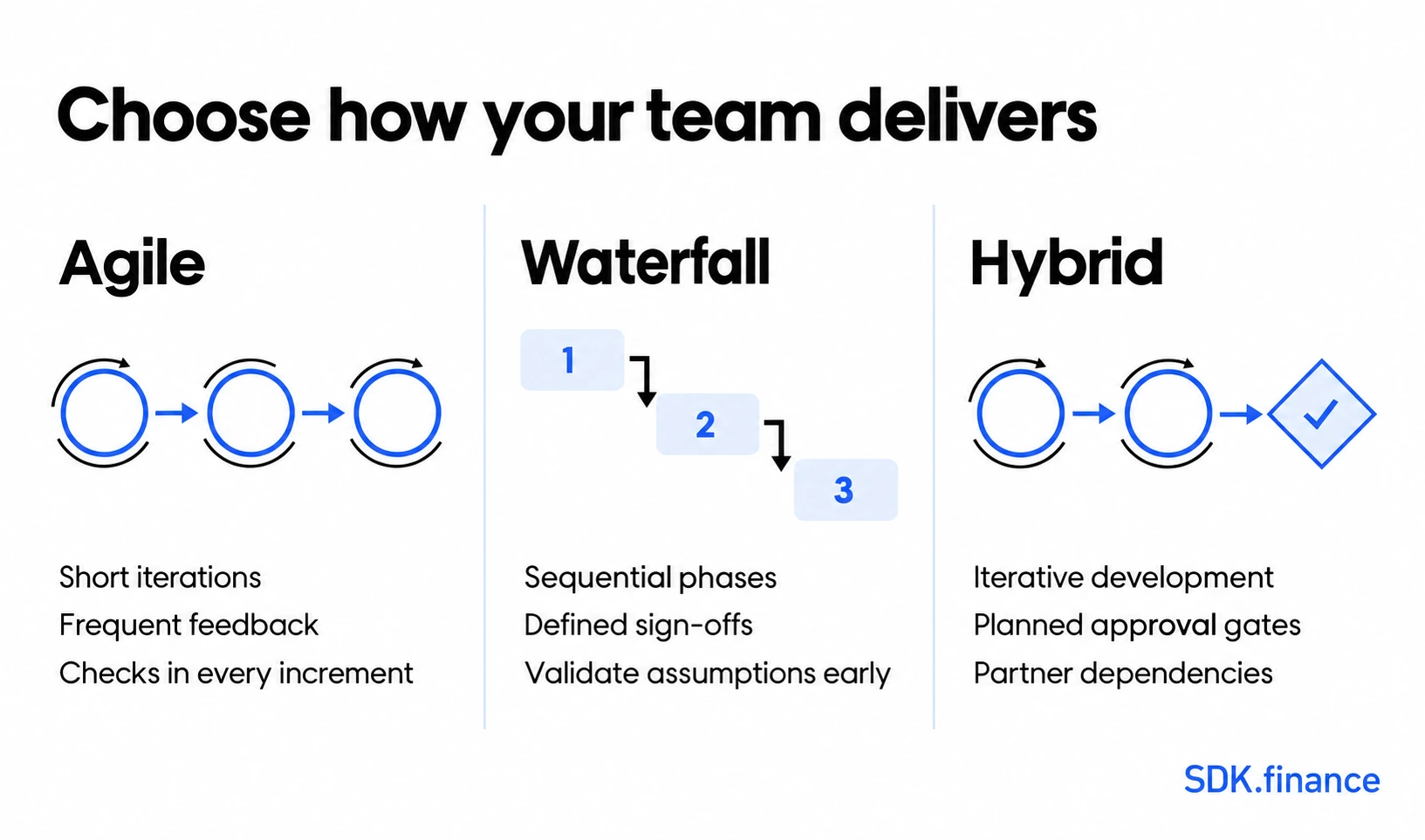
- Agile suits evolving journeys and priorities: deliver in short iterations and use feedback to refine the next increment. Each increment still needs financial and security checks and an agreed definition of done.
- Waterfall can suit a tightly specified deliverable with stable requirements and sequential sign-offs. Validate user journeys and provider assumptions early: late feedback can cause substantial rework.
- Hybrid delivery suits iterative development with fixed approval points, such as provider onboarding, migration or launch. Refine screens during sprints while finance validates postings and operations rehearses recovery.
Assign scope and release authority for any approach. Track external milestones separately from sprint completion.
Security and compliance across the FinTech SDLC
Turn risks into requirements and evidence before release. The NIST Secure Software Development Framework supports lifecycle-wide security practices, while OWASP ASVS supplies application-security verification requirements. Select relevant controls for your architecture and keep financial correctness checks alongside them.
For compliance, map the product’s markets, data and regulated activities with the responsible specialists. Translate applicable obligations and partner requirements into implementation tasks, retention rules and acceptance criteria. Assign who supplies each control and who verifies it. Review the mapping when a provider, market or product scope changes.
The following examples connect risks to practical checks. They are an illustrative project checklist, not an exhaustive standard or certification assessment.
| Risk | Stage | Control | Evidence |
|---|---|---|---|
| Excessive access | Design and testing | Define least-privilege roles; test denied actions | Approved role matrix and access-test results |
| Sensitive data in logs | Development and testing | Exclude secrets; minimise personal data in logs | Code review and sampled log checks |
| Vulnerable dependencies | Development and operations | Scan dependencies; assign remediation owners | Scan results and tracked fixes |
| Duplicate financial effects | Design and testing | Define idempotency and provider retry handling | Repeat-request and duplicate-notification tests |
| Unreliable recovery | Deployment and operations | Rehearse restoration and transaction reconciliation | Recovery results and reconciled records |
FinTech SDLC checklist: owners, deliverables and release gates
Use this FinTech SDLC checklist for a product launch or a change. Replace the example roles with named teams, including vendor and partner responsibilities.
The evidence column also serves as an SDLC documents checklist. Link existing tickets, repositories and reports rather than creating duplicate paperwork.
| Stage | Example accountable role | Evidence to retain | Condition for progression |
|---|---|---|---|
| Discovery and requirements | Product owner | MVP scope, customer journeys, acceptance criteria and dependency owners | Expected and exception behaviour is understood; unresolved scope decisions have owners |
| UX, architecture and planning | Technical lead | Tested prototypes, API contracts, accounting design and technology decisions | Retry handling, uncertain outcomes and system responsibilities are defined and testable |
| Development and review | Engineering lead | Versioned code/configuration, review record and automated check results | Required reviews and checks pass; implementation is linked to approved requirements |
| Testing | QA lead, with finance and security input | Functional, integration, regression and relevant security/performance results | Agreed coverage is complete; release-blocking defects are resolved and gaps documented |
| Acceptance and approval | Business owner and designated release authority | UAT results, readiness assessments, open risks and release decision | Required parties approve the identified version under the agreed release policy |
| Deployment and handover | Release or operations lead | Deployment plan, recovery evidence, monitoring and support runbook | Environment checks pass; financial recovery procedures and support ownership are clear |
| Operations and change | Service owner | Monitoring, reconciliation exceptions, incident records and prioritised backlog | Issues are assigned and investigated; necessary changes enter the next delivery cycle |
Use the checklist at handover
For WD-01, link the requirement to the versioned design, implementation, test results, UAT and release. At handover, operations should find the provider reference, finance should explain the fee and the release owner should see unresolved defects.
Keep evidence proportionate to the change: a new provider needs broader checks than a wording update. The matrix supports decisions; it does not certify the product or establish regulatory approval.
What affects FinTech development time and cost?
Before requesting an estimate, agree the first release’s journeys, reusable components, integrations and delivery responsibilities. Separate implementation effort from external waiting time.
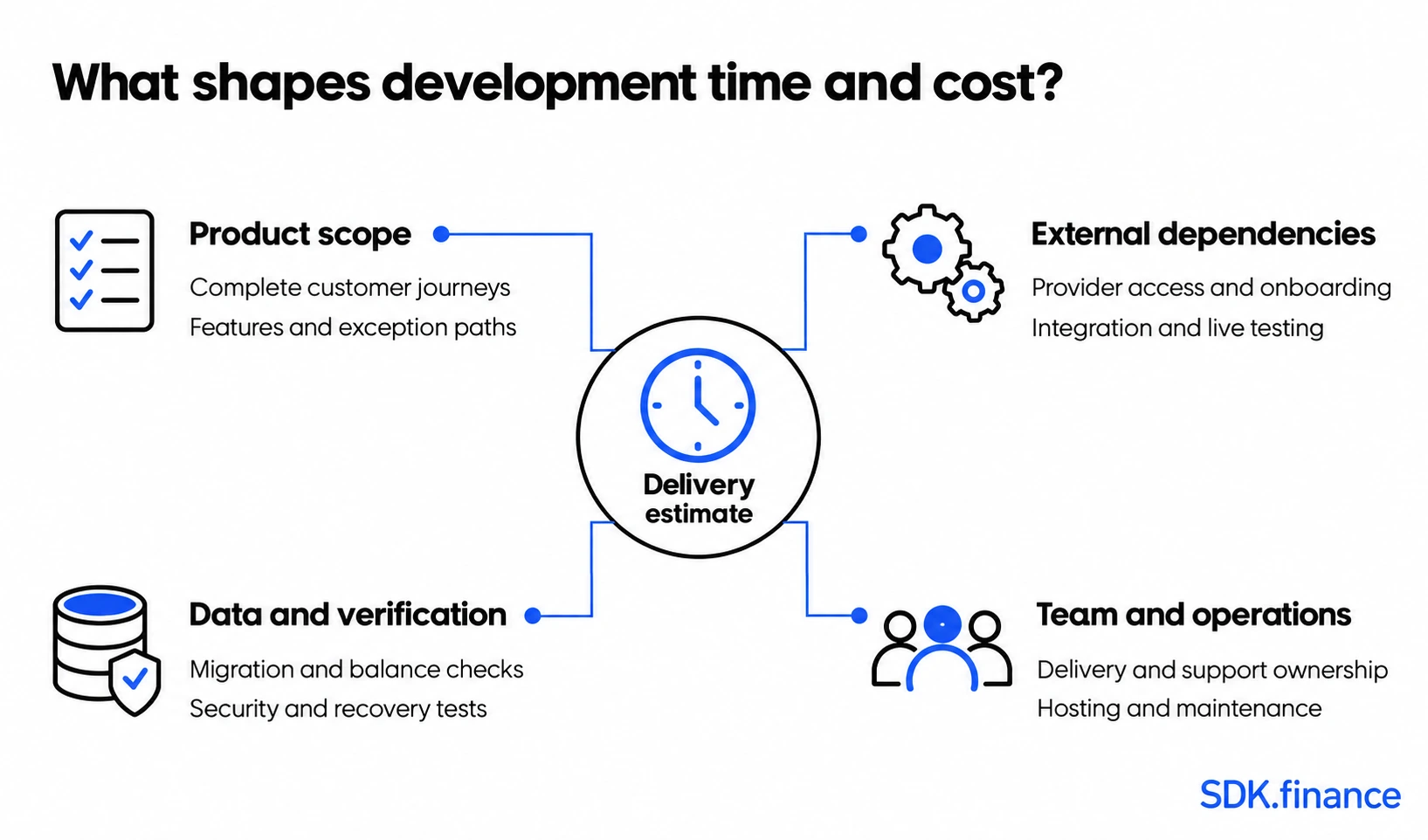
- MVP scope and product fit. Decide which complete journeys and exception paths belong in the first release, including administration and support. Confirm what existing software can provide and which changes need custom development and regression testing.
- Integrations and partner readiness. Confirm who supplies sandbox access, data mapping, provider onboarding and production credentials. Schedule end-to-end testing against those milestones.
- Data migration and verification. Decide whether historical records and balances must move. Include conversion, validation, transition rehearsals, security reviews, performance tests and recovery exercises in the estimate.
- Team and operating model. Choose in-house, outsourced or hybrid delivery and assign architecture, review, acceptance and maintenance. Budget separately for hosting, provider services, monitoring, patching and support.
Estimate work packages and dependency milestones as ranges with stated assumptions and contingency. Revise them after discovery and integration testing; there is no universal FinTech price or timeline. For a closer look at budgeting and cost drivers, see our guide to FinTech app development cost.
How to measure and improve the lifecycle
Choose measures that reveal where delivery is slowing down or allowing problems to escape. Define each measure consistently before comparing releases.
- End-to-end delivery lead time: measure from agreed scope to production, separating waiting time from implementation. Delayed provider access needs a different response from repeatedly failing tests.
- Rework after acceptance: record which missed requirement or scenario sent work back to development.
- Production defects and recovery time: distinguish restoring service from resolving affected financial transactions; these may finish at different times.
Track the number and age of reconciliation exceptions relative to transaction activity. More exceptions may reflect increased volume rather than a worsening process.
Compare releases against your own baseline. Faster delivery is useful only when financial correctness and operational workload remain acceptable.
Build and scale your FinTech product with SDK.finance
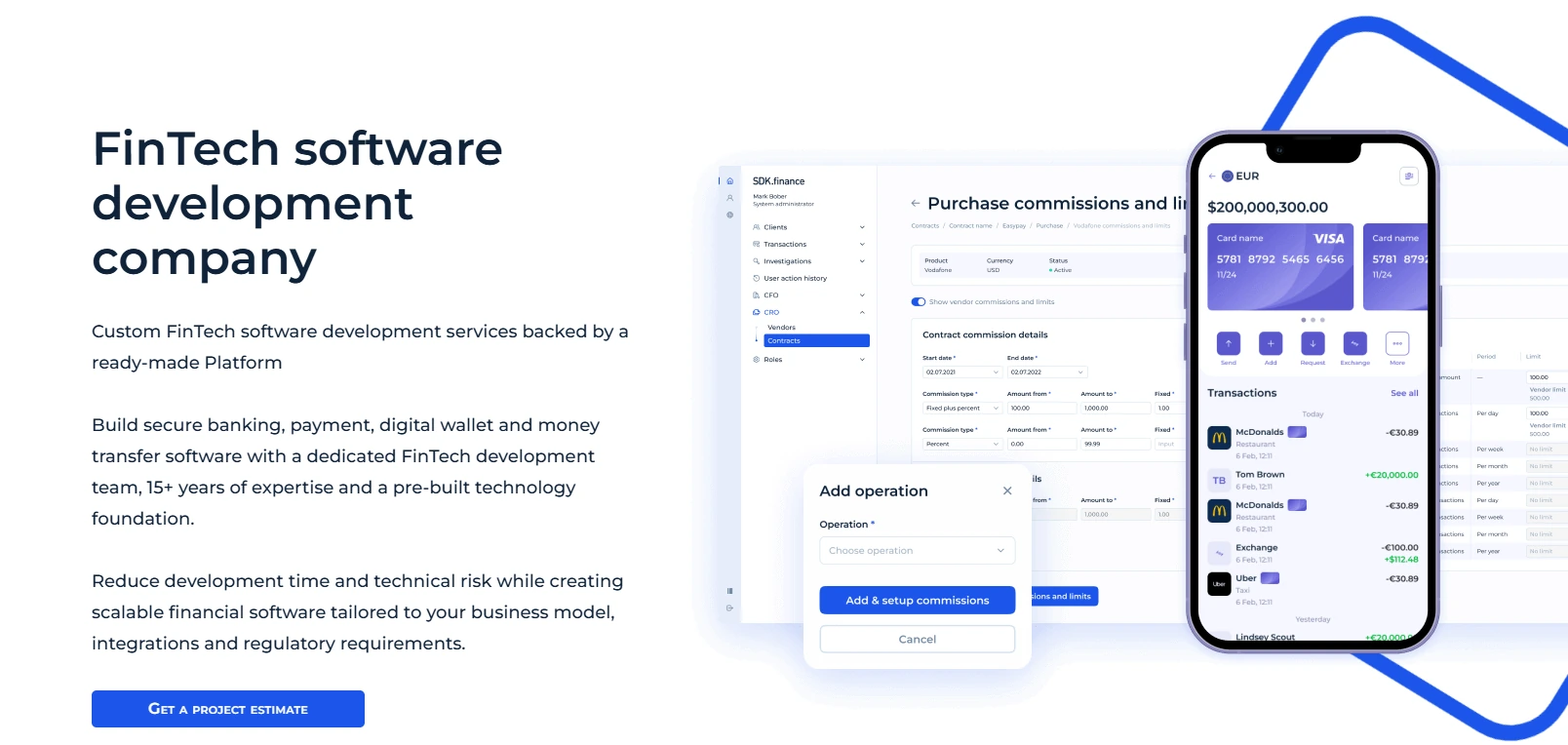
SDK.finance is a FinTech software development company with 15+ years of FinTech experience and a team of 40+ professionals, helping FinTech businesses, banks and payment providers build and evolve financial products. Its team supports the software development life cycle from discovery and architecture through development, testing, deployment and ongoing improvement.
Depending on your product stage, the development engagement can focus on validating an idea, launching an MVP or extending a live product.
- Discovery and proof of concept. Define MVP scope, explore user journeys and test critical technical assumptions.
- Custom FinTech and MVP development. Build payment software and mobile apps around your business logic and customer needs.
- Architecture and integrations. Design transaction flows, accounting and back-office workflows, and connect external providers through suitable integration options.
- Testing and launch. Verify the agreed functionality, prepare deployment and support operational handover.
- Ongoing development. Extend your engineering capacity with dedicated FinTech specialists to maintain and improve the product.
SDK.finance’s FinTech software development services are backed by the SDK.finance Transaction Platform – a modular foundation for accounts, balances, transactions, fees, limits and back-office operations. For platform-based projects, this foundation lets the team focus on business logic, customer experience and integrations instead of rebuilding core financial functionality. The platform is available through two delivery models, with different deployment and customisation responsibilities:
- SaaS (Software as a Service): a software delivery model in which you pay a subscription to use an application hosted and maintained by the provider. With SDK.finance, your team manages databases and integrations and adapts the platform through configuration and APIs, without backend code access. You can later move to a Source Code Licence for deeper customisation. Custom development is scoped separately.
- Source Code Licence: access to the platform’s code so your team can change core functionality and control deployment. Your business takes responsibility for hosting, maintenance and updates, with vendor support agreed separately.
The SDK.finance implementation guide explains the work involved in configuration, integrations, testing and launch preparation.
Turn your FinTech development plan into a launch-ready product
A launch-ready FinTech product needs clear financial rules, verified customer journeys and a team prepared to operate it. Use the lifecycle to connect these decisions from discovery through ongoing improvement. Apply the checklist to your next release: identify missing decisions, assign owners and resolve the dependencies that could prevent launch.
To plan delivery with SDK.finance, discuss your product stage, first-release scope and integration needs with its FinTech software development team. Use that conversation to define the work, responsibilities and dependencies behind a practical development plan.
Talk to our team and get a development approach tailored to your business model.
Get a FinTech development estimate