


Many products do not fail because the team cannot build them. They fail because the team builds the wrong thing, chooses an approach that does not scale, or discovers an expensive constraint too late.
That is the problem a proof of concept is designed to solve.
A proof of concept (PoC) is a focused experiment that tests the riskiest assumption behind a product. It helps the team collect evidence before committing to a minimum viable product (MVP) or a full launch.
For a banking product, the question might be:
- Can a payment provider support the transaction flow we designed?
- Will the ledger remain balanced after retries, fees and reversals?
- Can we connect to a legacy banking system without losing important data?
- Will the product work within the required performance and deployment conditions?
- Do transaction and provider costs fit the proposed business model?
A PoC will not prove that customers want the product. It will show whether a critical part of the product can work, where the risks are, and what the team should do next.
Why validate before you build?
- Atlassian’s 2026 survey of more than 1,000 product professionals found that 84% worried their current products would not succeed.
- A CB Insights analysis of 431 VC-backed companies that shut down since 2023 identified poor product-market fit in 43% of cases, bad timing in 29%, and unsustainable unit economics in 19%.
A PoC helps reduce this risk by testing critical technical, integration and cost assumptions before the team commits to an MVP or full product build.
What is a proof of concept in software development?

A proof of concept in software development is a time-limited experiment that answers a specific feasibility question. It uses a narrow slice of the proposed system and representative scenarios to produce evidence for a decision.
The key word is specific.
“Can we build a digital bank?” is too broad.
“Can our ledger model process a transfer, fee and reversal without creating an incorrect balance?” is a testable PoC question.
A useful PoC has five elements:
- One important assumption.
- A narrow scope.
- Representative data and scenarios.
- Clear success and stop criteria.
- A decision at the end: continue, revise or stop.
AWS describes a PoC as a process that uses representative data to test whether a technology or service meets technical and business requirements. Its methodology follows three broad phases: discovery, implementation and evaluation.
The output is not simply a demo. It is evidence that helps the team make the next decision.
What is PoC in banking?
A proof of concept (PoC) in banking is a small, controlled experiment used to determine whether a proposed technology, transaction flow or integration can work under defined financial, technical and operational conditions. It allows banks and FinTech companies to test critical assumptions such as ledger accuracy, payment processing, system integration, security controls and compliance workflows before investing in an MVP or full-scale implementation.
A banking PoC usually focuses on one high-risk question rather than delivering a complete customer-ready product. For example, it may test whether a payment flow remains accurate after retries and reversals, whether a new platform can exchange data with a legacy core banking system, or whether reconciliation can identify missing and duplicate transactions.
Which industries benefit most from a PoC?
A PoC is particularly useful when a wrong technical decision would be expensive, dangerous or difficult to reverse.
| Industry | What a PoC can test | Why early evidence matters |
|---|---|---|
| FinTech and banking | Ledger behavior, payment flows, identity checks, reconciliation, integrations and transaction costs | The product handles money, sensitive data and regulated processes. Small errors can create direct financial and operational losses. |
| Healthcare and medical technology | Data exchange, clinical workflows, device integration and model accuracy | Safety, privacy and interoperability requirements may invalidate an otherwise promising idea. |
| Artificial intelligence | Data quality, model accuracy, latency, operating cost and reliability | A model that works in a demo may fail on representative data or cost too much at scale. |
| Manufacturing and IoT | Hardware compatibility, connectivity, sensor accuracy and behavior in physical conditions | Problems may involve devices, networks and environments that are expensive to change later. |
| Enterprise software | Legacy integration, permissions, migration and performance | The new product must work with systems and processes that may have existed for decades. |
| Cybersecurity | Detection quality, false positives, response workflows and compatibility with existing controls | A tool must improve security without interrupting legitimate operations. |
Not every feature needs a PoC. If the team has implemented the same pattern successfully before and the technology is well understood, moving directly to a prototype or MVP may be more efficient.
Why proof of concept matters more in Banking & FinTech
FinTech products combine several difficult problems in one system:
- they move money;
- they store sensitive information;
- they depend on external providers;
- they must keep an accurate record of every transaction;
- they also need to behave correctly when a provider is slow, a webhook arrives twice, a payment is reversed or an operator makes a correction.
This creates a higher price for untested assumptions.
Imagine a wallet application with a clean interface and a successful customer demo. The transfer screen works. The user receives a confirmation. Everything looks ready.
But the team has not tested what happens when the payment provider times out after accepting the transaction. The application retries the request, and the customer is charged twice.
The interface was not the real risk. The transaction behavior was.
A strong FinTech PoC tests what happens outside the happy path. It asks not only whether a transaction can succeed, but also what happens when something is delayed, duplicated, rejected, reversed or only partly completed.
PoC vs prototype vs MVP vs pilot
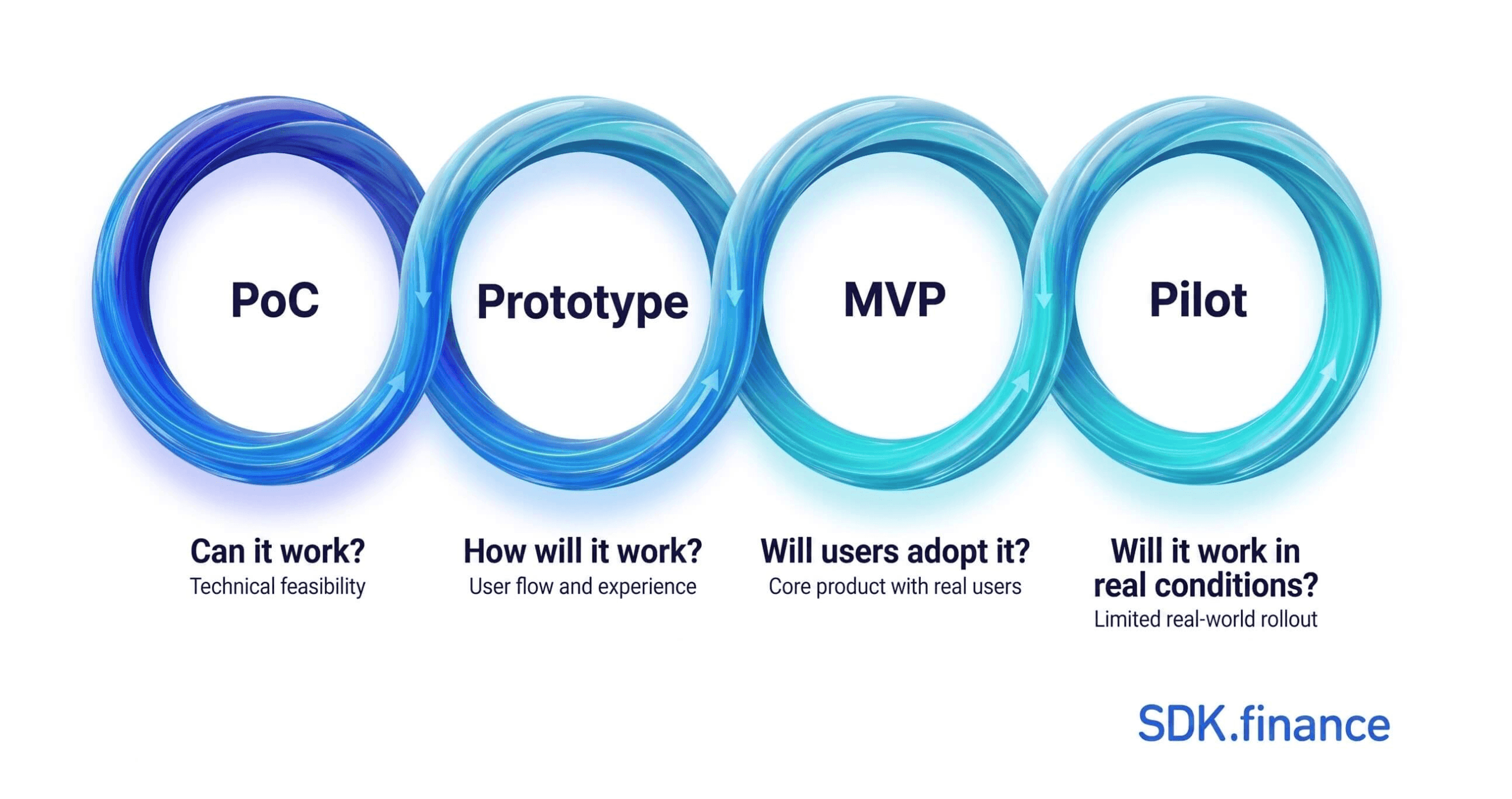
These stages answer different questions. Choosing the wrong one can lead to false confidence.
| Stage | Main question | What you create | Main outcome |
|---|---|---|---|
| PoC | Can the riskiest assumption work? | A narrow experiment and evidence | Continue, revise or stop |
| Prototype | How should the product look and behave? | A visual, clickable or partly functional model | Improve the experience and workflow |
| MVP | Does a usable version create value for users? | A limited but maintainable product | Learn, improve, pivot or scale |
| Pilot | Can the product operate in a controlled real environment? | A restricted live or production-like operation | Expand, contain or withdraw |
A company does not always need all four stages:
- if the biggest question is technical, start with a PoC;
- if the technology is understood but the customer journey is unclear, build a prototype. If the team needs evidence from users, move toward an MVP;
- if the remaining risk is operational, run a pilot.
When should you build a PoC?
Build a PoC when one untested assumption could invalidate the architecture, budget or launch plan.
Common signals include:
- a new or poorly documented provider integration;
- unusual ledger, settlement or fee logic;
- demanding performance or availability requirements;
- migration from a legacy banking or accounting system;
- uncertain source-data quality;
- an unfamiliar deployment or data-residency requirement;
- a fraud, risk or artificial intelligence model that must reach a minimum quality level;
- a vendor capability that needs evidence rather than a sales demonstration.
When can you skip or narrow the PoC?
A separate PoC may not be necessary when:
- the team has delivered the same pattern on comparable infrastructure;
- the uncertainty is about customer demand rather than feasibility;
- an existing platform already provides tested standard capabilities;
- a documented provider sandbox already answers the question;
- implementing the smallest MVP costs no more than running a separate experiment.
Narrowing is often better than skipping. A ready-made platform may remove the need to test basic account or ledger capabilities, but the team still needs to test its configuration, integrations and operating model.
What should a FinTech proof of concept test?
The strongest PoC focuses on behaviors that are expensive to fix later.
1. Ledger and balance integrity
Every transaction should create the correct debit and credit entries. Reversals, retries, corrections and concurrent requests should not create duplicate postings or incorrect balances.
Example test: Run transfers with fees, reversals and repeated requests.
Example success criteria:
- every transaction remains balanced;
- a repeated request does not create a second posting;
- balances return to the expected value after a reversal;
- temporary transit accounts return to zero after completed operations.
The thresholds should be defined as accounting invariants. A single unexplained imbalance is not a minor percentage error.
2. Payment states and failure handling
A payment is not simply successful or unsuccessful. It may be pending, declined, interrupted, reversed, refunded or waiting for confirmation.
Example test: Introduce a provider timeout, delayed callback, duplicate callback and refund after settlement.
Example success criteria:
- each event leads to a known transaction state;
- the balance and transaction record never disagree;
- a delayed or repeated message does not duplicate the operation;
- every unresolved state has a defined operational action.
3. Idempotency and retries
Retries are normal in distributed systems. They should not repeat the financial operation.
Stripe explains the basic principle in its idempotent request documentation: when a request is repeated with the same idempotency key, the server returns the result of the original request instead of performing it again.
The exact behavior differs between providers. Test key retention, conflicting payloads and retries after timeouts against the provider you plan to use.
4. Integrations and degraded operation
A sandbox may not reproduce production rate limits, settlement timing, real data quality or partial failures.
Test what happens when:
- the provider responds slowly;
- the service returns HTTP 429 Too Many Requests;
- the connection closes before a response arrives;
- a webhook arrives twice or out of order;
- a callback never arrives.
If the sandbox cannot reproduce a condition, record it as an open risk. Do not quietly treat it as a successful test.
5. Reconciliation
Internal records must match records received from banks and payment providers.
A practical PoC can introduce several deliberate breaks:
- a missing transaction;
- a duplicate line;
- an incorrect amount;
- a currency mismatch;
- a transaction that falls on a different side of the reporting cut-off.
The process should detect, classify and assign each break. It should also complete within the time available to the finance or operations team.
6. Identity and compliance workflows
A PoC can test Know Your Customer (KYC) and Know Your Business (KYB) integrations. Useful areas include document coverage, exception handling, decision records and manual-review routing.
It cannot validate an entire anti-money-laundering programme. Regulatory adequacy, transaction-monitoring rules and legal obligations require separate compliance and legal expertise.
7. Performance, deployment and data
The team may need to test peak transaction volume, response time, recovery after failure and behavior in the intended cloud or on-premise environment.
Use representative data, but avoid copying production data into a test environment by default. Synthetic or appropriately masked data can reduce privacy risk if it preserves the characteristics required for the test.
8. Business feasibility
A technically successful solution may still be a bad business.
Use the PoC measurements to estimate:
- provider cost per transaction;
- identity-verification costs;
- required infrastructure;
- manual-review and reconciliation effort;
- settlement or liquidity requirements.
If the cost does not fit the pricing model, the result should change the plan.
How to run a useful FinTech PoC in seven steps
The process does not need to be complicated. The main challenge is keeping it focused.
1. Name the risky assumption
Write one sentence:
We believe X will work under conditions Y, and we will measure it using Z.
If the sentence contains several unrelated assumptions, split them.
2. Define the decision
What will change if the result is positive or negative? Name the decision owner before the work starts.
3. Set the scope and exclusions
List what is included and what is not. One currency, one transaction type and one provider may be enough.
Do not add interface polish, extra integrations or production features unless they are necessary for the test.
4. Define success and stop criteria
Avoid statements such as “the integration works.” Use measurable conditions.
For example:
- no duplicate transaction after a retry;
- every transaction produces balanced entries;
- every introduced reconciliation mismatch is detected;
- 99% of requests complete within the agreed time under the test load.
These are examples, not universal benchmarks. Each team should set thresholds that match its product.
5. Use representative scenarios
Include the cases that make the team uncomfortable: duplicate requests, missing callbacks, invalid documents, rounding differences and provider timeouts.
6. Test the smallest complete path
For a payment product, the path might run from a payment request to a ledger entry and then to reconciliation. A thin end-to-end path usually reveals more than one large component tested in isolation.
7. Record the result honestly
Compare the measurements with the criteria. List what remains unknown. Decide whether to continue, change the approach or stop.
Stopping can be a successful PoC outcome. It means the team avoided a larger mistake.
Three FinTech proof-of-concept examples
Wallet transfer
Question: Can the system process a transfer, fee, retry and reversal without creating an incorrect balance?
Small scope: Two account types, one currency and one transfer flow.
Evidence: Balanced entries, no duplicate posting after a retry, and correct balances after reversal.
Payment-provider failover
Question: Can the system route a payment to a second provider without charging the customer twice?
Small scope: One payment type, two provider sandboxes and a deliberately interrupted request.
Evidence: No duplicate charge, every transaction reaches a final state, and the reason for each routing decision is recorded.
Legacy-ledger migration
Question: Can historical balances and transactions move to the new system without unexplained differences?
Small scope: One product line and one closed accounting period.
Evidence: Balances match to the smallest currency unit, or every difference is identified and explained.
How SDK.finance supports the journey from PoC to launch
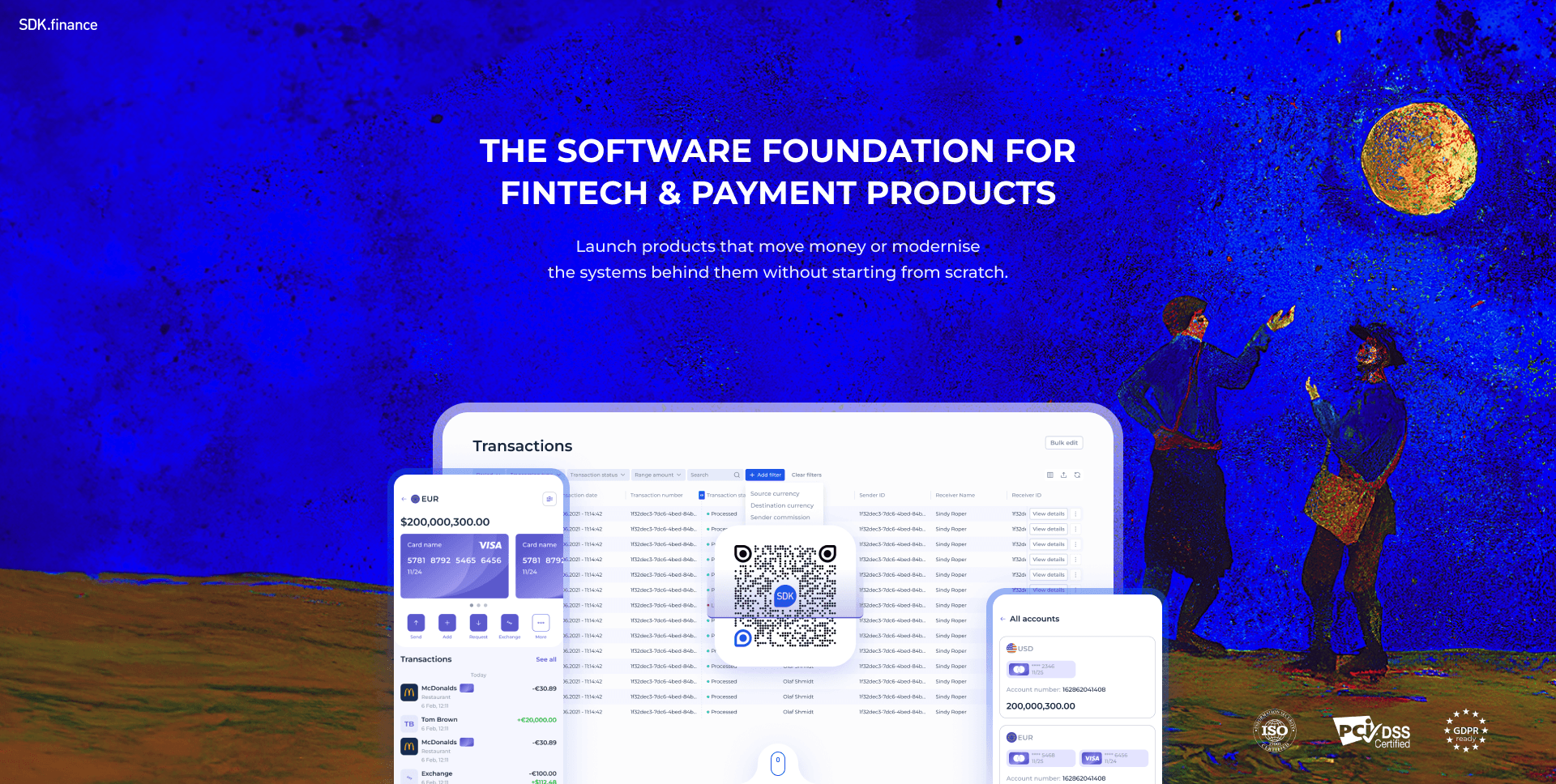
SDK.finance is a modular FinTech software platform for building payment products, digital wallets and digital banking services. It combines a Transaction Platform for accounts, payments, fees, limits and back-office operations with a General Ledger for real-time double-entry accounting.
This gives a product team a financial foundation before it starts building the differentiating layer.
Instead of spending the first stage creating accounts, balances, transaction states and back-office controls, the team can use SDK.finance to test the question that matters most to its product.
Stage 1: Build the PoC on SDK.finance
The first step can be deliberately small. The team configures one account structure, one transaction flow, one fee model and only the integrations needed for the experiment.
The PoC can test:
- whether the proposed ledger entries remain balanced;
- how fees and limits affect the transaction;
- how a provider integration behaves after a timeout;
- whether retries or callbacks create duplicate operations;
- whether reconciliation detects missing or mismatched records;
- whether the selected deployment model fits the infrastructure requirements.
SDK.finance supplies the transaction and ledger capabilities. The project team still defines the hypothesis, scenarios, thresholds and business requirements.
Stage 2: Expand the validated flow into an MVP
If the PoC succeeds, the team can extend the same platform foundation into an MVP.
That may involve adding:
- the main customer journey and user interface;
- more account and transaction types;
- identity verification;
- live provider integrations;
- operational roles and approval flows;
- reporting and customer-support processes;
- controls proportionate to the MVP’s real use.
The MVP remains focused. Its purpose is to learn whether the product creates value for users, not to implement the entire roadmap.
Stage 3: Prepare for a full launch
Once the MVP has produced useful market evidence, the team can prepare the product for wider operation.
This stage addresses the details a narrow PoC intentionally leaves out:
- production security and monitoring;
- complete error handling and recovery procedures;
- settlement, reconciliation and finance operations;
- roles, permissions and approvals;
- provider contracts and cut-off rules;
- regulatory and compliance work;
- capacity and performance testing;
- customer support and incident management;
- data residency and business continuity.
“Across almost two decades of FinTech development, we have seen the same pattern repeatedly: the decisions that determine a product’s future are often made before full-scale development begins. A well-designed PoC exposes weaknesses in the transaction logic, architecture, integrations and operating model while they are still inexpensive to address. This turns the move to an MVP from a costly leap of faith into an informed investment decision.”
Alex Malyshev, CEO, SDK.finance
SDK.finance is available through software as a service (SaaS) and source code delivery models. Teams can choose an approach based on their required speed, infrastructure model and level of control.
The value is continuity. A team can test a risky idea on a financial platform, expand the validated flow into an MVP, and then move toward a full launch while addressing the technical, operational and regulatory details discovered along the way.
SDK.finance does not replace licensing, legal advice, provider agreements or the operator’s responsibility for security and compliance. It provides the software foundation on which each product stage can be built.
If you are planning a FinTech product, start with the question you most need to answer. SDK.finance can help map that question to a focused PoC and identify the platform capabilities that can support the path from the first test to MVP and launch.
Ready to turn your FinTech idea into a validated product? Contact SDK.finance to identify the critical assumptions, test them with a PoC, and build a clear path from concept to launch.
Talk to our team and get a development approach tailored to your business model.
Get a FinTech development estimate
