Building a fintech MVP means deciding which customer problem is worth solving before committing to a full product. Start with one complete user journey, a defined audience and a clear way to measure demand. For a product that moves money, the budget must cover more than the interface: transaction processing, accurate financial records, provider connections and customer support all shape the first release. A focused scope helps you test whether customers return, whether they will pay and whether your team can operate the service reliably.
This article explains how to build a fintech MVP, from choosing essential features and an architecture to estimating development costs, planning a pilot and evaluating the results. It follows a hypothetical domestic-transfer wallet to make each decision concrete. You will also learn where SDK.finance, a financial software development company, can provide a ready-made software foundation and what your team still needs to design, integrate and validate.
Talk to our team and get a development approach tailored to your business model.
Get a FinTech development estimateWhat is a fintech MVP?
A fintech minimum viable product (MVP) is a first working version of a financial product with just enough features to solve a specific customer problem. It helps you test whether people find it useful, return to it and are willing to pay.
“Minimum” means a focused feature set. “Viable” means users can complete the main task and your team can support them. A product that moves money still needs secure access, accurate records, clear transaction statuses and a way to handle problems. For example, a wallet MVP might let users register, verify their identity, add funds, send money and see the result – all in one market and currency. Cards, currency exchange and loyalty features can come later.
A prototype tests the interface; a proof of concept tests whether the technology works. An MVP lets customers use the core service, often through a small pilot. Their behaviour and feedback help you decide what to improve, whether to expand or whether to rethink the idea.
How to build a fintech MVP: the six-step route
Define the hypothesis → Choose one user journey → Confirm the operating model → Design the solution → Estimate the budget → Build, test and run a limited pilot.
Choose the hypothesis and first user journey
Define the customer behaviour you need to validate
Start with a statement you can test. “People need a better wallet” leaves too much open. A more useful hypothesis is: “Members of this community will use a wallet to reimburse one another because the transfer process is easier to follow than their current method.”
Interview prospective users about their last reimbursement: what they used, where they struggled and why they would switch. Establish whether unclear status is actually a problem before designing around it.
This follows the Lean Startup approach to validated learning: build something that tests an assumption, observe behaviour and use the evidence to decide what comes next.
Map one complete wallet journey
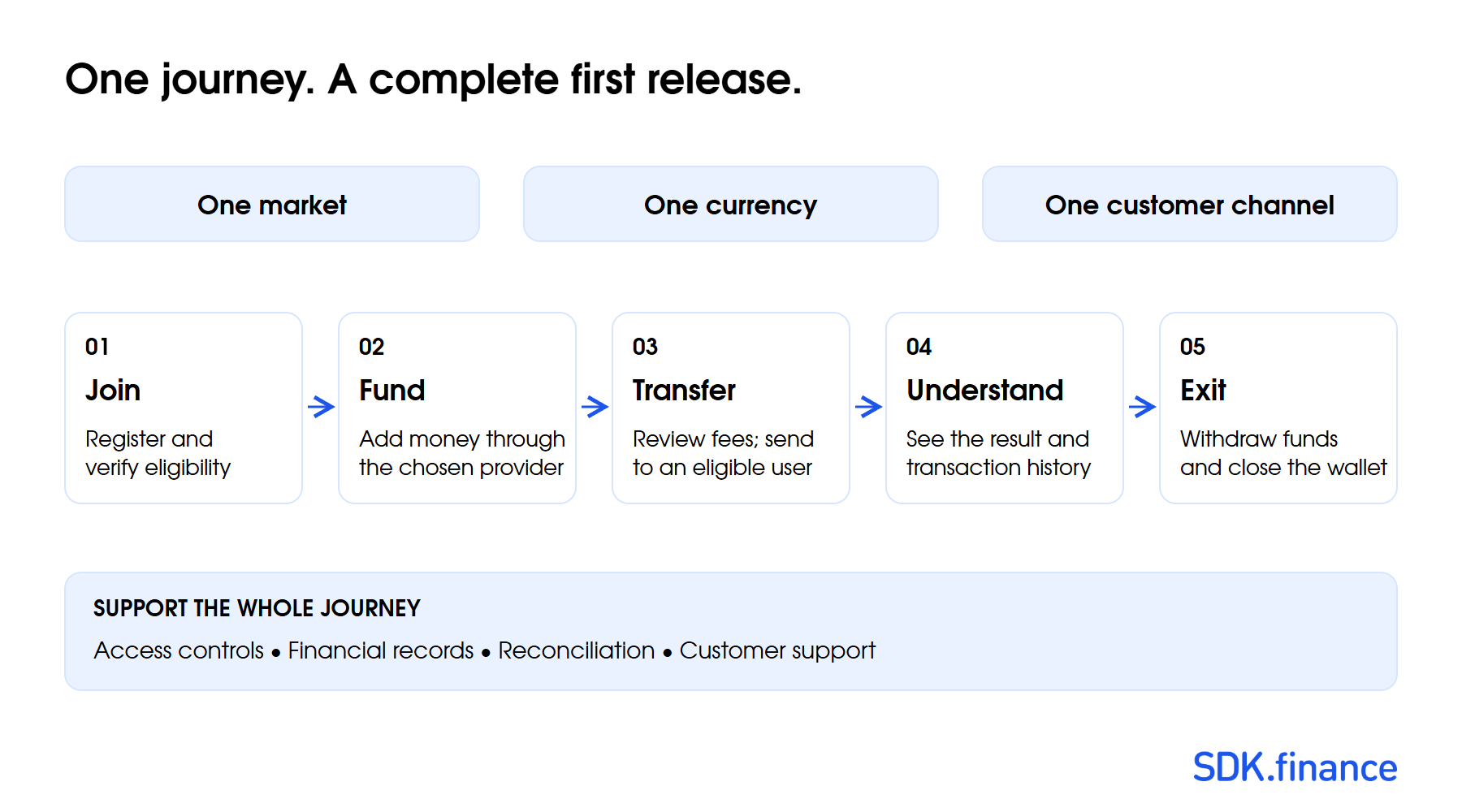
For our illustrative MVP, assume one country, its domestic currency, a mobile web interface and one funding and withdrawal provider. The journey is:
Register → complete the required verification → add funds → transfer to another eligible wallet user → see the result.
The hypothesis concerns transfers between users of the same service. Funding and withdrawal connect the wallet to external financial infrastructure.
For a deeper view of the customer-facing product, explore our guide to building a mobile wallet app.
Connect the MVP scope to the revenue model
Decide who pays, what they receive and which behaviour will show that the model can work. The same wallet idea can require different first-release features depending on its source of revenue:
-
Subscription-funded wallet. A community organisation pays for members to reimburse one another. Prioritise onboarding, transfers, member support and the reporting needed by the paying organisation. Defer cards and extra currencies. Test whether the organisation agrees to a paid continuation after members use the service.
-
Transfer-fee product. Users pay for each transfer. Include a fee preview, explicit confirmation, accurate fee records and rules for failed or reversed operations. Defer unrelated subscription features. Test whether users accept the fee and whether revenue covers the variable cost of processing and support.
-
Card-based product. Revenue depends on eligible card activity under the agreed partner terms. Card issuance, processing and card support become part of the core scope; a transfer-only wallet would not test this model. Confirm the commercial arrangement and measure revenue against programme and servicing costs before expanding.
Record the proposed price, expected usage and major supplier costs before development. Validate the payer’s commitment separately from user activity: frequent use does not by itself establish a viable business.
Set the fintech MVP scope
Separate essential capabilities from later features
Include a capability if the customer needs it to complete the journey, the business needs it to operate that journey, or the selected operating model requires it.
For this wallet, that includes funding, transfers and understandable statuses. It also includes handling rejected operations and preventing repeated requests from producing repeated financial effects.
Use the following MVP development checklist as the initial scope. The acceptance examples describe what the project must demonstrate, rather than promise specific vendor functionality.
| Capability | Reason for inclusion | Dependency | Acceptance evidence |
|---|---|---|---|
| Registration and secure access | Give eligible users controlled access | Identity and session design | Users access their own wallet; unauthorised access is blocked |
| Verification and eligibility | Apply the onboarding policy | Policy owner and verification process | Approved, pending and rejected users receive the correct permissions |
| Wallet and currency setup | Support the chosen domestic currency | Account model | Correct wallet and currency appear for each user |
| Funding | Make the first transfer possible | Provider connection and status rules | Successful, rejected and delayed funding produce the expected outcomes |
| Transfers, fees and limits | Deliver the core service | Balance and transaction rules | Amounts, fees and limits match approved examples |
| Duplicate-request handling | Avoid repeated financial effects | Request identification | Retrying the same instruction does not duplicate the transfer |
| Accounting records | Substantiate balances | Accounting policy | Transactions produce the expected records and balances |
| Status and history | Explain what happened | Transaction events | Customer and support views show consistent outcomes |
| Reconciliation | Detect differences in records | Provider reports | A deliberately introduced mismatch is identified and investigated |
| Support and monitoring | Operate the service | Staff permissions and response procedures | An authorised operator can investigate an incident |
| Withdrawal and closure | Let customers leave the service | Provider support and exit policy | Remaining funds and pending operations follow the agreed exit process |
Include the operations behind the customer journey
Keep additional currencies, international transfers, cards, loyalty programmes and advanced analytics outside this release. Record why they are deferred and what evidence would justify adding them.
Some early operations can be manual. For example, a trained operator may investigate reconciliation differences using controlled access and documented procedures. Assign an owner and preserve a record of the action.
Customer exit also needs attention. Even though repeat transfers are the behaviour you want to test, users still need a defined route to withdraw funds and close their wallet.
Define the operating model before development
An operating model explains who delivers the service and who is responsible when something goes wrong. Agree it alongside the feature scope, because these decisions affect the architecture, provider selection and launch plan.
-
Funds and money movement. Name the institution that will hold funds and the providers responsible for funding and withdrawal. Obtain confirmation that the proposed market, customer group and money flows are supported. A software balance is not evidence that these arrangements exist.
-
Customer eligibility. Assign an owner for onboarding rules and decisions about rejected or flagged users. The development team implements the agreed workflows; the responsible business and policy owners approve them. Record the rules and escalation route before testing.
-
Financial records and exceptions. Agree which records are compared, who investigates differences and who may authorise a correction. Assign responsibility for customer complaints and disputed operations, including the handoff to a financial provider. Rehearse one failed transaction from detection to resolution.
-
Live access and ongoing support. Identify who approves production access, monitors the service and handles incidents. Record the required agreements, access checks and support arrangements. Keep unresolved dependencies visible in the launch plan rather than treating completed software as permission to go live.
These are project decisions to confirm with the relevant financial partners and qualified advisers for the chosen market. Buying software does not transfer the operating responsibilities automatically.
Choose the architecture and implementation approach
The architecture should support the complete MVP journey, including what happens when a payment is delayed or fails. Start by deciding who holds customer funds, which system maintains wallet balances, and how your team will investigate problems.
As Alex Malyshev, CEO and co-founder of SDK.finance, writes in his Finextra article on launching payment products:
“The difference is usually not the technology stack, but the decisions made early on.”
For the wallet MVP, these decisions help define what you need to build, what an existing platform can provide, and which external services you need to connect.
Map the frontend, transaction core and financial providers
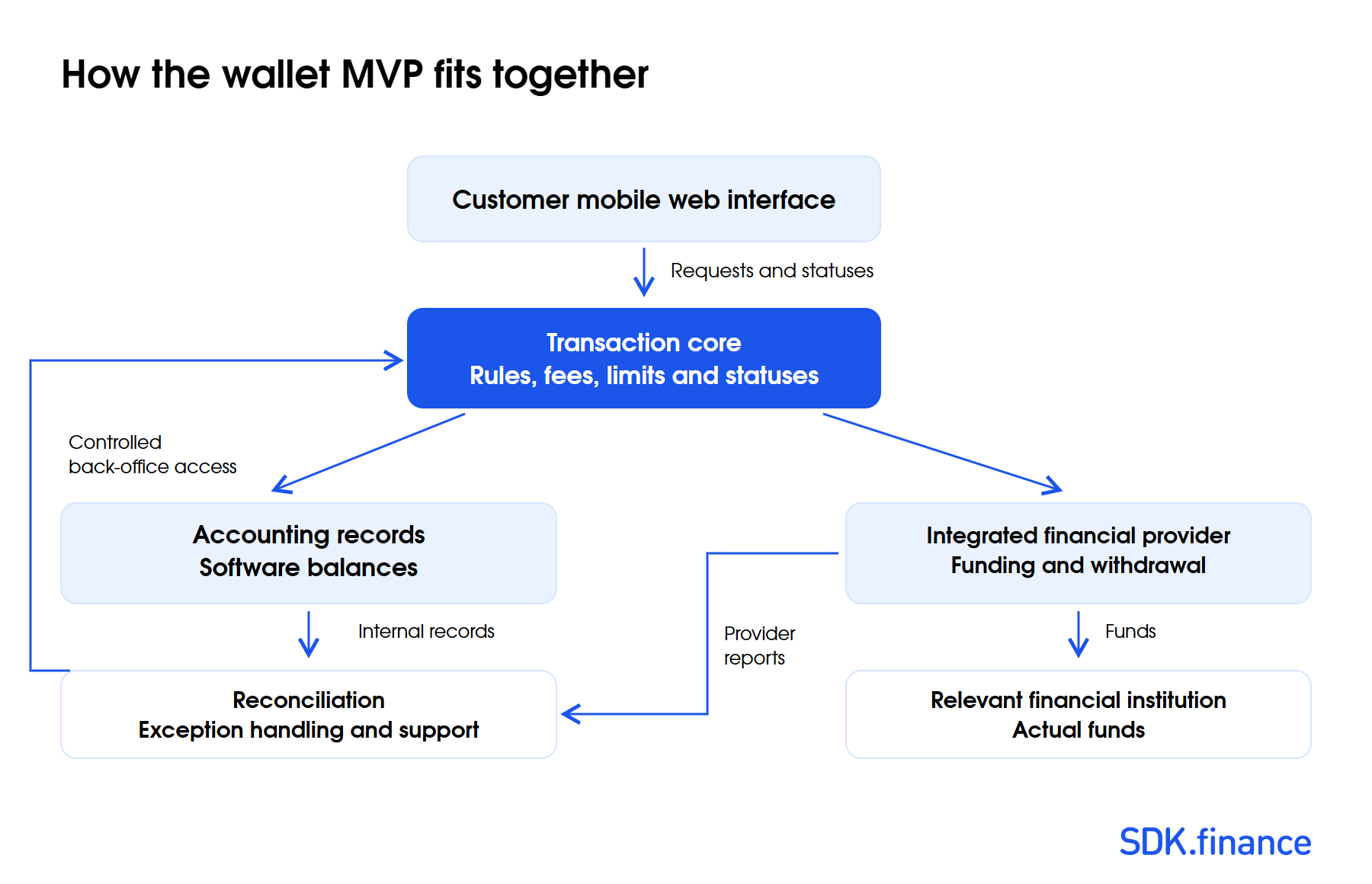
The frontend is the mobile or web interface customers use to register, add funds and make transfers. The transaction core checks whether an operation is allowed, applies fees and limits, and manages its progress. Accounting records explain how each financial event affects balances. The back office lets authorised staff review transactions, investigate exceptions and support customers.
Define which system maintains the authoritative wallet balance and how the frontend receives updates. A displayed balance is a software record; the actual funds are held by the relevant financial institution under the agreed operating model. Transfers between users of the same wallet service and external funding or withdrawal flows therefore need distinct accounting rules.
APIs connect these components. An API request lets one system ask another to perform an action, while a callback or webhook can notify it of a later status change. Submitting a request does not necessarily mean the payment has completed. If a funding provider has accepted a request but has not confirmed the outcome, the interface should show a pending status rather than a successful payment.
Agree how provider statuses map to the statuses shown to customers and support staff. Define how the system handles repeated requests, delayed responses and failed operations. Reconciliation then compares internal financial records with provider records so the team can identify and investigate differences.
For the wallet example, the main relationships look like this:
Compare a ready-made foundation with custom development
Fintech MVP development can combine existing infrastructure with custom features. Compare each approach against the same journey, the control you need and the work your team can maintain.
| Approach | Control and fit | Work your team retains | Best fit when… |
|---|---|---|---|
| Custom development | Design the core around specific requirements | Core engineering, integrations, testing, deployment and maintenance | Your core needs unusual logic and your team can build and maintain it |
| Configured SaaS | Use supported settings and extension options | Product design, configuration, integration work and operational acceptance; confirm the provider’s responsibilities | Supported configuration fits the journey and service boundaries are acceptable |
| Source Code Licence | Adapt an existing foundation and control deployment | Code changes, infrastructure, integrations, testing and ongoing maintenance | An existing core fits, but you need code changes or deployment control |
Evaluate each option against the same wallet scope. Ask what already works, what requires configuration and what must be developed. The broader build-versus-buy comparison can help structure that decision.
A no-code interface can support early journey testing. Moving real money introduces additional requirements for access, records and recovery. Assess the complete system before choosing tools solely for the speed of building screens.
Turn the scope into a delivery backlog
Identify dependencies before estimating dates
Turn each scope item into work with an owner, prerequisite and acceptance evidence. Start with provider feasibility and access to a test environment, or sandbox. Track production agreements and access separately: working test credentials do not mean live service is available.
If an untested provider connection or accounting rule could change the plan, use a focused fintech proof of concept to test that assumption before committing to the full MVP backlog.
For example:
| Task | Owner | Prerequisite | Completion evidence |
|---|---|---|---|
| Confirm funding and withdrawal support | Product and partnerships | Documented wallet journey | Provider confirms the proposed scope and onboarding requirements |
| Configure transfer fees and limits | Backend engineer | Approved commercial rules | Normal and boundary cases pass |
| Implement pending and failed statuses | Frontend and backend engineers | Agreed status mapping | Both interfaces show the expected outcome |
| Test financial records | QA and finance | Working transaction flow | Expected records match test results |
| Rehearse exception handling | Operations lead | Reports, permissions and procedures | Assigned staff investigate and resolve a test exception |
Use these fields for all items in the scope checklist. Build the schedule around the longest chain of prerequisites, including work outside the development team.
Plan the route from scope to live pilot
-
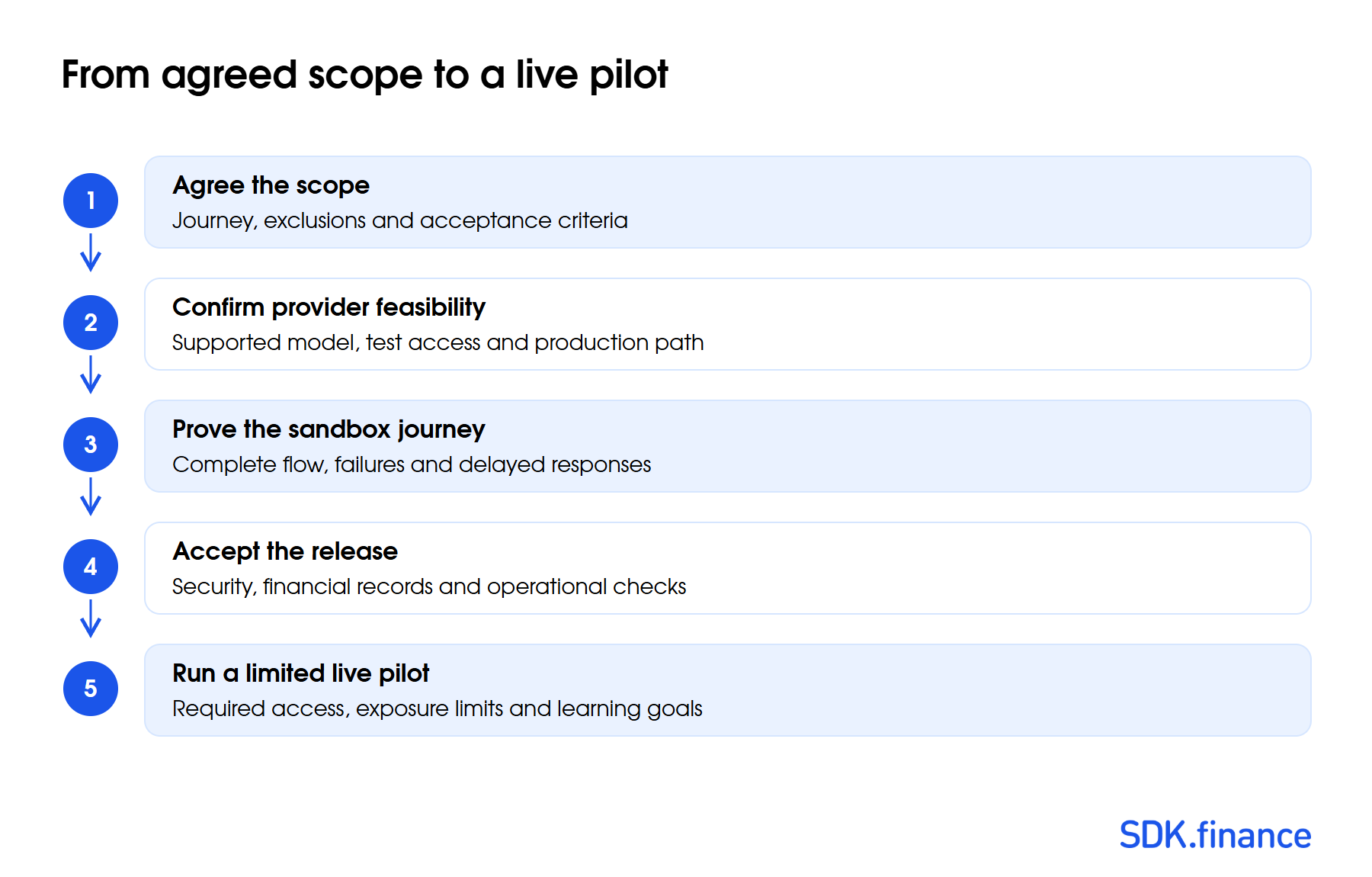
Scope agreed: product and engineering agree the journey, exclusions and acceptance criteria. Unresolved questions about who holds funds or supports withdrawal block a credible estimate.
-
Provider feasibility confirmed: partnerships verifies support for the proposed model, test access and the path to production. Commercial and onboarding requirements may change the scope.
-
Sandbox journey working: engineering demonstrates onboarding, funding, transfer and withdrawal, including delayed and failed responses. Missing provider events or reports require resolution.
-
Release accepted: QA, operations and policy owners review security tests, financial records, support procedures and outstanding issues. Material balance discrepancies block live release.
-
Limited live pilot: launch with an agreed audience and exposure limits only after the necessary arrangements and access are in place. Expand when customer behaviour, economics and operations support the decision.
Track software and provider readiness separately, even when work runs in parallel.
Test success and failure paths
Ask what happens if a user taps “Send” twice, the provider response arrives late, or funding is rejected. Idempotency means a repeated request does not create an additional financial effect. Define and test that behaviour across the relevant systems.
Test insufficient funds, interrupted sessions, reversals and discrepancies between internal records and provider reports. Include recovery: who receives an alert, how they investigate and what the customer sees while the issue is unresolved.
Talk to our team and get a development approach tailored to your business model.
Get a FinTech development estimateEstimate fintech MVP development and operating costs
Separate initial delivery from recurring operations
A useful fintech MVP cost estimate starts with the agreed journey and its dependencies. Two products with similar screens may require very different integration and operational work.
Use this worksheet for the wallet example. Fill it with team estimates and current supplier proposals, recording their dates and assumptions.
| Cost category | Calculation input | What to include |
|---|---|---|
| Discovery and design | Person-days × role rate | User research, journey, operating model and interface |
| Configuration and engineering | Person-days × role rate | Wallet rules, custom functions and back office |
| Integrations | Effort × rate, plus setup charges | Verification, funding, withdrawal and reporting |
| Testing and security | Effort × rate, plus specialist fees | Transaction scenarios, access tests and remediation |
| Launch preparation | Effort × rate, plus external fees | Environments, training, provider checks and handover |
| Contingency | Allowance for identified uncertainties | Integration changes and unresolved dependencies |
| Recurring operations | Monthly fixed fees + usage × unit rates | Software, hosting, verification, processing, monitoring, support and maintenance |
Calculate delivery cost and monthly operating cost separately. Include software licence or subscription charges and the legal and compliance work appropriate to the market. Model supplier minimums as well as usage fees.
A worked budget example
The following figures are invented to demonstrate the calculation. They are not a market benchmark, supplier quote or SDK.finance price.
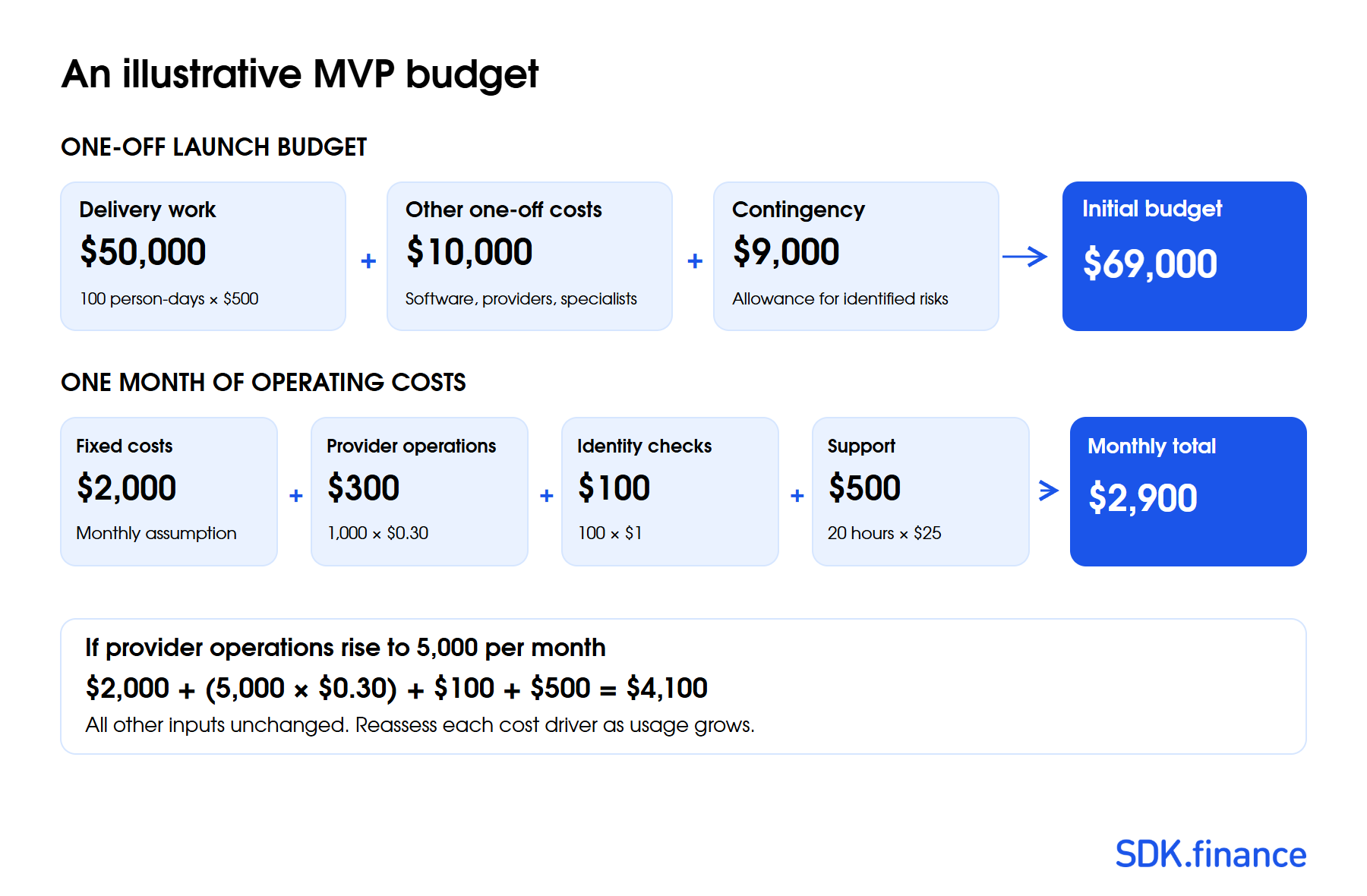
Suppose the agreed delivery backlog totals 100 person-days at a blended $500 per day: $50,000. Add an assumed $10,000 for one-off software, provider and specialist charges, plus a $9,000 contingency: the initial planning budget is $69,000. The real estimate must replace every assumption with role-level effort, current proposals and identified risks.
For one operating month, assume $2,000 in fixed costs, 1,000 chargeable provider operations at $0.30 each, 100 new identity checks at $1 each, and 20 support hours at $25 per hour. That gives $2,900. At 5,000 operations, with the other inputs unchanged, the total becomes $4,100.
In practice, support, hosting and staffing may also rise. Recalculate each driver separately; a customer transfer can trigger several chargeable provider operations. Keep customer funds and any required reserves separate from operating expenses, while accounting for their effect on cash requirements.
Compare the same scope across delivery models
With custom development, the estimate includes creating the transaction foundation. Configured SaaS can remove some of that engineering while adding subscription costs and contractual limits. A Source Code Licence can replace foundational development with adaptation, but leaves deployment and maintenance work with the implementation team.
Compare proposals using the same scope and acceptance tests so that a lower estimate does not conceal omitted work.
For broader budgeting considerations, see these fintech development cost drivers. Feature count alone cannot produce a credible estimate: provider behaviour, testing depth and ongoing responsibilities materially affect the total.
Validate product value and launch readiness
Recruit a focused pilot cohort
Start with the community named in the hypothesis. Ask its organiser to invite members who already reimburse one another, then use short screening conversations to confirm that need. A general waitlist can measure interest, but it does not guarantee relevant participants.
For a peer-to-peer wallet, recruit connected groups so participants have someone to pay. Choose a cohort small enough for the team to support closely and varied enough to expose different levels of digital confidence. Agree the pilot period, eligibility, transaction limits and support route before onboarding.
Observe the first journey, record where staff intervene and follow up with people who stop using the product. Separate assisted activity and incentive-driven transfers from unprompted repeat use. This makes it easier to distinguish demand from participation created by the pilot itself.
Measure adoption and repeat use
Agree the learning criteria before inviting users. For this wallet, activation could mean a first successful transfer within seven days of registration. Divide users completing that event by all registered invitees who met the pilot entry criteria and had seven days to act. Keep incomplete verification in the funnel so it does not disappear from the results.
Measure repeat use among users who completed a first transfer and have had the full observation period to return. For example, observe whether they make another transfer within 30 days. These windows are illustrative, not industry benchmarks; choose intervals that reflect how often the target community actually reimburses one another.
Pair the numbers with interviews and observed tasks. Ask users to explain the fee, identify whether a transfer is pending or complete, and find help after a failure. Record where they need assistance. A user may understand the product but have no reason to transfer again that month; another may abandon it because the status is confusing.
Check willingness to pay and unit economics
For the subscription hypothesis, test whether the community organisation will pay for the service after the pilot. A positive interview is weaker evidence than an agreed paid continuation. If pricing is still hypothetical, keep that uncertainty separate from evidence of member adoption.
Calculate contribution over a defined period: attributable revenue minus the variable costs of serving that cohort. Include relevant processing and verification charges, variable support effort, incentives and transaction losses. Report acquisition costs and fixed operating expenses separately; positive contribution is not the same as overall profitability.
If usage grows but servicing costs rise faster than revenue, investigate the cause before adding features. Test whether pricing, provider terms or a simpler support journey can improve the model.
Set technical and operational release gates
Product learning and release acceptance answer different questions. Use separate evidence for each:
| Signal | Evidence to collect | Decision |
|---|---|---|
| First transfer completed | Registration-to-transfer funnel for a defined cohort | Fix the step with meaningful drop-off |
| Repeat use | Return activity over a complete observation window, plus interviews | Expand if the behaviour supports the hypothesis |
| Fees and statuses understood | Observed tasks and support questions | Improve explanations before adding features |
| Financial records correct | Failure, duplicate and reversal tests; reconciled records | Block live release for unresolved material discrepancies |
| Exceptions manageable | Incident rehearsal, named owners and investigation records | Close operational gaps before increasing exposure |
| External dependencies ready | Required agreements, access and launch checks | Proceed, restrict scope or postpone affected capabilities |
| Willingness to pay and contribution | Paid continuation or actual revenue; cohort costs and incentives | Revisit pricing or cost drivers before expanding an unproven model |
Engineering can use the OWASP Application Security Verification Standard to select relevant application security requirements and attach test evidence to them. Use an identified stable version. The standard supports security verification; it does not establish financial regulatory compliance.
Agree acceptance thresholds with product, engineering, operations and policy owners. Strong activation cannot compensate for unexplained balance differences or unmet launch requirements.
Decide what to build after the MVP
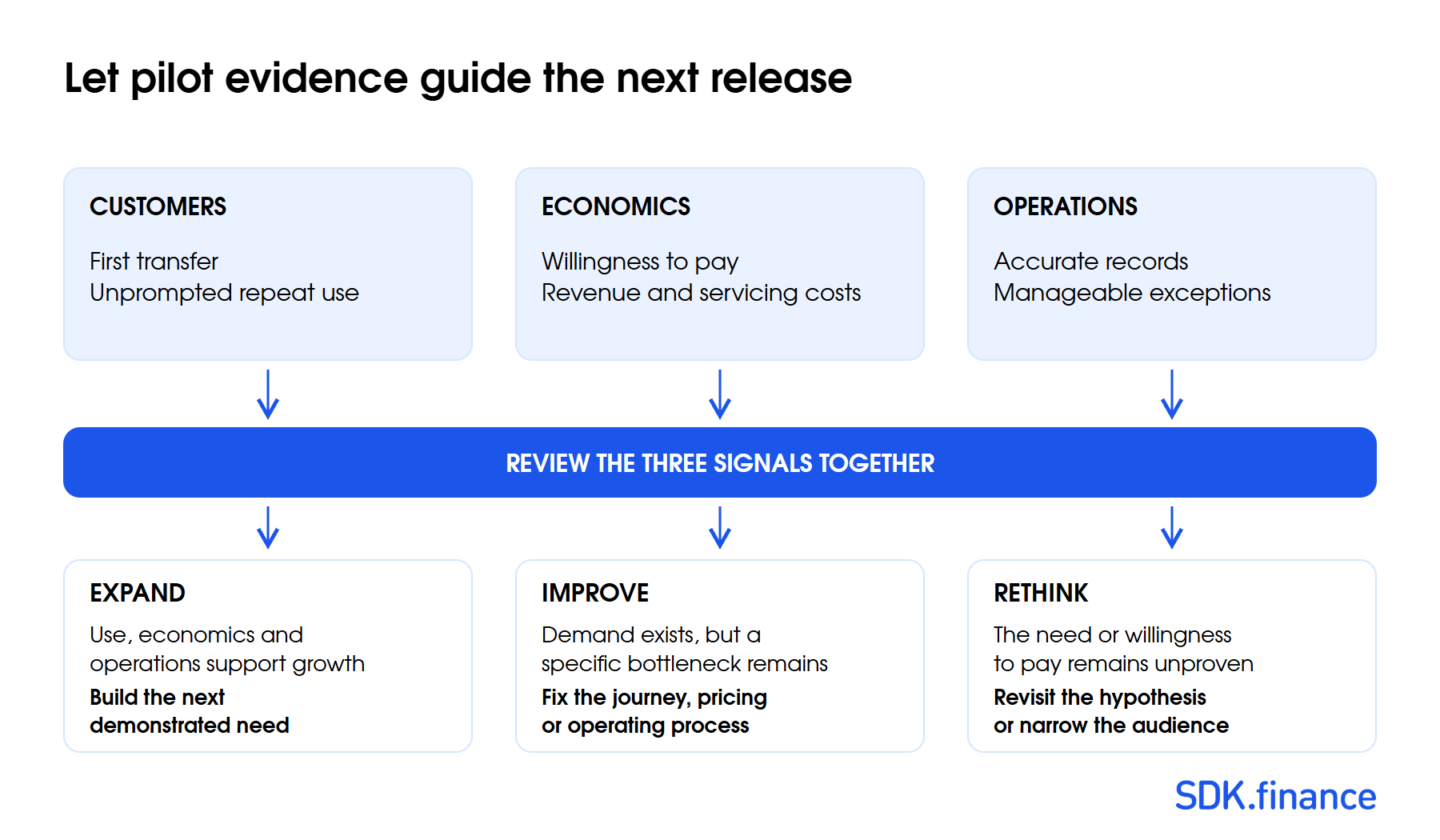
Use the evidence to change the backlog. Expand when users repeat the intended behaviour, the commercial hypothesis has support and operations remain manageable. Choose the next capability that addresses a demonstrated need.
If registration is strong but funding fails, investigate the funding experience and provider behaviour. Adding cards will not resolve that bottleneck. If one subgroup uses the wallet repeatedly while others do not, narrow the audience and test whether the pattern holds.
If users can transfer successfully but see little reason to return, revisit the hypothesis. Interviews may reveal that their existing method is sufficient or that the real problem lies elsewhere.
Keep a decision log linking each planned feature to the pilot evidence that justifies it.
How to choose a fintech MVP development partner
Ask each shortlisted team to respond to the same product brief. Compare the evidence behind its proposal, not just the total price or a list of technologies.
-
Relevant delivery experience. Request a comparable project and ask which money flows, integrations and operational problems the team actually handled. A polished interface alone does not demonstrate experience with financial records or reconciliation.
-
Failure handling. Ask how the team would test a repeated transfer request, a delayed provider response and a reversal. Look for test scenarios, expected financial outcomes and a clear investigation process.
-
Estimate and dependencies. Request a breakdown of configuration, custom development, integrations, testing and launch support. The proposal should name assumptions, exclusions, external prerequisites and how changes affect the estimate.
-
Ownership and handover. Confirm code and licence rights, repository access, deployment responsibilities and the documentation your team will receive. Check that the arrangement supports whoever will maintain the product after launch.
-
Pilot support. Agree who handles defects, incidents and provider coordination during the pilot, including support hours and escalation routes. Ask how user feedback becomes a prioritised backlog and how further work is approved.
How SDK.finance helps you build a fintech MVP
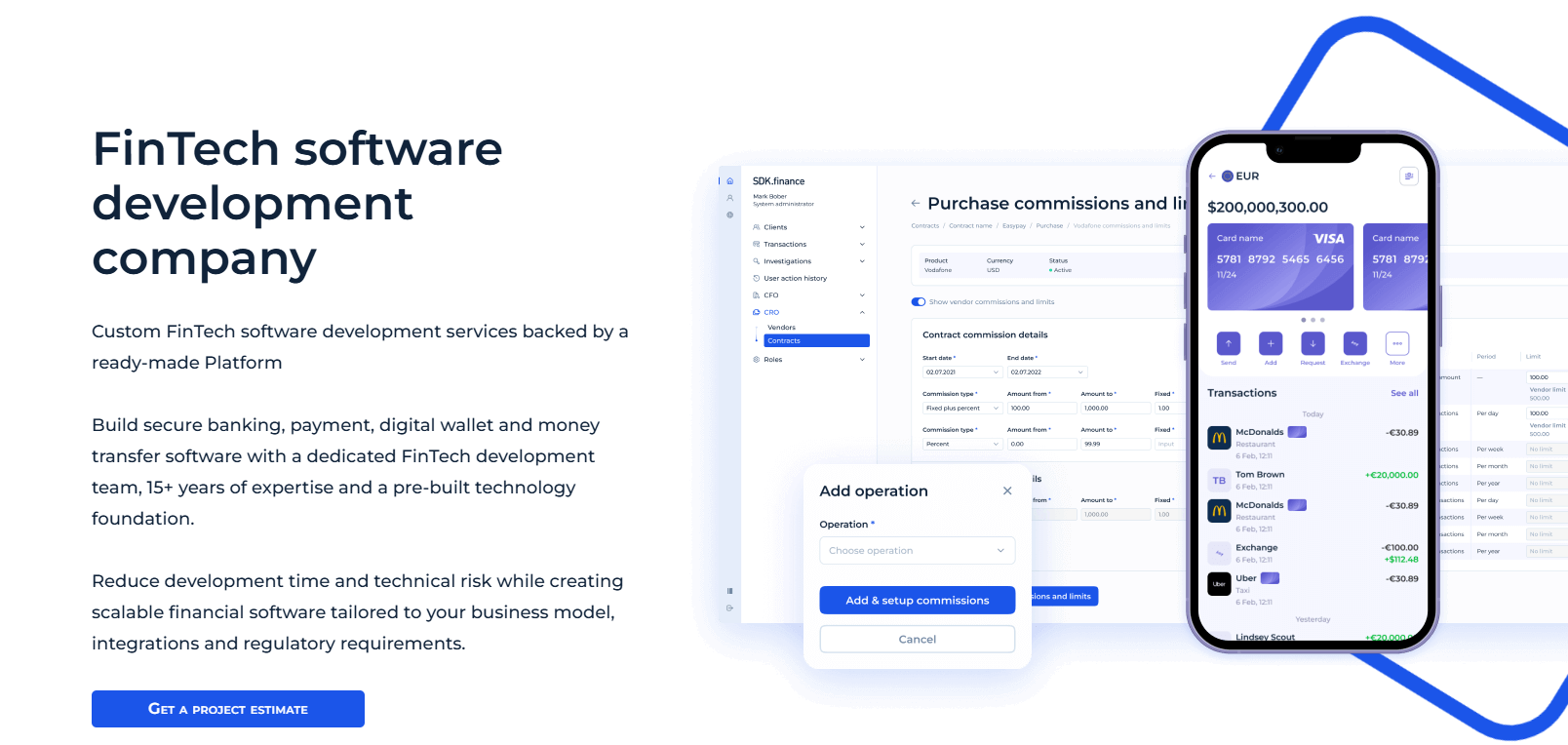
SDK.finance is a fintech software development company backed by 15+ years of industry experience and a team of 40+ professionals. It helps fintech businesses, banks and payment providers develop financial products, from the first MVP to further customisation and growth.
The company also develops the SDK.finance Transaction Platform: a ready-made software foundation for accounts, balances, transfers, fees, limits and back-office operations. Its transaction engine, customisable interfaces and pre-built mobile applications give an MVP team a starting point instead of building every component from scratch.
The platform is available through two delivery models, with different deployment and customisation responsibilities:
-
Start with SaaS for a focused MVP. Use the existing transaction engine and the interfaces and applications included in the agreed package. The team configures the core workflows, adapts branding and connects the required providers. For a narrowly scoped MVP based on available functionality, a 2-4-week software implementation target can be discussed and confirmed during scoping. Custom integrations, provider onboarding and app-store approval may extend the time needed for a live launch.
-
Move to a Source Code Licence for greater control. As the product develops, you can move from SaaS to the source code delivery model under an agreed licence and migration plan. Source-code access enables deeper changes to business logic, interfaces and integrations, with deployment on infrastructure you control. Your own team or a chosen development partner can maintain and extend the software, reducing dependence on SDK.finance’s hosted service and development roadmap.
This approach lets you test the first customer journey on SaaS, then take greater control when product requirements justify it. Plan the transition around data migration, existing integrations, infrastructure and maintenance responsibilities.
The SDK.finance implementation guide explains the work involved in configuration, integrations, testing and launch preparation.
Build a first release that informs your next investment
A fintech MVP should leave you with evidence and a clear next decision. Before development, agree the customer problem, first-release scope, operating responsibilities and acceptance criteria. Build the estimate around those decisions, with launch costs and recurring expenses shown separately.
During the pilot, review customer behaviour, willingness to pay and operational performance together. Record what you learned, which assumption changed and what that means for the next release. This turns the MVP into a basis for investment rather than a feature list that keeps growing.
To discuss your MVP with SDK.finance, prepare a short product brief with your target users, core money flow, intended market and pilot goals. This gives the team a practical starting point for assessing platform fit, development work and the path to a first release.
Talk to our team and get a development approach tailored to your business model.
Get a FinTech development estimate