


Technology
On this page
This page explains the technology behind SDK.finance: how Transaction Platform processes requests, stores data, and connects to other systems; what you can customise; and how deployment, security, and scaling are managed. General Ledger is covered separately as an accounting product that can connect to your existing core.
Transaction Platform architecture
Admin Panel, End-user Apps, and Merchant Portal connect to the same core through APIs. The core manages accounts, balances, transactions, fees, and limits. It is a modular monolith: one Spring Boot application containing distinct functional modules, deployed together as a single unit.
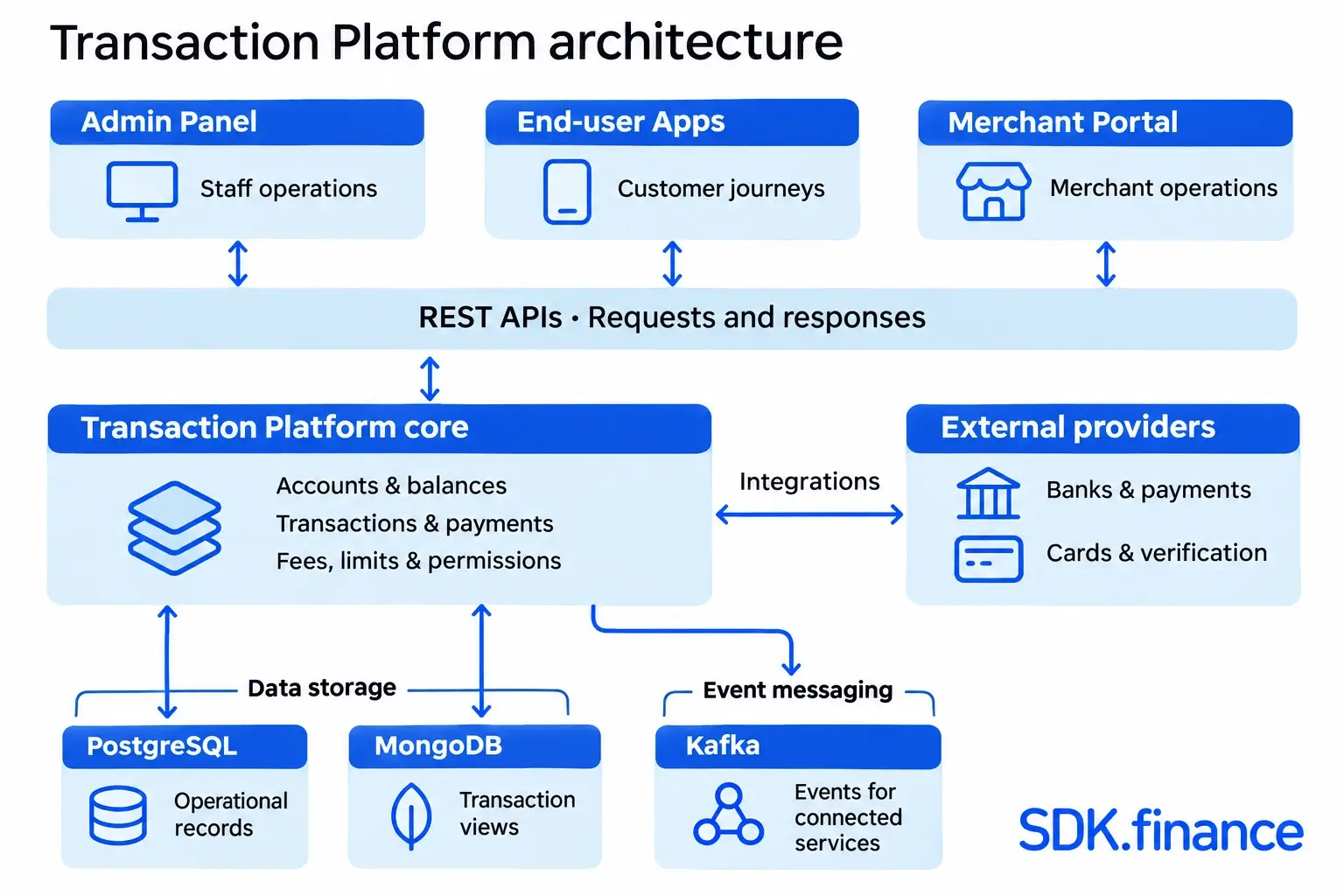
For example, an app sends a payment request to the core, which checks the applicable rules and processes the operation. When an external payment service is needed, a configured integration exchanges requests and status updates with that provider. The interface displays the result. Database storage and event messaging support this processing, as shown in the diagram.
APIs and system connections
Transaction Platform provides 650+ APIs for building customer journeys, managing operations, and connecting external systems. The main functional areas include:
- Customers and access: profiles, verification workflows, authentication, roles, and permissions.
- Accounts and transactions: wallets, balances, transfers, payments, and transaction history.
- Product configuration: currencies, exchange rates, contracts, fees, and limits.
- Operations and integrations: providers, notifications, reporting, and reconciliation.
REST APIs let an application request an action or retrieve data. Webhooks send notifications for supported events. Kafka carries event messages between the core and connected services, allowing them to react to changes without repeatedly checking for updates.
Technology stack
| Component | Technology | Purpose |
|---|---|---|
| Core application | Java, Spring Boot, Hibernate | Runs business logic and manages operational data. |
| Operational database | PostgreSQL | Stores the operational records used by the core. |
| Transaction view database | MongoDB | Stores transaction data for history views. |
| Event messaging | Apache Kafka | Carries events between the core and connected services. |
| Admin Panel | Vue.js, TypeScript | Provides the staff interface for daily operations and configuration. |
| Mobile application | React Native (Expo), TypeScript | Provides the customer-facing mobile experience. |
What you can configure and customise
- Configure existing capabilities: set currencies, contracts, fees, limits, and user permissions.
- Extend through APIs: connect services and build custom integrations without changing the core source code.
- Modify the core: a Source Code Licence allows your development team to change business logic, APIs, and workflows within the licence scope.
SaaS supports configuration and API-based extensions without direct backend source-code access. Changes to core business logic require the Source Code Licence and development work.
Deployment and environments
| Delivery model | Hosting and maintenance |
|---|---|
| SaaS | SDK.finance manages application hosting and platform updates. Your team manages the databases. |
| Source Code Licence | Your team manages infrastructure, deployment, maintenance, and updates. The platform can run in a cloud environment or a private data centre, including containerised deployment with Kubernetes. |
Plan separate environments for development, pre-production testing, and live operations. Pre-production lets you validate configuration, integrations, and releases before they reach customers. Keep it isolated from production; the environment setup and operating responsibilities depend on your delivery model.
Security and access control
- Role-based permissions: control which screens and actions staff can access.
- Authentication: supported options include token-based access, single sign-on, and two-factor authentication, depending on configuration.
- Encrypted connections: TLS protects data transmitted over configured secure connections.
- Operational visibility: user action history helps teams review activity and investigate issues.
Configure access policies, authentication, and infrastructure protection for your deployment.
Scaling and resilience
Multiple application instances can run behind a load balancer, which distributes requests between them. Adding instances increases application capacity. Database replication and failover provide recovery options; backups protect stored data. These measures need to be configured and maintained as part of the deployment.
Monitor application health, database performance, and connected services. Throughput and response times depend on the workload and infrastructure, so validate production targets with representative load tests.
How General Ledger connects
General Ledger is a separate accounting product that can connect to Transaction Platform or another banking or payment system. It receives business events through Kafka or REST APIs. Configured rules select the accounts and generate balanced debit and credit entries; automatic posting depends on configuration. This lets you add an accounting layer while keeping your existing transaction core.