An electric vehicle pays for charging; a software agent buys an API response to finish a task. Both need the same safeguards: the right account pays the right supplier, within budget, with a record that finance can reconcile.
Machine-to-machine payments connect these service events to authorised payment workflows. They can reduce manual purchasing steps and support usage-based services, but only when pricing, permissions and payment operations work together. In this guide, SDK.finance helps founders, product owners and CTOs understand the process, assess practical use cases and identify what their infrastructure must handle.
Discover how the SDK.finance TPS can power high-speed, secure operations across banking, fintech, and retail
Talk to Our TeamWhat are machine-to-machine payments?
Machine-to-machine payments, or M2M payments, let devices and software pay for goods or services on behalf of a person or business. The owner sets the rules and spending limits in advance, so purchases within those rules do not need separate manual approval.
“Machine” can mean a vehicle, industrial controller, server or software agent.
These terms overlap: one describes the transaction, another the device, and another the purchasing logic.
| Term | What it describes | Approval for each purchase? |
|---|---|---|
| M2M payments | A machine initiates payment under agreed rules | Usually delegated in advance |
| IoT payments | Payment involving connected physical devices | May involve a person |
| Agentic payments | An AI agent acts within delegated purchasing authority | Depends on spending controls |
These flows can form part of embedded finance, where financial functions sit inside another product or service. The distinction is useful: embedding a checkout describes where payment happens; M2M describes how a machine initiates it.
Exchanging data, detecting low stock or creating an invoice is not itself a payment. The system must connect that event to an authorised movement of value.
How machine-to-machine payments work
Start by mapping the payment workflow, from the service request to financial records that can be checked:
- Identify the need. A device event or software request specifies the resource and quantity required.
- Establish the terms. The supplier exposes the price, currency and delivery conditions in a form the system can interpret.
- Check authority. Authenticate the device or agent and verify its owner, permitted suppliers and remaining budget.
- Execute the payment. Submit an authorised instruction through the selected provider or account system, preserving a unique transaction reference.
- Confirm delivery. Connect the payment outcome to evidence that the requested service or resource was supplied.
- Record and reconcile. Record each payment status change, then match usage and charges against provider confirmations and settlement reports.
The order varies: a service may require prepayment, reserve funds before usage or collect an aggregated amount afterwards. Payment confirmation and delivery confirmation remain separate.
An EV charging example
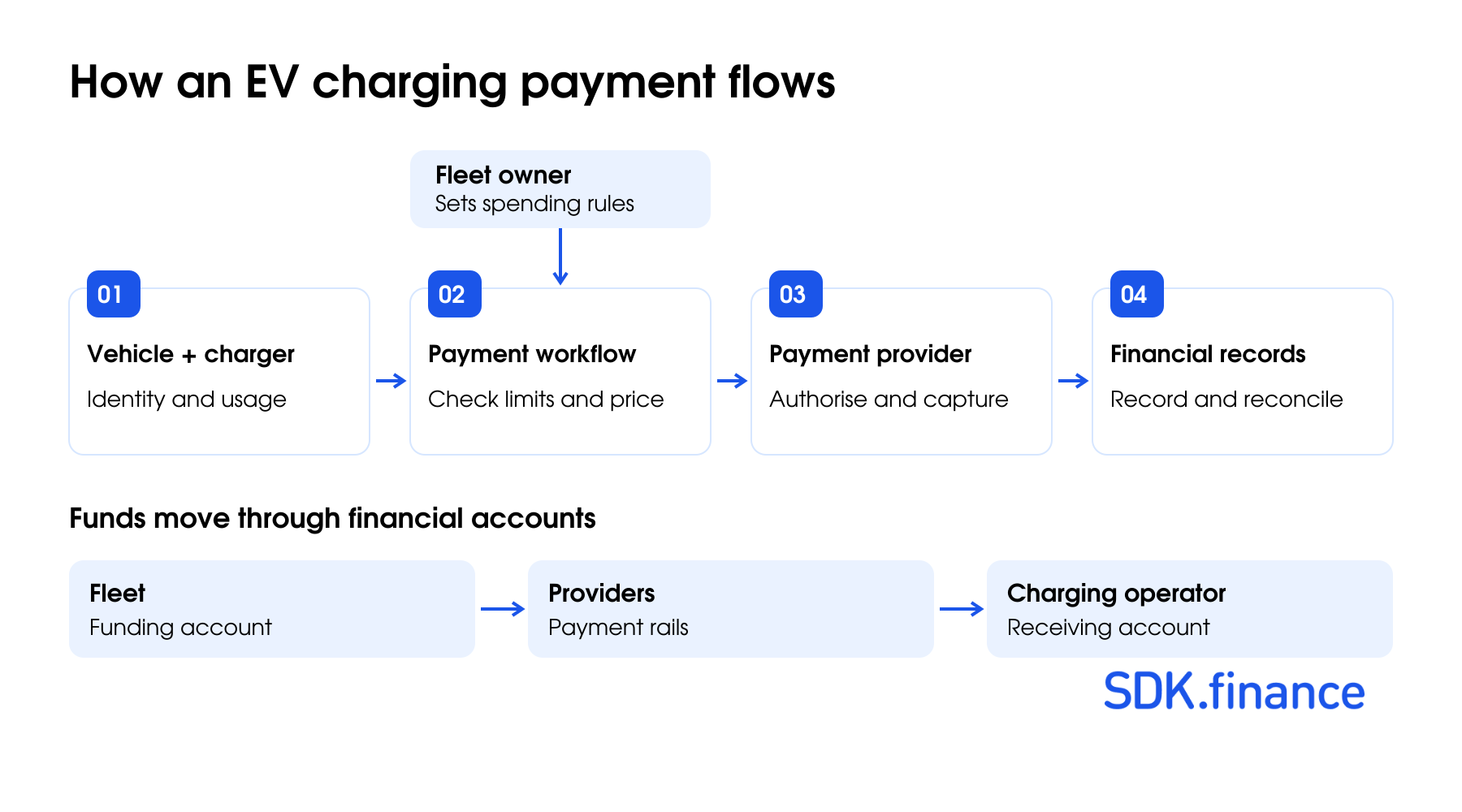
A fleet company authorises an eligible vehicle to charge with an approved operator. CharIN’s Plug & Charge guidance describes communication and billing between compatible vehicles and charging stations using ISO 15118 interfaces. The payment provider determines how funds are reserved, collected and settled.
Suppose the fleet permits EUR 50 per session. After checking the vehicle’s credential, tariff and budget, a compatible provider reserves funds. The vehicle consumes 20 kWh at EUR 0.40 per kWh, producing an EUR 8 bill with no additional fees. These are illustrative figures, not a market tariff.
The system captures EUR 8 and releases the unused reservation under the provider’s rules. A session reference links the usage record, charge and eventual settlement, allowing finance to investigate discrepancies.
Authorisation approves the payment and may reserve funds. Capture submits the final charge against that authorisation; it may be less than the reserved amount. Settlement transfers the funds between the financial parties under the provider’s rules.
Key use cases for M2M payments
The following scenarios cover physical and digital services. The industrial and replenishment examples are illustrative product designs.
AI agent payments for APIs and digital services
An API lets software request data or services from another system. A logistics agent might use one to buy traffic data within an approved supplier list and task budget.
The API returns machine-readable payment terms. The application checks them against the agent’s remaining allowance, submits a permitted payment credential and receives access once the supplier verifies the payment. It records the request, price, payment reference and delivery result together.
If payment succeeds but the response never arrives, the system must check the original purchase and recover access or request a refund under the supplier’s terms. Starting another paid request immediately could buy the same resource twice.
Where the purchasing agent also needs account information or transaction status, agentic banking infrastructure connects these tasks with the underlying financial workflows.
EV charging and connected mobility
Linking a charging session to the fleet account removes a separate driver checkout and gives finance a reference for allocating costs. The same principle can apply to parking and tolls where operators support compatible identification and payment integrations.
Operators also need a process for disputing incorrect charges.
Usage-based industrial equipment
An equipment supplier could charge a manufacturer for verified machine hours or production cycles. A signed usage record triggers the calculation, and the manufacturer’s account pays under the contract.
This enables pay-per-use pricing, provided both parties agree on billable usage and can challenge incorrect readings. Measurement and collection need not share a frequency: minute-by-minute usage can feed a daily aggregated payment.
Automated replenishment
A connected dispenser could detect low stock and request replacement supplies. The operating company pays, while purchasing rules constrain the item, supplier, quantity and total spend.
Validate the final price and delivery terms before committing funds. Recognise existing orders so repeated low-stock alerts do not create duplicate purchases.
Business benefits and the economics of micropayments
The benefits of M2M payments depend on accurate usage records, enforceable budgets and reliable service data. Automation alone does not guarantee lower costs: the collection model must fit the value of each purchase.
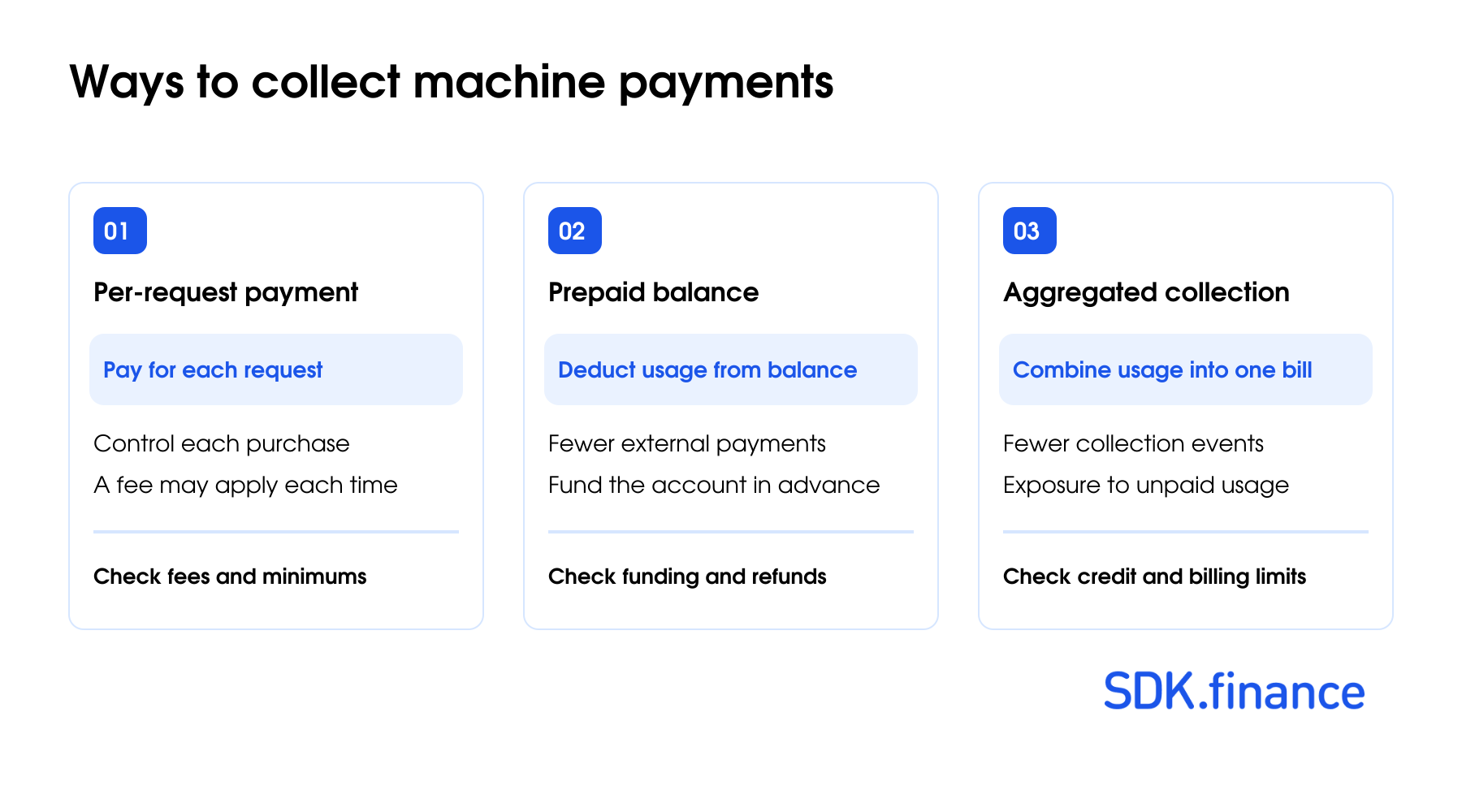
For small transactions, SDK.finance suggests comparing three collection models:
- Per-request payment: each request is paid separately, making individual charges easier to track but potentially incurring a fee each time.
- Prepaid balance: the business funds an account, and usage reduces the available balance. This requires balance controls and clear arrangements for holding and returning funds.
- Aggregated collection: usage accumulates into a larger charge. This reduces the number of external payments but creates a risk that usage will go unpaid.
Consider a hypothetical API charging $0.01 per call and a hypothetical fixed processing fee of $0.10 per payment. One thousand separately paid calls generate $10 in sales but $100 in fixed fees. Collecting those calls as one $10 charge incurs the fixed fee once. This simplified comparison excludes percentage fees, funding costs and other charges; it is not a provider quotation.
Choose the model using transaction value, provider minimums, service margins and the risk of unpaid usage. A micropayment only makes business sense when the amount earned covers collection costs and the work needed to manage it.
What infrastructure do M2M payments need?
Four participants need clearly assigned responsibilities. The funds owner sets budgets and permissions. The device or agent operator manages credentials and purchasing logic. The service supplier publishes prices, delivers the resource and handles service disputes. The payment provider processes supported instructions and supplies payment records under its agreement.
When planning integrations, SDK.finance recommends separating existing provider connections from custom work through APIs, webhooks or middleware. For M2M payments, confirm what the provider supports and what your application must enforce. A provider should not be assumed to validate every service event or business rule.
Service discovery and machine-readable terms
Before purchasing, an agent needs to find an approved service and interpret its current price, currency, usage unit and access conditions. Sellers can expose machine-readable catalogues or interfaces that software can call. They must also verify payment credentials and connect access to the agreed purchase. Making a service easy to find does not give an agent permission to buy it.
These hypothetical terms show what to record for the traffic-data purchase. The technical format depends on the payment protocol.
| Purchase term | Illustrative value |
|---|---|
| Resource | One traffic-data response |
| Price and currency | USD 0.01 |
| Usage unit | One successful request |
| Spending authority | Approved supplier and remaining task budget |
| Delivery evidence | Request ID linked to the returned result |
| Failure handling | Recover access or investigate the original payment |
Payment protocols and rails
HTTP 402 Payment Required can signal that an API request needs payment. The x402 protocol defines a way to communicate payment requirements and retry with payment evidence. Machine Payments Protocol (MPP) is another approach to programmatic payment interactions.
Stripe supports MPP payments using cards and stablecoins, and x402 using stablecoins. Availability depends on the provider and business location.
A protocol communicates instructions and evidence; payment infrastructure moves value. Neither alone guarantees delivery or resolves disputes.
Payment models and financial records
The payment method should fit the parties, transaction size and operating model. Different payment rails have different access requirements and settlement behaviour.
| Model | Where it can fit | Dependency to resolve |
|---|---|---|
| Internal account transfer | Participants transact within one platform | Underlying funds, funding and withdrawal arrangements |
| Cards | Approved credentials fund purchases | Provider support, payment authority and processing rules |
| Bank payments | Account-based collection or payout | Rail access, initiation permissions and status handling |
| Digital assets | Compatible programmable transfers | Key management, network costs and settlement arrangements |
An internal balance movement is not automatically a bank transfer.
A financial record layer, such as a general ledger, tracks the accounting effect. It needs identifiers that connect each entry to the service and provider transaction. Reconciliation compares those records with external evidence.
How to control security, spending and payment failures
Identity and permissions
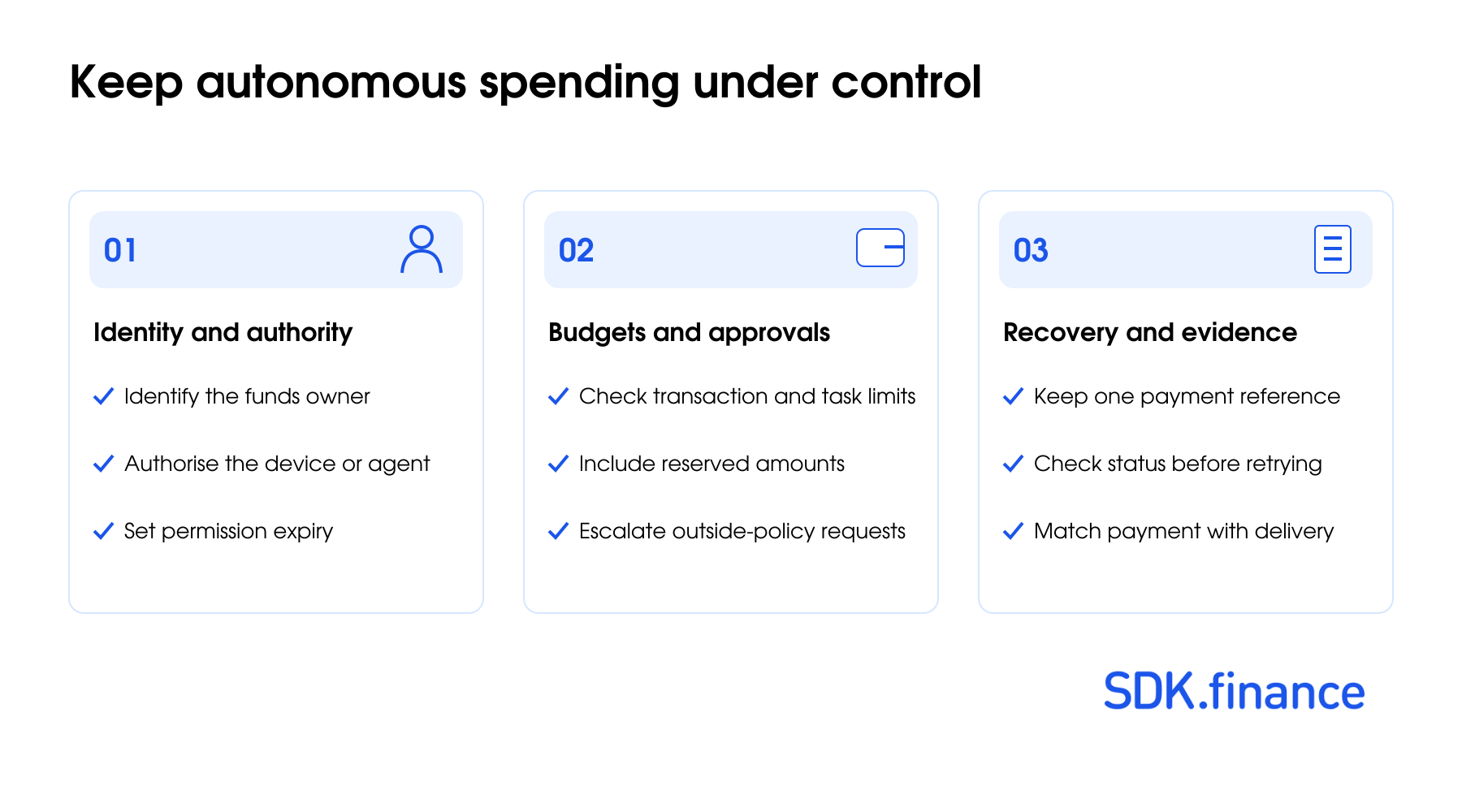
Associate each credential with a responsible person or organisation. Define permitted suppliers and purchases, expiry conditions and a way to revoke access when equipment is sold or credentials are compromised.
Authenticate incoming events and validate their price and usage data. Webhooks in banking and FinTech can carry notifications, but receiving a message does not itself authorise another charge. Consent and regulatory obligations depend on the jurisdiction and payment model; confirm them with the responsible provider and compliance team.
Spending limits
Check transaction, task and shared account budgets. If two agents see the same remaining allowance, separate checks must not let both spend it. Account for committed and reserved amounts when approving new requests.
Define when to stop and when to ask a person: an unfamiliar supplier, a price above the approved ceiling or insufficient funds should trigger a predetermined response.
Failures, refunds and reconciliation
Use idempotency: processing the same logical payment request again should not create a second payment. Reuse the provider’s idempotency key for retries of the same request, keeping its parameters unchanged and respecting the key’s validity period.
A timeout can leave the outcome unknown. Preserve the pending state, check the original transaction and retry only under a defined recovery policy. A fresh payment could duplicate a charge already accepted by the provider.
Incorrect usage records and undelivered services need investigation and, where appropriate, refunds. Retain the payment authority, agreed terms and delivery evidence. Assign an owner for resolving each exception and preserve the original financial history when recording corrections.
Is your use case ready for M2M payments?
Before building, confirm that the team can answer six questions:
- Who owns the funds, who receives them, and who is responsible for each device?
- What event creates the payment obligation, and how is its accuracy verified?
- Which rules limit spending, and how can the owner revoke permission?
- Does the provider support the intended authorisation, collection and recovery flow?
- Who handles refunds, disputes and differences between internal and provider records?
- Do the expected transaction values justify the fees and operating costs?
Test exceptions alongside successful payments. The charging example illustrates the responsibilities to agree before launch:
| Event | Expected behaviour | Responsible team |
|---|---|---|
| Duplicate completion message | Recognise the existing result; do not charge again | Integration team |
| Provider timeout | Check the original payment before retrying | Payment operations |
| Amount exceeds permission | Apply agreed stop or escalation rules | Fleet owner and service operator |
| Provider and ledger disagree | Investigate references and record any correction | Finance operations |
Use a proof of concept to resolve uncertainty about identity or interrupted payments. Then assess the pilot: does it reduce manual actions per purchase, keep total processing costs acceptable, and let the team explain every mismatch between purchase, payment and delivery?
Where SDK.finance fits in an M2M payment architecture
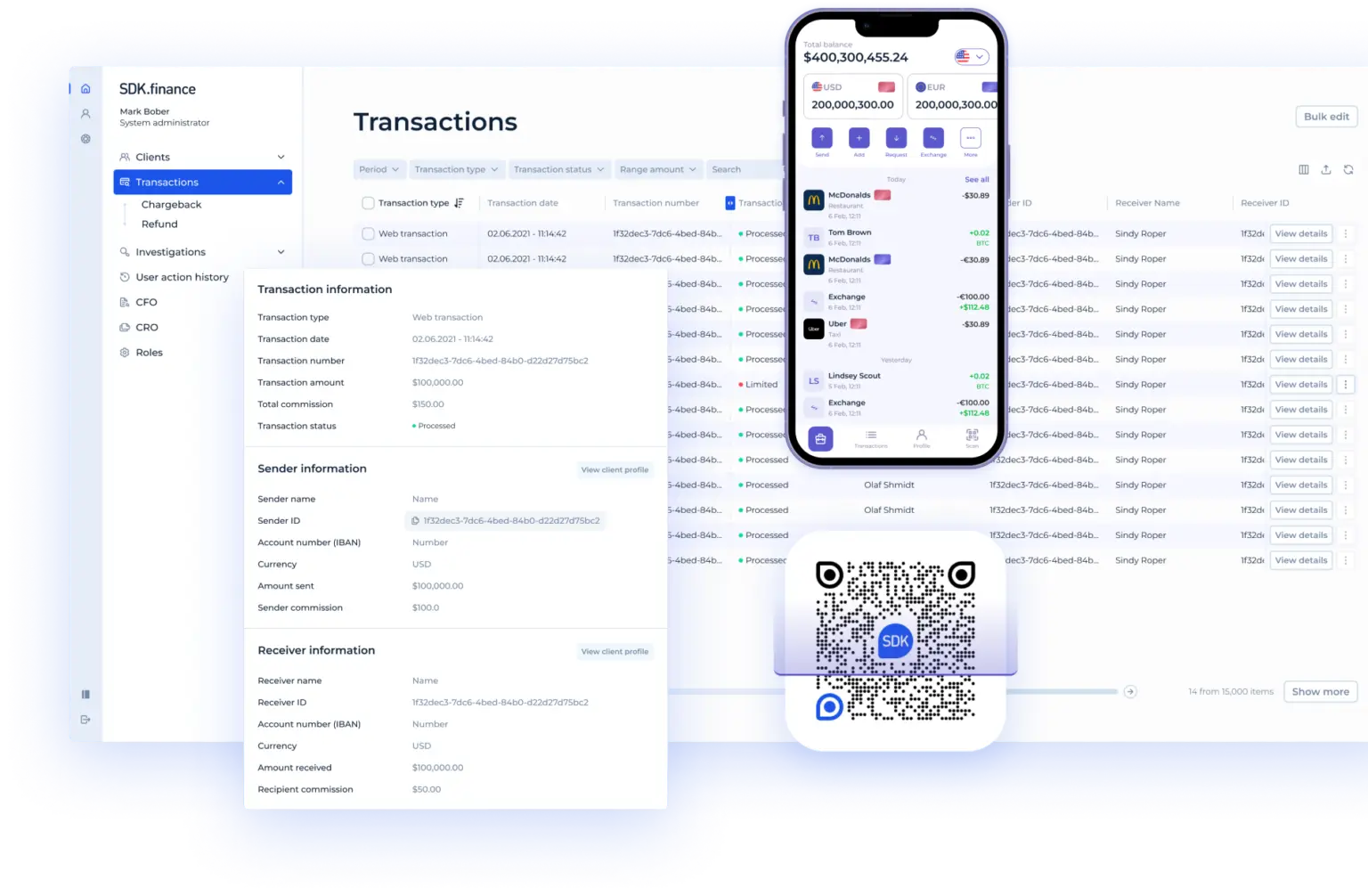
Our review of prospective customer enquiries highlights practical requirements across wallet and payment projects: embedding balances in existing applications, connecting chosen payment providers, recording every top-up, spend, and refund, and reconciling transactions with external records. These requirements also help frame an M2M payment architecture: who manages the balance, how systems exchange payment information, and how the team explains each charge.
SDK.finance provides transaction and accounting components that can address these underlying requirements. The relevant product depends on your existing infrastructure and payment model.
| Requirement observed in enquiries | Relevant SDK.finance capability | Application to an M2M design |
|---|---|---|
| Embed balances and payment functions in an existing application | Transaction Platform: wallet and account management, internal transfers | Manage prefunded balances and internal account movements where the payment model calls for them |
| Connect the application with external financial systems | Transaction Platform: APIs and signed event webhooks | Exchange transaction instructions and event notifications through a defined integration |
| Match internal transactions with provider records | Transaction Platform: file-based reconciliation and discrepancy review | Investigate missing transactions and amount differences between internal and external records |
| Connect transaction activity to accounting | General Ledger: configurable business-event mapping into balanced journal entries | Record the accounting effect of payment events received from the existing system |
For example, a team building an API marketplace could assess the Transaction Platform for prefunded accounts and internal transfers. A team that already processes payments could assess General Ledger for the accounting layer.
Device or agent authentication, purchasing policies, and payment protocol support need to be scoped alongside these components. External payment execution and settlement depend on the selected provider and integration.
Discuss your payment flow with SDK.finance to identify the required components, integrations, and additional development.
Discover how the SDK.finance TPS can power high-speed, secure operations across banking, fintech, and retail
Talk to Our Team