For a customer, a money transfer should feel simple: choose a recipient, see the fee and exchange rate, and know when the money will arrive. For the business behind that journey, each promise depends on a chain of decisions about licensing, banking access, payout partners, liquidity, and technology.
Starting a money transfer business means bringing these elements together around a clear customer need. A useful starting point is a specific transfer corridor and a delivery method your customers can access. That gives you a practical basis for comparing providers, estimating costs, and deciding which capabilities your software must support.
This guide explains how to start a money transfer business, covering the market, business models, licensing, costs, and launch readiness. It also shows how SDK.finance can provide the software foundation to turn your business plan into a working money transfer service.
Launch your payment project in record time
Talk to Our TeamThe international money transfer industry overview
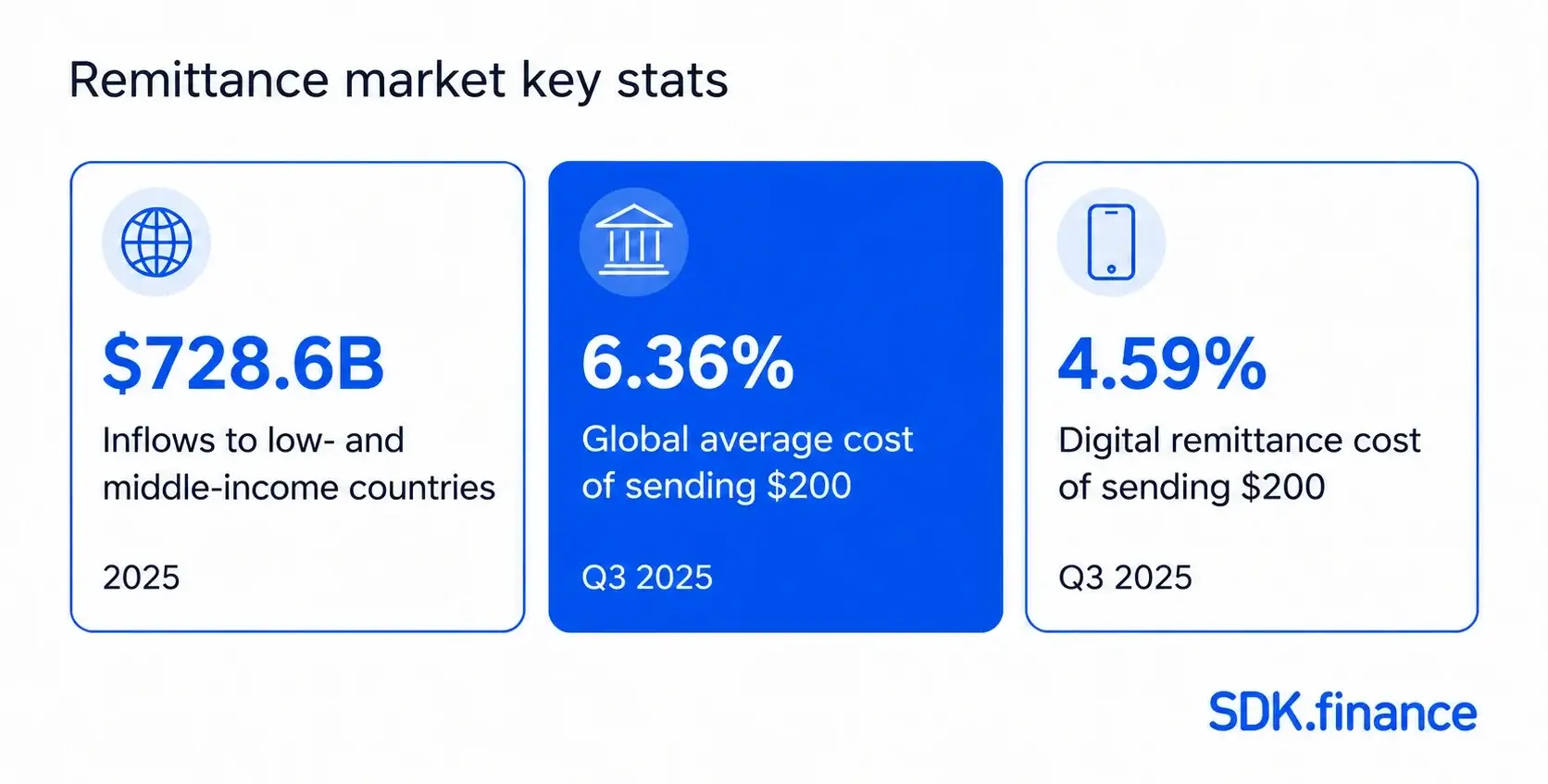
Remittances remain a substantial source of household finance. Inflows to low- and middle-income countries reached US$728.6 billion in 2025, up 94% since 2016, according to IFAD’s Sending Money Home 2026 report. Published in September 2026, the report measures flows to these countries, rather than the entire global cross-border payments market.
Price remains an important part of the customer proposition. The World Bank’s Remittance Prices Worldwide report recorded a global average cost of 6.36% for sending US$200 in Q3 2025. Digital remittances averaged 4.59%, compared with 7.30% for non-digital services. These are average customer costs, not operator profit margins; actual costs vary by corridor and provider.
Choosing your money transfer business model
A money transfer business moves funds between senders and recipients. Consumer remittances often involve repeat payments to family, making recipient access, predictable pricing, and customer acquisition central to the service. Business payments may require invoice documentation, approval workflows, and reconciliation with company records. These needs affect both operations and software requirements.
Define your initial service around three decisions:
- Customer and corridor: specify who will send money, the sending and receiving countries, currencies, typical transfer size, and frequency. Compare existing services on total customer cost, delivery options, and support.
- Customer channels: choose a digital service, an agent network, or a combination. An online money transfer business can still offer cash pickup through a payout partner; the app and the delivery method are separate choices.
- Regulatory model: compare operating with your own permissions with a permitted agent arrangement. Your own authorisation brings direct regulatory responsibilities and potentially greater operating control. An agent model depends on the principal’s permitted scope, oversight, contractual restrictions, and charges.
Use these decisions to write a one-page launch brief as the starting point for your money transfer business plan. Develop it into a budget and operating plan covering permissions, partners, liquidity, and revenue assumptions. For example, a proposed US-to-Philippines service would specify its US coverage, customer segment, funding and payout methods, and provider responsibilities before software selection.
The basics of remittance and money transfer clarify the terminology behind these service choices.
Participants, banking and payout partners
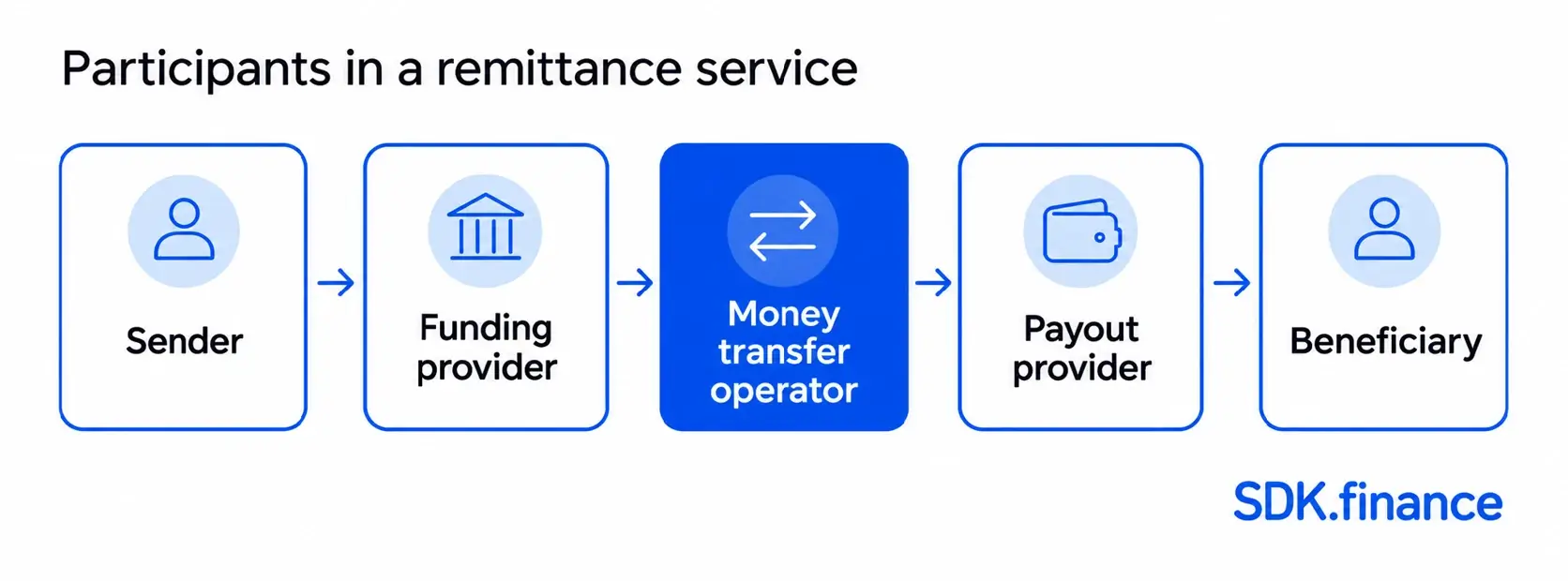
A remittance service depends on several participants. The same provider may perform more than one role; the operating model should identify who holds each responsibility.
| Participant or service | Role in the remittance service |
|---|---|
| Sender, remitter | The individual who sends the remittance |
| Beneficiary | The person who receives the remittance money. |
| Funding provider | The bank or payment provider used by the sender to fund the transfer. |
| Payout provider | The bank or payment provider receiving the transfer. Depending on the service, the beneficiary may receive funds in an account, a wallet, or through cash pickup. |
| Money transfer operator (MTO) | The operator providing the transfer service within its authorised scope or permitted partner arrangement. |
| Payment processor | The payment processor is used by an MTO to conduct transactions when payment instruments such as ACH, debit/credit cards, or other platforms like PayPal are used. |
| Payment network | MTOs can route the remittance transfer through different payment networks, including a third-party network to settle transactions in regions where the MTO is not directly integrated. |
| Transfer platform | The software used to manage customer accounts, transfer workflows, transaction records, fees, and operational controls. External providers supply the relevant financial services and payment connections. |
| Identity verification provider | A third-party service may verify customer identity documents during onboarding. The operator must define its verification and ongoing due-diligence processes. |
For example, in an account-to-account transfer, the sender funds the payment; the operator and its providers complete the required checks, process the transfer and any currency conversion, and deliver funds through the payout provider. Status confirmations then support customer notifications and reconciliation of internal records with provider reports. The precise sequence, including when checks occur and funds become available, depends on the operating model.
Understanding how funds move across borders helps identify the participants and handoffs in a transfer journey.
Selecting banking and payout partners
Confirm that each provider supports your business model and chosen corridor before committing to integration work. Assess the following:
- Coverage and delivery: check countries, currencies, funding and payout methods, limits, cut-off times, and expected delivery times.
- Commercial terms and liquidity: request fees, FX pricing, minimum commitments, deposits, prefunding requirements, and settlement schedules. Establish how balances will be monitored and replenished.
- Exceptions and responsibility: agree how failed, delayed, duplicated, or returned payments will be handled, who responds to customers, and how transaction records will be reconciled.
Ask for the relevant API documentation, test environment, reporting formats, and onboarding requirements. A connector alone does not establish a banking relationship or activate a payout corridor.
What bank account does a money transfer business need?
The right bank account for a money transfer business depends on its activities, markets, and regulatory model. Confirm that the bank supports the intended remittance activity, currencies, and expected transaction volumes. Identify the accounts needed for operating expenses, customer funding, and settlement, and establish who holds and controls each account. Where safeguarding requirements apply, agree the appropriate arrangements for customer funds rather than assuming an ordinary business account is sufficient. An agent should confirm which accounts and fund flows are managed by its principal.
Licensing and compliance requirements
Identify the authorisation or registration required for your activities in each market before accepting customer funds. Licensing, registration, and a provider contract serve different purposes. Where an agent arrangement is permitted, confirm the principal’s coverage, your own registration requirements, and the activities the arrangement allows.
Money transmitter licence in the USA
The operation of a money transfer business requires compliance with federal, state, and local regulations governing this service. In the United States, money transmitters form part of the wider category of money services businesses.
Most money services businesses must file FinCEN Form 107 with the U.S. Treasury Department’s Financial Crimes Enforcement Network (FinCEN). The initial filing is due within 180 days after the business is established; this is a registration deadline, not a business setup period. Separate state money transmitter licences may also be required.
FinCEN registration does not replace state-level permission. For each state you plan to serve, check the regulator’s licensing requirements, applicable exemptions, financial requirements, and authorised delegate rules. State application checklists are available through NMLS.
FinCEN exempts a business from its registration requirement when it is an MSB solely because it acts as another MSB’s agent. This exemption does not settle state licensing or other compliance obligations. Confirm the principal’s coverage, your permitted activities, and the allocation of responsibilities before relying on an agent arrangement.
Licensing costs depend on the states and activities covered, including application fees, bonds, legal work, and ongoing reporting.
Money transfer licence in the UK
If you want to become a money transfer operator in the UK and offer services such as sending and receiving money in and out of the country, you need to assess the appropriate FCA payment institution route. Depending on your activities and eligibility, this may involve registration as a small payment institution (SPI) or authorisation as an authorised payment institution (API).
For SPI registration, average monthly payment transactions must not exceed €3 million, alongside other eligibility conditions. This threshold concerns transaction volume, not revenue. Check the FCA’s current application requirements and fees for the services you plan to offer.
Money transfer licensing in the EU
To start a money transfer business in the EU, you may need a payment institution (PI) licence rather than an electronic money institution (EMI) licence. The appropriate route depends on your activities, including whether you issue electronic money. You must demonstrate the financial resources, governance, and operational arrangements required by the relevant regulator.
For example, the Bank of Lithuania specifies minimum initial capital of €20,000 for a PI providing money remittance services. Regulatory capital is separate from your technology, staffing, and other launch costs.
Money transfer licensing in the UAE
The Central Bank of the UAE’s retail payment services framework covers domestic and cross-border fund transfers. Confirm the regulator and licence category for your location and activities: retail payments, exchange business, and financial free-zone permissions are not interchangeable.
Money transfer licensing in Saudi Arabia
It is prohibited to conduct money transfer business in the Kingdom of Saudi Arabia without the required authorisation from SAMA. Money remittance falls within SAMA’s payment services framework. Capital and other requirements depend on the licence category and activities, so confirm the current requirements for your business model.
What affects the cost of a money transfer licence?
The cost of obtaining a money transfer business licence depends on the jurisdiction, permitted activities, and application requirements. Budget for regulatory application fees, legal advice, and the work needed to prepare policies, controls, and supporting documents. Assess ongoing regulatory fees and compliance costs separately. For a US money transmitter licence, check the requirements of each state you intend to serve. Keep regulatory capital, any required bond arrangements, and provider deposits distinct from application expenses, and confirm current requirements with the relevant regulator.
Preparing compliance and operating controls
Turn the applicable requirements into documented procedures with named owners. For US MSBs, FinCEN’s guidance describes an AML programme covering internal controls, a designated responsible person, training, and independent review. The programme must fit the business and its risks.
Plan customer verification, risk assessment, applicable sanctions checks, transaction monitoring, escalation of alerts, and required reporting and record retention. Define who can approve exceptions, release held transfers, and handle complaints or refunds.
Software can support these workflows, but your team needs policies, trained staff, and tested procedures. Before launch, test both a successful transfer and cases that require investigation or intervention.
How much does it cost to start a money transfer business?
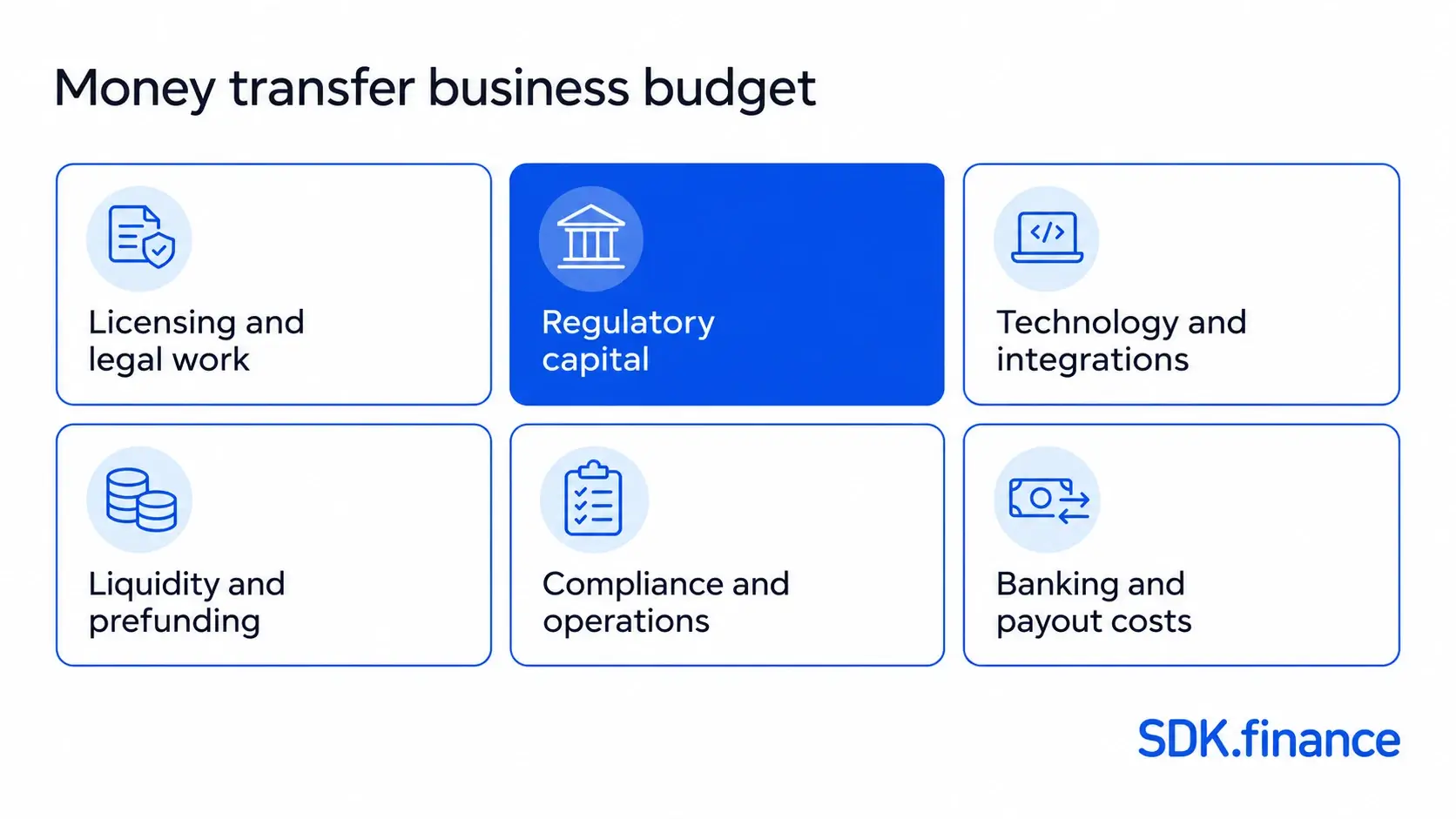
Build the budget around your jurisdiction, operating model, first corridor, and provider quotations. Separate the following categories rather than relying on one headline launch price:
- One-off setup costs: licensing applications, legal advice, software configuration or development, integrations, security reviews, and testing.
- Recurring operating costs: staff, hosting, software subscriptions or maintenance, compliance reviews, customer support, and acquisition.
- Variable costs: funding and payout fees, FX execution, transaction screening, and expected fraud or refund losses. Budget customer onboarding checks separately or allocate their cost across the customer’s expected transfers.
- Capital and liquidity: regulatory capital, provider deposits, and payout prefunding. Track these separately from operating expenses and assess how much cash remains available for day-to-day operations.
Revenue and contribution per transfer
Revenue may come from a disclosed transfer fee and an FX spread where currency conversion is involved. In the calculation below, FX revenue means spread revenue before the provider’s FX execution cost. Deduct that cost once within variable costs; if using net FX revenue instead, do not deduct it again.
Contribution per transfer = transfer fee + FX revenue − variable funding, payout, FX, compliance, and expected loss costs.
In a simplified example, $6 of revenue minus $4 of variable costs leaves $2 per transfer towards fixed costs. Covering $20,000 in monthly fixed costs would therefore require 10,000 transfers, before tax and capital funding.
Use quotes for your own corridor and test lower volumes, a more expensive funding mix, and higher support or fraud costs. A positive contribution on each transfer does not by itself mean the business is profitable.
The operational complexity behind money transfer costs extends beyond software, making provider quotations and operating assumptions essential to the budget.
Launch your payment project in record time
Talk to Our TeamDeveloping the payment software
Payment software should support the transfer journey, accounting records, and operating controls defined for your service.
When evaluating software, ask the vendor to demonstrate the full transfer journey, including what happens when a provider rejects a payment or returns an ambiguous status.
- Transaction and accounting records: trace each transfer, fee, currency conversion, balance change, and reversal; compare internal records with provider reports.
- Integrations and exceptions: confirm the exact provider services, credentials, configuration, and testing required. Test duplicate requests, delayed responses, failed payouts, and refunds.
- Operational controls: check staff permissions, audit history, review queues, customer notifications, and access to data for reporting and support.
Compare an in-house build with an existing software foundation using your requirements, integration scope, deployment needs, ongoing maintenance, and total cost. Ask vendors to separate included capabilities from configuration, third-party services, and additional development. A comparison of remittance software providers can help create an initial shortlist; validate each option against the same corridor, integration, and operating requirements.
The money transfer app development guide connects customer-facing features with backend configuration and integration work.
How to start a money transfer business: the main steps
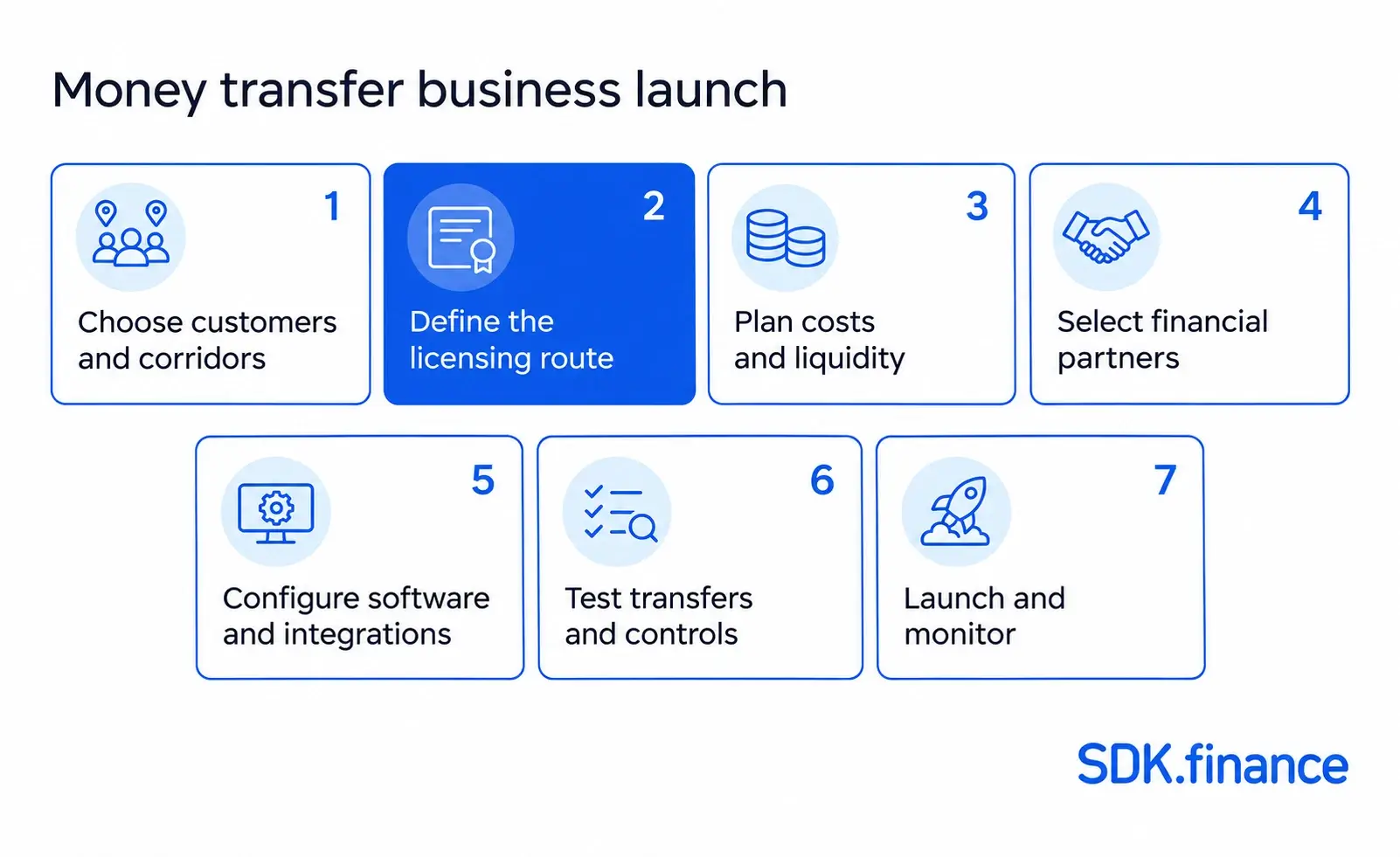
Use the following checklist to review your money transfer business requirements and bring the business, regulatory, and technical work together before launch:
- Choose customers and corridors: an approved service brief identifies the customer segment, countries, currencies, funding and payout methods, and pricing.
- Define the licensing route: documented permissions or a permitted agent arrangement cover the intended activities and markets before operations begin.
- Plan costs and liquidity: a funded budget separates setup and operating costs from capital, deposits, and prefunding, with assumptions tested at lower volumes.
- Select financial partners: signed agreements establish coverage, charges, settlement terms, and responsibility for exceptions and customer support.
- Configure software and integrations: the agreed transfer flows, provider connections, fees, limits, staff access, and reporting are implemented.
- Test transfers and controls: recorded test results cover successful transfers, rejected and duplicate requests, refunds, reconciliation, and compliance escalation.
- Launch and monitor: named owners track delivery times, failed transfers, losses, complaints, and contribution per transfer, with criteria for pausing or expanding the service.
SDK.finance: Remittance Software for Launching a Money Transfer Business
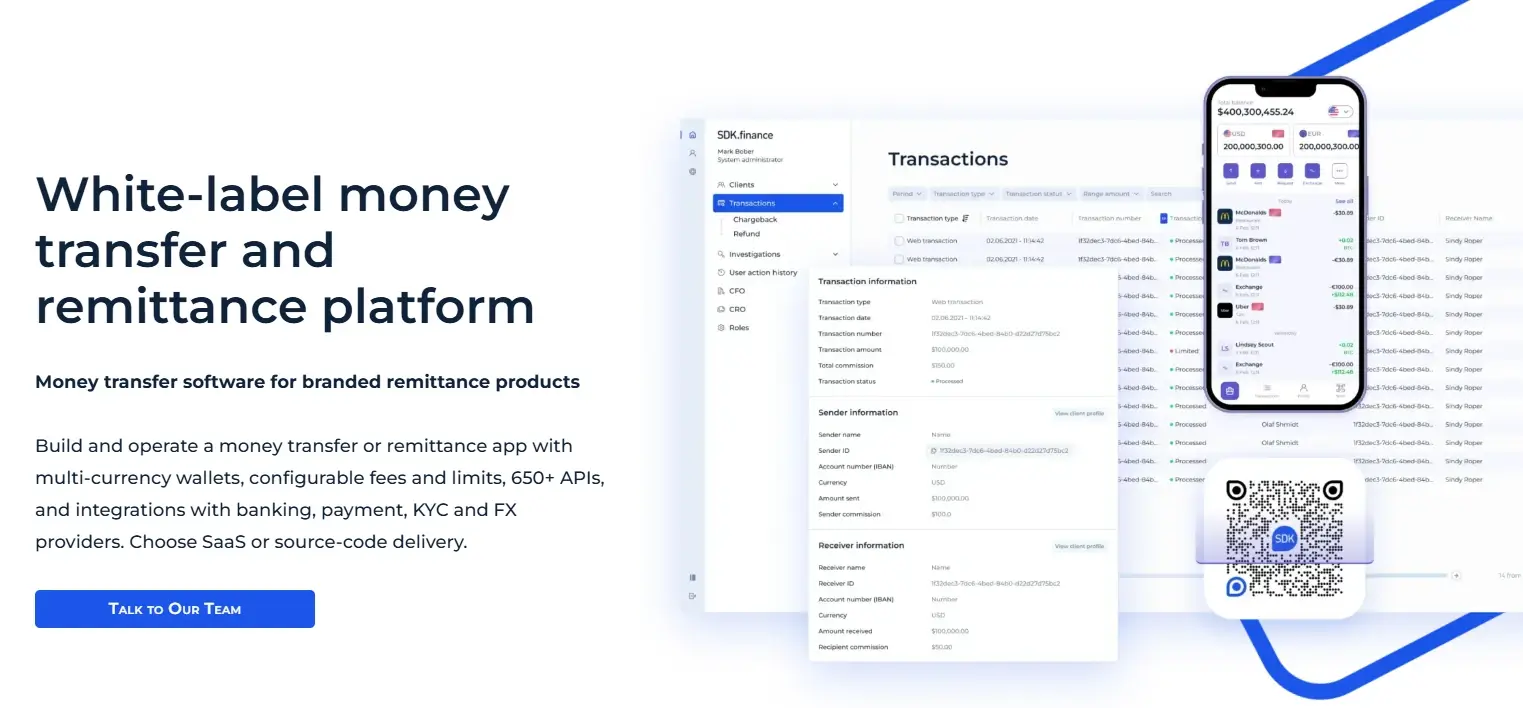
SDK.finance provides money transfer software for building and launching your own remittance service. The platform combines account and wallet management, transfer workflows, configurable fees and limits, and back-office tools. These capabilities give your team a foundation for recording transactions, applying operating rules, and managing exceptions.
Your team designs the customer experience, defines how the service will operate, and connects the financial providers needed for each transfer corridor. The table below shows which capabilities SDK.finance provides and where configuration or external integrations are required.
| Money transfer service feature | SDK.finance Transaction Platform |
|---|---|
| Two-factor authentication (2FA) | Available as a configurable security feature. |
| Online ID check (KYC) | Manual verification workflows and third-party integration options. The documented Sumsub integration requires configuration. |
| Ewallets | Multiple wallets in different currencies can be created. |
| Transaction notifications | Email and SMS notifications, with channels and event handling configured for the implementation. |
| P2P transfers | Internal transfer functionality; configure the relevant accounts, fees, and operating rules. |
| International remittance | Requires integrations with suitable external financial providers and payout arrangements for the chosen corridors. |
| Currency exchange | Available between a user’s accounts, with currencies and exchange reserves configured. |
| Fees and limits | Configurable rules for the supported transaction workflows. |
| Integrations | 650+ APIs across the Platform. Available connectors and additional integration work depend on the selected providers, delivery model, and scope. |
SDK.finance offers SaaS and source code licensing, so you can choose how much of the technology your team wants to manage and customise.
With the SaaS model, SDK.finance manages application hosting, updates, and fixes, while your team manages the databases. Configuration and API-based extensions let you connect providers and develop the customer experience without maintaining the backend code. This suits teams that want to focus their engineering resources on the product and integrations; the budget includes subscription and applicable usage charges, database infrastructure, and external services.
A source code licence provides a ready-made transaction core on which to build your future money transfer business. Your team can use the existing accounts, wallets, and transfer workflows as a foundation, then modify the core logic, develop new features, and adapt integrations to your operating model. You control deployment and the development roadmap, with responsibility for infrastructure, security operations, and maintenance. SDK.finance usage fees do not apply under this model, while development, infrastructure, and provider costs remain.
The pricing and delivery comparison outlines the costs and responsibilities of each model.
TheOneGate case study: building a corporate money transfer platform
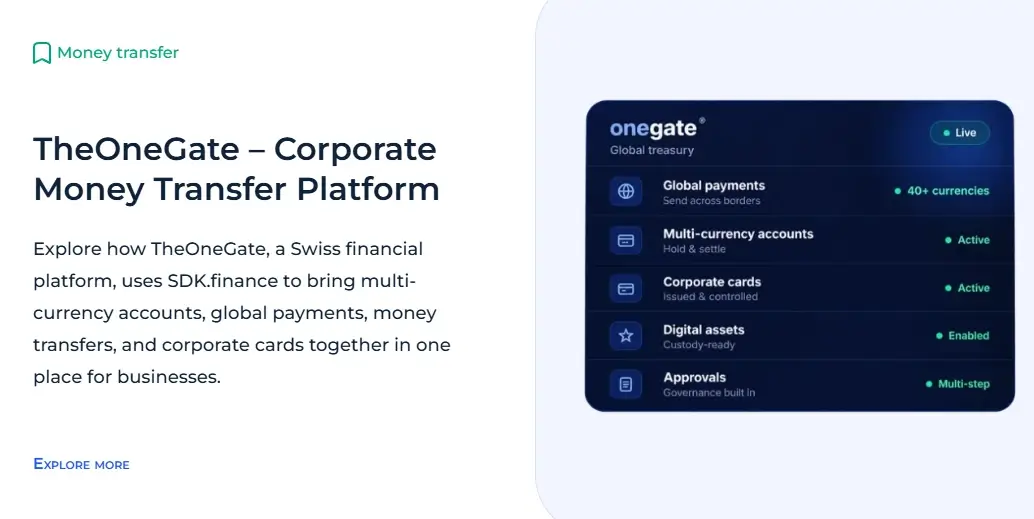
TheOneGate, a Swiss financial platform, set out to bring corporate accounts, multicurrency payments, and money transfers into one service. SDK.finance supplied the SaaS Transaction Platform as the underlying payment core, providing existing functionality for accounts, multicurrency wallets, payment processing, and transfers.
The Platform’s API architecture gave TheOneGate a way to connect the external financial providers required for its operations. TheOneGate then extended the software’s capabilities, implemented its own business processes, and developed its services and customer experience around that core.
As described in the TheOneGate case study, SDK.finance’s contribution was to provide the transaction infrastructure that the company would otherwise have needed to build. This allowed TheOneGate to direct development resources towards its corporate payment offering while using the Platform to manage customer balances and support multiple payment flows.
Starting a money transfer business: from launch to sustainable growth
The first corridor provides a practical test of whether the business can deliver transfers reliably and at a sustainable cost.
A focused launch also makes it easier to learn why customers use the service again, where transfers become delayed, and which exceptions consume the most staff time. These findings can guide changes to the customer journey, provider arrangements, and pricing before the business takes on additional markets.
Before adding a corridor or payout method, reassess settlement timing, prefunding, support workload, and contribution per transfer. Higher volumes are valuable only if the business can fund and support them.
Launch your payment project in record time
Talk to Our Team