Digital banking now extends far beyond mobile apps. Banks, EMIs, PSPs, and fintechs need infrastructure that can process transactions, automate compliance, integrate third-party services, and support new products without creating technical debt.
The global digital banking solutions market is projected to reach $43.98 billion in 2026, driven by the shift from inflexible legacy systems to SaaS and modular platforms.
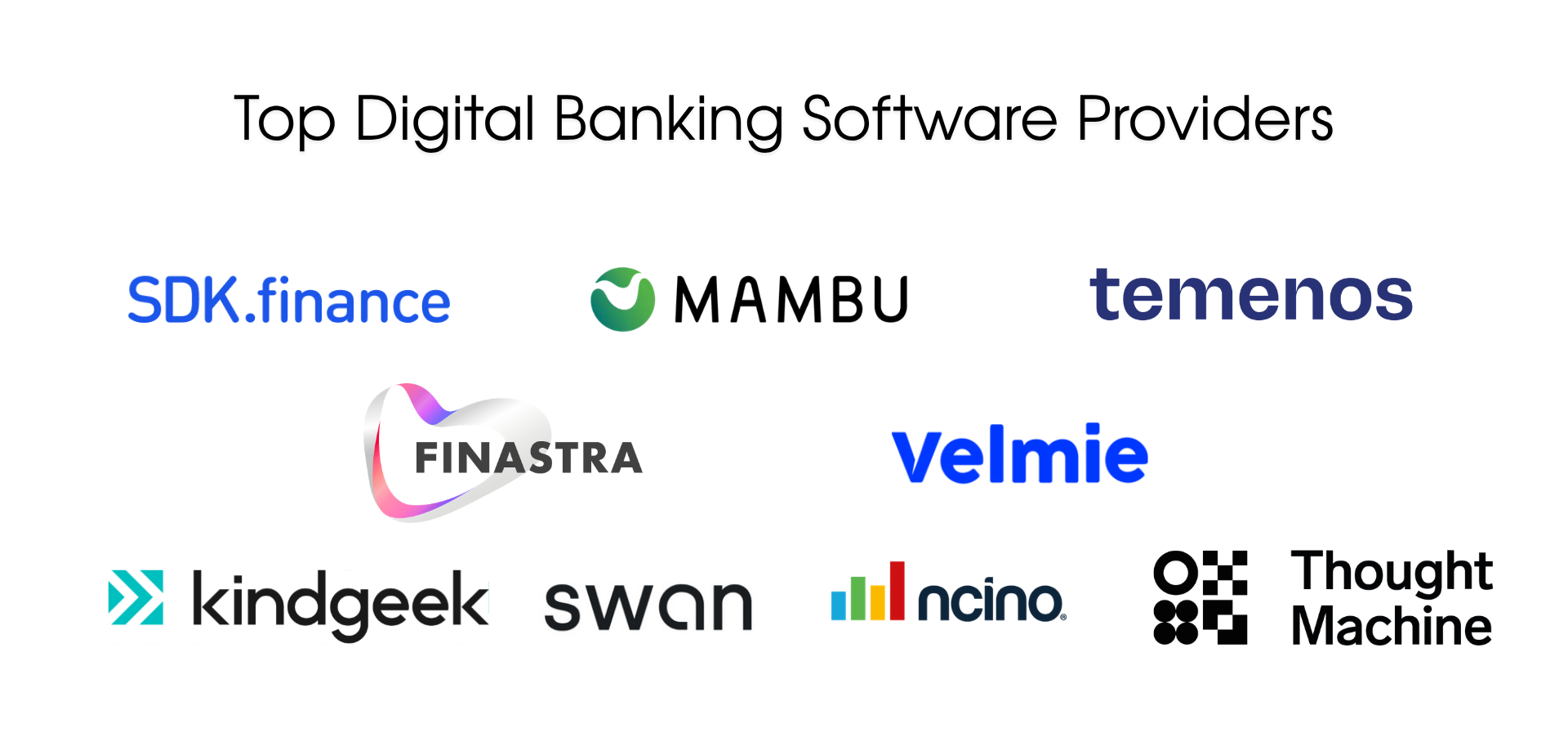
This guide compares nine leading digital banking software providers: SDK.finance, Mambu, Temenos, Kindgeek, Thought Machine, Finastra, Velmie, nCino, and Swan. We evaluate their functionality, architecture, deployment models, target customers, and level of technology ownership.
What Are Digital Banking Solutions?
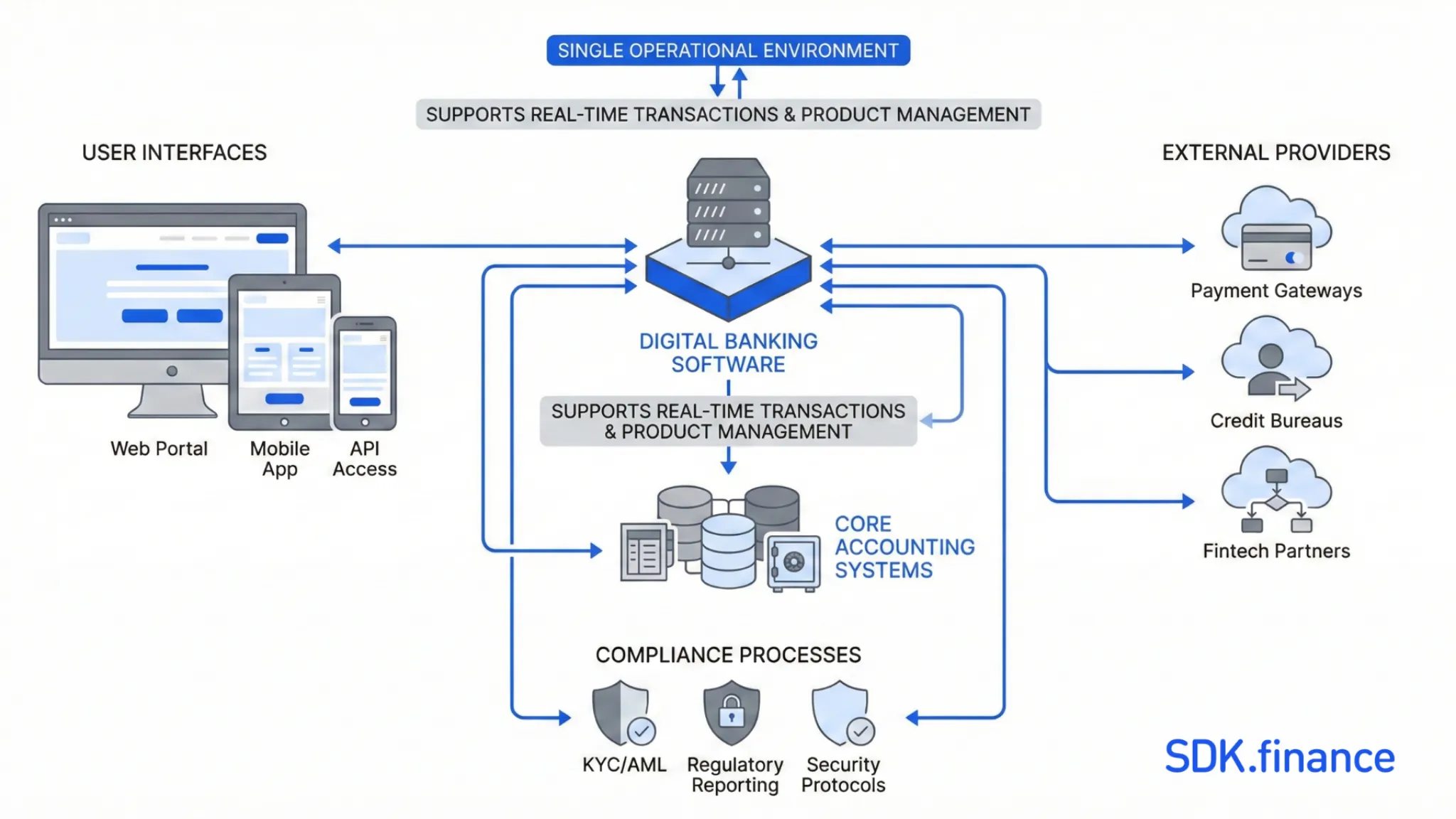
Digital banking solutions are technology platforms and software infrastructures that enable banks, EMIs, PSPs, and FinTech companies to deliver banking services through digital channels. They typically combine core transaction processing, account management, payment workflows, card operations, onboarding, KYC/AML compliance, APIs, and customer-facing mobile or web interfaces into one connected environment.
Unlike a standalone mobile banking app, a digital banking solution covers both the front-end experience and the backend infrastructure behind it. It helps financial institutions launch, manage, and scale digital banking products without building every system from scratch.
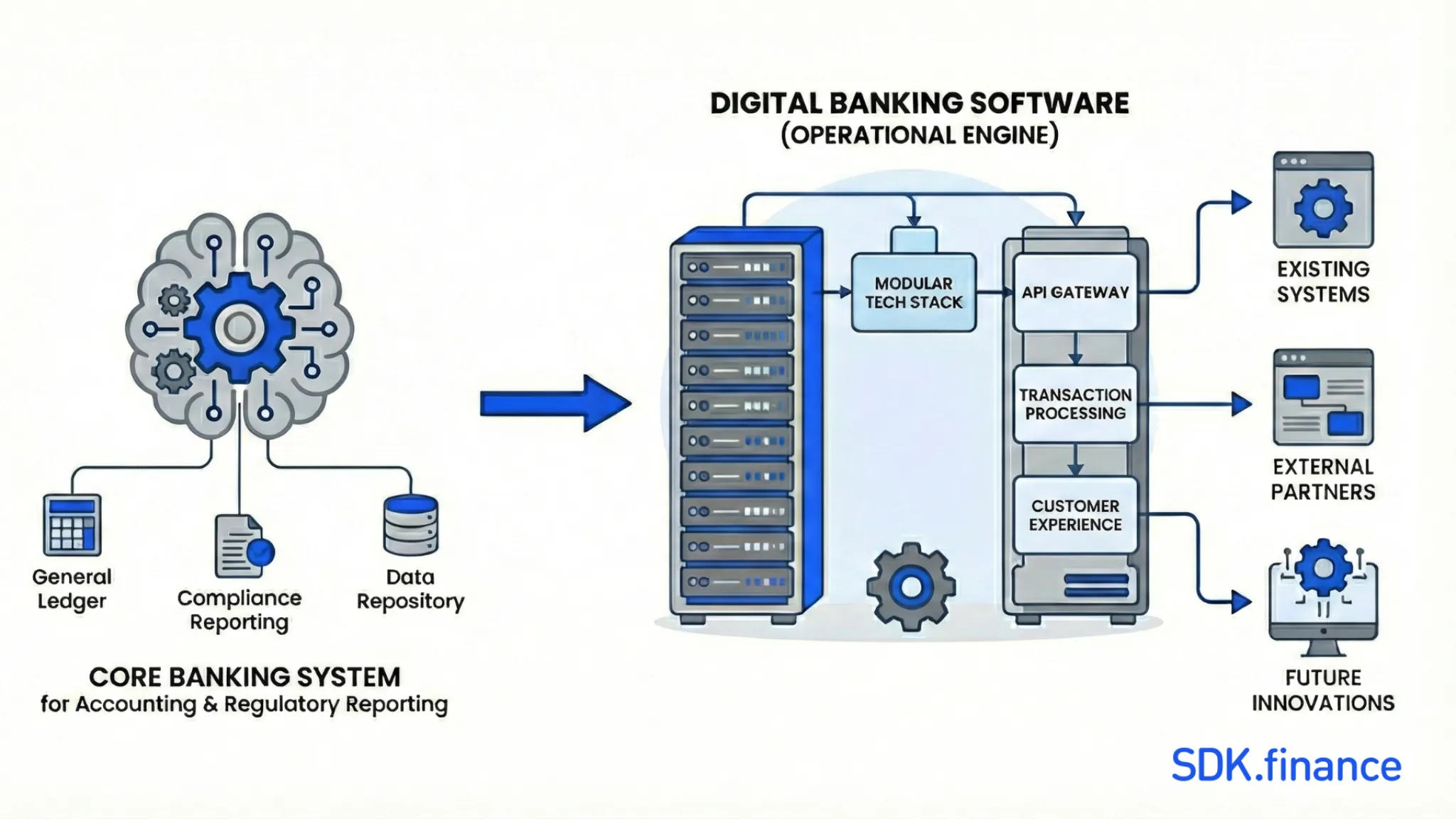
It is important to distinguish this from the front-end mobile applications or the legacy core banking systems that manage the final ledger of record. Legacy systems often limit digital transformation due to their inflexibility, high maintenance costs, and inability to support rapid innovation.
Modern digital banking software is specifically designed to overcome these limitations by providing a flexible, modular, and scalable foundation for new financial products and services.
While a core banking system acts as the “brain” for accounting and regulatory reporting, digital banking software serves as the operational engine. Built on a modern, modular tech stack, it enables flexibility and scalability to support evolving business needs and seamless integration with existing systems and external systems. It handles:
- User Management: Identity verification, KYC/AML workflows, and profile security.
- Service Orchestration: Coordinating complex actions across multiple APIs, such as card issuing, international transfers, and currency exchange, with easy integration to third-party services, accounting systems, external systems, and fintech solutions.
- Product Definition: The ability to configure, manage, and customize a wide range of banking products (e.g., savings pockets, multi-currency wallets, loans, cards) without altering the underlying ledger, supporting the rapid launch and adaptation of financial services.
- Document Management: Streamlining compliance and operational efficiency by enabling secure storage, retrieval, and automation of customer and regulatory documents within digital workflows.
How We Evaluated Digital Banking Solutions
To provide an objective ranking, we evaluated each provider based on seven critical performance and operational metrics:
- Functional Coverage: The breadth of native features, including account management, payment processing, payments solutions, and onboarding modules, as well as the ability to support new features to keep up with evolving market demands.
- Architecture and Modularity: The use of micro services architecture or independent modules that allow for selective deployment and scaling.
- API-First Design: The quality and quantity of documented APIs (REST or GraphQL) available for third-party integrations.
- Deployment Models: Availability of flexible hosting options, including SaaS, private cloud, and source code licensing.
- Scalability: The platform’s proven ability to handle high transaction volumes and concurrent users.
- Target Customers: Alignment with specific institutional needs, from small fintechs to Tier-1 global banks, ensuring that offerings can be tailored to the unique business needs of different organizations.
- Geographic Flexibility: Multi-currency support and compliance readiness for different regulatory jurisdictions (US, UK, EU, MENA, Asia, etc.).
Digital Banking Software Providers Comparison
| Provider | Platform focus | Deployment | Best for |
|---|---|---|---|
| SDK.finance | Digital banking and payment infrastructure with 650+ APIs | SaaS or source-code licence | Digital banks, EMIs, PSPs and fintechs |
| Mambu | Composable cloud banking platform | SaaS | Challenger banks and greenfield projects |
| Temenos | Enterprise core and digital banking suite | SaaS or private cloud | Tier-1 and established banks |
| Kindgeek | White-label banking modules plus custom fintech engineering | Private cloud or client-managed deployment | EMIs, PSPs and fintechs |
| Thought Machine | Cloud-native core banking platform | Cloud/SaaS | Large banks and highly configurable products |
| Finastra | Retail, commercial and corporate banking software | SaaS or hybrid | Universal and established banks |
| Velmie | Modular banking and crypto platform | SaaS or hybrid | Startups and mid-market institutions |
| nCino | Cloud banking, CRM and lending platform | Salesforce-based SaaS | Regional and community banks |
| Swan | Banking-as-a-Service and embedded finance | SaaS | European SaaS companies and marketplaces |
Top Digital Banking Solutions in 2026
1. SDK.finance
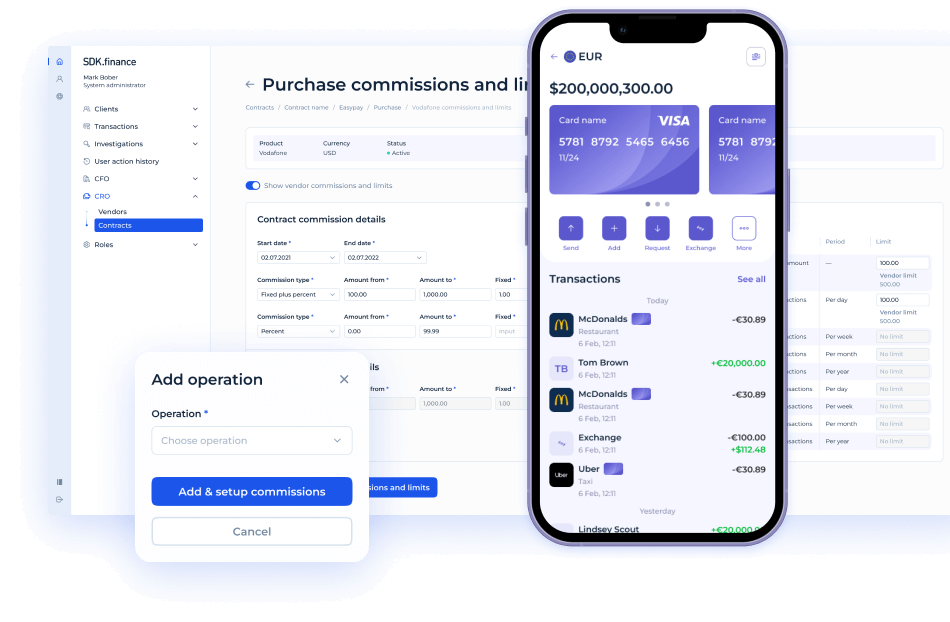
SDK.finance is a leading digital banking solutions provider with over 15 years of deep-seated expertise in fintech infrastructure. Internationally recognised as a regular finalist of the prestigious PayTech Awards and Banking Tech Awards, the company has established a robust global footprint, serving clients across the United States, Europe, North America, MENA, and Africa.
The platform offers an expert-grade balance between rapid market entry and long-term architectural autonomy. In 2026, SDK.finance is distinguished by its flexible delivery models, offering both a cloud subscription for agile scaling and a source code license for institutions that require total ownership of their intellectual property.
This digital banking software is engineered for high-performance environments, capable of handling 2,700+ transactions per second. It is fully PCI DSS and ISO certified, ensuring rigorous adherence to global security standards. With an expansive library of 650+ REST APIs, it provides the connectivity required to thrive in a modern, open-banking ecosystem.
To further accelerate launch timelines, SDK.finance includes professional white-label mobile and web applications, featuring a user friendly interface that enhances ease of use and enables end users to easily manage accounts, payments, and permissions across multiple currencies and markets. This allows clients to deliver a premium user experience from day one, while also ensuring seamless digital experiences across digital channels through real-time control and smooth customer interactions.
- Key Strengths: Source code ownership to eliminate vendor lock-in, native crypto-fiat capabilities, 650+ documented APIs for deep customisation, and configuration and deployment with less effort compared to traditional solutions.
- Product Capabilities: Powering Neobanks, Digital Wallets, Payment Gateways, Currency Exchanges (Fiat & Crypto), Crypto Banking, and Remittance services.
- Best suited for: EMIs, PSPs, and banks seeking secure, scalable, and independent infrastructure.
- Considerations: Institutions opting for the source code license should maintain a technical team to manage and evolve their proprietary version.
SDK.finance also provides ready-to-use white-label mobile and web applications, allowing institutions to launch faster while maintaining control over accounts, payments, user permissions, and multi-currency operations. The mobile application supports multiple languages, including English, French, Spanish, and Arabic. Additional languages can be added based on project requirements, making it suitable for international deployments and region-specific rollouts.
To better understand how the end-user experience works in practice, you can explore the mobile application demo below, which showcases account management, multi-currency wallets, payments, and back-office interaction in a real operational environment:
Create your digital banking solution in weeks
Talk to Our Team2. Mambu
Mambu is a cloud-native, SaaS-only platform known for its “composable banking” approach. It allows banks to build their stack by picking and choosing various third-party services. Mambu supports both retail and business customers through its flexible modules, enabling financial institutions to serve a wide range of client needs. Its Digital One platform offers a comprehensive, modular solution for modern banking needs.
- Strengths: Rapid deployment, pure SaaS model with zero maintenance overhead, and a large marketplace of pre-integrated partners.
- Best suited for: Challenger banks and established retail banks launching “greenfield” digital brands, as well as other businesses seeking to innovate in financial services.
- Limitations: No option for on-premise deployment or source code access; subscription costs can scale significantly with user growth.
3. Temenos (Temenos Banking Cloud)
A dominant force in global banking, Temenos has successfully transitioned its legacy expertise into a modern, cloud-based offering serving over 3,000 clients globally. Temenos delivers comprehensive digital solutions for global banks, supporting online banking, mobile platforms, and enhanced operational efficiency.
- Strengths: Massive functional depth, global regulatory coverage, robust digital payments capabilities, and a proven track record with 41 of the world’s top 50 banks.
- Best suited for: Large incumbent banks undergoing enterprise-wide digital transformation.
- Limitations: Implementation cycles can be longer and more complex compared to leaner fintech-native platforms.
4. Kindgeek
Kindgeek is a FinTech-specialised engineering company, delivering white-label digital banking infrastructure together with the custom product layers built on top of it. Its offering covers neobank, e-wallet, and digital retail bank use cases. The platform offers pre-built modules for multi-currency accounts, KYC and customer onboarding, P2P transfers, payments and invoicing, currency exchange, and an administration backoffice with fee, limit, and user management.
Operating for 11+ years exclusively in regulated financial services, the company has delivered more than 100 regulated projects.
- Strengths: Combines proven licensed core infrastructure with the engineering capacity to build differentiated product layers above it. API-first architecture with integrations to acquirers, card processors, KYC/AML and fraud providers, and open banking connectivity.
- Best suited for: EMIs, PSPs, and fintechs that want proven infrastructure underneath and a differentiated product above it, plus enterprises modernising financial platforms they already operate.
- Limitations: Delivery is engagement-based rather than a subscription, so timelines and costs depend on scope. Institutions that want to configure a finished platform and go live without engineering involvement will launch faster on a vendor-hosted subscription, accepting the configuration limits that come with it.
5. Thought Machine
Thought Machine’s core product, Vault Core, is built on a “smart contracts” logic, allowing banks to create any financial product from scratch without traditional ledger constraints. The platform also enables banks to launch new services quickly, helping them expand their digital offerings and adapt to evolving customer needs.
- Strengths: Extremely flexible product engine, high-performance ledger, modern, cloud-native engineering, and helps banks streamline operations through automation and flexible product configuration.
- Best suited for: Tier-1 banks and high-growth fintechs needing unique, non-standard financial products.
- Limitations: The high degree of flexibility requires significant configuration effort to define products.
6. Finastra
Finastra provides a broad suite of financial software, with its FusionFabric.cloud platform focusing on open collaboration and ecosystem integration.
- Strengths: Extensive experience in corporate banking and retail banking; strong focus on open banking and API connectivity; robust support for small business banking solutions, including tailored account management and deposit tools for small business clients.
- Best suited for: Universal banks that require a blend of retail, commercial, and treasury capabilities.
- Limitations: Navigating their vast product portfolio can be complex for smaller, agile fintech startups.
7. Velmie
Velmie offers a modular digital banking platform with a focus on high-performance architecture and specialized modules like crypto-banking and micro-investing. Velmie also provides a streamlined account opening process for new accounts, enabling fast, digital onboarding with automation and multi-channel support to enhance customer experience and operational efficiency.
- Strengths: Hybrid architecture that blends traditional fintech with native crypto-fiat capabilities.
- Best suited for: Fintech startups and mid-market financial institutions in emerging markets.
- Limitations: Smaller global footprint compared to major incumbents like Temenos or Finastra.
8. nCino
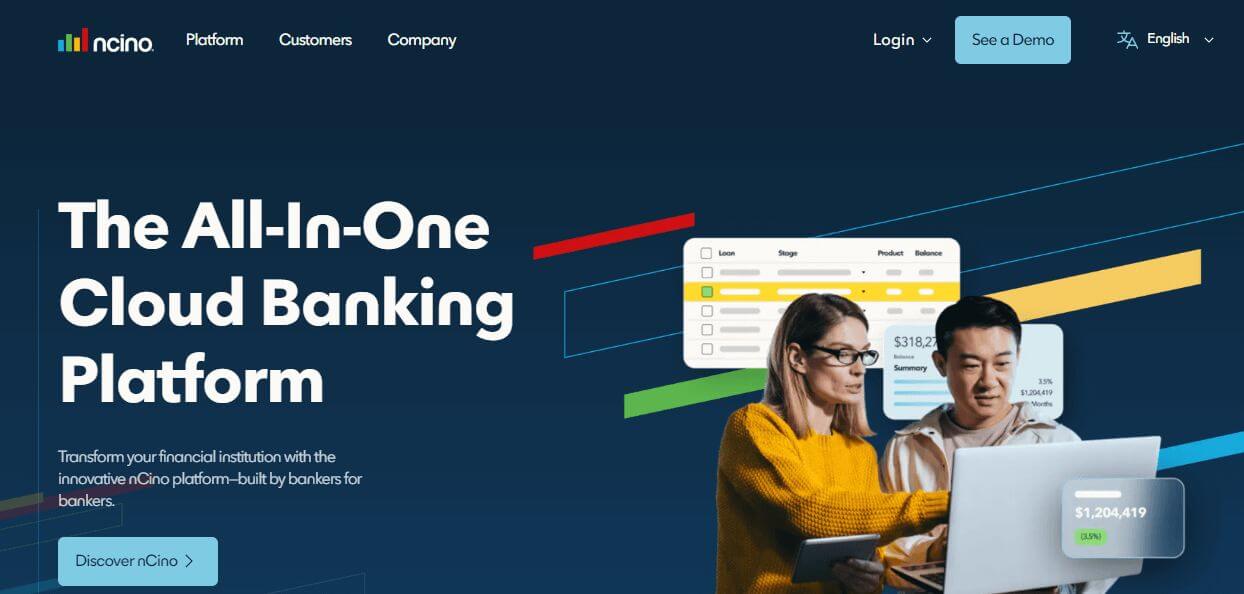
While often associated with loan origination, nCino’s Cloud Banking Platform has expanded into a comprehensive digital experience layer built on Salesforce.
- Strengths: Exceptional CRM integration, streamlined commercial lending workflows, and efficient onboarding processes that make it easier to acquire new customers through quick online sign-up and user-friendly systems.
- Best suited for: Community and regional banks focusing on improving the banker and customer experience.
- Limitations: Less focus on the transactional ledger compared to other infrastructure-heavy providers.
9. Swan
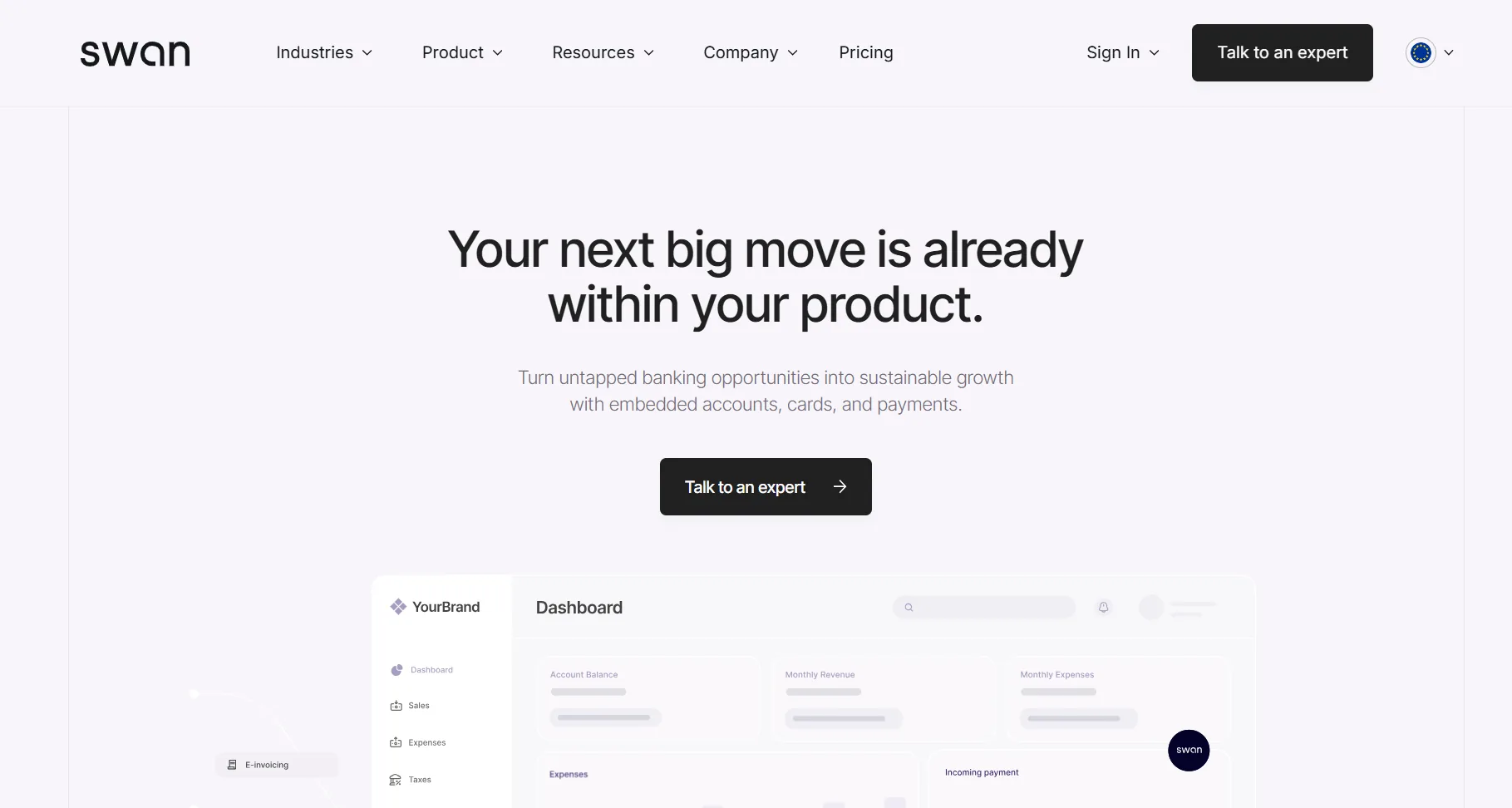
Swan is a European Banking-as-a-Service (BaaS) provider that allows companies to embed banking features, including Mastercard card issuing, via a simple API. Swan empowers financial institutions to offer embedded finance solutions, enabling them to expand their digital banking services with greater flexibility and speed.
- Strengths: Includes the regulatory licence (EMI); incredibly fast to go live (days rather than months).
- Best suited for: Non-financial companies (SaaS, marketplaces) looking to offer embedded finance.
- Limitations: Limited customisation of the underlying banking logic; restricted primarily to the European market.
How to Choose Digital Banking Software Providers
When comparing digital banking software providers, consider these key criteria:
- Functionality: Check whether the platform supports the products and workflows you need, including accounts, payments, cards, onboarding, KYC/AML, multi-currency operations, and reporting.
- Integrations: Review API quality and compatibility with payment networks, card processors, KYC providers, accounting systems, and other third-party services.
- Deployment models: Compare SaaS, private cloud, on-premise, and source-code options based on your requirements for launch speed, customisation, security, and technology ownership.
- Pricing model: Consider setup and licence fees, subscriptions, transaction-based charges, infrastructure, integrations, support, and scaling costs.
- Market reputation: Assess how long the provider has operated, who its clients are, which markets it serves, and what customers say about its technology and support.
- Implementation: Compare expected timelines, customisation requirements, data migration, and the internal resources needed.
- Scalability and compliance: Confirm that the platform can support growing transaction volumes, new markets, and relevant regulatory requirements.
The right provider should offer the required functionality while fitting your technical resources, budget, target markets, and growth plans.
Build vs Buy
Building a digital banking platform internally provides maximum control, but requires significant engineering resources, specialised expertise, and a longer launch timeline. Buying an existing platform reduces development risk and accelerates time to market.
Many institutions choose a hybrid approach: they use proven infrastructure for ledger operations, payments, and compliance workflows, while developing customer-facing features that differentiate their product. The decision should depend on which capabilities create genuine competitive value and which can be sourced more efficiently.
SaaS vs Source Code
SaaS is well suited to organisations prioritising rapid deployment, lower infrastructure requirements, and vendor-managed maintenance. It can reduce initial costs, although customisation and technology control may be limited.
A source-code licence gives institutions greater control over deployment, security, integrations, and product development. It can also reduce dependence on the vendor’s roadmap, but requires a capable internal engineering team.
The right model depends on launch priorities, technical resources, regulatory requirements, and the level of long-term ownership the institution needs.
Integration and Exit Flexibility
A digital banking platform should integrate smoothly with KYC and AML providers, card processors, payment networks, accounting systems, and other third-party services. Evaluate API coverage, documentation, webhooks, sandbox access, and support for custom integrations.
Exit flexibility is equally important. Clear data-export procedures, standard data formats, documented APIs, and transparent contract terms make it easier to change providers or deployment models. These capabilities reduce vendor lock-in and protect the institution’s long-term flexibility.
Final Thoughts
The best digital banking software provider is not necessarily the one with the most features. It is the one that fits the institution’s operating model, technical resources, regulatory environment, budget, and growth plans.
When evaluating providers, consider both immediate needs and long-term implications. Functionality and implementation speed matter at launch, while scalability, integration flexibility, data portability, and technology ownership become increasingly important as the business grows. A platform that balances these factors provides a stronger foundation for sustainable product development.
Create your digital banking solution in weeks
Talk to Our Team