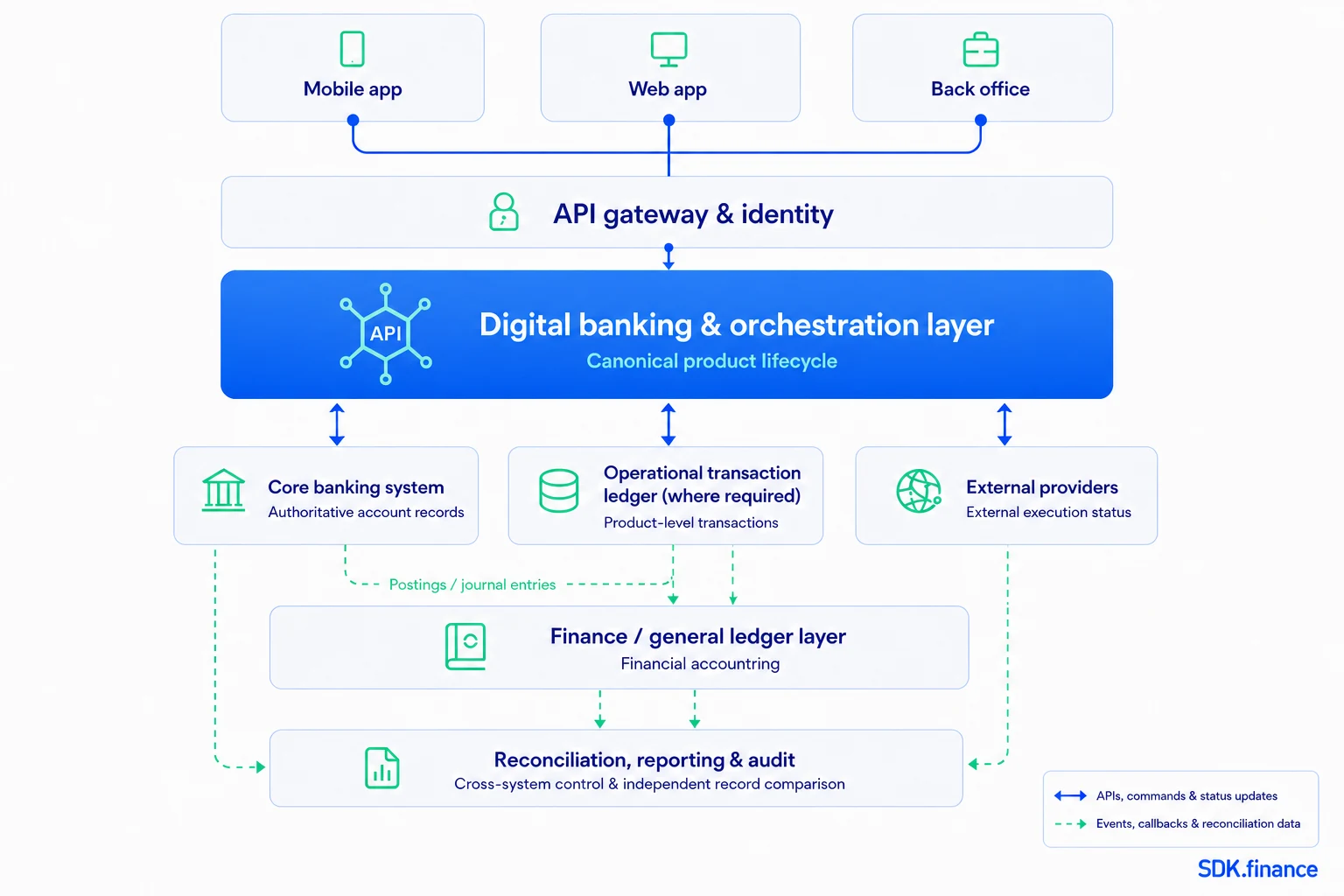
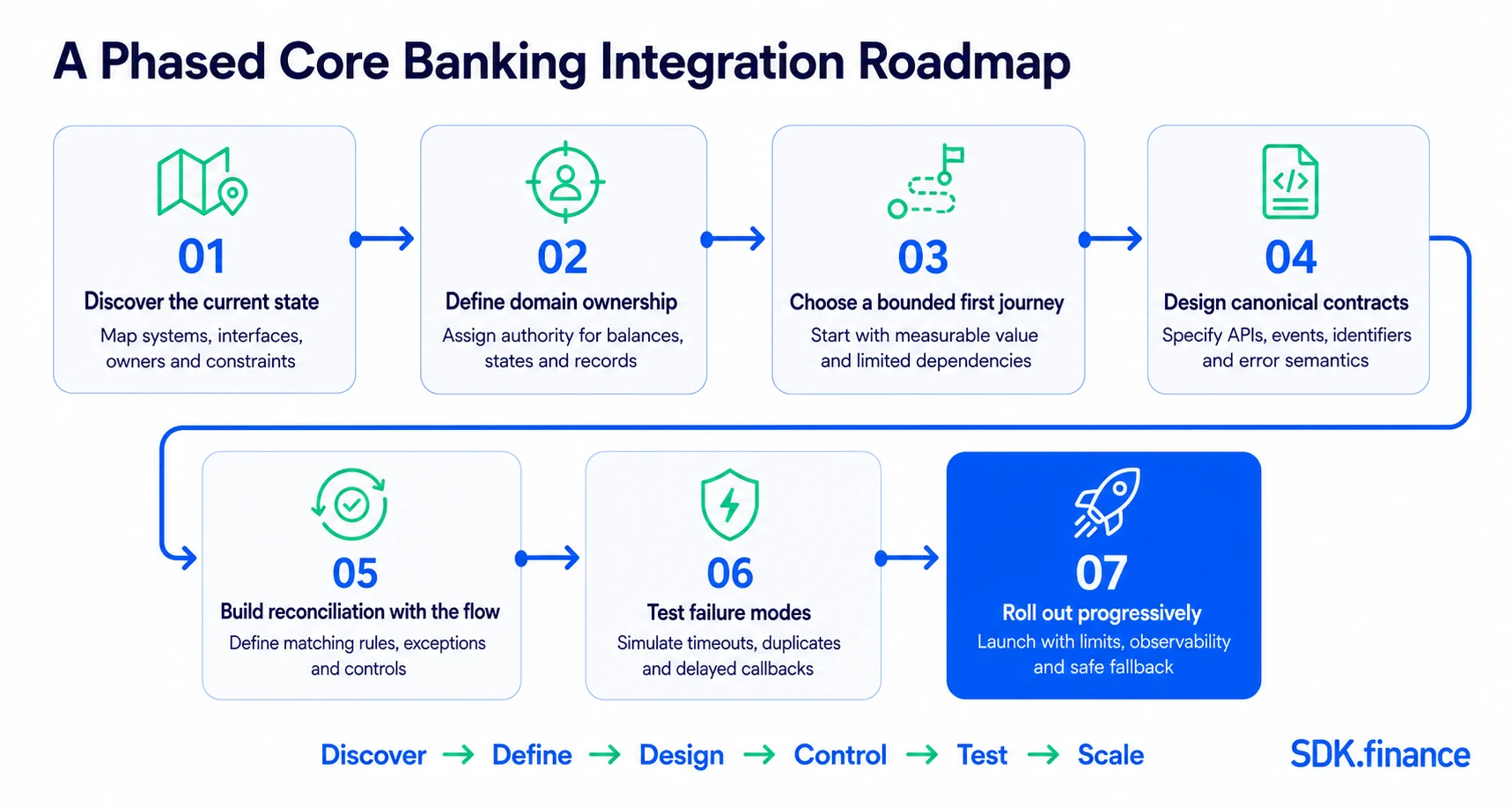
Integration is therefore not simply a connector between two applications. It is an operating model that defines: The specific boundary varies by institution. A retail bank modernising its channels will have different ownership rules from a fintech adding wallets around sponsor-bank accounts. The architecture must follow the product, regulatory and accounting model rather than a generic diagram. Legacy cores often support decades of product configuration, accounting logic, compliance processes and downstream reporting. Replacing them can require extensive data migration, parallel runs, customer remediation and coordination across multiple business units. A digital layer can isolate customer-facing innovation from the release cycle of the core. Teams can redesign onboarding, launch wallet or payment functionality and connect external providers while retaining proven booking processes. This creates a progressive modernisation path: move one journey or capability at a time, measure results and replace core functions only where the business case justifies it. This is not a shortcut around architecture. If both layers can independently change the same financial state, the institution may create conflicting balances, duplicate postings and unclear accountability. The first design question is therefore not “Which API should we call?” but “Which system owns this fact?”. A practical target architecture separates customer experiences, product orchestration, financial records and external execution. The integration layer provides stable contracts between them. This makes bank API integration easier to govern and limits the effect of changes in a legacy interface or external provider. A responsibility matrix should be agreed before implementation. The following model is illustrative: Ownership does not mean other systems cannot hold a copy. It means they know which source prevails when values disagree. Cached balances must carry timestamps; derived states must retain their source; corrections must be traceable rather than overwritten. Most programmes use a combination: Financial APIs require more than clean endpoints. Every money-moving command should carry an idempotency key, correlation ID and durable business reference. A timeout is not proof of failure, so the transaction outcome must be established before retrying. An API success response confirms only the outcome defined by that API contract; it does not by itself prove settlement or cross-system agreement. See how to evaluate an API for additional design criteria. A resilient integration treats reconciliation as part of transaction processing, not as an afterthought. The platform must be able to explain the complete path from a customer instruction to internal postings, external execution, fees, settlement and any reversal or adjustment. Double-entry accounting helps preserve internal balance integrity because each journal entry has equal debits and credits. It does not guarantee that an external provider, core system or settlement account agrees. Reconciliation compares independent records and identifies missing transactions, amount or currency mismatches, duplicate postings, timing differences and incorrect states. At minimum, design three controls: Exceptions should enter an owned queue with reason codes, evidence, ageing, escalation rules and an auditable resolution. Manual edits to “make the numbers match” hide the cause and weaken controls. A better pattern is an explicit correcting entry linked to the original transaction. For further guidance, see payment reconciliation as core fintech infrastructure and double-entry ledgers in fintech. Architecture metrics should extend beyond uptime. Track end-to-end latency, duplicate suppression, unmatched items, reconciliation ageing, manual interventions and time to establish an uncertain transaction outcome. These reveal whether the integration is operationally safe. Integration is prominent in buyer demand. According to SDK.finance’s internal analysis, 28.3% of positively qualified enquiries received in 2026 explicitly identified APIs or integration with existing systems as a priority. Since one enquiry could mention several requirements, the categories could overlap. “You do not necessarily need to replace your existing core banking system to introduce modern digital banking services. Financial institutions approaching SDK.finance have asked about integration with environments built around Temenos Transact and T24, Infosys Finacle, Fiserv, and Sopra Banking. SDK.finance’s API-first digital banking solution and general ledger layer can operate above or alongside the existing core, subject to the institution’s architecture and integration requirements. This approach allows the core to remain the authoritative system of record while a modern digital layer supports customer journeys, accounts and wallets, payment workflows, and operational control.” These examples come from inbound enquiries and do not imply ready-made or certified connectors or formal partnerships with the named vendors. Each implementation requires architecture discovery, API and data-model mapping, clearly defined domain ownership, security controls, testing and institution-specific reconciliation design. Core banking integration can provide a controlled route to digital modernisation without requiring immediate replacement of the existing core. The strongest designs preserve clear system ownership, isolate vendor-specific formats, use synchronous and asynchronous patterns deliberately, and make ledger integrity and reconciliation part of the transaction lifecycle. The result is not merely a modern interface over legacy infrastructure. It is a modular operating architecture in which the core, digital platform, ledgers and external providers each perform a defined role – and every financial outcome can be traced, verified and corrected. Explore how SDK.finance can add a modern digital banking, transaction and ledger layer above or alongside your existing core banking system. Our team can help you evaluate system ownership, API connectivity, transaction flows and reconciliation requirements for your target architecture. SDK.finance provides core banking infrastructure with ledger, payments, wallets, ready applications and flexible deployment optionsWhat Core Banking Integration Actually Means
Core banking integration is the controlled exchange of data and instructions between a bank’s core system and the digital, payment and operational services around it. The core may continue to manage regulated accounts, booked balances, interest, posting rules and end-of-day processing, while a digital banking platform handles mobile and web journeys, wallets, payment orchestration, notifications and back-office workflows.
Why Add a Digital Layer Instead of Replacing the Core?
Target Architecture for Core Banking Integration
Define System Ownership Before Building APIs
Domain
Typical authoritative system
Integration implication
Regulated account and booked balance
Core banking system
Digital channels retrieve or receive the authoritative balance and must not silently recalculate it.
Wallet or product-level balance
Operational transaction ledger
Every movement is recorded as balanced entries and mapped to settlement accounts.
External payment execution status
Payment, banking or card provider
Provider callbacks and enquiries establish the external outcome.
Canonical product transaction lifecycle
Digital orchestration layer
Provider-specific states are mapped into one controlled internal state model.
Statutory accounting
Finance/general ledger
Summaries or journals are transferred with traceable references and controls.
Customer profile
Core, CRM or customer master
Field-level ownership and update permissions must be explicit.
Five Integration Patterns and When to Use Them
Pattern
Best suited to
Main consideration
Synchronous APIs
Balance checks, validation and commands that require an immediate response
Latency and outages propagate unless timeouts and fallback behaviour are controlled.
Event-driven integration
Asynchronous state changes, settlement updates, provider callbacks and notifications
Consumers must handle duplicate and out-of-order events.
Batch or file exchange
Legacy end-of-day processing, reports and bulk transfers
Validation, encryption, acknowledgements and replay procedures are essential.
Change data capture
Publishing database changes where the source cannot emit suitable events
Database structures can leak into integrations and create brittle dependencies.
Adapter or anti-corruption layer
Protecting a canonical model from legacy or vendor-specific formats
The adapter becomes a governed product that requires testing and versioning.
The Role of the Ledger and Reconciliation
A Phased Core Banking Integration Roadmap
How SDK.finance Fits into an Existing Core Banking Environment
Conclusion
For a detailed comparison of responsibilities, seeCore Banking Software vs Digital Banking Software: Key Differences
Read more about the distinction between aledger and a core banking system
Building a FinTech product, PSP/EMI platform, digital wallet, neobank or crypto-friendly banking solution?