Agentic banking uses AI agents to plan and carry out banking tasks within defined permissions. A customer might ask their bank to set aside money for savings while leaving enough for upcoming bills. Fulfilling that request requires the agent to check available funds, identify obligations, propose an amount, and coordinate an authorised transfer.
For bank and FinTech leaders, the question is which tasks agents can complete reliably. In this guide, SDK.finance, a digital banking software provider, covers five use cases, their infrastructure requirements, and how to measure value before expanding deployment.
Discover how the SDK.finance TPS can power high-speed, secure operations across banking, fintech, and retail
Talk to Our TeamWhat is agentic banking?
Agentic banking applies goal-directed AI to banking workflows. An agent interprets a request, selects permitted tools, checks results, and decides what to do next. Its scope may end at preparing a recommendation or extend to executing an authorised action.
An agentic centric approach organises the workflow around the customer’s goal, while the bank defines which actions the agent may take and when a person must approve them.
Many applications of machine learning in banking predict an outcome or classify information. Agentic AI in banking connects analysis to a sequence of actions. A fraud score, for example, could inform an investigation without the scoring model managing that investigation.
Generative AI produces content, such as a response or document summary. Agentic AI coordinates actions towards a goal, using tools and checking results across steps. A generative model can be part of an agent, but generating an answer does not itself complete a banking task.
| Approach | Who selects the next step? | Actions and approvals |
|---|---|---|
| Traditional automation, including RPA | Predefined workflow rules | Can call APIs and span systems; approvals follow configured rules |
| AI copilot | Usually a person using AI suggestions | Assists work; execution depends on its permissions and design |
| AI agent | Agent selects steps towards a goal | Uses permitted tools; independent controls enforce authority and approval requirements |
The autonomy of AI agents in banking is a design choice. Three practical operating modes clarify who authorises execution:
- Recommendation: the agent reads permitted information and proposes a next step. A person decides whether to act and initiates the operation.
- Confirmed action: the agent prepares an operation, but a customer or authorised employee must approve it before execution.
- Delegated execution: the agent acts within previously approved limits, such as specified accounts, amounts, and duration. Independent controls check each operation and escalate anything outside that authority.
These are operating choices, not an official banking classification. For a stable task with a fixed sequence, conventional automation may be simpler and cheaper.
Agentic payments concern payment-related tasks within this broader field. Machine-to-machine payments describe systems transacting with each other and do not necessarily involve AI.
Agentic banking use cases
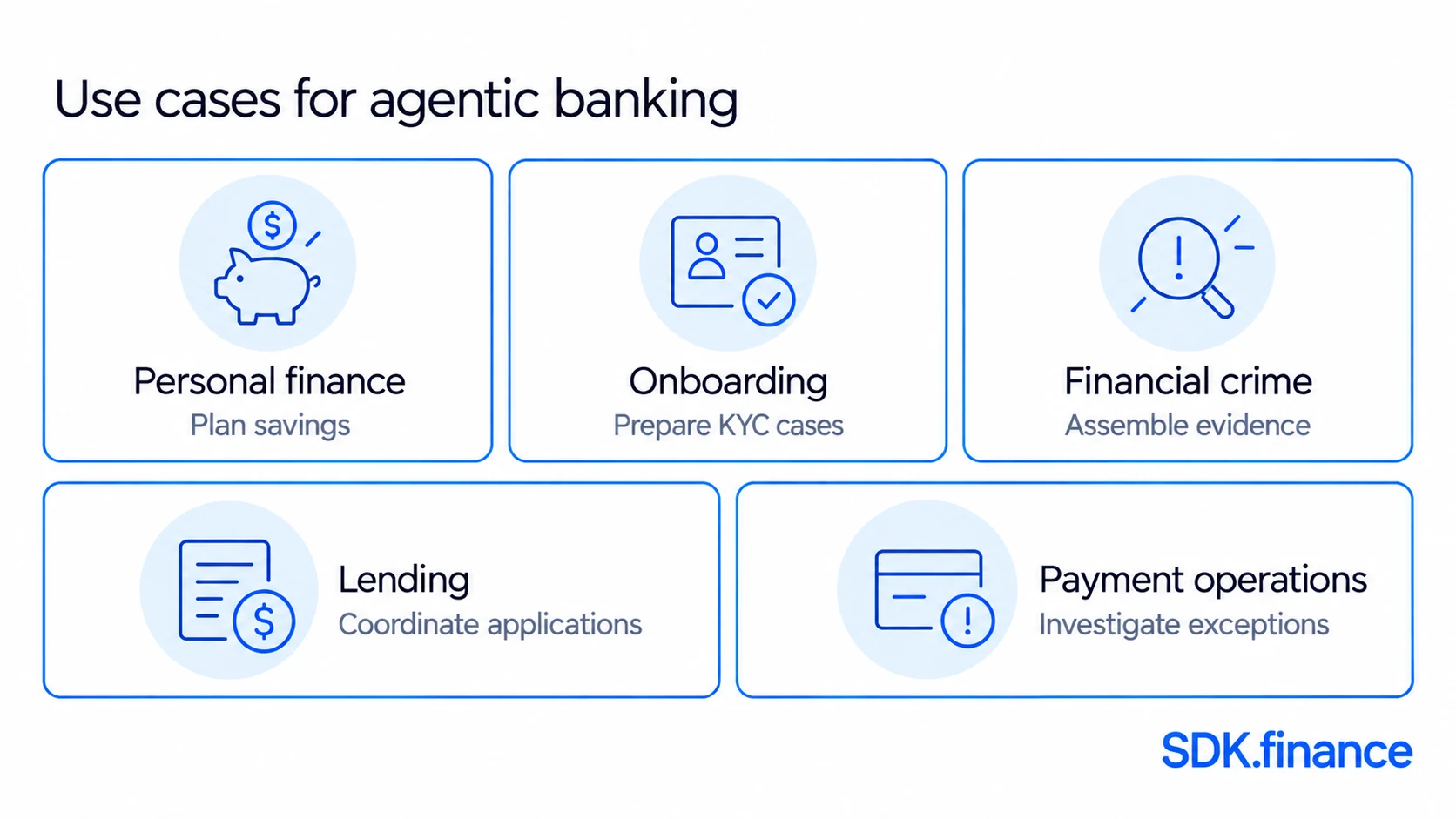
SDK.finance examines practical agentic AI use cases in banking across customer-facing tasks and internal operations. Personal money management serves the customer directly; the remaining examples support onboarding, investigation, lending, and payment teams. Evaluate each workflow by its outcome, permitted actions, and review requirements.
Personal money management and servicing
A confirmed example is Starling Assistant. Starling’s launch announcement describes conversational support for savings goals, automatic transfers to dedicated Spaces, budgeting, and spending questions. It announced a rollout to personal current account customers and requires customers to opt in.
For a similar workflow, measure completion, abandonment, and customer corrections. Define account access, transfer authority, and confirmation requirements.
The savings workflow below is a separate illustrative scenario, not a description of Starling’s implementation.
Customer onboarding and KYC case preparation
In an illustrative onboarding workflow, an agent checks whether an application contains the required documents, identifies inconsistent details, and requests missing information through an approved channel. It then prepares a case for know your customer (KYC) review.
The potential benefit comes from reducing repeated document chasing and incomplete submissions. Measure time to a complete dossier, rework, and the accuracy of flagged discrepancies.
The agent’s preparation role must remain distinct from identity verification, screening, and the bank’s acceptance decision. External providers and authorised staff retain their assigned responsibilities. When evaluating payment and KYC integrations, establish which system supplies each result and how unresolved checks reach a reviewer.
Financial crime investigation support
An investigation agent could assemble transaction history, relevant customer information, and earlier case records into an evidence-linked timeline. An analyst would review the material and decide what further investigation or escalation is needed.
This illustrative use case targets preparation effort. It does not require the agent to replace fraud scoring, close alerts independently, or determine reporting obligations.
Measure preparation time, factual corrections, and missing evidence. Restrict access to the case being investigated, and require the agent to distinguish observed facts from proposed explanations.
Lending workflow coordination
A lending agent could coordinate the steps needed to make an application ready for assessment: check document completeness, request approved supplementary information, and assemble the evidence for a reviewer.
Applicants could face fewer document requests, while lending teams spend less time chasing information. Track time to an assessment-ready application and dossiers returned for correction.
This coordination workflow leaves credit decisions with authorised reviewers. Eligibility, affordability, and customer communications require separate controls; conflicting evidence should trigger review.
Payment exceptions and reconciliation investigations
When a payment status and an internal record disagree, an agent could retrieve the relevant transaction, provider response, and ledger entries, then suggest a likely cause and next step.
The potential gain is less manual searching across systems. Measure investigation time and the accuracy of exception classification against reviewed cases.
In this illustrative workflow, the agent cannot simply overwrite posted accounting entries or assume a payment has failed because a response is missing. It should route proposed corrections through authorised procedures. Accounting adjustments and reversing an external payment are separate operations.
For a first pilot, favour verifiable outcomes and errors that reviewers can detect and correct.
How agentic banking works: data, authority, and execution
In the illustrative savings workflow, the application establishes who is making the request and which accounts the agent may access.
Customer context includes available funds, scheduled bills, pending transactions, and open service requests, each with a source and timestamp. Pending card payments may reduce safe-to-save funds before ledger posting. If inputs conflict, pause and seek clarification.
The agent retrieves permitted balance and obligation data through banking APIs. It proposes an amount and explains the information used.
Before execution, independent controls recheck permissions, available funds, transfer limits, and confirmation against current data. The balance may have changed since planning.
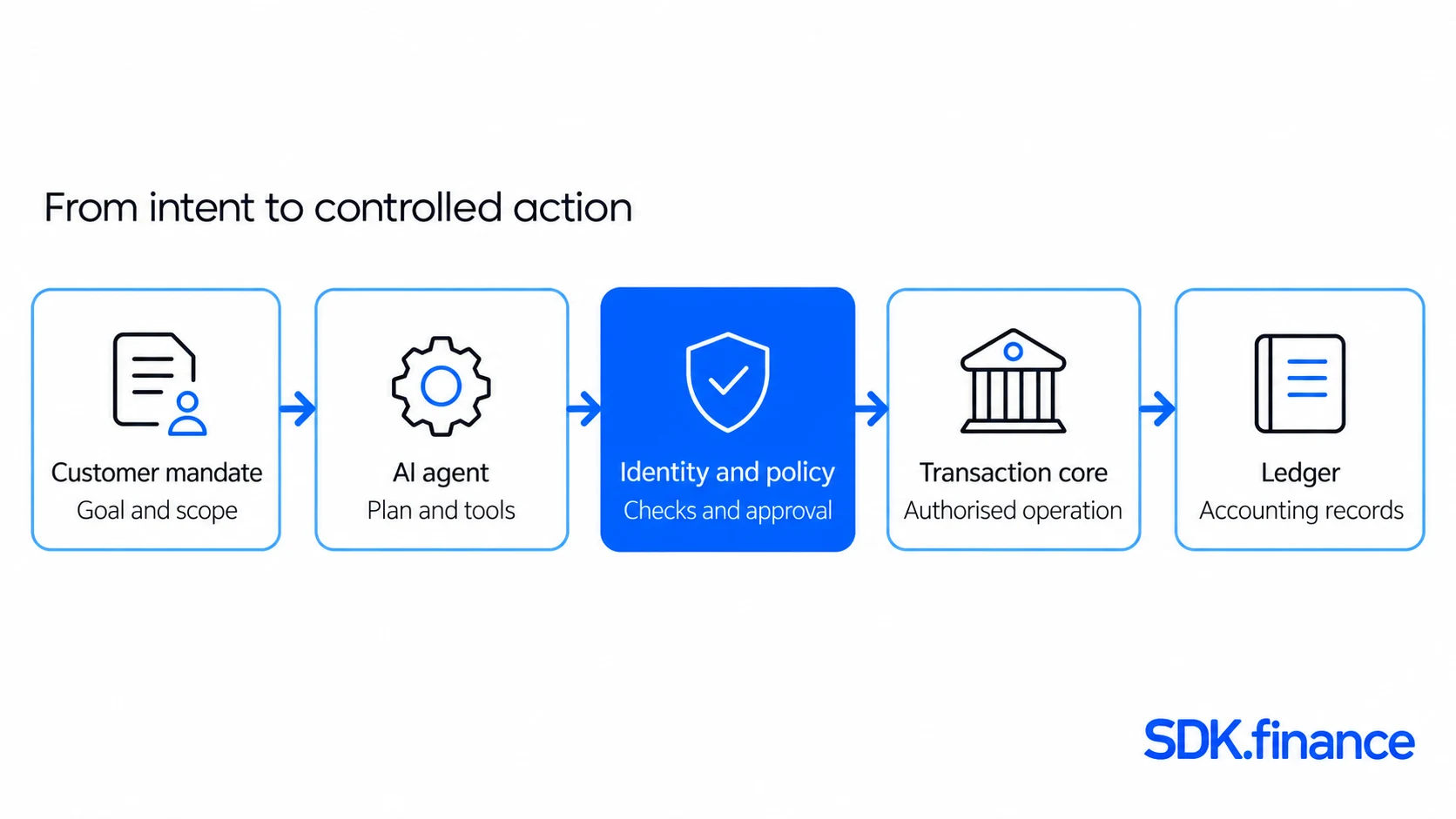
The authorised request then reaches the transaction system. For an internal savings transfer, no external payment provider may be needed. An external transfer adds the relevant provider and its processing statuses.
An API accepting a request does not prove settlement. The application must track the operation to the appropriate final state and explain unresolved outcomes accurately. An event-driven banking architecture can help systems react to status changes, but events may arrive late or more than once.
The model never writes balances directly. Financial operations pass through controlled services, while double-entry ledger infrastructure records the corresponding accounting entries. The ledger explains the financial effect; the agent’s action log explains the request, tools used, and decisions applied. Both are needed for investigation.
SDK.finance frames agentic banking infrastructure around four responsibilities: planning, authority, execution, and accounting. This lets teams change the agent without weakening the controls protecting financial records.
Discover how the SDK.finance TPS can power high-speed, secure operations across banking, fintech, and retail
Talk to Our TeamBenefits of agentic banking and how to measure them
Agentic banking can reduce the effort required to complete work across several systems. The benefit depends on task quality and the amount of human intervention still required.
| Potential benefit | Mechanism | Metric | Dependency |
|---|---|---|---|
| Less manual preparation | Collect and organise evidence | Time per accepted case | Reliable records and traceable sources |
| More completed customer tasks | Coordinate steps through approved tools | Completion and correction rates | Usable journey and valid permissions |
| Fewer manual handovers | Route work with relevant context | Transfers and rework per case | Clear ownership and exception handling |
Compare results with a pre-pilot baseline, including difficult cases. Cost per successful task equals attributable costs divided by accepted completions. Include human review and corrections so faster processing does not conceal work elsewhere.
The ROI of agentic process automation in banking must also account for integration, licences, model usage, monitoring, and support. Allocate implementation expenditure consistently over the business-case period.
Net benefit equals measured benefits minus attributable costs. Released time creates financial value only when reused productively. Track customer outcomes separately where their monetary value is uncertain.
Key implementation challenges in agentic banking
Data quality and legacy integration
Legacy interfaces may omit pending activity, expose stale balances, or return inconsistent status codes. Test whether each connected system supplies the inputs and outcomes your workflow requires.
Assign a data owner to resolve discrepancies and define how long each input remains valid. A limited workflow can run alongside an existing core if its interfaces meet these requirements; full core replacement is not automatically necessary.
Identity, permissions, and consent
Consent must remain valid as the workflow changes. Define how customers withdraw authority and how that withdrawal reaches every service capable of executing an operation.
AI agents need clearly defined identities and accountability for their actions. Apply narrowly scoped permissions, revocable access, and additional approval for higher-risk actions. Avoid broad shared credentials that make it difficult to establish who authorised an operation.
Reliability and security
Agents can choose unsuitable tools, repeat an operation, or follow malicious instructions embedded in retrieved content. Testing should check how agents respond when attackers manipulate the information they read, including attempts to redirect actions or bypass controls.
Treat external content as data, restrict available tools, and enforce transaction checks outside the model. Use execution limits to stop loops. Design idempotency so a repeated request cannot create a second financial operation, and check an uncertain transaction’s status before retrying. Test these controls with adversarial inputs and realistic failure scenarios.
Accountability, privacy, and auditability
Assign an owner who can explain and stop each workflow. Keep evidence of the request, relevant source records, approvals, tool results, and applicable model and policy versions.
An action record should document observable events and decision grounds. It should not depend on exposing a model’s internal chain of thought. Apply appropriate access and retention controls to personal information, including copies created during investigations. Legal and regulatory obligations depend on the activity and jurisdiction and require assessment by the responsible teams.
Economics and operational readiness
Assign a business process owner accountable for outcomes. Business and risk owners should approve the agent’s permitted actions and escalation thresholds, with security teams validating access controls.
Name the operations team that receives exceptions and give it the evidence and authority to resolve or escalate them. Train staff to resume suspended tasks, and match escalation volumes to the team’s capacity.
How to implement and scale agentic banking
SDK.finance recommends five steps for an agentic centric implementation:
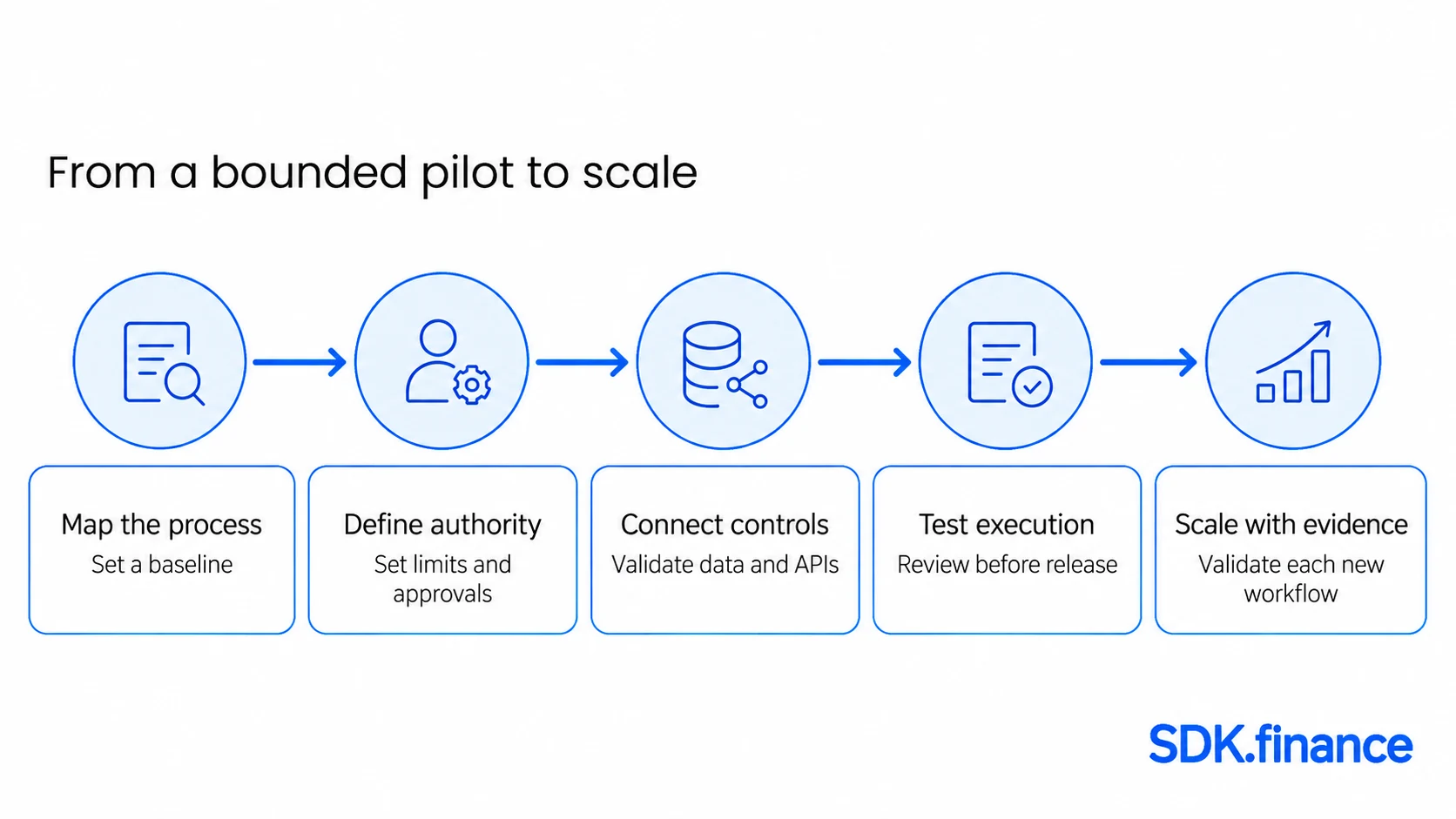
- Select a pilot and establish a baseline. Assess task frequency, data quality, whether results can be verified, the consequences of errors, and the ability to hand work to a person. Map the required systems and measure current completion time, quality, and cost per successful outcome.
- Specify authority. Record permitted and prohibited actions, limits, confirmation rules, and conditions requiring a handover.
- Connect data and controls. Test API access, data freshness, independent authorisation checks, and transaction status handling.
- Test before enabling execution. Begin with read-only or shadow operation, where proposed actions are reviewed without being carried out. Introduce confirmed actions after evaluation.
- Scale one workflow at a time. Reuse interfaces and monitoring, but validate each process’s data, permissions, and failure cases. Confirm support capacity before increasing autonomy and retest after model or policy changes.
For the savings example, agree on exception handling before the first live transfer:
| Situation | Expected behaviour | Accountable team |
|---|---|---|
| Upcoming bill data is incomplete | Ask for clarification; do not guess spare funds | Product and operations |
| Amount exceeds delegated authority | Request approval or reject | Policy and security |
| Provider response is missing | Establish status before retrying | Integration and payment operations |
| Request or event repeats | Prevent a second financial operation | Engineering |
Where SDK.finance fits in an agentic banking architecture
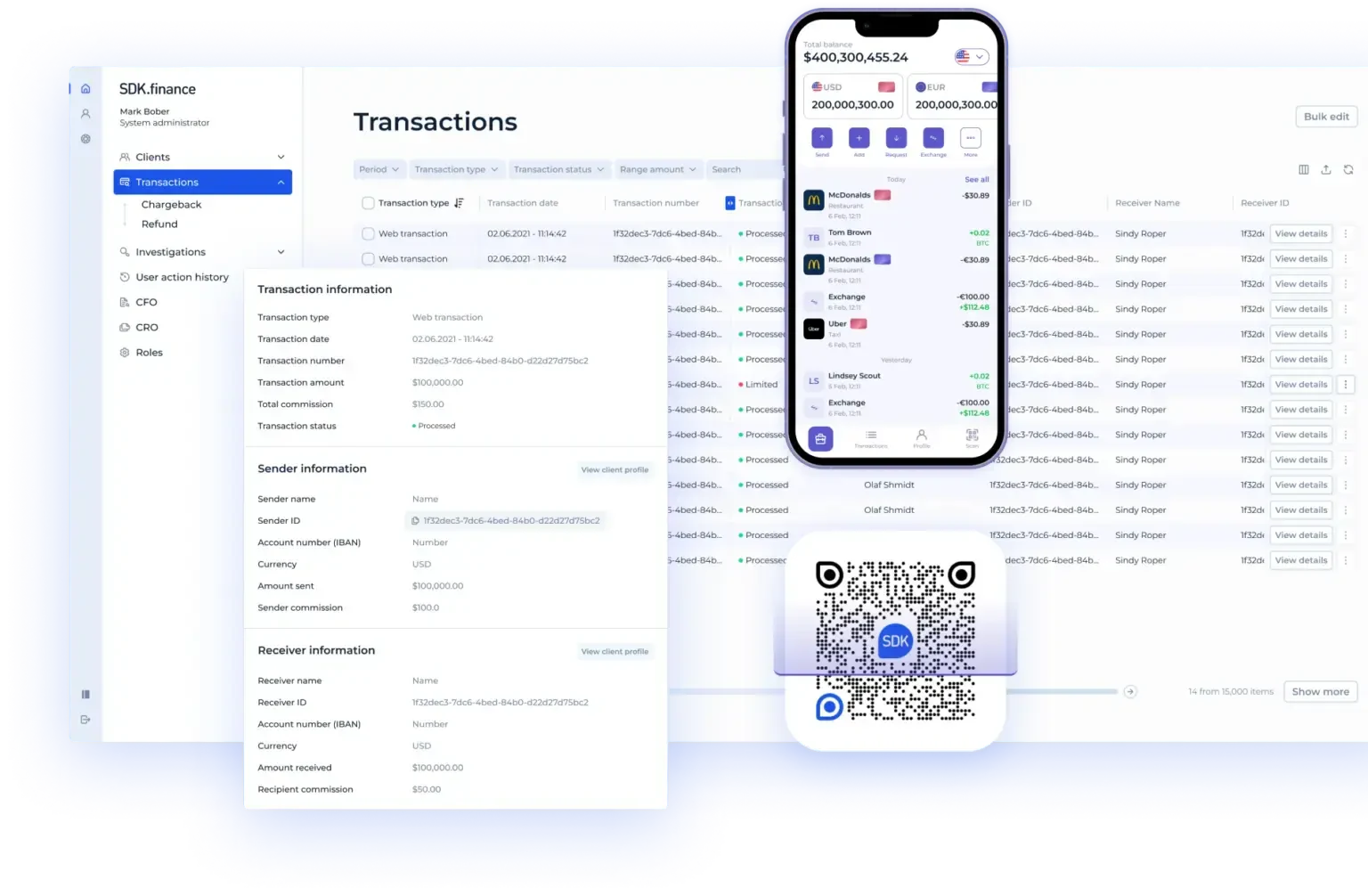
An agent handling a savings request needs access to the right balance, a permitted way to initiate a transfer, and a reliable result to report to the customer. The Transaction Platform can provide wallet and account management, internal transfers, and APIs for the underlying financial operations. In this design, the integration must translate the customer’s approved instruction into a supported operation and enforce the required account permissions before execution.
For an agent assisting with a payment exception, transaction records provide concrete evidence to investigate: the transaction status, business request status, and provider reference. A team could use these records to help the agent prepare a case for an operator, rather than infer a payment outcome from a missing response. Access to provider data and the investigation workflow must be scoped as part of the integration.
If the bank already executes transactions in an existing core, General Ledger can provide the accounting layer. It maps incoming business events into balanced journal entries through configurable rules. In an agentic banking workflow, this records the financial effect of executed operations; the agent’s request, approvals, and tool actions still need their own linked operational record.
Map the agent’s task to the required transaction and accounting components. Scope customer delegation, agent identity, approvals, and exception handling alongside them.
Explore SDK.finance Agentic Banking to discuss how AI agents can connect with account data, banking APIs, and transaction workflows in your product.
Discover how the SDK.finance TPS can power high-speed, secure operations across banking, fintech, and retail
Talk to Our Team