For banks, payment providers, and FinTech teams, this makes financial cyber attacks a question of control over money as well as access to systems. If a trusted account is compromised, what prevents it from creating and approving its own transaction?
The cases below show how attackers reached payment and core systems, which controls they bypassed, and what payment product teams can check before a similar weakness leads to a loss.
Discover how the SDK.finance TPS can power high-speed, secure operations across banking, fintech, and retail
Talk to Our TeamHow financial cyber attacks reach payment and core systems
A financial core maintains accounts, balances, and transaction rules. Through core banking integrations, it connects to applications and external services that may instruct a bank or custodian to move assets. Each connection needs separate checks on identity and financial authority:
- Authentication: which identity is making the request?
- Authorisation: what may that identity do, and is this particular operation approved?
A successful login does not establish permission to release a payment. Likewise, permission to deploy software should not automatically include permission to approve withdrawals.
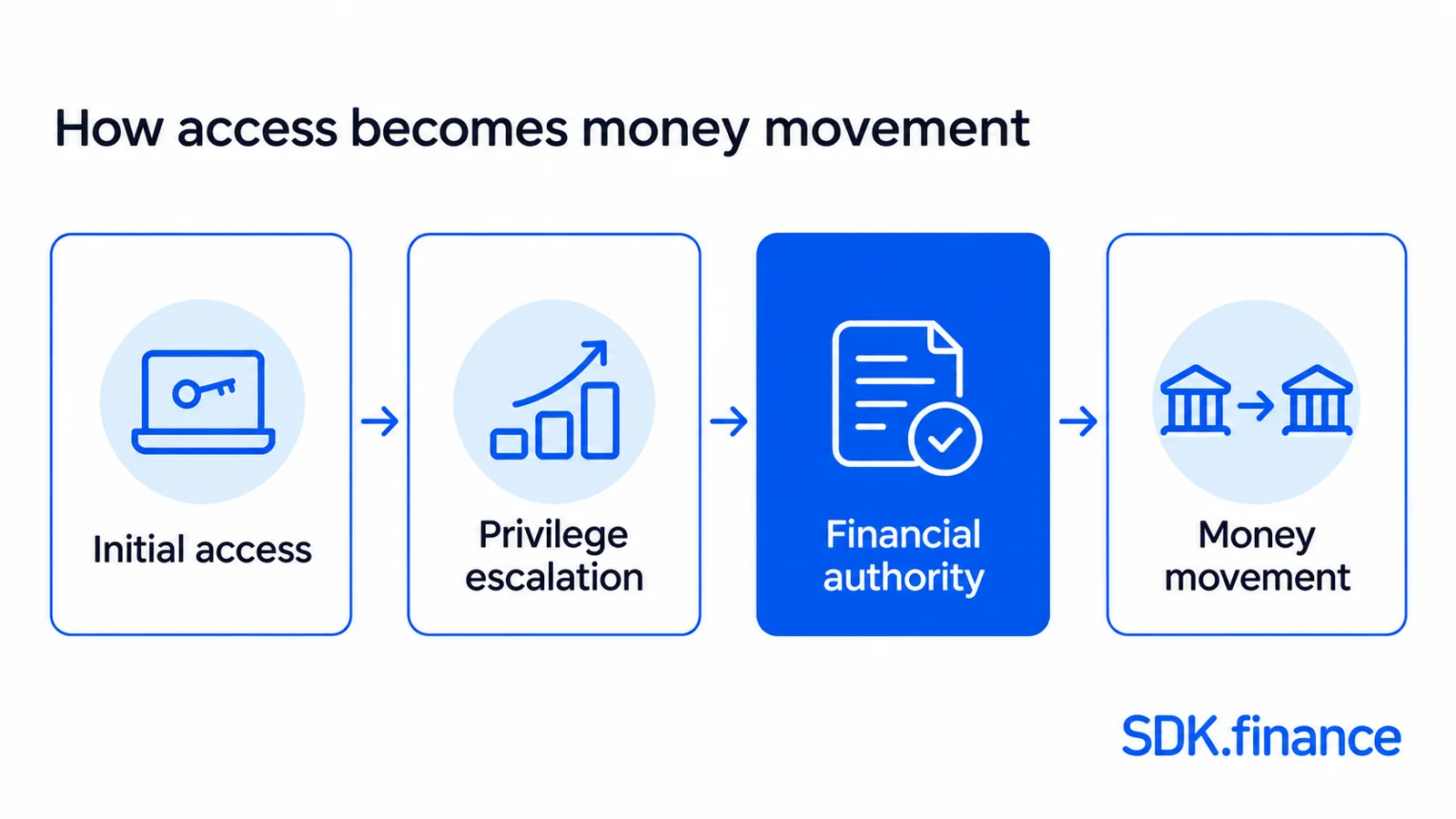
Attackers may enter through employees and devices, applications and APIs, management interfaces, or connected suppliers. They then seek credentials or permissions that bring financial operations within reach. The stages may overlap: an insider may already hold financial authority. Some public reports confirm unauthorised transactions but leave the entry point unknown.
This is more than a theoretical distinction. Mandiant and Google Threat Intelligence Group’s BREEZE COMET study describes activity investigated from 2024 onwards that targeted Brazilian organisations with access to banking software and payment APIs. It links compromised privileged accounts and access to financial applications with fraudulent transactions. It describes a campaign, not a single 2026 incident.
What attackers can change once they gain access
Review the financial outcome an action can create, not just the screen or endpoint that exposes it. A change to a balance, beneficiary, or risk rule may be as consequential as the final transfer instruction.
These are possible financial outcomes, not claims that every failure occurred in the incidents below.
| What attackers can change | Possible financial consequence |
|---|---|
| Available balances and funding records | Funds become spendable without evidence they were received |
| Beneficiary, amount, currency, or payout route | An approved payment becomes a different payment |
| Direct APIs and service functions | Release bypasses the normal workflow |
| System accounts, posting rules, and risk settings | Financial records or release decisions are altered |
| Provider confirmations and internal status | An unexecuted payment appears complete |
| External mandates or delegated permissions | Asset movement continues after local shutdown |
A balanced set of double-entry accounting entries does not by itself prove that an operation was authorised or funded. Similarly, an internal success status does not establish that an external institution completed the expected transfer. Those are separate questions, requiring separate evidence.
Ways attackers bypass financial controls
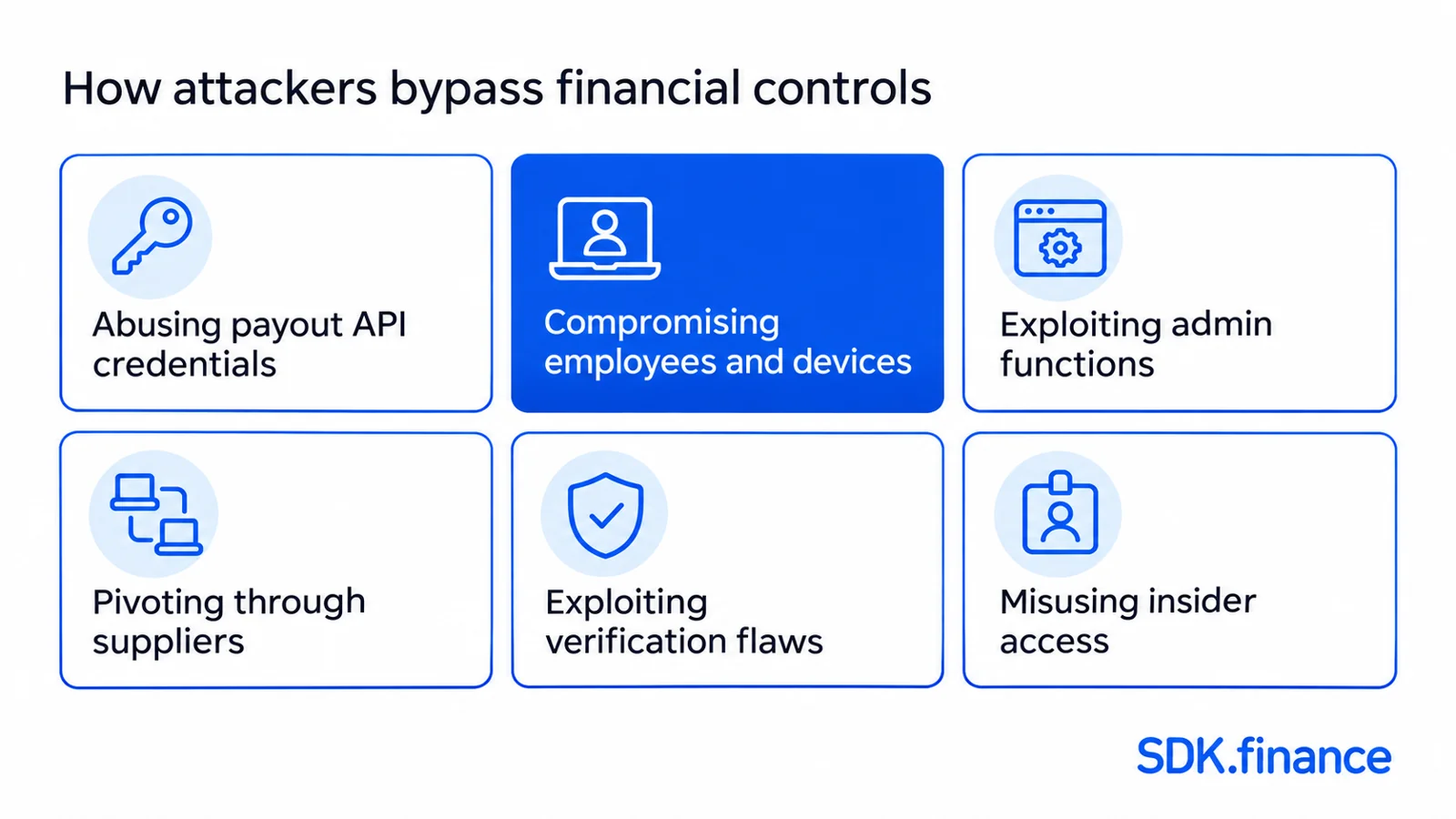
The cases below show how these attack routes affected different financial systems, and where the public reports leave gaps.
| Case | Affected system | Reported activity and outcome | Unknowns and report limits |
|---|---|---|---|
| Western Capital | Bank payouts via IMPS | Unauthorised debits involving ICICI Bank payout APIs integrated through OneFin. | The 10 October 2026 filing did not establish the entry point or link every CERT-In campaign technique to this case. |
| Triple-A | Crypto operational wallets | Valid API credentials used to withdraw cryptocurrency. The company says its own assets were affected; safeguarded client funds were unaffected. | The 21 August 2026 report described an ongoing investigation, with asset tracing and recovery continuing. |
| Trade Works | Securities trading | Unauthorised trades; accounts restored the same day. In its 2 November update, the company said it had not confirmed any unauthorised outflow of customer funds. | The exact request and credential were not disclosed. The company was still confirming details with the affected institution. |
| Bitget | Crypto withdrawal infrastructure | Unauthorised outbound transfers from hot and warm wallet infrastructure were detected. Reports also describe privileged appliance access, malicious packages on a wallet server, and forged withdrawal risk parameters. | Mandiant’s 28 September and SlowMist’s 29 September 2026 findings were preliminary; the full path between systems remained unresolved. |
| Gnosis Pay | On-chain withdrawal modules | A verification flaw enabled unauthorised withdrawals, and attackers extracted approximately $1.5 million. Gnosis absorbed the losses and restored all user funds, according to its 3 July report. | The finding concerns specific smart-contract modules; it does not establish the same flaw in banking APIs. |
| Tântalo / Chave Mestra | Banking operations | Police alleged false system entries, fraudulent credit operations, improper transfers, and misuse of employee access. | The 10 September and 5 November 2026 police releases described allegations under investigation, not findings of guilt. Exact failed controls were not established. |
Abusing legitimate payout API credentials
A payout API lets software instruct a provider or bank to send money. If its credentials are stolen, the final payment checks must still reject instructions that lack business approval.
CERT-In’s October 2026 advisory describes attackers compromising exposed applications and middleware, stealing payment credentials, and sending transfer requests from organisations’ own trusted infrastructure. These requests bypassed application checks, including approved records, beneficiary verification, and limits. The bank-facing request could therefore look legitimate while skipping the workflow that made it legitimate in business terms.
According to Western Capital’s exchange filing, unauthorised debits used India’s IMPS payment rail, with abnormal activity involving ICICI Bank payout APIs integrated through OneFin. The filing did not establish the initial entry point. It does not prove that Western Capital suffered every technique in the separate CERT-In campaign.
Controls to verify
- Require an approved business operation and check its recipient, amount, currency, and limits before release.
- Separate test and production credentials, and restrict each integration’s permissions.
- Make credential revocation practical, including at the external provider.
A source-IP restriction narrows access, but cannot establish payment approval when the trusted server itself is compromised.
Compromising employees and trusted devices
An engineering account may connect deployment tools and production services. The Triple-A case shows why that access needs to remain separate from permission to withdraw funds.
According to Triple-A’s incident post-mortem, the July 2026 attack began with social engineering across several communication channels, including impersonation and a live call. Compromised engineering credentials led to higher permissions, malware deployment, production-database access, and abuse of valid API credentials to withdraw cryptocurrency.
Triple-A says the affected wallets held its own assets and separately safeguarded client funds were unaffected. Its 21 August 2026 report described the investigation as ongoing, with the focus shifting to tracing assets and potential recovery.
For the surrounding workflow, see how crypto deposits and withdrawals connect provider execution with internal balances.
Controls to verify
- Protect work devices and verify unusual support or recruitment requests through independent channels.
- Restrict access from employee systems to production services.
- Separate deployment and administration rights from permission to release funds.
- Show the actual destination and amount when a person approves a withdrawal.
Exploiting exposed administration functions
Management functions can bypass the steps that ordinary users see. A support or maintenance route becomes a financial risk if it can initiate payments, trades, or balance changes without equivalent checks.
According to the Trade Works incident update published on 2 November 2026, a configuration flaw exposed a restricted management function to external access. A third party used it to execute unauthorised securities trades. The affected accounts were restored to their pre-transaction state the same day. The company said it had not confirmed any unauthorised outflow of customer funds.
The exact request and credential were not disclosed. The company said it had closed external access to the function and inspected other internet-accessible paths. The case shows why reviews must cover trading operations as well as withdrawals.
Controls to verify
- Restrict management-interface access and enforce permissions on the server for every sensitive action.
- Test access through actual external entry points, including proxies and gateways.
- Apply equivalent financial checks to administration, background services, and normal user workflows.
- Record the reason and authority for balance corrections or orders, and expose the resulting activity to an independent reviewer.
Pivoting through suppliers and security infrastructure
Security appliances and supplier connections often have broad production access. Review them as privileged systems that could become a route to payment services.
According to Mandiant’s preliminary Bitget report dated 28 September 2026, attackers gained privileged access to third-party security appliances, moved to a production wallet job server, and deployed malicious packages. The report also states that Bitget detected unauthorised outbound transfers from part of its hot and warm wallet infrastructure on 25 September. This confirms actual asset movement, while the preliminary findings establish an infrastructure path rather than a breach of the appliance vendor’s own corporate network.
SlowMist’s investigation update, covering findings as of 29 September 2026, reports a customised tool that forged risk-control parameters and invoked withdrawals. It also identifies a zero-day vulnerability in a service on a security-product node. The report describes parts of the attack, but does not establish the complete path between systems.
Controls to verify
- Give suppliers dedicated identities with narrow permissions and isolate them from payment-release services.
- Review and monitor security products as privileged infrastructure.
- Separate permission to change withdrawal rules from permission to release assets.
- Revoke surviving sessions, credentials, and external delegations when disconnecting a supplier.
Exploiting approval and verification flaws
A verification error must stop the payment. Software should not treat a response as approval unless the check itself succeeded.
According to the Gnosis Pay vulnerability post-mortem, the June 2026 incident involved smart-contract modules that checked a returned approval value without requiring the verification call itself to succeed. A failed call could therefore be accepted as valid, allowing unauthorised withdrawals to be queued and subsequently executed. Gnosis’s 3 July 2026 report states that attackers extracted approximately $1.5 million, while a further approximately $300,000 became inaccessible. Gnosis absorbed the losses and restored all user funds. This was a specific on-chain mechanism, not evidence that ordinary banking APIs share the same flaw.
A separate integration risk is a forged callback: a message claiming that a provider completed an operation. If software trusts that message without verifying its source and matching it to the expected payment, it could update a balance or mark an operation complete incorrectly. This is a failure path to test, not the reported cause of the Gnosis incident.
Controls to verify
- Require verification to succeed and reject malformed or failed responses.
- Bind approval to the exact beneficiary, amount, currency, and operation reference.
- Invalidate approval after material changes to the instruction.
Misusing privileged insider access
Some financial attacks begin with legitimate employee access. An insider may misuse an authorised function, submit false data, or combine duties that should require independent checking.
Brazil’s Federal Police described suspected misuse of an employee’s position in Operation Tântalo, including alleged false system entries, fraudulent credit operations, and improper transfers. Its Operation Chave Mestra release describes allegations involving employee access, credentials, and unauthorised customer-account activity. The releases, dated 10 September and 5 November 2026 respectively, describe allegations under investigation. They do not establish the exact software controls that failed, and the police-operation dates are not necessarily the dates of the financial acts.
Controls to verify
- Separate the maker who prepares an operation from the checker who approves it. Two roles controlled by one person do not provide independence.
- Review privileges for conflicting duties and excessive access.
- Monitor changes to beneficiaries, balances, and financial rules against the employee’s responsibilities.
- Make emergency access time-limited and review its use afterwards.
- Retain what was approved, by whom, and whether the details changed before execution.
Discover how the SDK.finance TPS can power high-speed, secure operations across banking, fintech, and retail
Talk to Our TeamHow to defend the core, integrations and payment execution
Map your payment processing architecture across three layers and assign controls so that compromising one component does not automatically give an attacker control over the whole payment journey.
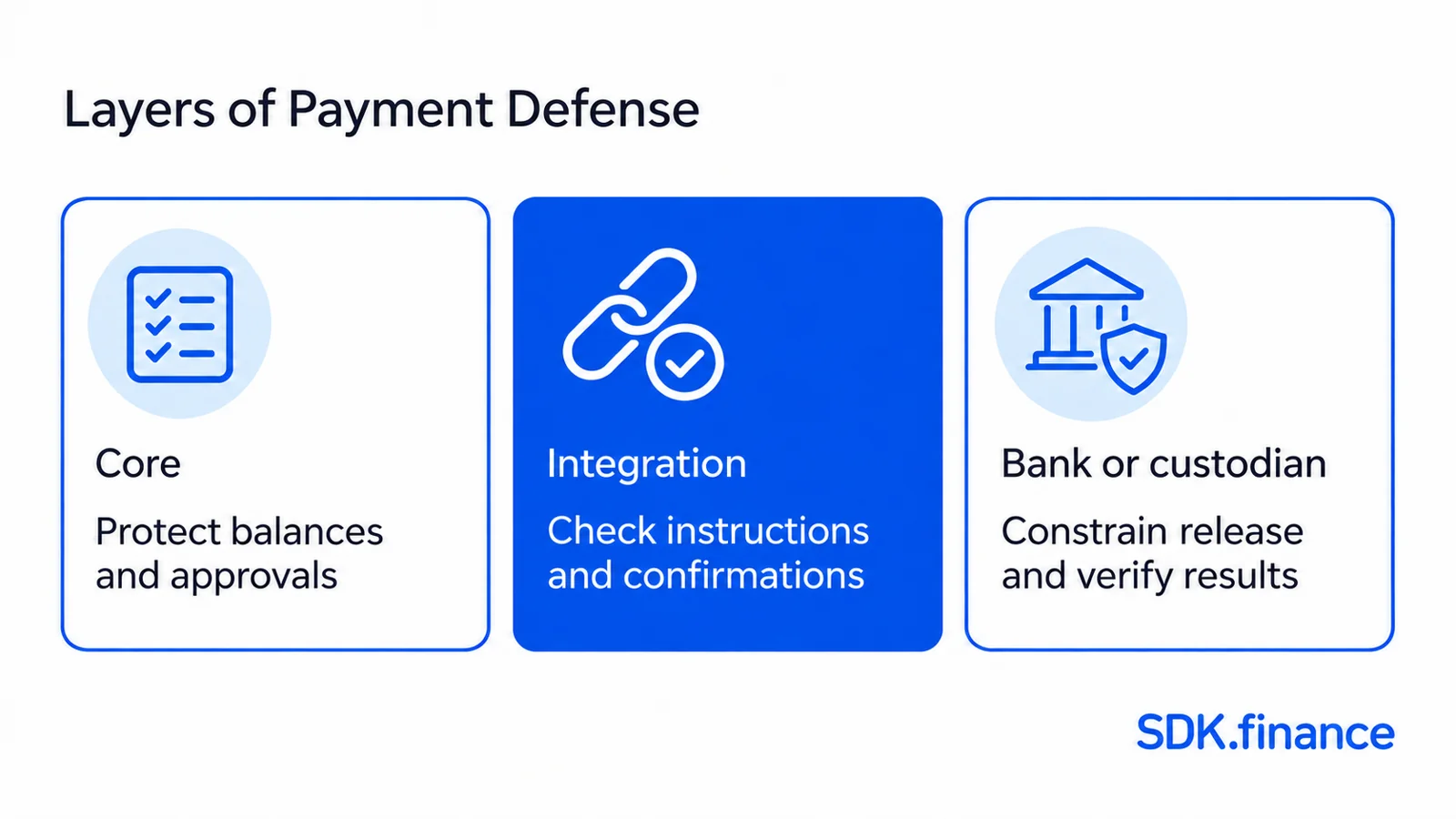
Protect each layer
- Core: restrict posting, balance adjustments, system accounts, and financial-rule changes. Require funding evidence before credit becomes spendable. OWASP’s transaction-authorisation guidance recommends a final authorisation check before execution.
- Integration: restrict provider credentials and match instructions and confirmations to the same approved operation. OWASP’s secrets-management guidance covers creation, rotation, revocation, and expiry. Rotating a key does not repair an unchecked payment workflow.
- Bank, provider, or custodian: agree independent limits and release controls where supported. Establish which records confirm acceptance, execution, and settlement. An internal “processed” status is not universal proof of external settlement.
Handle repeated requests explicitly
- Idempotency: retrying the same operation should not produce another financial effect.
- Replay protection: reject reuse of an old request or approval outside its allowed context.
- Execution confirmation: use provider status or reliable external records to establish whether a timed-out payment actually executed.
These are separate checks. Idempotency and replay protection alone cannot resolve an unknown payment outcome.
These controls do not require a person to approve every routine transaction. Automated payments can follow independently governed policy. The question is whether the submitting service can change that policy, invent its own approval, or bypass it through another route.
Read more: Payment fraud prevention across customer and merchant payment journeys.
How to detect and contain financial abuse
Warning signs
- Unusual privilege changes or altered risk settings.
- New beneficiaries followed by bursts of operations.
- Small probe transfers followed by larger payments.
- Bank debits with no approved internal instruction.
CERT-In’s November follow-up describes probe payments, access from test environments into production, and repeat attacks after incomplete remediation.
Reconciliation checks
Payment reconciliation compares independent records. Match approved operations against bank or provider records, confirm that expected files arrived, and define the accounts and period covered. Assign an owner to missing or unknown outcomes: a clean match over incomplete data can hide an unresolved problem.
Containment and safe restart
- Stop affected execution paths and preserve forensic evidence.
- Revoke compromised sessions, credentials, and external permissions.
- Establish the outcome of pending instructions and reconcile independently.
- Verify that the compromised route and permissions that remain active have been addressed before restarting.
According to Binance’s preliminary incident report dated 3 November 2026, suspending withdrawals did not remove malicious EIP-7702 delegations that granted execution rights to an on-chain contract. Separate transactions were needed to revoke them. This blockchain-specific case also informs SDK.finance’s analysis of containment lessons from the Binance attack.
Binance’s 14 November recovery update reported further reopening of withdrawals. That operational update does not replace the preliminary technical findings cited here.
Do not resend an uncertain payment simply because the internal system lacks a success response. Assign a named owner to the restart decision and retain the evidence behind it.
Payment security checks to prioritise
First, test whether one compromised account can both create a payment and satisfy the checks needed to send it. Then test detection and recovery. Request transaction test results showing blocked requests and the records behind each decision, using synthetic data in an authorised, isolated environment.
| Question | Evidence to request |
|---|---|
| Can an engineering account obtain permission to release funds? | Role boundaries and an access test covering production services. |
| Can a trusted server initiate a payout without an approved business operation? | Execution-policy checks and a rejected-request test. |
| Can a direct API bypass approval enforced in the interface? | Results across the interface, direct API, and service paths. |
| Can one person create and approve a beneficiary, or change approved details? | Independent identities and tests that invalidate approval after changes. |
| Can internal credit become spendable without required funding evidence or approval? | Rejected cases for missing evidence, missing approval, and reused funding references. Available balance stays unchanged in each case. |
| Can a forged, failed, or repeated confirmation change financial state? | Tests of message authenticity, verification failure, and duplicate events. |
| Can retrying after a timeout send the payment twice? | Idempotency results and a documented process for unknown outcomes. |
| Will an external debit without an approved internal operation be detected? | Reconciliation coverage, exception ownership, and a demonstrated alert. |
| Do financial permissions survive supplier disconnection or route shutdown? | Revocation records covering internal access and external authority. |
Record each test’s expected and actual result, the responsible owner, and any unresolved gap.
What payment product teams should take away
A payment product is only as reliable as the controls that connect its application, core, integrations, and external providers. Review that complete journey before launch and whenever a provider, permission model, or payment flow changes.
Use the checks above to make practical product decisions:
- Define ownership: agree who maintains each control, investigates exceptions, and can stop or restart the affected payment route.
- Design for uncertain outcomes: decide what customers and operations teams see when a payment is pending, rejected, or awaiting confirmation. Give them a clear resolution process rather than encouraging repeated submissions.
- Include exceptional flows: review refunds, balance corrections, manual interventions, and emergency access alongside routine payments. These routes need explicit permissions and evidence too.
Start with a payment flow that could expose the most funds or give one account the broadest control. Document the gaps, assign owners, and verify the fixes with tests. The goal is to make unauthorised money movement harder, detect it sooner, and give the team a clear path to containment and recovery.
Discover how the SDK.finance TPS can power high-speed, secure operations across banking, fintech, and retail
Talk to Our Team