FinTech in South Africa covers technology-enabled financial services and the software behind them, from digital banking and merchant payments to remittances, lending and investing. For product builders, the key distinction is between a customer-facing financial service, access to payment networks and the systems that maintain accounts and transaction records.
The market combines broad access to bank accounts with persistent gaps in everyday use. A useful product must help customers complete a specific task, such as accepting a purchase or sending money home, at a cost and level of effort they can sustain.
This guide maps South Africa’s FinTech ecosystem, with a focus on payments and product development. It also explains how SDK.finance, a FinTech software provider, supplies reusable account, wallet, and transaction workflows for teams building products for this market.
Discover how the SDK.finance TPS can power high-speed, secure operations across banking, fintech, and retail
Talk to Our Team
South Africa’s FinTech market: access and everyday use
Account access does not equal active use
Account ownership, payment activity, and customer experience reveal different aspects of the market. These indicators describe access and use rather than total industry revenue.
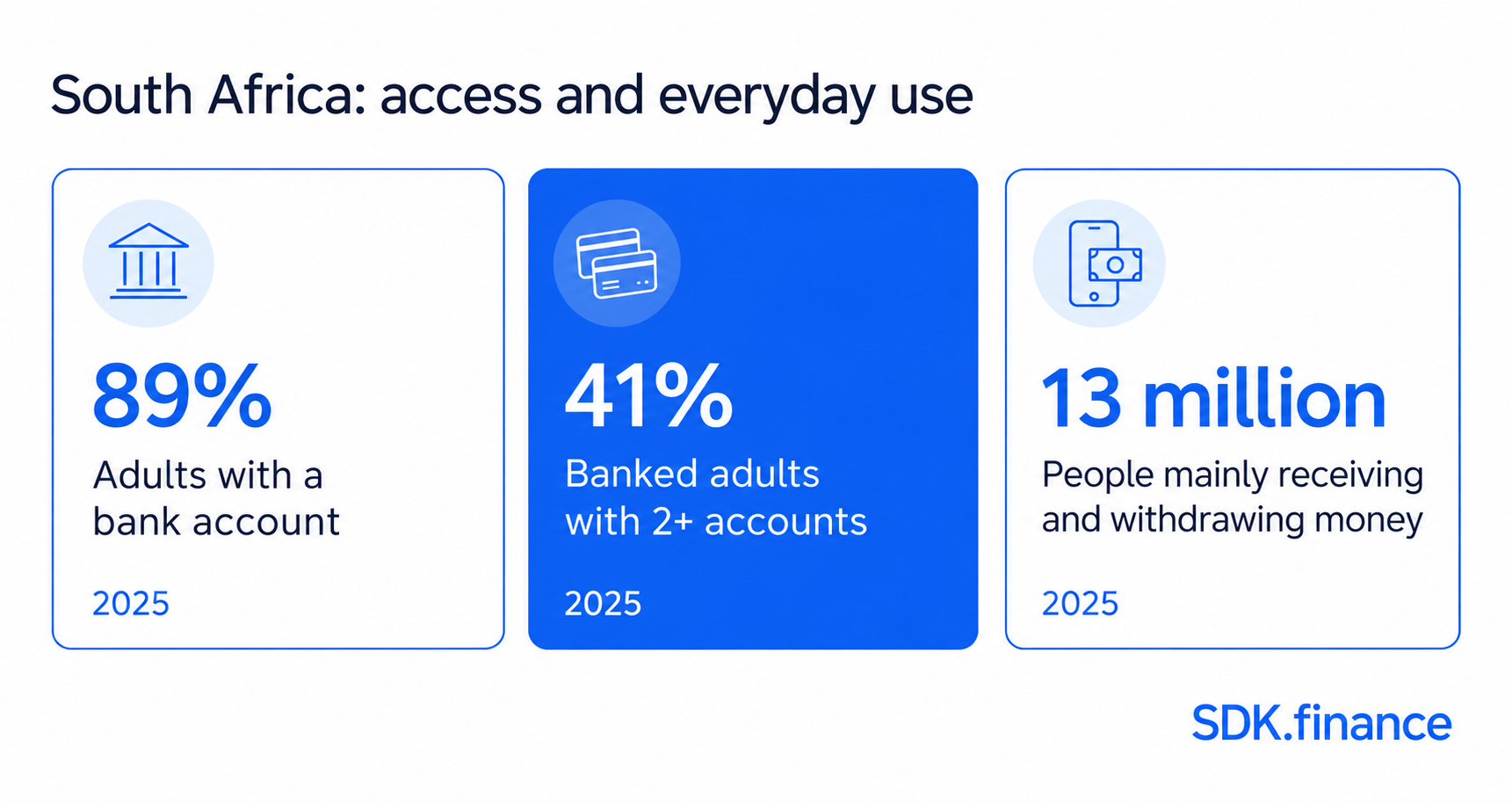
The FinScope South Africa 2025 findings, published by FinMark Trust in July 2026, are based on interviews with 5,600 adults across all nine provinces:
- 89% of adults had a bank account.
- 41% of banked South Africans held two or more accounts, compared with 39% in 2024. This covers banked adults, not the whole population.
- Around 13 million South Africans mainly used their accounts to receive money and immediately withdraw it.
- 46% of consumers reported a problem with their bank during the previous year. This is a self-reported experience measure, not a transaction failure rate or fraud rate.
For product teams, these findings suggest three questions:
- Everyday value: why is an existing account insufficient for the customer’s task?
- Money movement: how do funds move between accounts, cash, merchants and recipients?
- Repeat use: does the product improve a recurring activity, or simply add another registration?
PayShap adoption: cumulative volume versus monthly use
The official PayShap adoption update quoting PayInc reports two distinct measures:
- More than 1 billion cumulative transactions: the milestone was reached on 18 June 2026.
- More than 60 million transactions per month: the monthly pace reported at that milestone.
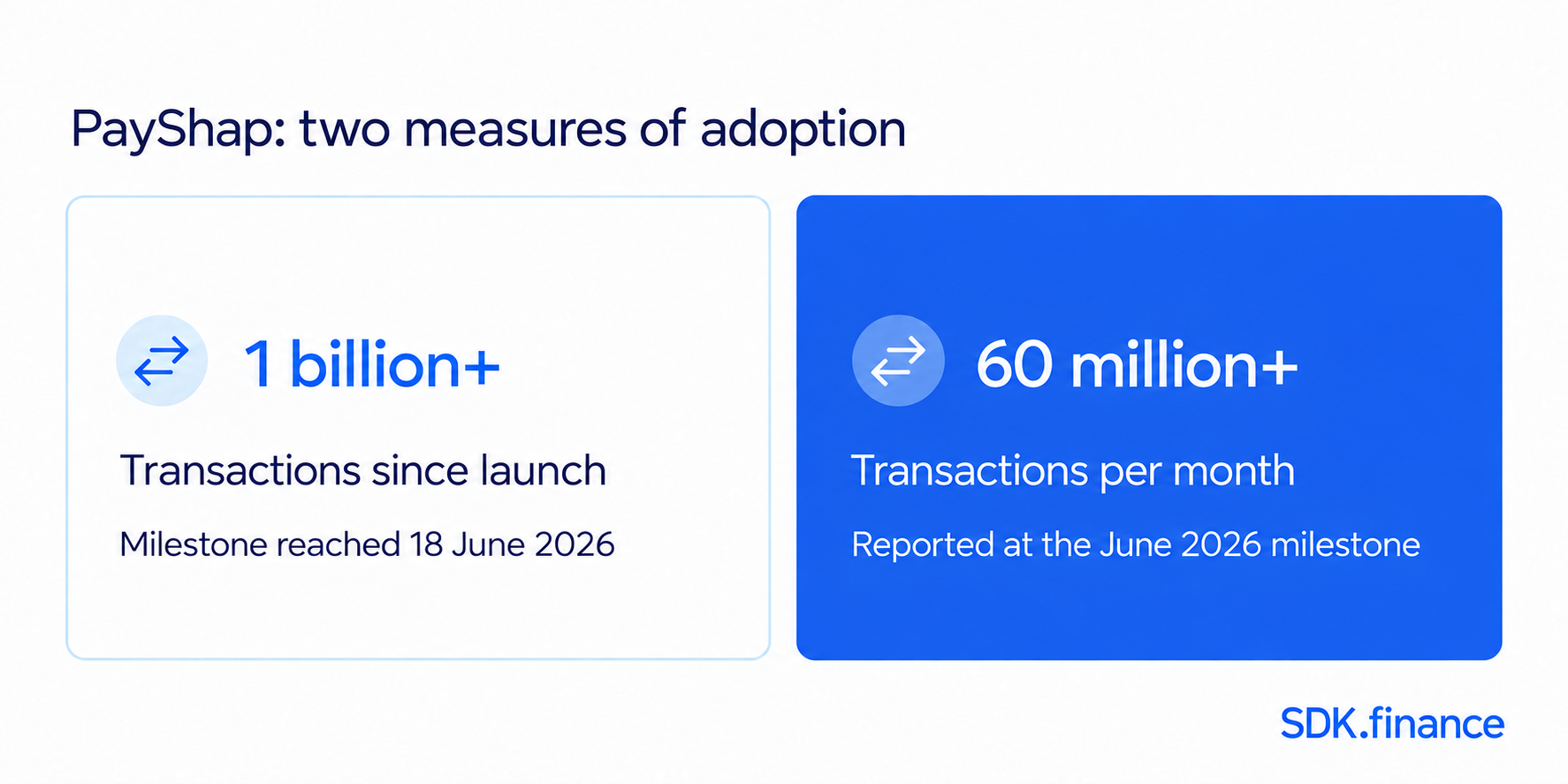
The figures measure transactions, not unique customers or the value of the FinTech market.
Cash, merchants and cross-border money movement
Cash access, payment confirmation, and cross-border delivery shape the customer journey:
- Cash access: map how money enters, where it can be spent, what withdrawal options exist and what each step costs. Cash-in and cash-out depend on financial providers and distribution partners.
- Merchant certainty: connect authoritative payment confirmation to the correct order and amount. Staff need clear procedures for pending payments and refunds; a buyer’s screenshot is not proof of payment.
- Cross-border delivery: show the exchange rate, fees, recipient amount, payout method and identification requirements. Each corridor needs suitable foreign-exchange and destination-provider arrangements.
For remittances, show distinct statuses for payment received, funds available for collection, and funds collected.
Assess the full cost to the customer, including mobile data, cash handling, and withdrawal charges, as well as the time before funds become usable.
FinTech companies and providers in South Africa
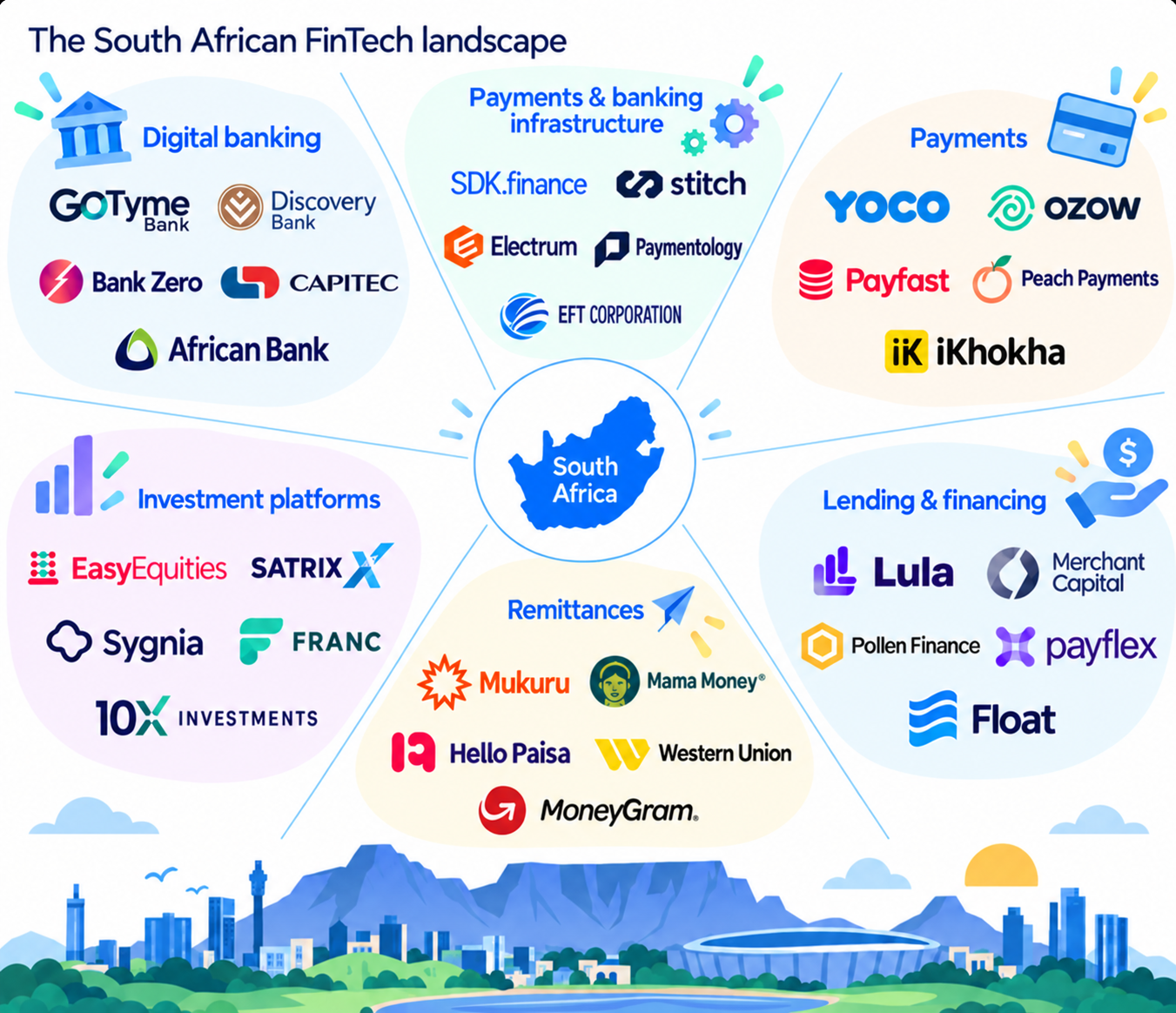
The South African ecosystem includes consumer-facing businesses, banks, payment specialists, and infrastructure vendors. They solve different problems, so comparing them as interchangeable providers would be misleading.
| Provider | Primary role | Relevant product need |
| SDK.finance | Financial software | Accounts, wallets, workflows, and a separate General Ledger |
| Yoco | Merchant payments | Card acceptance, point of sale, and business tools |
| Ozow | Pay-by-bank | Collecting payments from customers’ bank accounts |
| Stitch | Payments infrastructure | Online and in-person payments for businesses |
| GoTyme Bank | Digital bank | Everyday banking through digital and supporting channels |
| Mukuru | Remittances | Cross-border transfers and market-specific financial services |
| EasyEquities | Digital investing | Access to investment accounts and instruments |

SDK.finance
SDK.finance provides a FinTech software foundation and payment infrastructure for teams building new remittance services, digital banking products, merchant payment solutions, currency exchange services, and other payment products. Its software core lets teams develop their customer experience and connect the financial providers required for launch.

Yoco
Yoco combines card acceptance with point-of-sale and business tools for independent businesses. Merchants can assess its devices, sales reporting, refund processes and payout arrangements against their day-to-day operations.

Ozow
Ozow helps businesses collect payments from bank accounts through online checkout, payment links and QR-based journeys. Supported banks, payment methods, refunds and reporting should be checked for the intended use case.

Stitch
Stitch provides payments infrastructure for online and in-person transactions, with offerings for enterprises and growing retailers. It is relevant to teams connecting payment methods and sales channels, with integration and payout arrangements depending on the selected setup.

GoTyme Bank
GoTyme Bank, formerly TymeBank, offers everyday banking in South Africa through digital and supporting physical channels. Its model shows why cash access and assistance remain important alongside an app-based experience.

Mukuru
Mukuru connects remittances with bank, wallet and cash-related delivery options, depending on the service and destination. Fees, exchange rates, limits and documentation vary by country, corridor and product.

EasyEquities
EasyEquities offers digital access to investment accounts and instruments, including South African shares and exchange-traded funds. Its role differs from everyday payments: investment risk, fees, settlement and withdrawal conditions remain part of the customer experience.
Payments versus banking infrastructure
Choose providers by the capability your product needs. Payment acceptance, transaction software, and regulated financial services serve different roles:
- Payment acceptance: a merchant needs suitable payment methods, checkout confirmation, refunds and payout reporting.
- Transaction software: a product team needs accounts, balances, workflows and integration points for external financial providers.
- Banking or other regulated services: the relevant institution supplies services within its permissions and agreed partnership scope; buying software does not supply those permissions.
The map contains five examples per category; roles can overlap. Digital banking includes established banks’ digital channels. Inclusion does not imply a partnership with SDK.finance.
PayShap and the wider payments infrastructure

Instant payments in daily use
PayShap is part of South Africa’s instant interbank payment infrastructure. It gives participating providers a route for fast payments, including journeys using a ShapID where supported. The customer-facing service still depends on the bank or provider through which the payment is initiated.
The SARB’s payment system oversight report provides historical context for PayShap and the wider national payment system. Current access, transaction limits, and charges should be checked with the relevant provider. A national payment scheme does not mean every bank offers identical terms or functionality.
Compare payment methods by the customer’s task and the operational requirements:
| Method | Typical task | Check before integration |
| PayShap | Instant transfer between participating bank accounts | Bank coverage, limits, fees, payment confirmation |
| Cards | Pay for an online or in-store purchase | Acquiring setup, authentication, refunds, chargebacks, settlement |
| Debit orders | Collect agreed recurring payments under a mandate | Mandate process, collection dates, failed collections, disputes |
For mandate-based collections, PASA’s debit-order guidance explains the role of customer authorisation. Confirm the selected provider’s coverage, charges, and handling of failed or disputed payments.
From a payment message to operational records
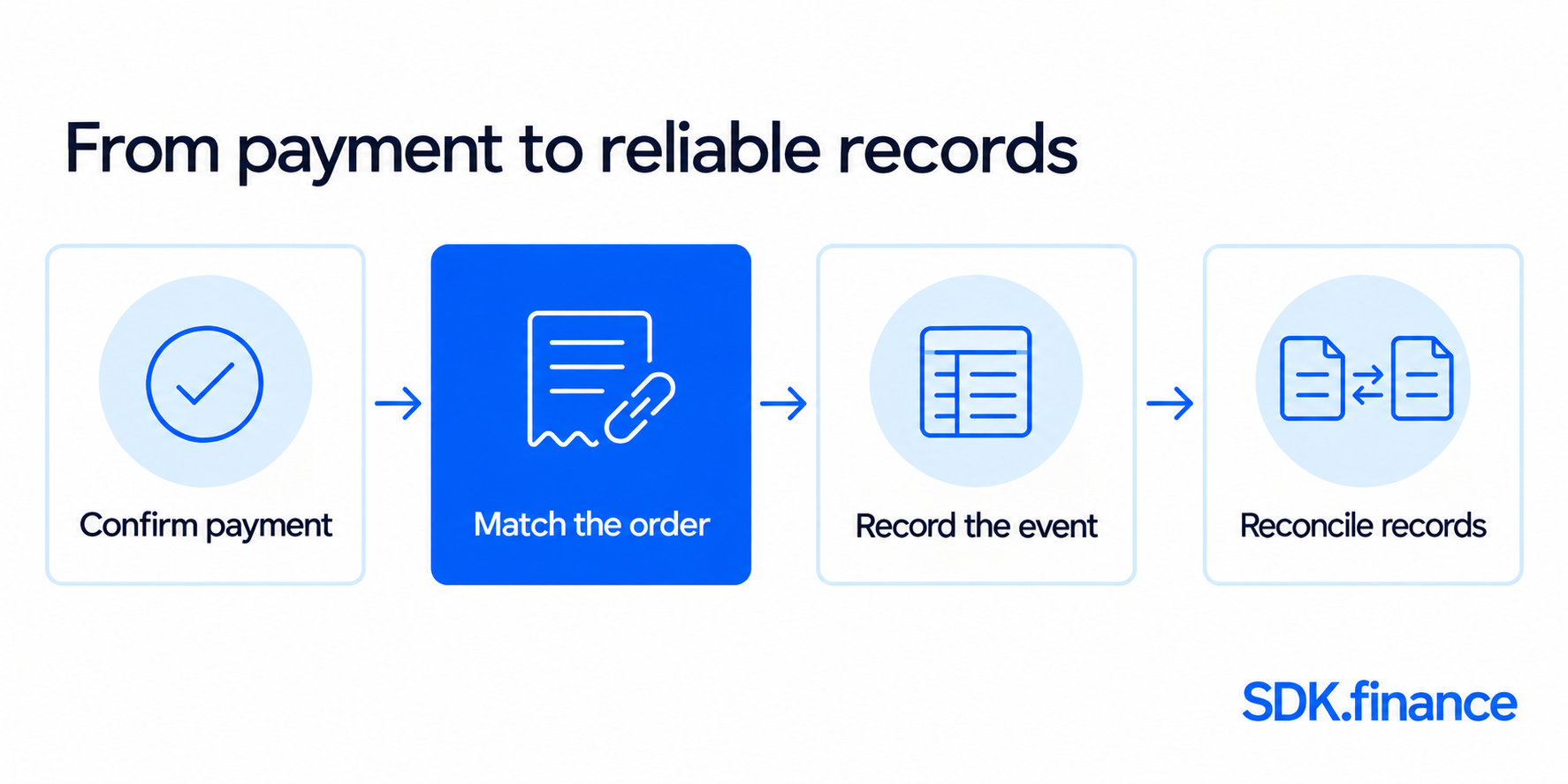
A merchant payment passes through several operational stages. Each needs a clear meaning in the product:
- Authorisation and confirmation: distinguish an initiated instruction from a confirmed payment before releasing an order or crediting a balance.
- Matching and exception handling: connect the provider’s result to the right order, recognise duplicate notifications and give staff a way to investigate delayed confirmations.
- Accounting: record the financial event under the business’s accounting policy.
- Reconciliation and settlement: compare internal records with external reports, while tracking the movement of funds between the relevant parties separately.
Open banking and access to payment networks
Open banking in South Africa also needs a precise definition in any supplier conversation. Access to account data, payment initiation, and a banking partnership are different capabilities. Teams should confirm the actual interfaces, customer authorisation process, bank coverage, and contractual permissions available for their intended service.
Discover how the SDK.finance TPS can power high-speed, secure operations across banking, fintech, and retail
Talk to Our TeamRegulation and the responsibilities behind a FinTech product
The regulatory starting point is the activity, not the label “FinTech.” Selling software, holding deposits, arranging an investment, extending credit, and transferring money can involve different requirements. One registration should not be treated as permission to perform every financial service.
South Africa’s prudential and conduct framework separates important responsibilities. The Prudential Authority supervises the safety and soundness of institutions within its remit, while the Financial Sector Conduct Authority addresses market conduct. The SARB also has responsibilities for the national payment system. A product’s legal and partnership structure determines which requirements are relevant.
Before selecting an architecture, assign named owners to the responsibilities behind the service:
- Funds and payments: who holds the money, executes each payment and contracts with the customer?
- Customer support: who handles complaints, restrictions, failed payments and refunds?
- Oversight and records: who investigates suspicious activity, maintains required records and supplies information to authorities?
For accountable institutions, the Financial Intelligence Centre’s guidance describes a risk-based approach to obligations such as customer due diligence, transaction monitoring, record keeping, and reporting. An identity check at onboarding is only one part of that operating model.
Translate these responsibilities into product controls: clear restriction messages, investigation records, and access for authorised staff.
Personal information creates a related design responsibility. The Information Regulator’s POPIA guidance is relevant when deciding what data to collect, who can access it, how it is protected, and how requests or incidents are handled. Collecting more information than the journey requires can increase both friction and operational exposure.
Partner due diligence should cover more than an API demonstration. Confirm the partner’s permissions for the intended activity, its role in the funds flow, service availability, reporting, escalation arrangements, and the terms for changing or ending the relationship.
Where to get regulatory guidance
The IFWG Regulatory Guidance Unit helps innovators clarify questions about financial-sector policy and regulation. It does not approve products or advise how a business should comply. The IFWG Regulatory Sandbox offers supervised testing within agreed parameters and timeframes; entry is subject to assessment and regulators’ discretion.
Before seeking guidance, prepare a specific question, a funds-flow diagram, and a description of the proposed activity.
Opportunities that depend on affordability and everyday usability
Test these product hypotheses with intended users. Each links a customer problem to a feature and a measurable pilot outcome:
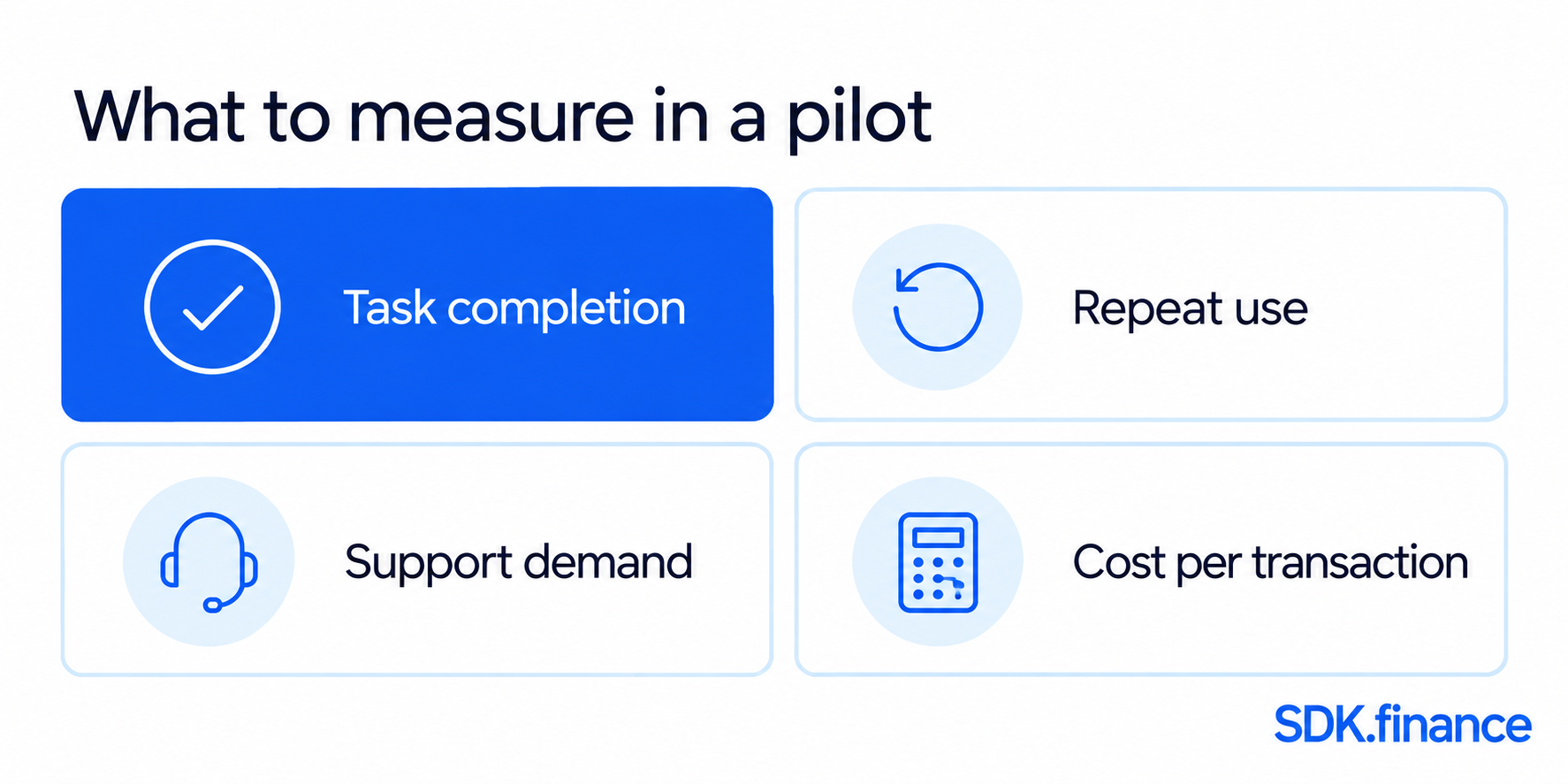
- Small-business acceptance: when merchants struggle to match payments to orders, test a single view linking each order to its payment status. Track unmatched payments and payment-related support requests.
- Payouts and remittances: when recipients cannot tell whether money is ready to collect, test clear delivery stages and next actions. Track completed collections and status-related enquiries.
- Tools for existing account holders: when customers struggle to organise money for recurring needs, test purpose-based balances and clear charges. Track task completion and repeat use.
Include people with irregular income, limited mobile data, or a need for assisted service. Validate the problem before expanding the feature set.
Design for interrupted connectivity: reduce unnecessary screens, explain pending states and support safe recovery. Saving a draft instruction does not mean the product can complete an offline payment.
Evaluate each pilot against its delivery cost, including provider fees, connectivity, and support, before expanding.
Funding and ecosystem support for founders
Investment readiness combines customer demand, viable unit economics, and a credible delivery plan.
FINASA connects participants in South Africa’s FinTech ecosystem, and its Industry Spotlight includes discussions about investment readiness. Such networks can help founders understand the market and meet potential collaborators, but membership or visibility does not guarantee funding.
Before approaching an investor, prepare a concise evidence pack:
- Customer traction: active usage, retention and the problem customers are paying to solve.
- Unit economics: revenue per customer or transaction, provider charges, support costs and cash requirements.
- Execution readiness: the team, financial-provider arrangements, regulatory questions and milestones the funding will support.
What comes next for South African payments
South Africa’s next phase of payment development centres on making digital services easier to use across providers. The SARB’s Payments Ecosystem Modernisation programme prioritises interoperability and inclusion, while its QR+ Standard 1.2 addresses payment initiation through QR codes, barcodes, and digital links.
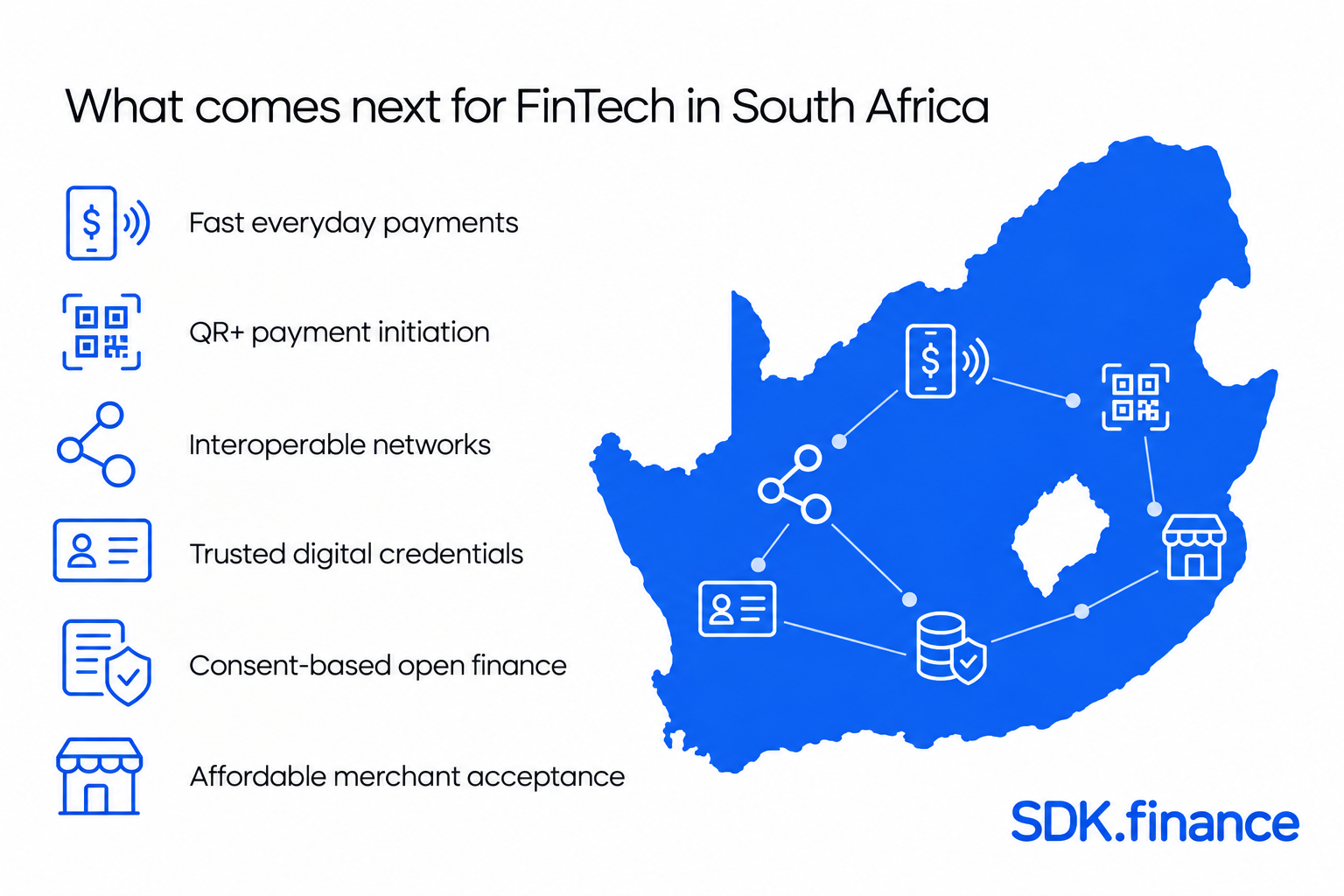
For product teams, three developments deserve attention:
- QR+ and interoperability: design payment journeys that can accommodate additional providers and initiation methods as support becomes available.
- Trusted digital credentials: follow the PEMKey initiative when planning identity journeys; do not assume that every provider already supports it.
- Consent-based open finance: the FSCA’s position paper sets a policy direction for secure data sharing. Plan clear consent and permissions, while checking the rules and interfaces that apply to each integration.
These are development priorities, not a list of features already available through every bank or payment provider. Use them to guide the roadmap, and verify actual partner capabilities before committing to a launch.
Build a South African FinTech product with SDK.finance
For a founder building a South African wallet, a PSP serving local merchants, or a team developing a money-transfer service, the challenge is connecting the customer journey to reliable balances, payment statuses, and financial records. SDK.finance supplies the software core on which to build these products, while the team develops its proposition and connects the financial providers needed for its market.
Transaction Platform and General Ledger
SDK.finance Transaction Platform manages the product’s operational core: accounts, wallets, balances, transaction workflows, fees, and limits. SDK.finance General Ledger provides a separate accounting layer, converting business events into balanced double-entry journal entries through configured accounting rules. The two can work together, with the ledger’s account structure and posting rules reflecting the business’s accounting policy.
For the opportunities covered in this article, these capabilities address practical product requirements:
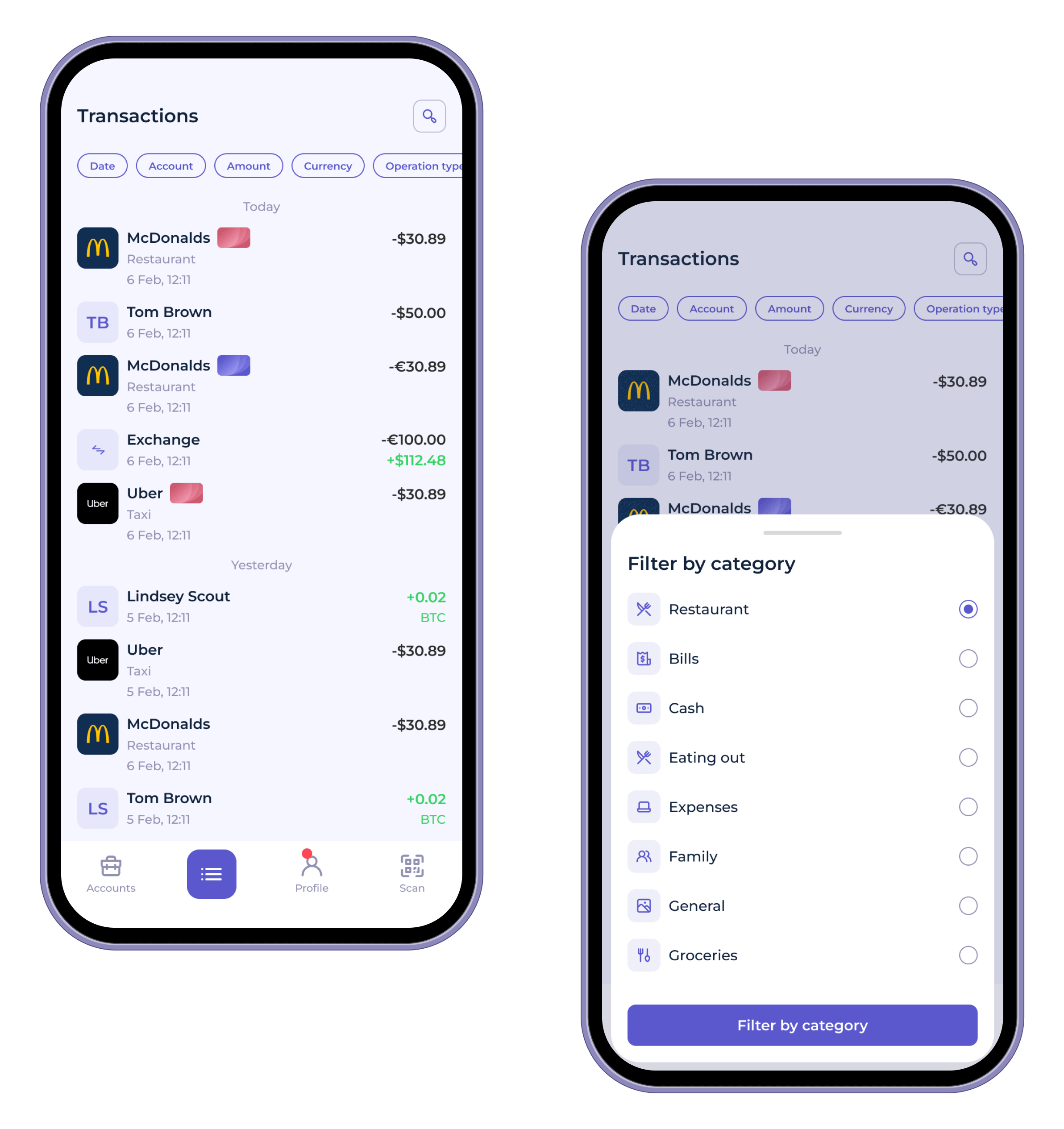
- Wallet balances: use Transaction Platform accounts and multi-currency wallets to maintain customer and merchant balances, including available and held amounts. This gives a wallet product a basis for showing what a customer can spend.
- Merchant payment workflows: build payment and withdrawal flows with status tracking, so the product can distinguish an initiated operation from its reported result. Map provider confirmations to the merchant journey during integration.
- Fees and transaction limits: configure charges and usage limits for the intended customer segment. This helps teams implement the pricing and transaction rules they test with small businesses or wallet users.
- Provider connections: use APIs and webhooks to connect the product interface and external payment services. For PayShap or cross-border payouts, confirm access through the selected financial provider and scope the integration before launch.
- Payment support and reconciliation: give authorised operations staff transaction history and reconciliation tools to investigate differences between internal records and provider reports, including cases where a customer queries a payment.
- Accounting for payments and fees: map merchant payments, transfer fees, and other events to the business’s chart of accounts so finance teams can trace how balances were formed.
Source Code or SaaS: two ways to build
- Source Code Licence: use the SDK.finance core to build your own South African wallet, merchant platform, or transfer product. Your developers or implementation partner can customise workflows and provider integrations, deploy on your chosen infrastructure, and control further development. Your team takes responsibility for testing, maintenance, and operations.
- SaaS: build on a standard platform when its configuration and supported integration approach fit your launch scope. SDK.finance manages application hosting and scheduled updates; your team manages databases and product integrations. Extensions use configuration and APIs, without direct access to the backend source code.
Neither delivery model supplies local payment access or regulated financial services; these require suitable financial-provider arrangements.
From market insight to a launch-ready product
Start with one South African customer need: a merchant matching payments to sales, a wallet user managing available funds, or a recipient tracking a transfer. Define the journey, the financial providers, and the measures of a successful pilot before expanding the product.
To assess the software core for your launch, contact the SDK.finance team with your target users, payment flows, and integration requirements. This gives the discussion a concrete starting point for choosing between Source Code and SaaS.
Discover how the SDK.finance TPS can power high-speed, secure operations across banking, fintech, and retail
Talk to Our Team