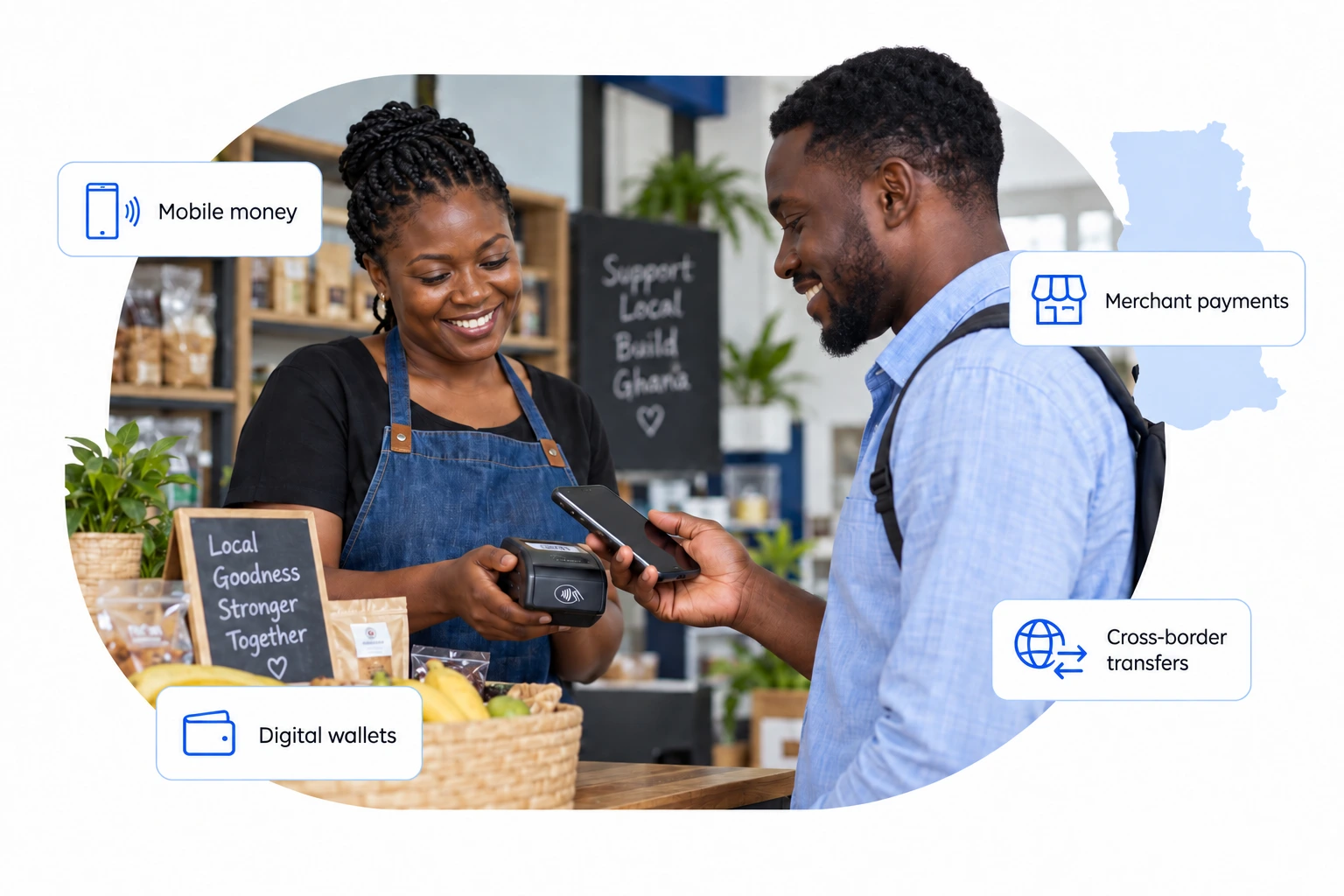
FinTech in Ghana brings together mobile money, merchant payments, remittances, digital lending, and software that helps financial businesses operate. Mobile wallets and shared payment infrastructure are central to the market, but the opportunity extends beyond launching another way to send money.
For founders, payment businesses, and product teams, the challenge is to identify a useful service and understand the local arrangements needed to deliver it.
In this guide, you will find an overview of Ghana’s FinTech companies, payment infrastructure, regulation, market growth and product opportunities. You will also learn how SDK.finance, a FinTech software provider, supports businesses building financial products for the Ghanaian market.
Discover how the SDK.finance TPS can power high-speed, secure operations across banking, fintech, and retail
Talk to Our TeamGhana’s FinTech market at a glance
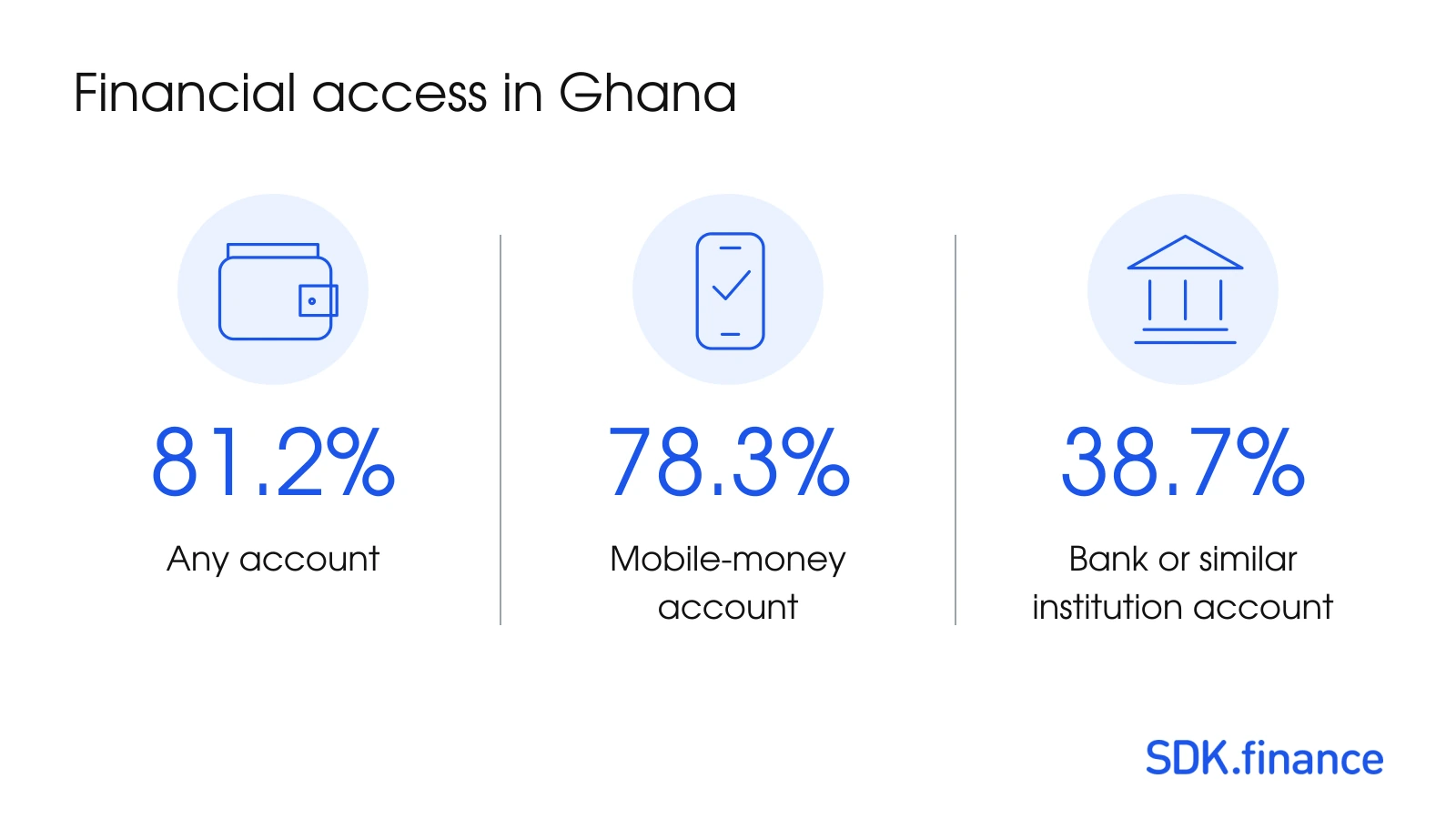
Ghana combines broad access to financial accounts with a strong mobile-money presence. The World Bank’s 2025 publication, based on its 2024 survey, reports 81.2% of adults aged 15 and above under its account indicator, 78.3% under its mobile-money account indicator, and 38.7% with an account at a bank or similar financial institution. The categories overlap, so they should not be added together. The mobile-money measure includes personal use of a qualifying service in the preceding 12 months.
Mobile money growth and the wider market
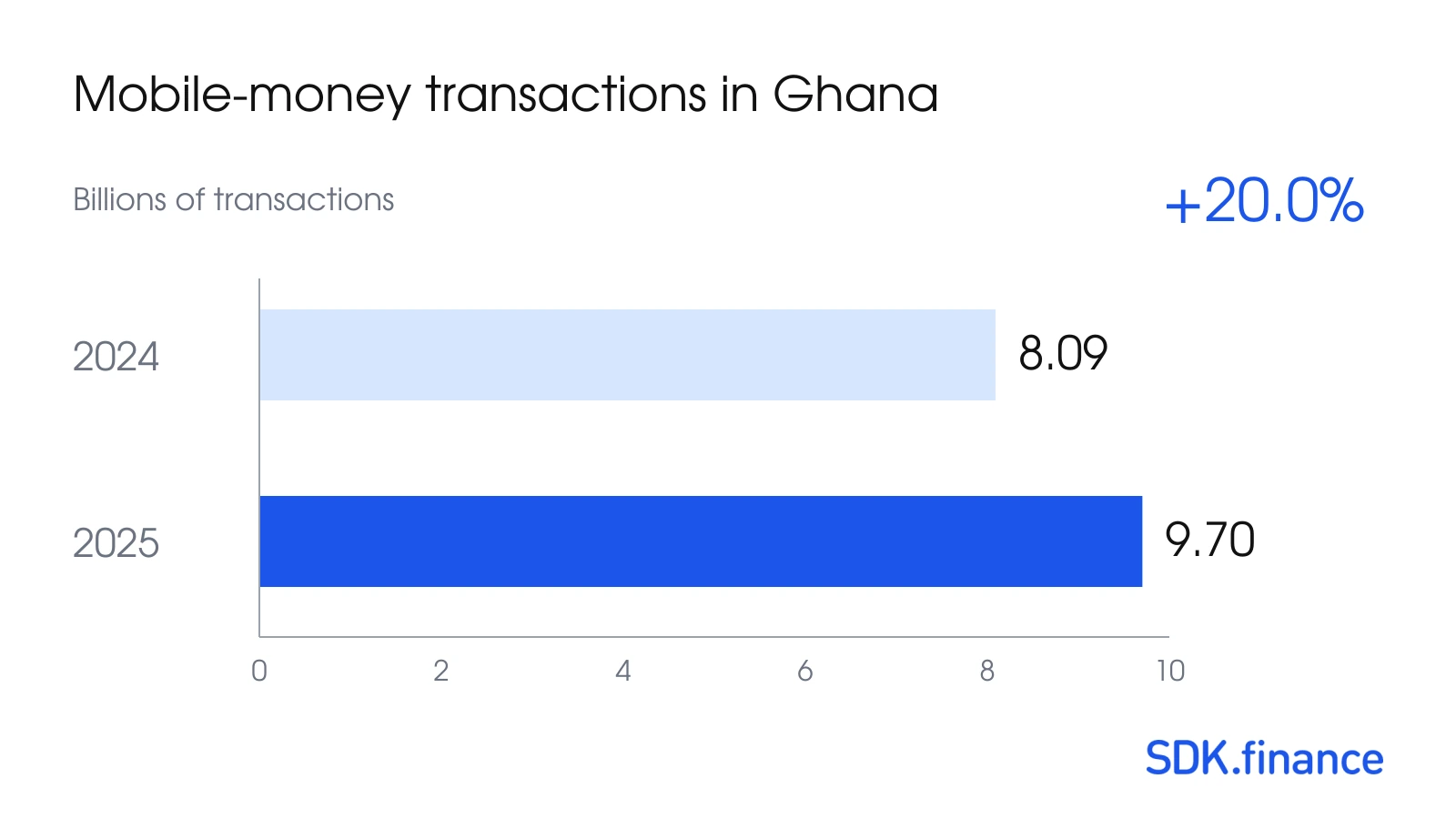
Ghana mobile money growth is visible in transaction activity as well as account access. The Bank of Ghana’s 2025 payment systems report, Table 3.12, records approximately 8.09 billion mobile-money transactions in 2024 and 9.70 billion in 2025, an increase of 20%. These are transaction counts across the ecosystem, not unique users or FinTech company revenues.
The same report records 23.49 million active mobile-money accounts in 2024 and 26.66 million in 2025, an increase of 13.5%. Active means at least one transaction in the preceding 90 days. These are accounts, not unique people, so this measure should not be compared directly with the World Bank’s adult account-ownership percentages.
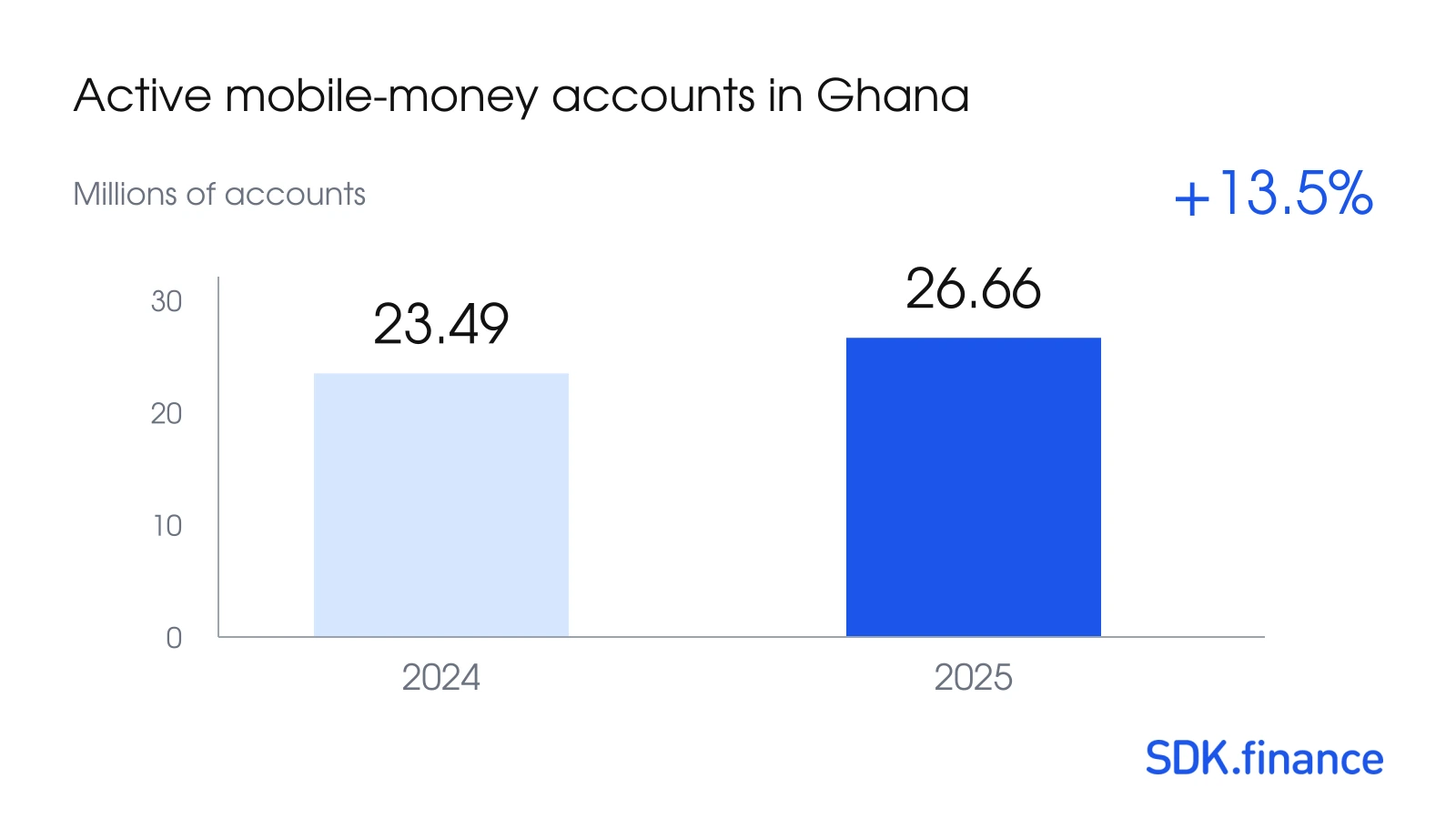
For a product builder, growing activity creates more occasions to serve customers: collecting a merchant payment, paying suppliers, or managing daily receipts.
Main FinTech segments in Ghana
Ghana’s FinTech market spans five connected segments, each serving a different customer need:
- Payments and mobile money: receiving income, paying merchants, transferring funds, and accessing cash. Accepting a payment, moving money, and holding a spendable balance are different services.
- Remittances: sending money across borders with a clear total cost and usable payout method. Household transfers and international trade payments require different currency and settlement arrangements.
- Digital lending: applying for and managing credit through digital channels. Technology supports the journey, while the lender supplies funds and sets the loan terms.
- Savings, investment, and insurance: building reserves, planning ahead, and managing risk. Eligibility, withdrawal conditions, and the responsible financial institution matter beyond the mobile interface.
- B2B software: managing customer accounts, payment workflows, records, and operations. The software must fit the business model and connect with the required financial providers.
Distribution helps determine which opportunities are practical. GSMA’s analysis of digital transformation in Ghana identifies device affordability as a barrier to wider internet use. Financial inclusion in Ghana therefore depends on more than having an account. Agent support, simple phone menus, and low-data journeys may matter alongside smartphone apps, especially when a service needs to reach customers outside its first urban user group.
FinTech companies in Ghana
The market includes organisations that provide software, issue electronic money, accept payments, and support business payouts. These roles can overlap, but they are not interchangeable. Choosing a partner starts with understanding which part of the service that partner will actually provide.
The following selection groups providers by their role, rather than ranking their size or service quality. Check payment-provider categories and status notes in the Bank of Ghana’s approved-institutions register. For lending services, consult its approved digital credit products and applications.
| Provider | Entity or category | Role and example use |
|---|---|---|
| SDK.finance | FinTech software provider | Provides software for building digital wallets, payment services and other financial products for the Ghanaian market. |
| MTN MoMo | MobileMoney LTD; DEMI category, subject to the register’s operating-status note | Mobile-money transfers, bills, and agent-based cash access for everyday users. |
| Telecel Cash | Telecel Ghana Mobile Financial Services LTD; dedicated electronic money issuer | Wallet payments, transfers across networks, and connections between wallets and bank accounts. |
| AT Money | Airtel Mobile Commerce (Ghana) Limited; dedicated electronic money issuer | Sending and receiving money, bill payments, and deposits or withdrawals through authorised agents. |
| G-Money | G-Money Financial Services LTD; dedicated electronic money issuer | Wallet transfers, merchant payments, and business collections or disbursements. |
| Hubtel | Hubtel LTD; PSP Enhanced | Payment acceptance and business tools for merchants managing sales and collections. |
| expressPay | Expresspay Ghana LTD; PSP Enhanced | Consumer bill payments and payment acceptance for businesses. |
| Paystack Ghana | Paystack Ghana LTD; PSP Enhanced | Online collections and business transfer services, with published Ghana pricing. |
| Nsano | Nsano Limited; PSP Enhanced | Business payment tools, including bulk payouts to mobile-money wallets and bank accounts. |
| JUMO | Banking technology provider | Technology connecting banks and mobile-network partners to deliver digital credit products. |
| Fido | Fido Micro Credit Limited; microcredit provider | Digital loans delivered through a mobile application. |
PSP means payment service provider; DEMI means dedicated electronic money issuer. The BoG register includes a specific note that Mobile Money Limited has special dispensation to continue operating while completing its licence application. Read that qualification alongside the table entry, rather than treating a category label as the full authorisation record.
Banks are another important part of this picture. They provide financial services in their own right and can participate in wallet propositions. For example, GhanaPay is a mobile-money service offered through banks, rural banks, and savings and loans companies. It illustrates how bank and wallet channels can serve the same customer journey.
Payment service providers in Ghana should be compared against the intended transaction pattern. An online shop needs collection and refund journeys; a business making bulk payouts needs recipient coverage and clear batch results.
How Ghana’s payment infrastructure and institutions work
A payment involves several organisations, each with a different role. Knowing who does what helps a product team direct questions to the right place.
- Bank of Ghana: oversees relevant financial and payment activities, including provider licensing and supervision.
- GhIPSS: operates shared infrastructure connecting participating financial institutions.
- Ghana FinTech and Payments Association: the industry association supports professional connections, advocacy, and sector learning.
- National Identification Authority: provides Ghana Card identity verification services used in customer identification.
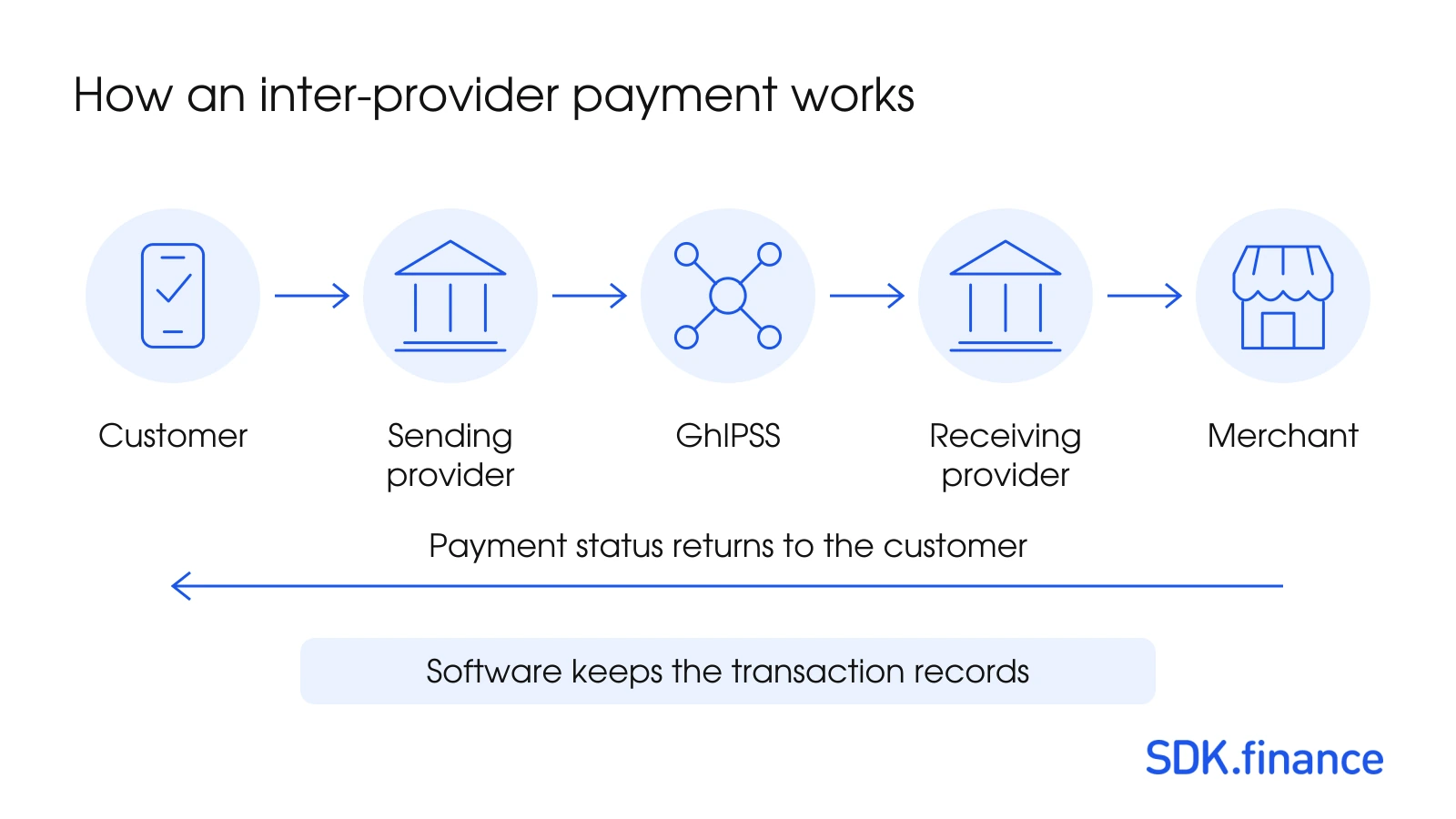
A payment service connects a payer and a recipient through institutions that pass instructions and move funds. For a business, the useful distinction is between the payment route, the confirmation it receives, and the records it needs to manage the transaction.
Ghana Interbank Payment and Settlement Systems, or GhIPSS, operates shared infrastructure used by financial institutions. Its payment service catalogue includes GhIPSS Instant Pay for instant transfers, GhQR for QR-based payments, and automated clearing house services for bulk payments and direct debits. These services support different needs; they are not alternative names for the same payment method.
Mobile money connects to a wider network
Mobile money in Ghana connects to a wider financial network. GhIPSS describes mobile money interoperability as enabling transfers between mobile-money networks and connections between wallets and bank accounts. This gives product builders an existing network to consider when planning how users will add, send, or withdraw money.
Access to these routes depends on the participating institution and service arrangement. A product team needs to know which routes its provider supports and what confirmation data it returns.
Payment confirmation and usable funds are different
Consider a shop taking a wallet payment. The shop needs confirmation that the payment succeeded. Its records must show which sale was paid and what fee applies. Later, the business needs to know that the amount received matches what the provider owes.
Matching these records is called reconciliation. Settlement is the transfer of funds between the relevant parties. A successful payment message and a completed settlement can occur at different times, depending on the service.
A ledger is the record of money movements and balances inside a product. Understanding how a wallet ledger works is useful when a business needs to explain why a balance changed, trace a refund, or investigate a missing payout. It does not replace the external institution responsible for moving or holding funds.
FinTech regulation in Ghana: what product teams need to know
FinTech regulation in Ghana depends on the activity a business performs. A company issuing electronic money, a payment aggregator, and a technology service provider can occupy different categories. Define the proposed service before deciding which regulatory route to investigate.
The Payment Systems and Services Act, 2019, Act 987, provides the legal framework for payment services. BoG’s licensing and authorisation information is a starting point for reviewing the requirements relevant to a payment business.
Understand the main provider categories
- Dedicated electronic money issuer (DEMI): this category covers activities including wallet creation and management, cash-in and cash-out, and wallet-based transfers. It matters when the proposition involves issuing electronic money, rather than simply presenting a payment interface.
- Payment service provider (PSP): the permitted activities differ across categories. An Enhanced PSP and a Standard PSP should not be treated as interchangeable. Some categories operate through connections to an Enhanced PSP, which affects the delivery arrangement a team must establish.
- Payment and financial technology service provider (PFTSP): BoG lists services such as digital product development and support, credit-scoring analytics, fraud management, and identity-authentication services within this category. It is a distinct regulatory classification, not a label to apply automatically to every software vendor.
The central bank’s licence-category descriptions set out these distinctions. Use them to frame a discussion about the actual activities and entities involved, rather than choosing a category because its name resembles the product’s marketing description.
Understand what a sandbox is for
BoG’s regulatory sandbox resources explain how qualifying innovations can be tested under regulatory supervision. This route may be useful when a new business model or technology needs controlled testing to understand its benefits and risks. A team should be able to explain what it wants to test, who will participate, and how customers will be protected. Participation does not establish unrestricted permission to launch.
Turn the regulatory scope into an operating plan
Before launch, document who provides the regulated service, who holds or safeguards customer funds, and who handles complaints and disputed payments. These responsibilities should agree across customer terms, partner contracts, and daily operations.
Identity verification is part of that operating plan. Ghana Card checks establish identity; account access and payment authorisation are separate steps. The onboarding journey should explain which information is needed and what happens when a check fails, with a support route for customers who cannot complete it.
Beyond payments, lending, insurance, investment, and other activities may raise additional sector-specific requirements. Expanding a product into a new financial service should trigger a review of its permissions and responsibilities, rather than an assumption that the original payment arrangement covers it.
Discover how the SDK.finance TPS can power high-speed, secure operations across banking, fintech, and retail
Talk to Our TeamThe challenges behind everyday digital payments
Everyday adoption depends on practical access, workable costs, and trust. A technically successful payment can still disappoint a customer who cannot use the proceeds, understand a charge, or get help. These issues should be tested as part of the customer journey.
Access includes the last step
Someone who receives money digitally may still need cash. An agent can have a working connection and an electronic balance but insufficient cash for a withdrawal. In that situation, the customer’s practical options depend on replenishment or another nearby outlet.
For a retailer, access may mean being able to pay a supplier after receiving sales proceeds. For a rural customer, it may mean getting help nearby. Test these final steps with the intended users.
A small fee can have a larger effect on profit
Paystack’s published Ghana pricing lists a 1.95% collection fee. Consider an illustrative GHS 1,000 sale with an assumed gross margin of 5%. Gross profit before the fee would be GHS 50, and the collection fee would be GHS 19.50. That leaves GHS 30.50 before other costs: the fee uses 39% of gross profit, leaving 61%. The margin is an assumption for this calculation, not a measured average for Ghanaian merchants; actual costs depend on the business and its provider terms.
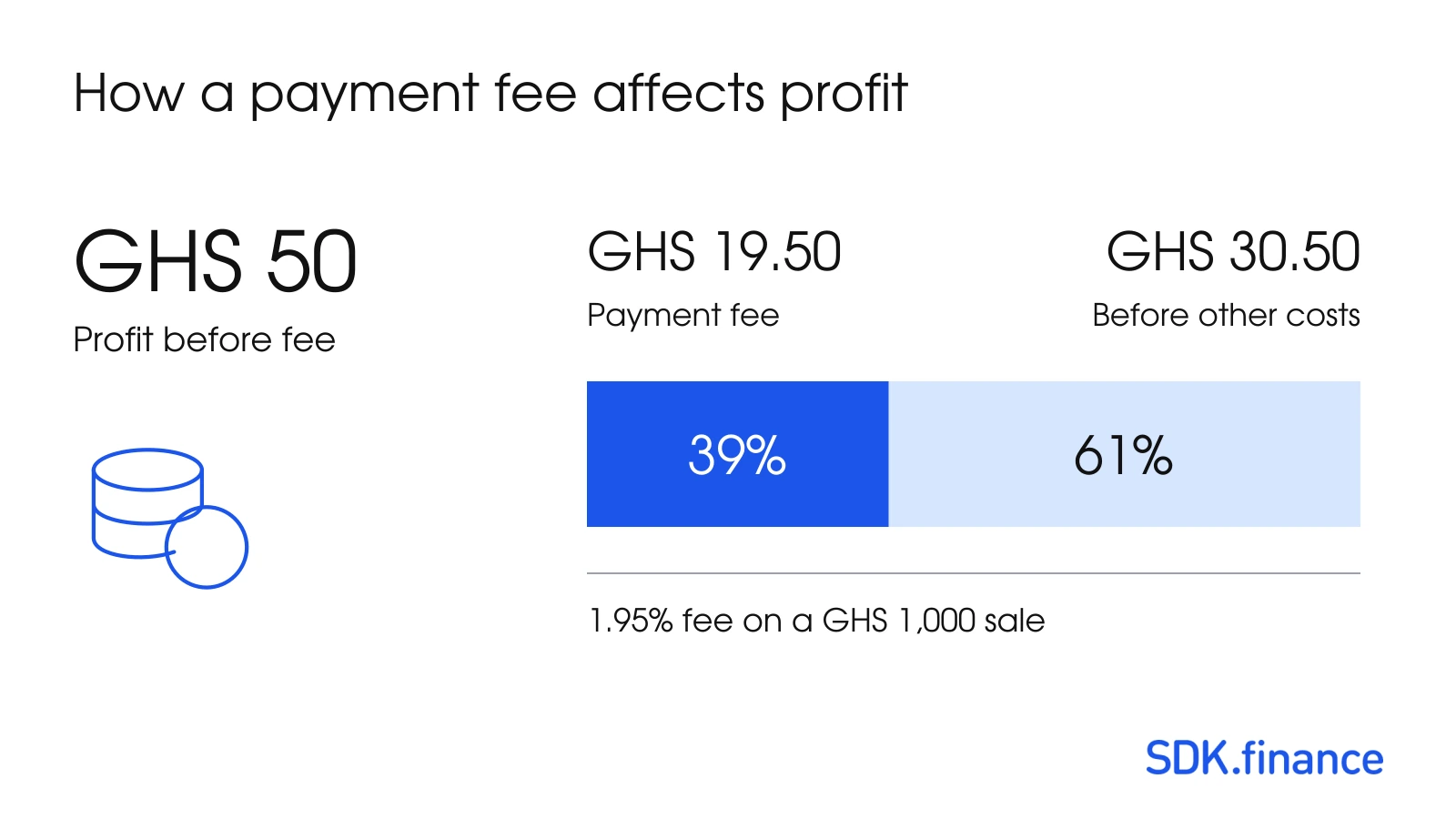
Assess the full journey, not only the advertised collection rate. Depending on the arrangement, a business may also face transfer, withdrawal, currency-conversion, or refund costs. Settlement timing matters when proceeds are needed to restock. Compare those costs with collection time saved and customer convenience. A merchant with a different margin or negotiated tariff would reach a different result.
Trust requires protection and a recovery path
A delayed confirmation, suspected fraud, and a lost phone are different problems. The customer should not have to understand the underlying systems to find the right help.
Before a payment, show the recipient and fee clearly so the customer can check what they are approving. Afterwards, provide a recognisable confirmation and reference. If the result is uncertain, explain the status and next step; repeatedly asking the customer to retry can create duplicate-payment risk.
Account recovery needs its own process. Replacing a phone or number should trigger checks appropriate to the account, with a clear support route. Staff should be able to distinguish an access problem from an unauthorised transaction and direct complaints to the responsible provider.
Measure how quickly customers receive a useful answer and how long unresolved cases remain open. These measures reveal whether the service earns trust after its first successful payment.
Where financial product builders can create value
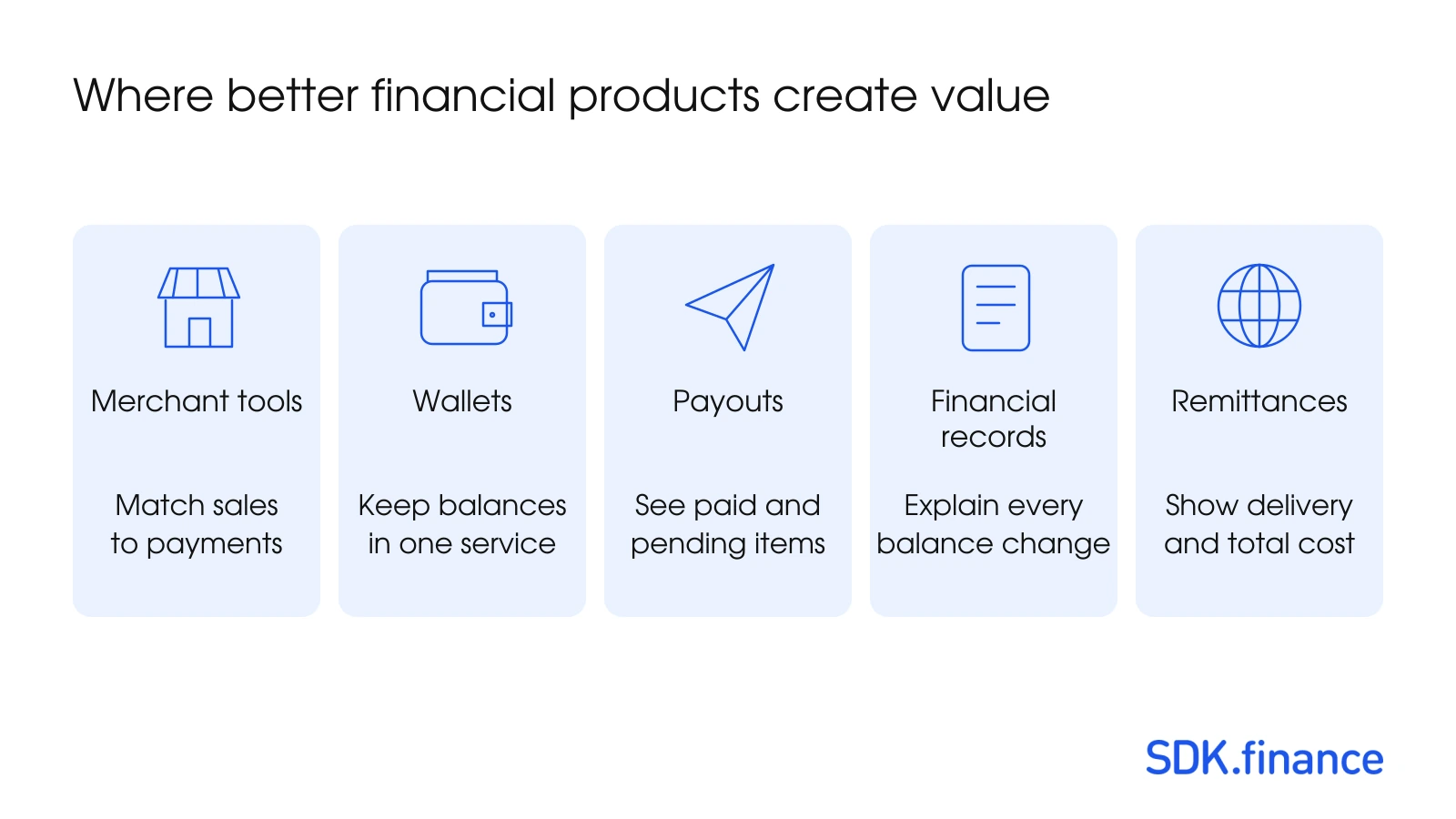
The strongest opportunities address everyday payment problems. These ideas should be tested with customers in Ghana:
Make merchant payments easier to manage
Help retailers match mobile-money receipts to sales, track refunds, and see funds available for suppliers. A single view that flags unmatched payments can reduce manual checking and support cash planning.
Build wallets into services customers already use
Give marketplace sellers a wallet within the service they use, showing earnings, fees, and available funds. Clear balances and reliable funding and withdrawal options make the wallet useful beyond simply receiving payments.
Give organisations visibility over payouts
Help businesses track successful, pending, and returned payments to suppliers or other recipients. Combine payment approval controls with provider confirmations so teams can focus on exceptions.
Improve financial records in an existing service
Add an accounting layer to organise balances and adjustments as payment methods and partners grow. Clear records help teams explain balance changes, investigate refunds, and resolve discrepancies without replacing their existing product.
Make cross-border transfers clearer for recipients
For remittances, show the recipient’s amount, currency conversion, payout method, and delivery status. Start with a specific corridor and confirm which transfer directions are supported. Clear updates and transaction records help households and businesses track funds and understand delays
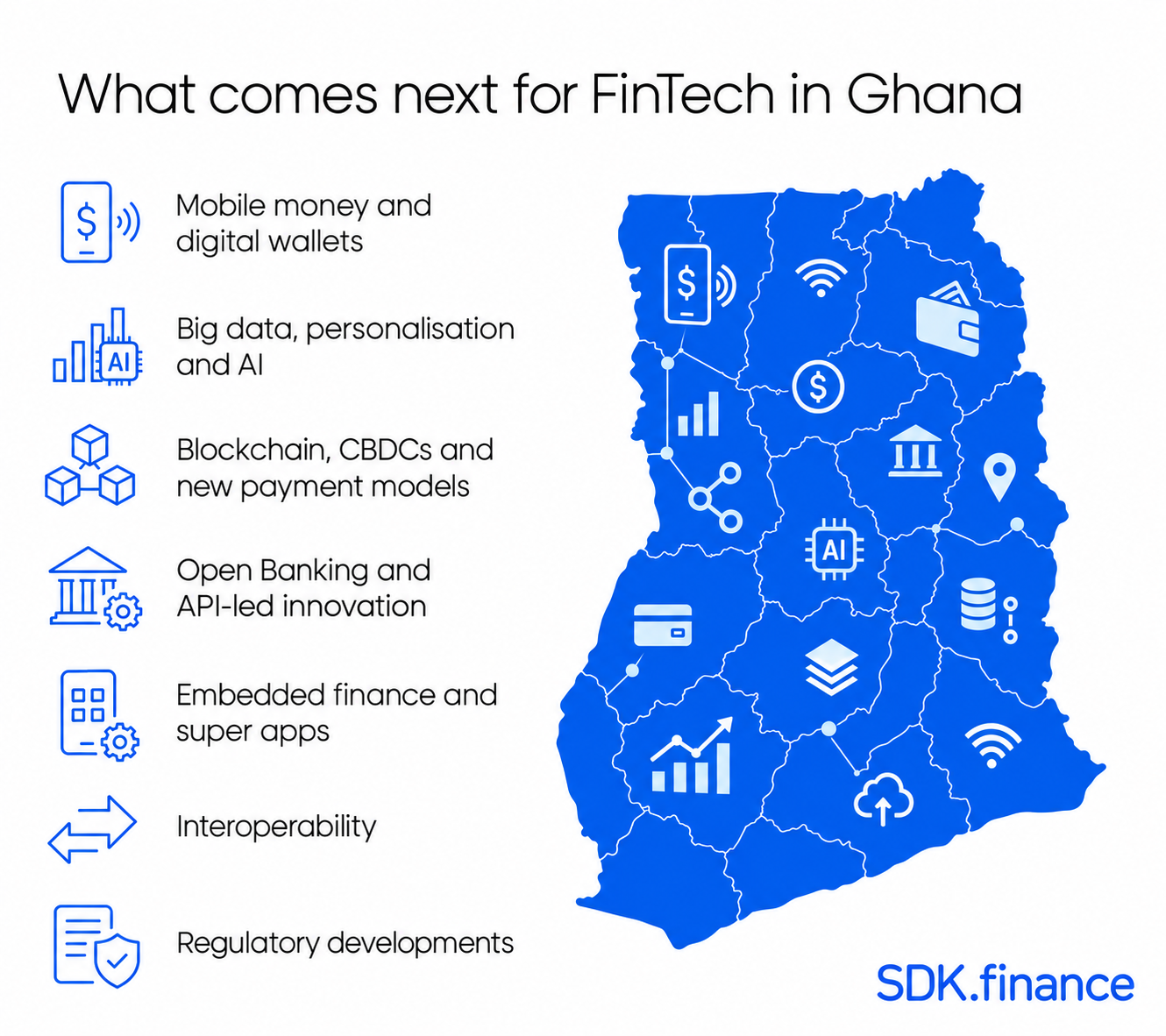
What comes next for FinTech in Ghana
Open Banking and eCedi could change how financial products use data and move money. The opportunity for product teams is to understand the business problem each initiative could solve, while separating published plans from services available for integration.
Open Banking: access with permission
The Bank of Ghana’s draft Open Banking directive describes customer-consented financial-data sharing. It offers a basis for exploring services that use information from participating institutions, such as a clearer view of a customer’s finances. A published draft does not establish that every proposed connection is available.
For a product team, the opportunity is to use permitted data to improve a customer journey. Before relying on it, establish which institutions participate, what data is available, and how customers grant or withdraw consent. Data access should not be treated as permission to initiate payments.
eCedi: assess the practical use case
BoG’s eCedi report describes its central bank digital currency pilot. A central bank digital currency differs from a bank deposit or privately issued electronic money. Pilot findings can inform future product design, but they do not establish nationwide availability or final production terms.
For a business, the relevant questions concern acceptance, customer access, and operating support. A new payment option would need to improve a real journey, such as paying a supplier or receiving funds, and fit the organisation’s existing records. Build current launch plans around available services and revisit them when confirmed developments change the business case.
How to assess a FinTech opportunity in Ghana
Use a short operating brief to align the founder, financial partner, and delivery team before selecting technology:
- Define the customer problem. Describe who will use the service, how they manage the task today, and where time, cost, or uncertainty enters the journey. Distinguish the essential need from optional features.
- Map the money movement. Identify where funds enter, who holds them, and how they reach the recipient. Include refunds and rejected payments, with a responsible organisation for each step.
- Check the partner’s operating fit. Request a sample settlement report and an unsuccessful-payment walkthrough. Confirm supported routes, when funds become usable, applicable fees, and the support available during interruptions.
- Limit the first release. Select one complete customer journey and the records needed to operate it. Defer features that become useful only after the service has an established user base.
- Measure the result. Choose measures such as time spent matching receipts, unresolved payouts, or onboarding completion. Compare the pilot with the customer’s current process to see whether it solves the original problem.
Build Ghana’s next payment business with SDK.finance
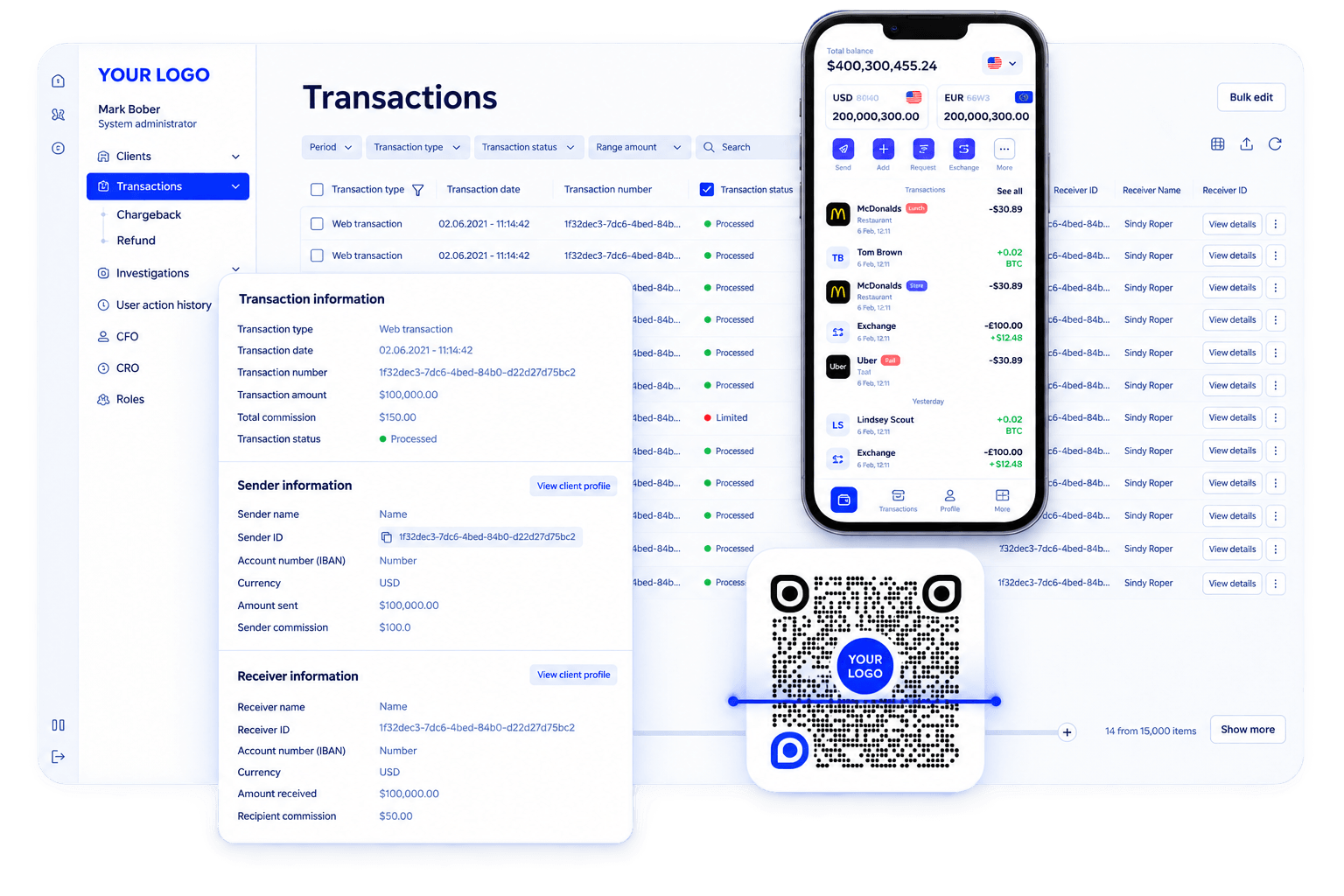
For founders in Ghana, the opportunity is to make mobile-money payments more useful for merchants, customers, and the businesses serving them. The SDK.finance Transaction Platform provides the software foundation for turning that opportunity into a product, with account management, payment workflows, and operational controls your team can adapt to its local business model.
For a Ghana-focused launch, these features address the day-to-day needs of merchants and the teams serving them:
- Customer and merchant wallets. Give marketplace sellers a clear view of balances and payment history with the SDK.finance digital wallet solution.
- Merchant payment management. Track paid, pending, and declined collections so Ghanaian merchants can check mobile-money receipts using integrated provider confirmations.
- Configurable fees and limits. Set pricing and transaction limits for different merchant segments, from small shops to higher-volume businesses.
- Reconciliation and financial records. Match local provider files against internal transactions and investigate discrepancies. Add double-entry accounting with real-time ledger software.
- Local provider integration. Connect your chosen Ghana payment providers through APIs, with access, integration, and testing agreed for each collection or payout route.
- Backoffice access controls. Give support, finance, and operations staff the permissions they need as your merchant base grows.
Choose how to run and adapt the software based on your launch requirements and technical resources:
- SaaS is a hosted version of the software with less infrastructure management for your team. It suits founders whose Ghana launch fits the available features and supported integrations, allowing them to focus on customers and operations.
- A Source Code Licence gives your team access to modify the software and deploy it on your chosen infrastructure. It suits projects needing custom local-provider connections, specialised payment workflows, or greater control over development. You need an internal technical team or implementation partner to manage customisation, testing, deployment, and maintenance.
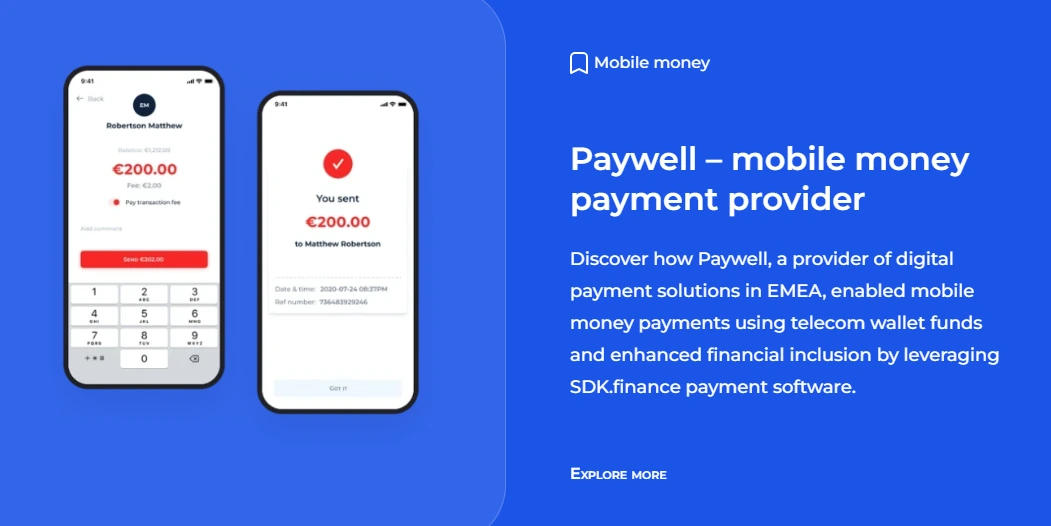
A Ghana example: Paywell
The Paywell case shows this approach in a Ghanaian merchant-payment project. SDK.finance supplied the software foundation and delivered requested customisations, including QR-related functionality and provider integrations. A new project can draw on that experience, with its own provider connections and requirements scoped separately.
Bring your first Ghana customer journey to the SDK.finance team: who pays, how the merchant receives funds, which providers you plan to use, and what your team needs to track. Use that journey to define the essential features and implementation scope for your first release.
Build around a specific market need
Ghana’s FinTech landscape combines established mobile-money use, growing payment activity, and opportunities across digital financial services. For a business entering the market, the practical task is to understand both the customer need and the organisations that make the service possible.
A useful plan connects the service to a workable cost model and a clear operating process. Success should be visible in the customer’s experience, whether that means less manual collection work, better payout visibility, or fewer unresolved payment problems.
Discover how the SDK.finance TPS can power high-speed, secure operations across banking, fintech, and retail
Talk to Our Team