Payment fraud trends in 2026 point to a wider challenge than stopping suspicious transactions at checkout. Criminals are using AI to repeat familiar scams faster, abusing card and wallet enrolment flows, and targeting providers whose compromise can expose many merchants at once. For payment service providers (PSPs), acquirers, and FinTech teams, the question is where to intervene without adding unnecessary friction for legitimate customers.
Visa’s Fall 2026 Biannual Threats Report examines activity observed mainly between January and June 2026. It connects these changing attack patterns with the evidence payment teams need: credential checks, merchant relationships, provider dependencies, and customer complaints.
The findings describe Visa’s observations, rather than total worldwide fraud. This analysis explains what changed, how to interpret the figures, and which payment flows deserve closer review.
Discover how the SDK.finance TPS can power high-speed, secure operations across banking, fintech, and retail
Talk to Our TeamPayment fraud statistics: key numbers from Visa’s report
According to Visa’s Fall 2026 Biannual Threats Report, the following payment fraud statistics cover January–June 2026. Each has its own metric and comparison base:
- 62% more incidents involving third-party agents than in July–December 2025.
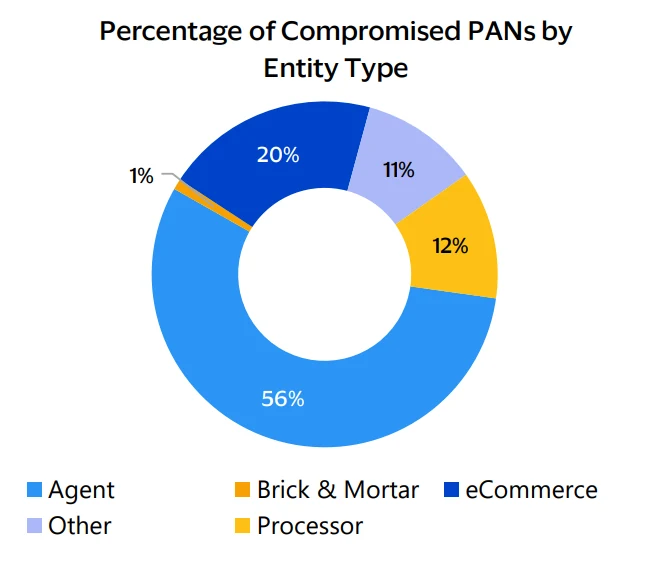
- Approximately 56% of compromised primary account numbers (PANs) identified in the period were linked to third-party providers and agents.
- Over US$1.4 billion in attempted fraud was identified through Visa Scam Disruption (VSD), a 40% increase in the amount identified compared with the previous six months.
- 35% higher payment account enumeration (automated attempts to discover valid payment credentials) volume than in January–June 2025.
- 7.8% lower enumeration volume than in July–December 2025. This is the same activity measured against a different comparison period.
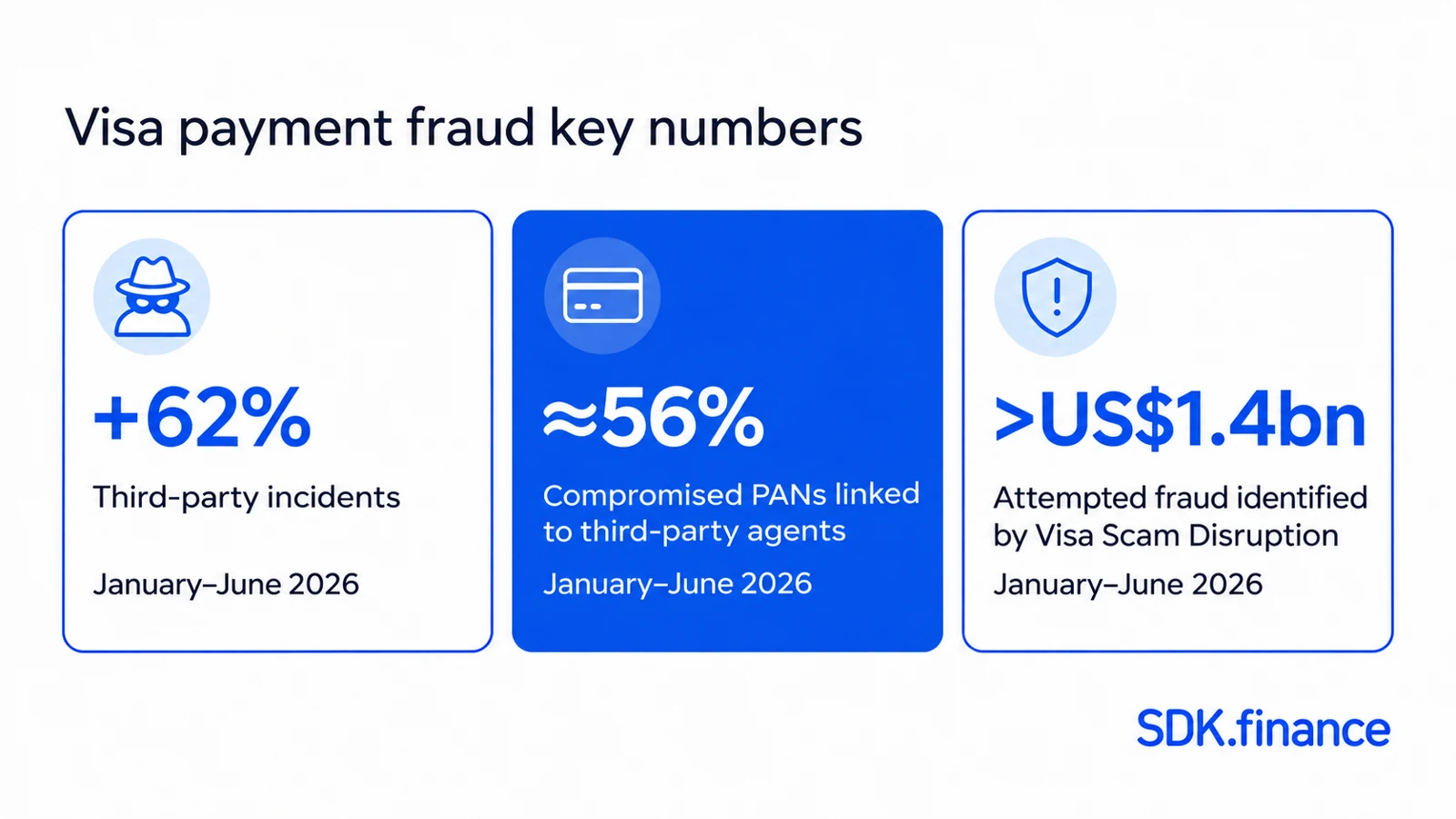
Source: Visa’s Fall 2026 Biannual Threats Report. Research period: January–June 2026.
The US$1.4 billion figure represents attempted fraud identified through Visa Scam Disruption (VSD), not money confirmed stolen. Likewise, a larger amount detected may reflect changes in both criminal activity and detection coverage. It does not establish an equivalent increase in total market losses.
Five payment fraud trends highlighted by Visa
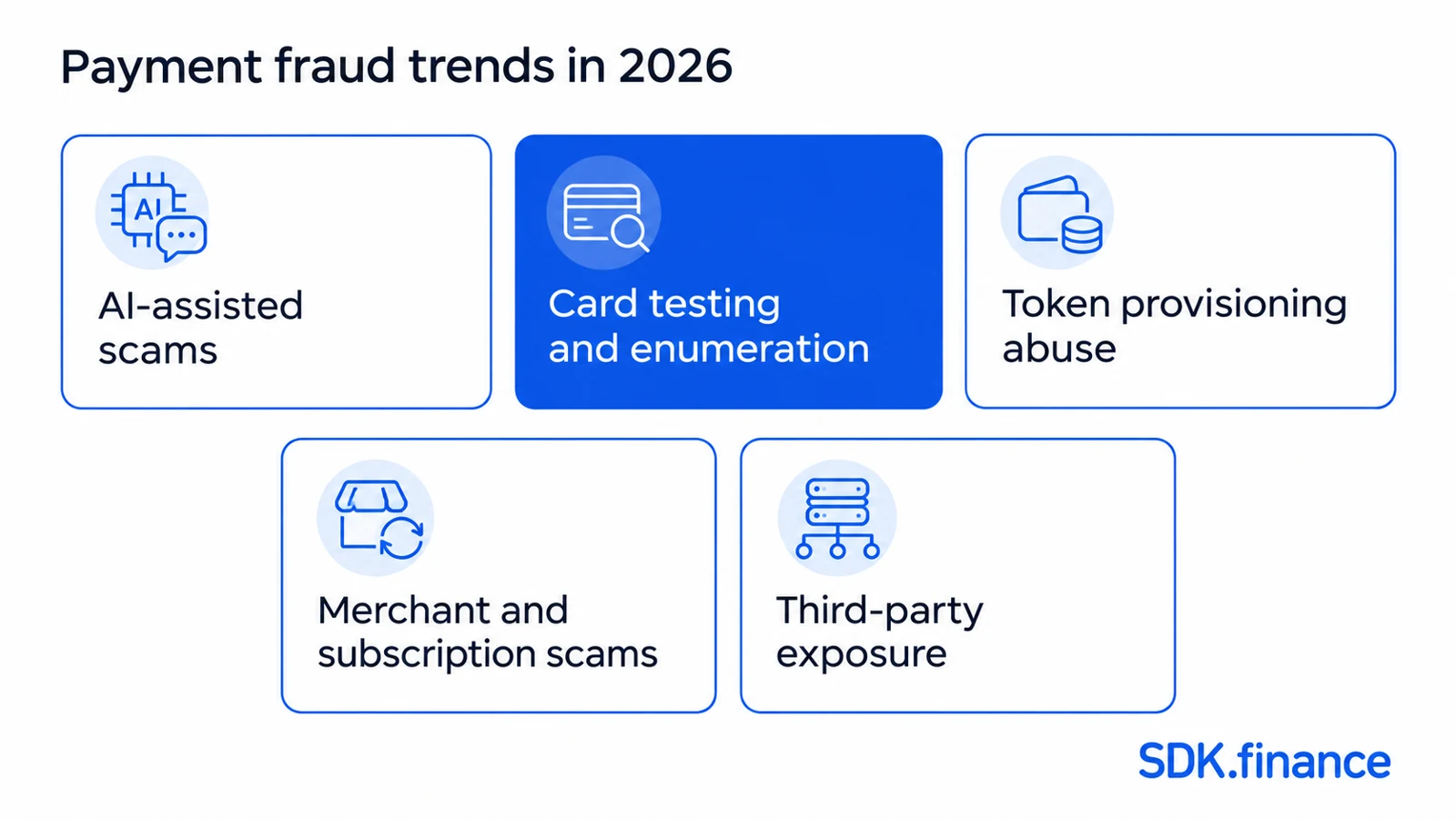
Five developments in Visa’s findings deserve attention. Their relevance depends on your payment flows, merchant portfolio, and access to investigation data.
- AI-assisted scams: assess whether your team can recognise a coordinated campaign across different messages, languages, and merchant accounts.
- Card testing and enumeration: distinguish automated attempts to validate credentials from subsequent fraudulent purchases.
- Token provisioning abuse: examine the decision to add a card to a wallet, as well as the payments made afterwards.
- Merchant and subscription schemes: connect customer complaints with billing terms and relationships between merchant accounts.
- Third-party exposure: establish which merchants and payment flows depend on a provider before an incident requires urgent action.
These developments call for different responses. A checkout control may help with automated card testing but will not explain why customers repeatedly dispute a subscription. Start by identifying the mechanism behind the signal, then decide which team can investigate it.
Source: Visa’s Fall 2026 Biannual Threats Report. Research period: January–June 2026.
How AI is changing the scale of payment fraud

Visa’s accompanying announcement describes AI being used to automate research, produce convincing messages, and support attacks across languages and regions. The business issue is the cost and speed of repeating an attack: a campaign that previously required substantial manual effort can reach more potential victims and change its approach more quickly.
Personalisation can make a scam more convincing by adapting messages to a target’s circumstances, language, or apparent interests. AI also helps criminals change messages and tactics quickly, so payment teams need to connect recurring patterns across campaigns even when the wording or presentation changes.
For a PSP expanding into another market, this changes a useful planning question. Alongside asking whether payment acceptance works in the new country, ask whether fraud operations can recognise complaints, misleading merchant claims, and unusual payment patterns in that market.
For example, assess whether complaints describing the same offer in different languages reach the same review process. Otherwise, a campaign may appear to be several unrelated local incidents. This is a practical test of operational coverage before choosing another detection tool.
Card testing fraud and enumeration: what changed
Card testing checks whether card details can be used. Enumeration involves systematically trying combinations of payment credentials to discover valid ones. The terms overlap in industry usage, but the distinction helps explain whether a business is seeing attempts to validate known details or discover missing information.
Stripe’s card-testing documentation explains why the damage can extend beyond fraudulent purchases. Repeated attempts can raise decline rates, generate fees, consume infrastructure capacity, and distort business data. A small payment amount therefore does not necessarily mean a small operational problem.
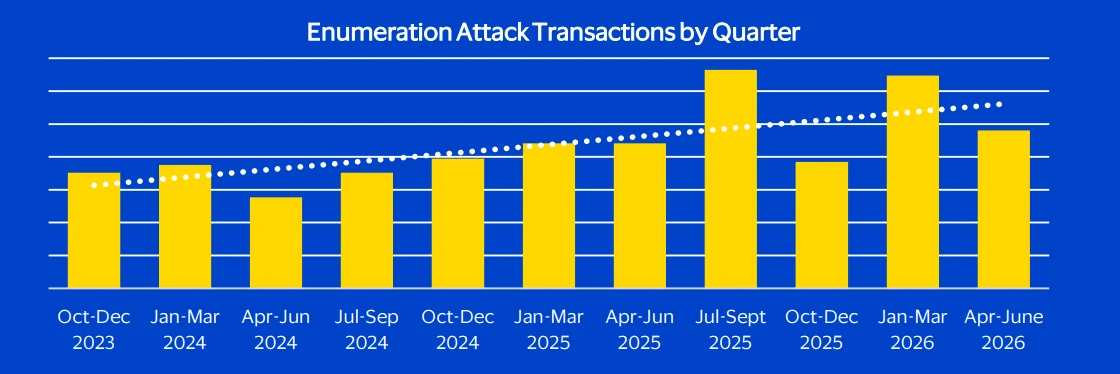
Visa recorded 35% more enumeration activity than in January to June 2025, but 7.8% less than in July to December 2025. The implication is specific: a decline from the preceding half-year does not mean pressure has returned to the previous year’s level. Use both comparisons when assessing whether your own traffic follows the wider pattern.
Source: Visa, Fall 2026 Biannual Threats Report
For management reporting, separate the number of attempts from the number of affected credentials and the value of subsequent confirmed fraud. Then examine where the activity is concentrated. A portfolio average can conceal a sharp change at one merchant or integration.
Token provisioning abuse: fraud before the payment
Token provisioning creates a payment token that can be used instead of a card number in a particular payment environment. Visa reports that attackers are also using provisioning attempts to test stolen credentials. This moves part of the activity to a stage before a purchase.
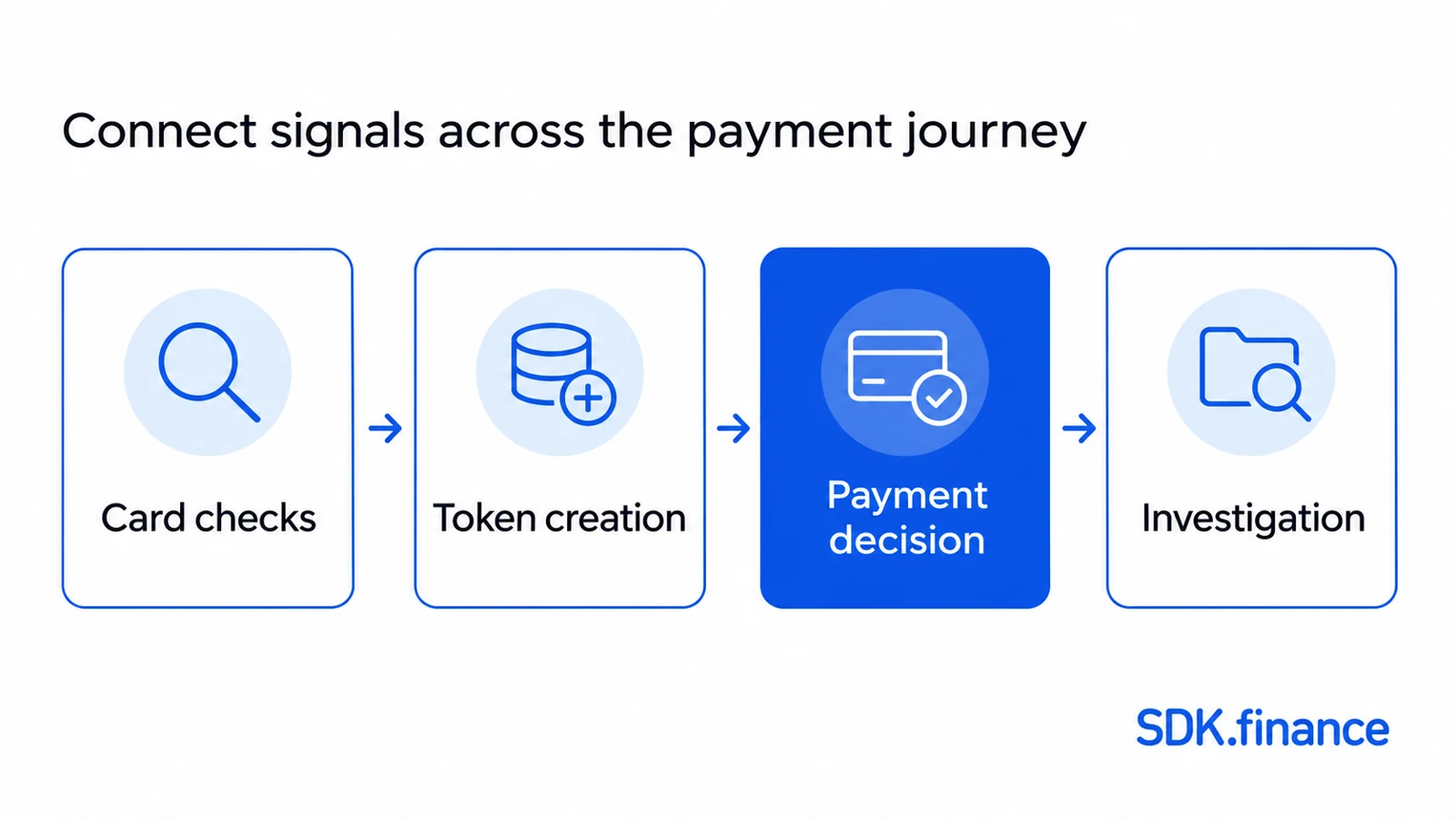
The implication for a payment business is to establish who can see and act on those earlier signals. An issuer, wallet operator, processor, and merchant may hold different pieces of the history. Ask which provisioning outcomes are available through the relevant partner, how they relate to later payments, and which team owns escalation.
Do not assume that a checkout fraud rule covers token creation, or that using tokens proves the person who enrolled the card was legitimate. The review should follow the customer journey across the participating systems.
Merchant fraud networks and deceptive subscriptions
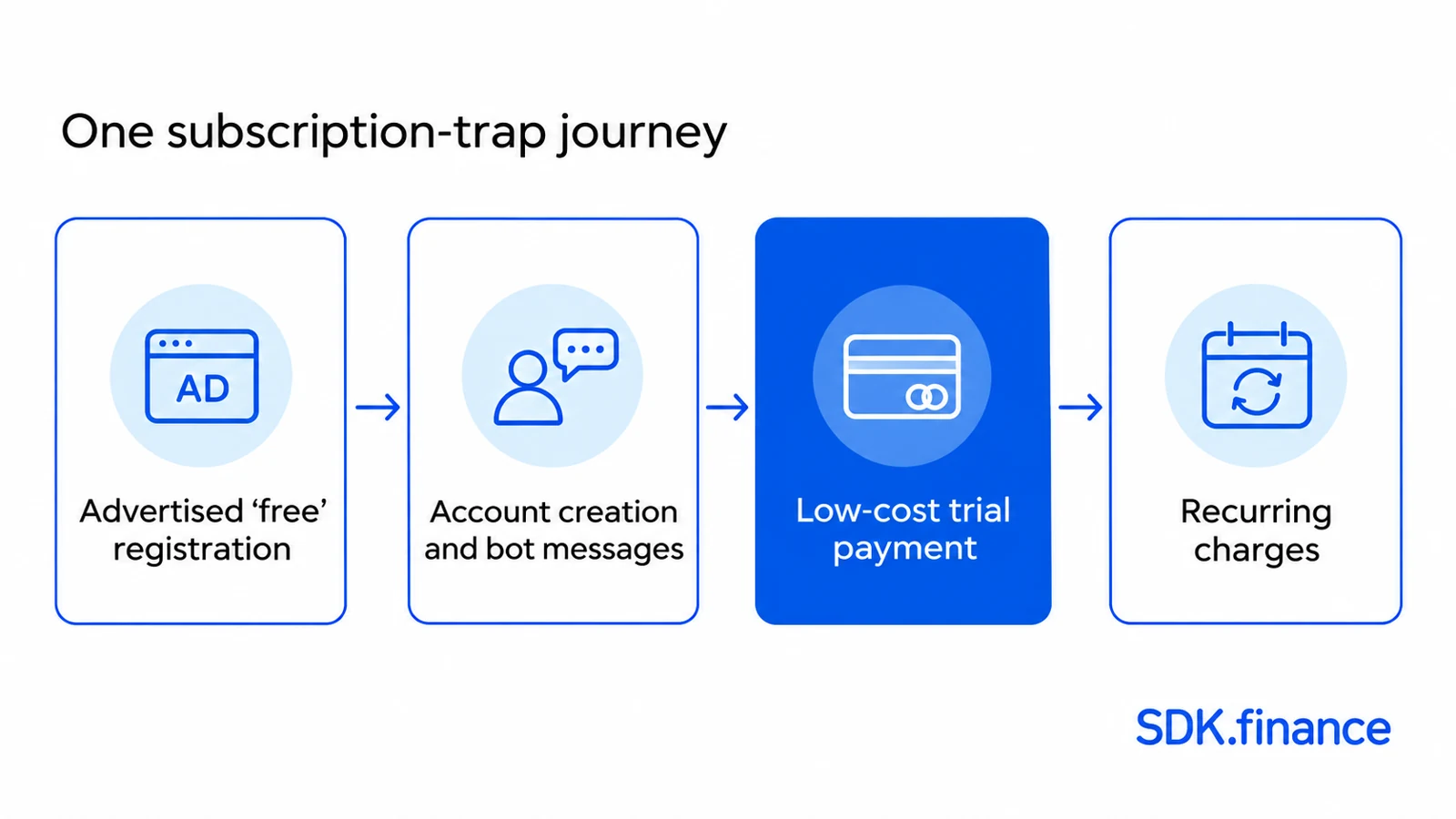
Subscription fraud can involve a deliberately misleading offer or recurring charges without valid consent. A merchant account should be assessed in the context of the business behind it. Visa’s report describes connected fraudulent websites and subscription schemes involving misleading trials, repeat billing, and unclear merchant descriptors, the names customers see on their statements.
Separate stolen credentials from customer deception
Start with two questions: who initiated the payment, and what did the customer believe they were paying for?
- Stolen credentials: a criminal uses someone else’s card details. Investigate authentication, device and payment patterns, including card-not-present fraud and signs of card testing.
- Customer deception: the customer approves a payment after being misled about the offer or recipient. Check the advertised terms, consent, billing descriptor, and cancellation process.
Successful authentication does not prove that an offer was honest. Equally, a complaint or chargeback alone does not prove merchant fraud.
For an acquirer, similar complaints across merchant accounts can justify a wider review. Compare the payment evidence with support records and merchant details to distinguish credential misuse, deception, and ordinary billing problems.
What a connected merchant investigation looks like
Consider a hypothetical acquirer that receives complaints about recurring charges from several small merchants. Each account has only a few complaints, so reviewing accounts individually reveals no obvious concentration. Customers nevertheless describe similar trial offers and difficulty identifying the name on their statements.
The investigation should establish whether the similarities reflect a shared legitimate service or a coordinated problem. Useful evidence includes:
- Offer and consent: capture the advertised trial, the recurring price and frequency disclosed before payment, and the record of the customer’s agreement.
- Statement recognition: compare the billing descriptor with the trading name customers encountered. Establish whether customers can identify the purchase from their statement.
- Cancellation: check the steps customers must complete, records of cancellation requests, and whether later charges match the agreed terms.
- Merchant relationships: examine connections supported by onboarding and transaction records, alongside shared customer-support details. Separate verified links from similarities that require further investigation.
The next action depends on that evidence. Unclear descriptors may require a billing correction; misleading terms may require a different escalation. Shared infrastructure alone is insufficient to label a merchant fraudulent. Documenting the reasoning makes the response more defensible and gives subsequent reviewers a clear basis for reassessment.
This approach also gives product teams useful feedback. If repeated complaints arise because customers cannot recognise a legitimate payment, improving the descriptor or cancellation journey may address the problem more directly than tightening payment rejection rules.
Third-party exposure: the implications for payment businesses
Visa recorded a 62% increase in third-party agent incidents compared with the preceding half-year, while approximately 56% of observed compromised PANs were linked to third parties. For a payment business, that makes shared providers a source of concentrated exposure: an incident outside its direct merchant relationships may still affect several parts of its portfolio.
Source: Visa, Fall 2026 Biannual Threats Report
Test whether a provider incident would leave your team able to:
- Identify the affected merchants and payment flows.
- Reach a contact who can confirm the scope.
- Separate affected traffic from unrelated activity before changing controls.
This is also a useful test of contractual and operational readiness: an incident notification is only actionable if it reaches someone who can connect it to the business’s own records. For the technical mechanisms and defensive controls, see our analysis of cyber attacks on payment and core systems.
Discover how the SDK.finance TPS can power high-speed, secure operations across banking, fintech, and retail
Talk to Our TeamWhy rising attack volumes do not always mean higher fraud losses
Fraud reporting is easier to interpret when it separates three measures:
- Attack attempts: the pressure on the system, including unsuccessful activity.
- Detected fraud: activity identified by controls; results depend partly on detection coverage.
- Confirmed losses: the financial outcome, which may become visible later.
Visa reports that its Risk Operations Center (ROC) blocked 200% more enumeration transactions in January–June 2026 than in July–December 2025. This shows a larger volume of blocked attempts, even as enumeration activity remained above the same period a year earlier. It does not establish a matching reduction in confirmed losses: that requires a separate measure with a comparable period and population.
For your own reporting, keep the population, payment channel, and time window consistent. Review fraud outcomes alongside approval rates, manual-review demand, and complaints about rejected payments. A rule that stops more legitimate payments can make a loss figure look better without producing a better customer outcome.
Also account for merchant mix, transaction volume, and reporting delays before attributing a change to one control.
Why loss amounts and loss rates can move in different directions
Suppose a merchant portfolio records £10,000 in confirmed fraud losses on £10 million of payment value. Its loss rate is 0.10%, or 10 basis points. In a comparable later period, losses reach £12,000 on £20 million of payment value: the rate falls to 0.06%, or 6 basis points, although the amount lost increases.
These hypothetical figures answer two different questions. The loss rate describes exposure relative to payment value; the absolute amount describes the financial impact. Neither establishes whether a new rule caused the change. To assess that, examine comparable traffic, reporting maturity, and changes in customer approvals.
Include the operational burden too. Track investigation time, review queues, support contacts, and dispute-handling work separately from confirmed fraud losses. That gives product and risk leaders a clearer view of whether a control reduces the overall cost of an incident or simply moves work to another team.
What PSPs and acquirers should review next
Choose a priority based on your business model, then define a review that produces a decision and a measurable result.
Match the review to your business model
The same trend can create different operational priorities across a payment portfolio. Segmenting the review makes it easier to assign ownership and avoid a single control applied to every customer journey.
- Online checkout and saved cards: examine account creation, card-saving attempts, authorisation failures, and the cost of automated traffic.
- Wallet-related flows: establish who controls provisioning decisions, which risk signals you receive, and how suspicious activity reaches the responsible partner.
- Subscription merchants: connect acquisition offers, recurring billing, cancellation requests, refunds, and disputes.
- Platforms serving many merchants: assess whether incidents cluster around a shared provider, integration, or operational dependency.
Treat these as starting points for an exposure review. Prioritisation should follow your own traffic and incidents, rather than a global ranking of payment channels. A business with no wallet provisioning role, for example, may need a clearer escalation agreement more than another internal dashboard.
Turn the review into a control decision
Before choosing a tool, distinguish rule-based controls from machine-learning fraud detection. The choice depends on the available data, the behaviour you need to identify, and how the team will review the results. Use the following sequence for the selected flow.
- Establish the baseline. Select a clearly defined merchant group or payment flow and record payment volume, confirmed losses, approval rates, and review demand. Allow for the time needed for fraud reports to arrive before comparing periods.
- Assign evidence and decision owners. Identify who can retrieve the relevant provider references, merchant records, or complaint history, and who has authority to approve a change. Agree how unresolved cases will be escalated.
- Test a bounded change. Specify which traffic a proposed rule or process will affect, what result would justify keeping it, and what would trigger a rollback. A narrower test makes unintended effects easier to identify.
- Review the outcome. Compare equivalent traffic and sufficiently mature fraud data. Record whether the result supports retaining, adjusting, or withdrawing the change, including its effect on legitimate customers and operational workload.
For a broader explanation of the underlying controls, see our guide to payment fraud prevention.
Make the next control decision count
Visa’s findings show why a payment decision alone is too narrow a view of fraud exposure. Credential checks, wallet enrolment, merchant conduct, and provider dependencies create different opportunities for abuse, and each calls for different evidence.
The strongest next step is a targeted review of the flow where those findings matter most to your portfolio. Success means a better-supported decision about that exposure, with a clear understanding of the cost to both the business and its legitimate customers.
Discover how the SDK.finance TPS can power high-speed, secure operations across banking, fintech, and retail
Talk to Our Team