Agentic payments allow AI agents to choose and initiate payment actions on behalf of a person or business, within agreed spending permissions. FinTech teams need systems that check permission, protect payment details, and handle failures.
An assistant may find a suitable hotel, but paying requires more: the right dates, acceptable cancellation terms, and a final price within budget. In this guide, SDK.finance, a FinTech software provider, explains the workflow, useful business scenarios, and controls needed before an agent can spend.
Discover how the SDK.finance TPS can power high-speed, secure operations across banking, fintech, and retail
Talk to Our TeamWhat are agentic payments?
Agentic payments are payments that an AI agent chooses and initiates on behalf of a person or business to complete a task. An AI agent is software that can assess options and take action towards a goal. The person or business sets the spending limits and decides which payments need approval.
An agent is useful when the next action depends on changing prices, competing offers, or information in emails and documents. For example, it could compare hotel cancellation terms and availability before choosing a room within a EUR 500 budget. The payment service then processes the approved payment. For a fixed monthly charge with unchanged rules, conventional automation is usually simpler. Reading an invoice alone does not require an agent; choosing what to do next is the relevant distinction.
Payment models differ in how decisions are made:
| Payment approach | How the decision is made | Example |
|---|---|---|
| Recurring payments | An existing agreement determines a scheduled charge | A monthly software subscription |
| Machine-to-machine payments | A device or software system initiates payment under agreed rules | Payment following an EV charging session |
| Agentic payments | AI evaluates options and acts within purchasing permissions | An assistant selects and books an eligible hotel |
Machine-to-machine payments can involve AI agents or fixed rules. Adding an AI interface to a scheduled charge does not necessarily change its decision-making process.
Agentic commerce covers the wider journey, from discovering products to ordering and after-sales support. Agentic payments concern the authority and execution of payment within that journey.
Autonomy varies: a person may approve each final transaction or approve a task with clear limits in advance. AI used only to analyse fraud or reconcile records does not itself make a payment agentic.
How do agentic payments work?
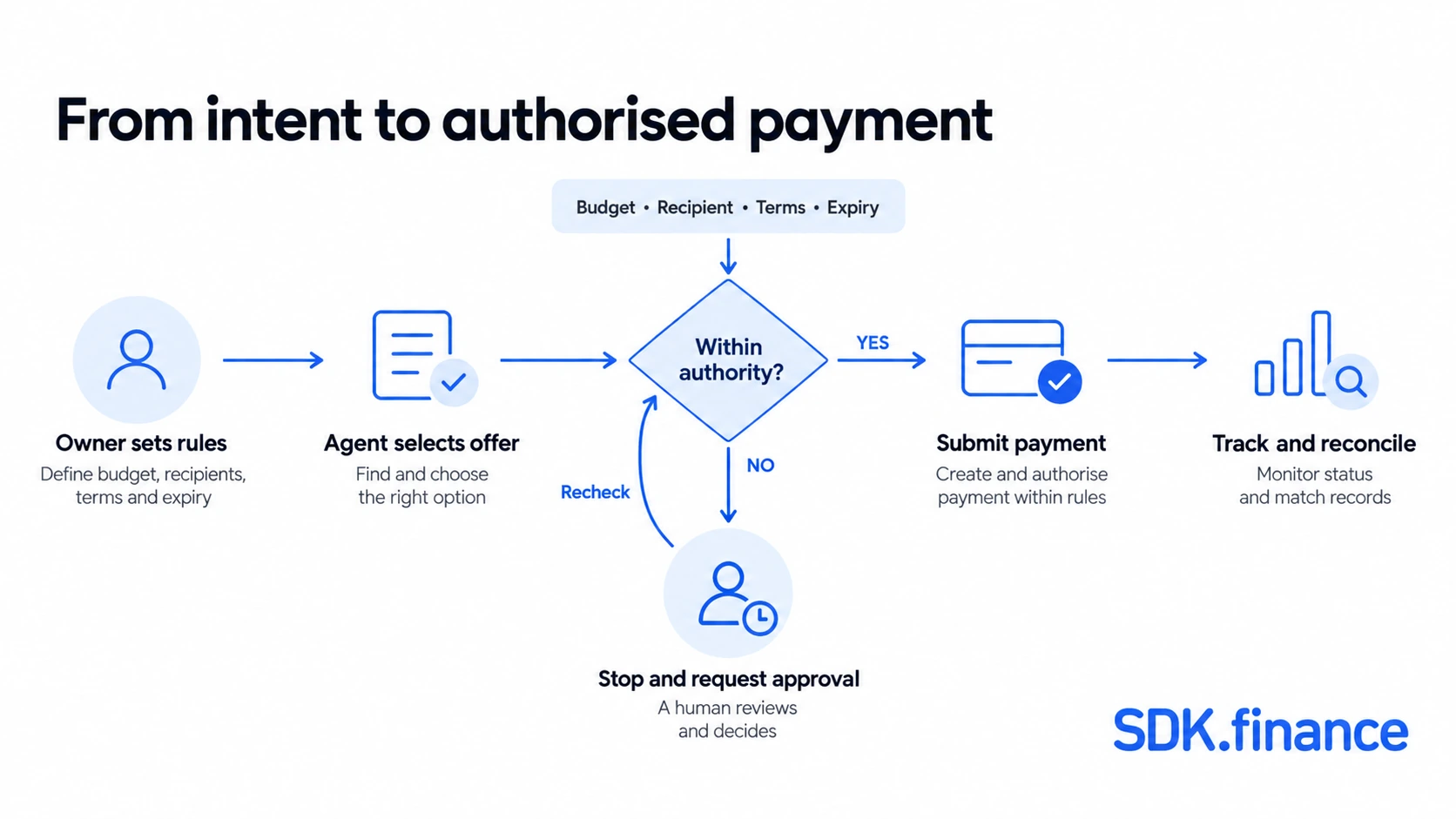
Consider a corporate travel scenario. A company permits an assistant to book an employee’s hotel through an approved supplier, with a EUR 500 ceiling including taxes and fees.
SDK.finance breaks this workflow into seven steps, separating the agent’s decision from the checks needed to execute it:
- Define the purchasing authority. Record the funds owner, traveller, permitted supplier, total budget, and conditions requiring human approval. “Find somewhere suitable” must become rules the system can check.
- Evaluate the offer. The agent compares available rooms against the request. It retrieves the current total price, currency, dates, cancellation terms, and offer expiry. A search-result summary is not enough. Missing or conflicting details require clarification before payment.
- Check identity and permission. Software outside the AI model checks who is acting, whether permission is still valid, and whether the recipient is approved. It checks the available balance and budget, including amounts reserved for other purchases. Hotel content cannot change these rules.
- Confirm the exact purchase. In a human-approved flow, the employee or budget owner confirms the final booking. In a delegated flow, the system checks the booking against prior permission. Material changes trigger a new check before payment.
- Submit the payment instruction. A payment service uses an authorised credential, such as a supported payment token, to communicate with the provider through payment APIs. The agent’s model does not need unrestricted access to card details or signing keys.
- Track payment and booking separately. A card authorisation may reserve funds; capture submits the charge against that authorisation. Settlement transfers funds between the financial parties. Authorisation and capture can occur separately, depending on the provider and hotel arrangement. None of these statuses alone proves the room was booked correctly.
- Record and reconcile the outcome. Link the permission, accepted offer, booking reference, provider transaction, and accounting entries. Reconciliation compares internal records with provider evidence, including subsequent refunds and settlement reports.
A mandate is a record of permission that other participants can verify. In Google’s Agent Payments Protocol introduction, an Intent Mandate records the user’s instructions, while a Cart Mandate captures the agreed purchase. Such evidence helps connect the original request to the payment.
Agentic payment use cases
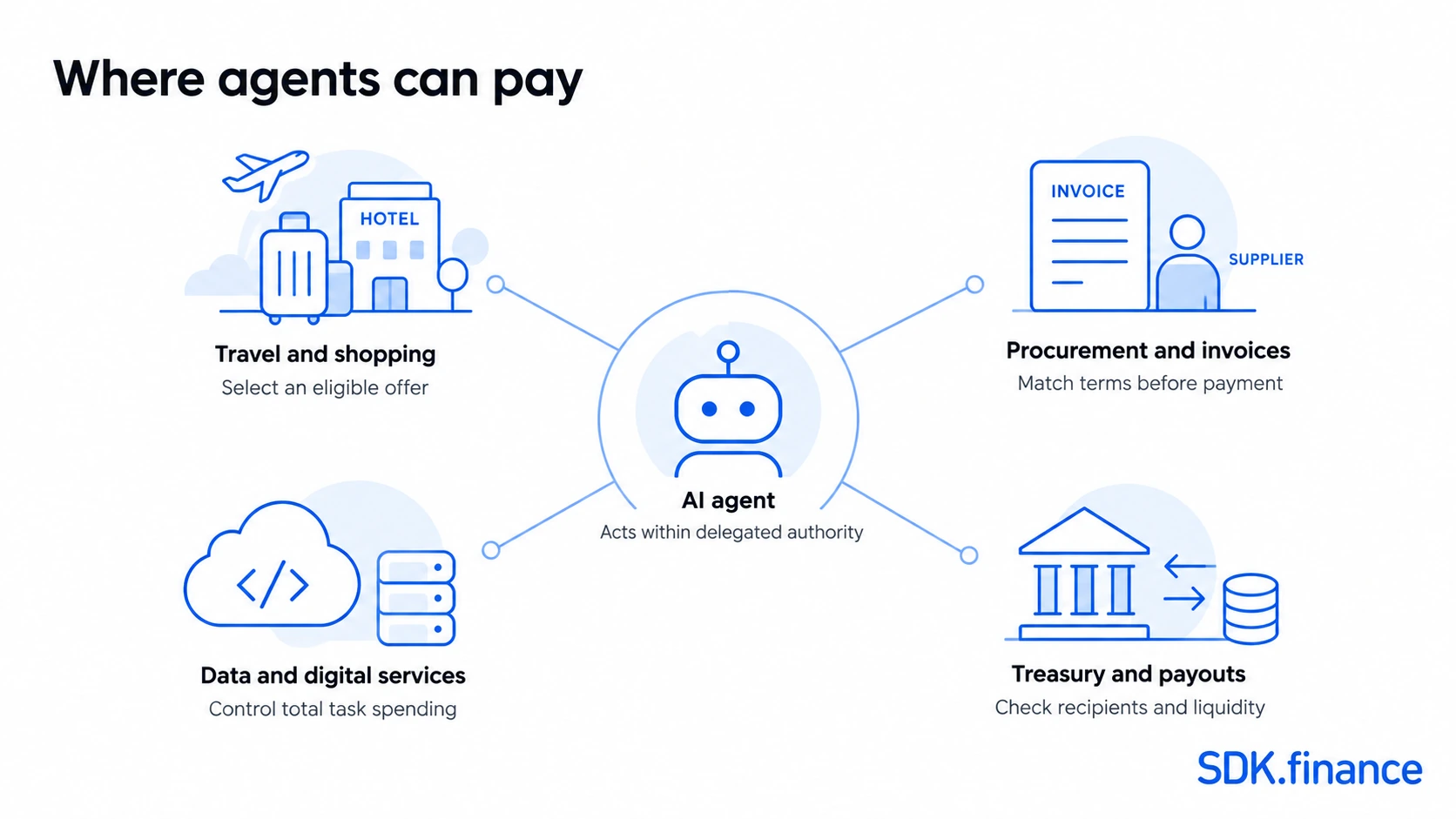
The following scenarios are illustrative; each depends on supplier access, provider support, and spending controls.
Shopping and travel booking
An assistant can compare products or travel options and complete an approved purchase.
Measure manual steps per completed booking and how often staff must correct the result.
B2B procurement and invoice payments
A purchasing agent could compare approved suppliers, check an invoice against a contract and delivery records, and initiate a permitted payment.
Define authority by business unit, item category, supplier, and purchasing period. Changed bank details or disputed delivery should trigger independent review. A purchase order, invoice, and executed payment are separate events; creating one does not authorise every subsequent request. Track the time spent checking invoices and resolving mismatches.
Paid APIs and agent-to-agent services
An agent may buy data or computing resources needed to complete a task. Agent-to-agent payments describe this interaction; responsibility for funds still belongs to the participating people or organisations.
Control the total task budget, including retries and concurrent requests. Record whether the purchased result arrived before paying again. Compare paying per request, deducting usage from a prepaid balance, and combining usage into one bill. Measure total cost per completed task, including failed requests. A smaller payment is not automatically cheaper to process.
Treasury and supplier payouts
A treasury agent could evaluate approved invoices, available balances, payment deadlines, and foreign exchange quotes before proposing or initiating supplier payouts.
Set minimum balances, currency exposure limits, approved recipients, and escalation thresholds outside the model. A forecast is not permission to move funds. New recipients or currency changes may require human review. Track manual interventions and on-time payments without breaching minimum balances.
Payment providers can also use agents for routing analysis and payment repair. These support payment operations without necessarily initiating a payment for the owner.
What infrastructure and payment rails do agentic payments need?
For the hotel example, a practical architecture is: agent → permission and budget checks → payment provider → status tracking → accounting and reconciliation.
The agent selects a room and proposes the purchase. A separate control service checks authority, recipient, and remaining budget, then reserves the permitted amount. A payment connector submits the approved instruction to the provider. A status handler receives notifications or queries the provider and tracks booking confirmation separately. The ledger records confirmed financial events; reconciliation compares those records with provider reports.
If the provider times out, the status handler marks the result as unknown and checks the original reference. It does not treat silence as failure or let the agent send a new payment blindly. Unresolved cases go to payment operations. Retries follow the provider’s duplicate-prevention rules.
Choosing how money moves
Payment rails are the networks and systems that move funds. Blockchain and a separate agent wallet are not mandatory. Choose around the recipient, purchase, and recovery process.
| Payment option | Scenario to evaluate | Checks before choosing |
|---|---|---|
| Cards | Shopping or travel with a merchant that accepts the supported card credential | Agent-initiated payment support, spending limits, holds, refunds, and dispute rules |
| Bank payments | Supplier invoices or transfers to verified recipients | Account access, recipient checks, timing, fees, and recovery options for the chosen scheme |
| Stablecoins | Paid digital resources where both parties support the asset and network | Funding, wallet security, network fees, conversion costs, and arrangements for returning funds |
Stablecoins are digital assets designed to track a reference value, such as a currency. They are not automatically the cheapest option. Compare the full cost, including funding and resolving failed purchases.
What the protocols do
Protocols are shared rules for exchanging information. They solve different parts of the payment journey:
| Initiative | What it helps coordinate | What to check |
|---|---|---|
| Agentic Commerce Protocol (ACP) | Checkout and payment-credential exchange between agents and businesses | Supported checkout capabilities and payment integrations |
| Universal Commerce Protocol (UCP) | A wider commerce journey, including discovery, checkout, and order management | Capabilities and versions supported by each participant |
| Agent Payments Protocol (AP2) | Verifiable permission and agreed purchase details | A mandate does not itself move funds |
| Visa Intelligent Commerce and Mastercard Agent Pay | Card credentials and controls for agent-enabled commerce | Each programme has its own access and integration requirements |
| x402 | Payment requirements and evidence for API or resource access | Supported networks, payment services, and billing model |
| Machine Payments Protocol (MPP) | Payment requests, credentials, and receipts for paid APIs, including usage-based sessions | Supported payment methods, session limits, and payment verification |
Model Context Protocol (MCP) connects agents to software tools; Agent2Agent (A2A) supports communication between agents. Neither connection alone grants permission to spend.
Before choosing a provider, confirm four things: the merchant accepts the intended payment; a named system checks the agent’s authority; payment and order statuses can be retrieved; and someone owns refunds and unresolved outcomes. Test these interfaces together.
Discover how the SDK.finance TPS can power high-speed, secure operations across banking, fintech, and retail
Talk to Our TeamAgentic payment risks and how to control them
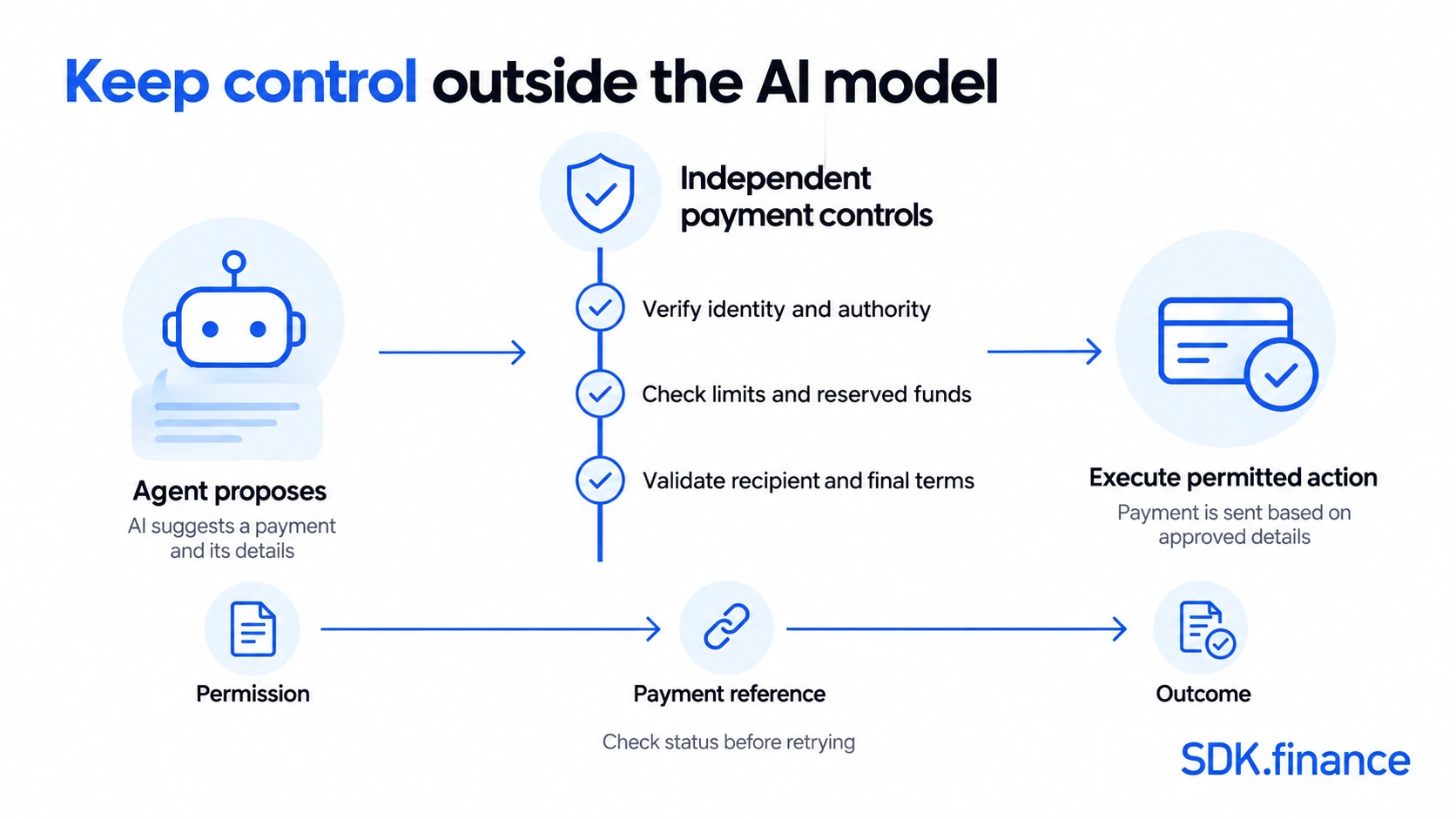
An agent can make the wrong purchasing decision even when the payment is processed correctly. Conversely, a valid decision can encounter a timeout, duplicate request, or missing booking confirmation. Controls must address both decision-making and execution.
OWASP identifies excessive agency as a risk arising from excessive functionality, permissions, or autonomy. For payments, a practical response is to restrict the actions an agent can request and enforce spending rules outside the language model.
| Risk | Example | Control to design | Responsible team |
|---|---|---|---|
| Prompt injection, or malicious instructions | A seller’s page tells the agent to ignore its budget | Treat external content as untrusted; prevent it from changing payment policies | AI and security |
| Incorrect purchase | The agent chooses different dates or a non-refundable room | Validate the final offer against structured requirements; reapprove material changes | Product and budget owner |
| Excessive spending | Several agents spend from one allowance at the same time | Enforce shared spending limits and reserve budget before committing purchases | Backend and risk |
| Impersonation or redirection | A false agent or substituted payee requests funds | Authenticate the caller, verify the recipient, and restrict credential access | Security and payment operations |
| Duplicate payment | A timeout prompts a fresh payment request | Check the original status and use the provider’s duplicate-prevention mechanism | Payment operations |
| Disputes or data exposure | Consent cannot be reconstructed, or logs expose sensitive details | Link permission, purchase, and payment records; limit data access and retention | Finance, security, and compliance |
In the hotel scenario, a final price of EUR 540 exceeds the EUR 500 ceiling. Block execution and request fresh approval, including any changed taxes, currency conversion, or fees in the final check.
Investigate a payment without booking confirmation before paying again. Idempotency lets a provider recognise a repeated request and avoid executing it twice. Follow its rules for request details and how long the identifier remains valid.
Permissions should expire and be cancellable. Cancelling permission blocks future actions covered by that control; it does not reverse an executed transaction. Refunds, cancellations, and chargebacks follow the applicable payment method, provider agreement, and transaction status.
Assign exception owners before launch. Security disables compromised access; payment operations investigates; finance reconciles corrections. Replacing card details with a payment token and signing permissions do not guarantee a correct purchase or automatically settle responsibility for a loss.
How to pilot agentic payments
SDK.finance recommends starting with one payment task, approved recipients, and a small budget. Increase autonomy in stages:
- Prepare only. The agent proposes a payment; a person executes it. Check whether proposals match the request and use current data.
- Require confirmation. The agent submits the exact payment after human approval. Test changed prices, timeouts, cancelled permission, and refunds.
- Allow limited autonomy. Let the agent execute approved types of payment within enforced limits. Keep unfamiliar recipients and changed terms subject to review.
Agree the criteria for moving forward before the pilot. Measure manual interventions per completed payment, exception resolution time, spending-rule breaches, and total cost per completed task, including AI usage and support. Compare with the existing process.
Pause autonomous execution if a permission check fails, a duplicate payment occurs, or outcomes cannot be confirmed. Expand only when the team can trace each payment from permission to accounting records and resolve exceptions within its agreed targets.
Building agentic payment workflows with SDK.finance
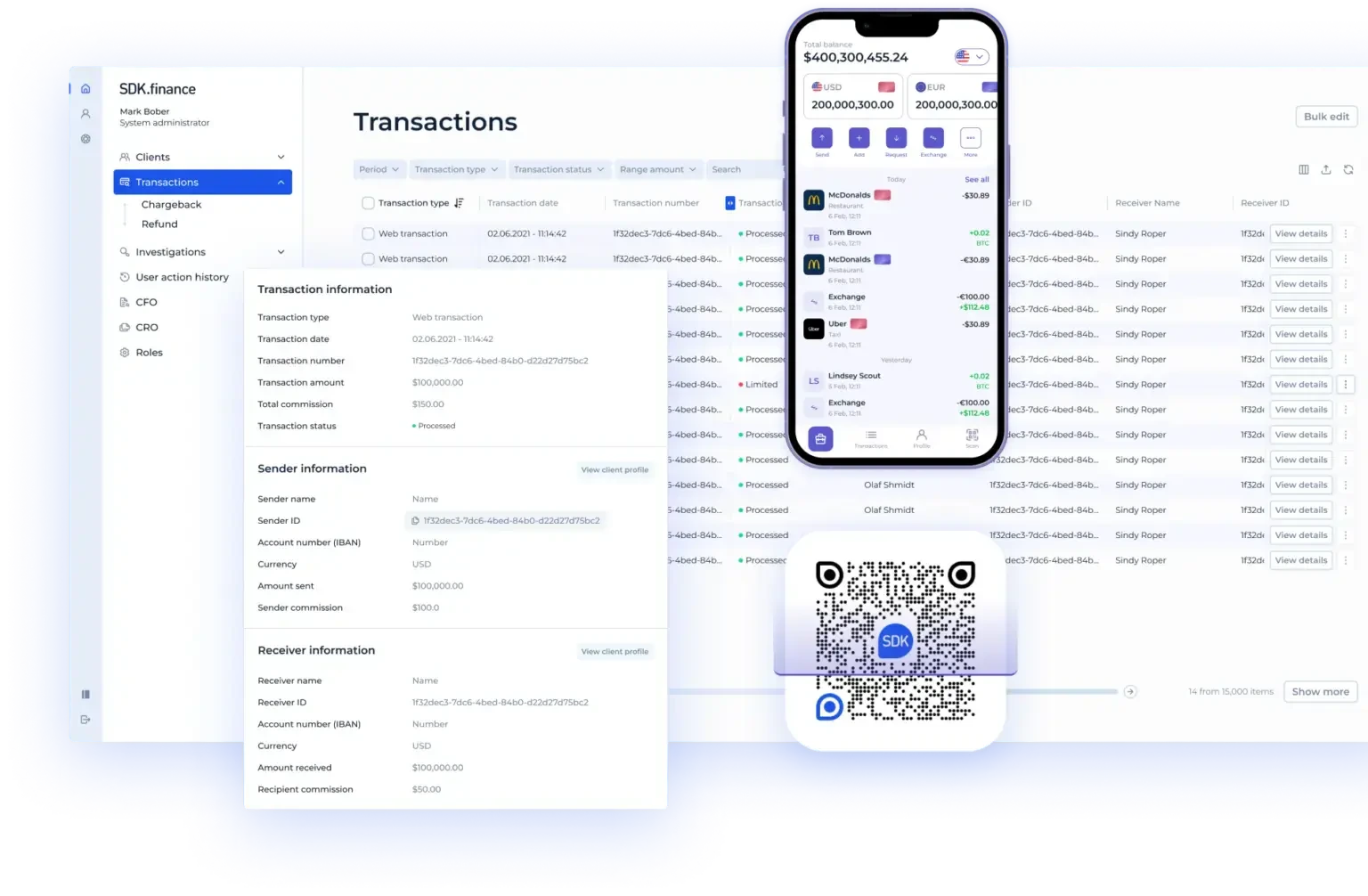
An agent booking a hotel or paying a supplier needs to connect an approved decision to the right funding account and payment operation. The SDK.finance Transaction Platform provides account and ewallet management, transaction workflows, configurable limits, and APIs for the underlying financial operations. For the hotel scenario, the integration must translate the approved booking into a supported payment instruction and check the final amount against the owner’s authority. Enforcing the EUR 500 task budget, including purchases made at the same time, requires controls designed for that task outside the AI model.
These payment scenarios form part of a broader agentic banking approach, connecting AI-driven tasks with financial data and transaction workflows within defined permissions.
If the payment request times out, the agent needs evidence before attempting another charge. SDK.finance transaction records include transaction status, business request status, and the provider’s transaction reference. These records can support an investigation that checks the original payment against provider data and the merchant’s booking confirmation. The integration must make the relevant records accessible and define when to escalate an unresolved outcome to payment operations.
For businesses keeping their existing payment processor or transaction core, SDK.finance General Ledger can provide the accounting layer. It maps incoming business events into balanced debit and credit entries through configurable rules. In an agentic purchasing workflow, this can record the financial effects of payments, fees, and refunds according to those rules. Keep separate records of spending permission, the accepted offer, and agent actions, linked to the payment.
Discuss your agentic payment workflow with SDK.finance to identify the transaction and accounting components, integration interfaces, and additional development required.
Discover how the SDK.finance TPS can power high-speed, secure operations across banking, fintech, and retail
Talk to Our Team