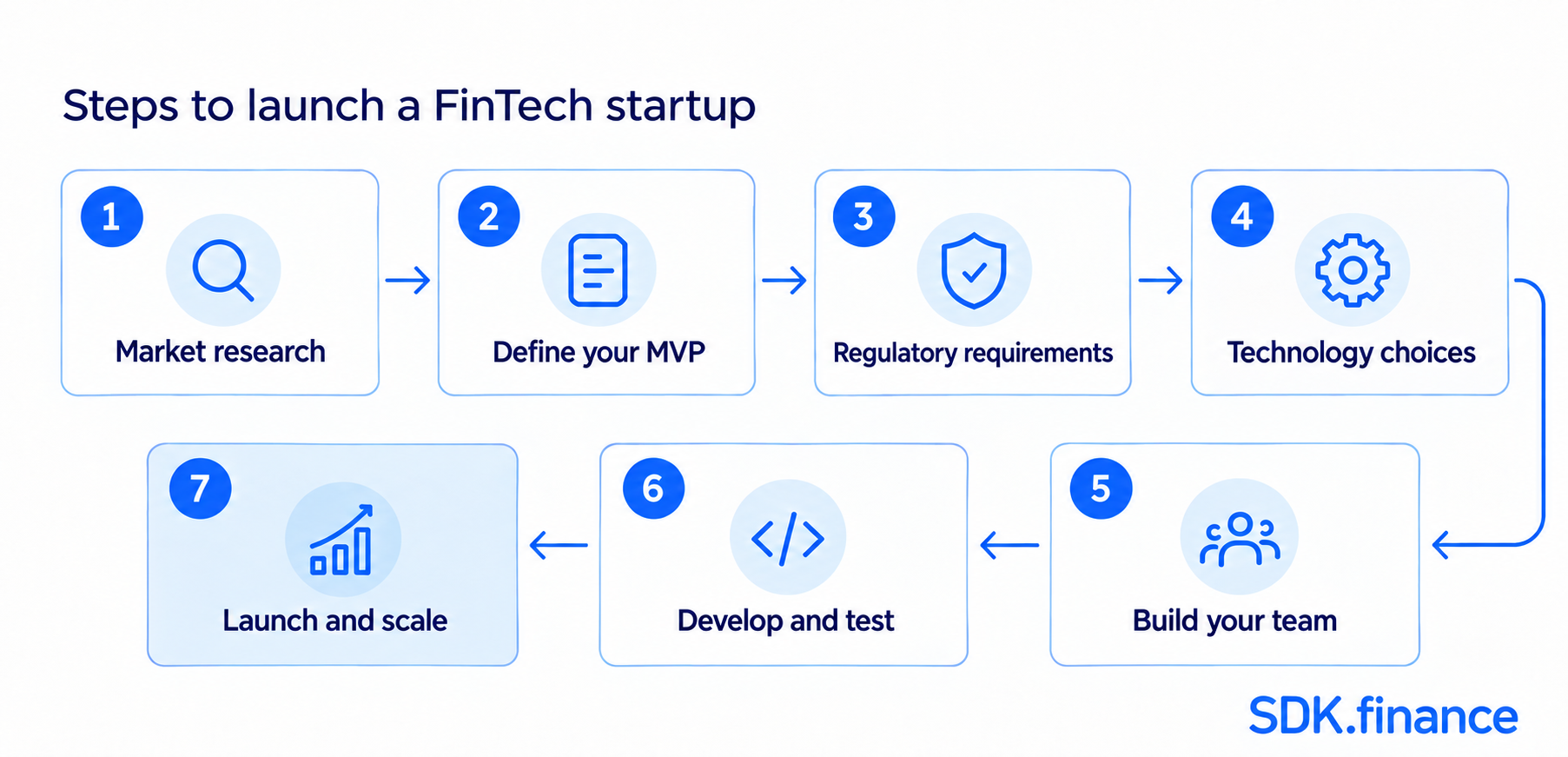
To start a FinTech company, identify a customer problem, validate demand, and define your minimum viable product. Confirm the regulatory requirements and financial partners your service needs, choose a technology approach, build your team, and test the product before a controlled launch. The seven steps below explain the decisions to make along the way. We also explore how SDK.finance, a FinTech software provider, can give your startup a ready-made foundation for building its financial product.
Discover how the SDK.finance TPS can power high-speed, secure operations across banking, fintech, and retail
Talk to Our TeamFinTech market trends and payment adoption
Recent mobile money and digital payment statistics provide context for founders exploring payment and wallet products. They describe these segments rather than the whole FinTech market; startups in other categories need evidence specific to their customers and use case.
- Global mobile money transaction value: More than $2 trillion in 2025, double the level reached in 2021, according to GSMA’s State of the Industry Report on Mobile Money 2026.
- Registered mobile money accounts: 2.3 billion globally in 2025, according to the same GSMA report. Registered accounts are not unique or active users, and these figures describe mobile money services rather than the entire FinTech market.
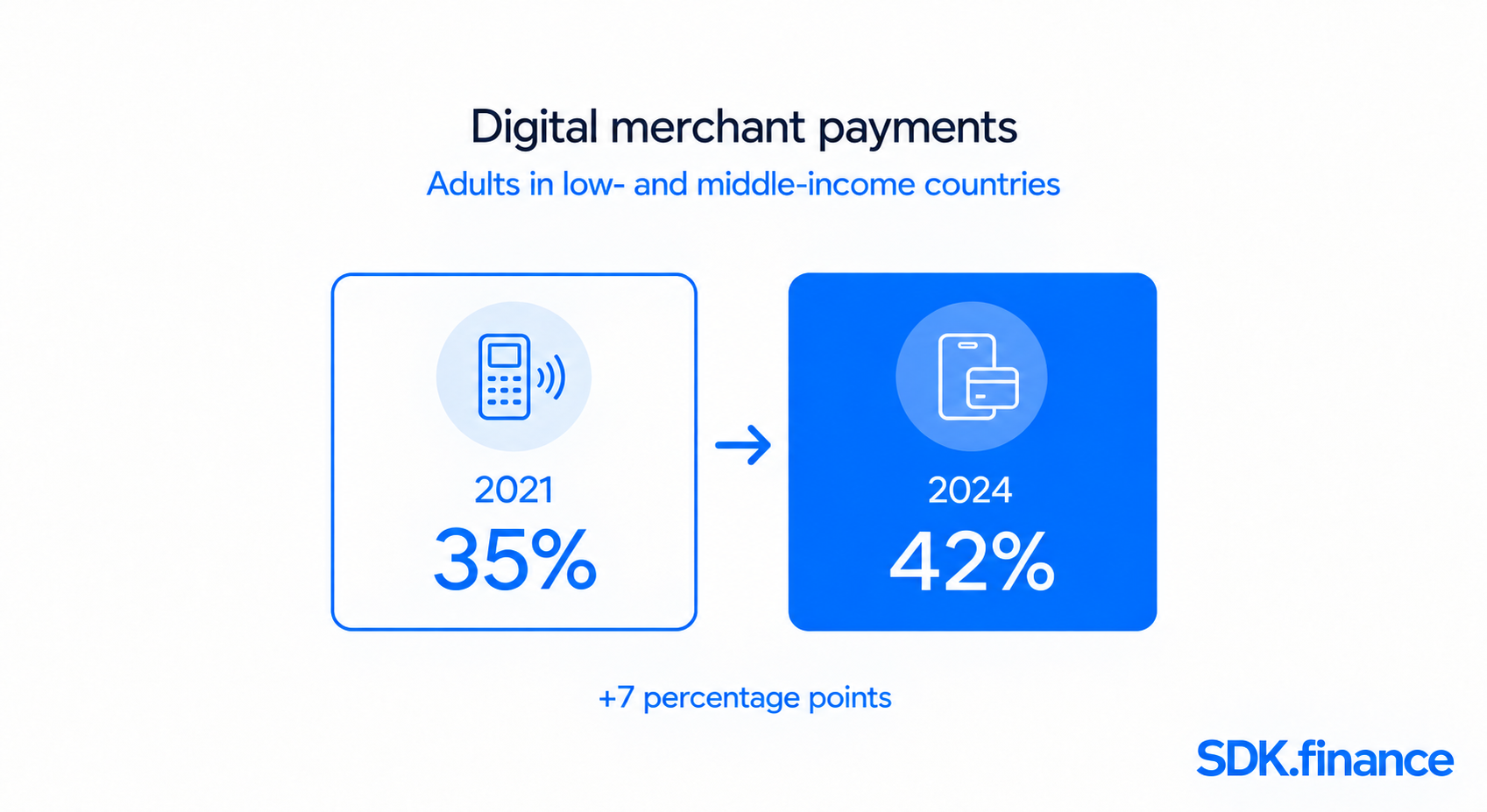
- Digital merchant payments: 42% of adults in low- and middle-income countries made an in-store or online digital merchant payment in 2024, up from 35% in 2021, according to the World Bank’s Global Findex 2025.
Use these figures as market context, then test demand within your chosen customer segment.
7 steps to start a FinTech company
1. Conduct market research
Before starting a FinTech company, conduct market research. This involves analysing current market trends, identifying customer pain points, and looking at the competitive landscape. This research helps refine your product idea, identify potential challenges, and validate the demand for your FinTech solution.
FinTech business ideas to validate
Possible starting points include invoice collection for small businesses, cash-flow tools for freelancers, or a digital wallet for a defined customer community. Treat these as ideas to research, not proven market opportunities. For each one, identify the user’s problem, existing alternatives, willingness to pay, and the financial partners or permissions the service would require.
Choose a revenue model and check unit economics
Before prioritising MVP features, decide who will pay for your service and what they will pay for.
- Test your pricing: A business payments product might charge a subscription, a transaction fee, or a combination of both. Test whether customers accept the proposed price alongside your research into their needs.
- Estimate your contribution margin: Deduct payment processing and other variable provider charges from the fee you expect to earn. Include expected fraud losses and support costs where relevant. Assess whether that contribution can cover fixed operating costs as usage grows.
- Compare volume scenarios: Model conservative and higher transaction volumes, including provider minimum fees. Use the results to identify whether you need different pricing, a narrower service scope, or better commercial terms before investing in development.
2. Define your MVP scope
Use your research to define a provisional minimum viable product (MVP): the smallest set of features needed to complete one useful customer journey. Prioritise the functions that solve the core problem, then refine this scope after checking regulatory requirements and financial partner dependencies in the next step.
For a practical scoping framework, see how to define and validate a FinTech MVP.
Using product management tools can help organise feature prioritisation, track development progress, and ensure that your team stays aligned while building the MVP efficiently.
3. Ensure compliance with regulatory requirements
FinTech companies must assess the rules that apply to their activities and target markets. Depending on the business model, these may include authorisation, Anti-Money Laundering (AML), Know Your Customer (KYC), and data protection requirements. Consult legal experts before finalising the product scope.
Confirm whether your company needs its own authorisation or will deliver the service through regulated partners. Document who holds customer funds, performs customer checks, executes payments, and handles complaints. Buying software does not provide a banking licence.
4. Choose your development approach and technology
Before choosing a stack or hiring your development team, compare building from scratch with adapting ready-made software against the same MVP requirements. Assess functional gaps, integration work, customisation options, and maintenance responsibilities.
Plan your launch budget
Separate one-off costs for software or development, integrations, legal work, and testing from monthly costs for hosting, providers, support, and operations. Plan how you will fund these expenses before revenue covers them, and set aside a reserve for delays in integrations or partner onboarding. A lower initial software fee does not necessarily mean a lower total launch cost.
Building from scratch vs adapting ready-made software
| Decision factor | Build from scratch | Adapt ready-made software |
|---|---|---|
| Initial scope | Build and test the foundational components | Assess existing components and identify gaps |
| Customisation | Implement changes within your own architecture | Check supported extensions and licence terms |
| Integrations | Build and maintain required connections | Verify available connections and remaining integration work |
| Cost estimate | Engineering, integrations, infrastructure, testing and ongoing maintenance | Licence or subscription, customisation, integrations, infrastructure, testing and support; responsibilities depend on the delivery model |
| Best fit | Core requirements justify substantial custom development | Existing functionality closely matches the launch scope |
Choose technologies your team can maintain and that fit the selected software, provider integrations, security requirements, and expected workload. Compare ongoing hosting and support costs alongside development effort. Common technology options include:
- Backend: Python, Java, or Node.js for robust server-side development.
- Frontend: React.js, Angular, or Vue.js for a responsive user interface.
- Database: SQL databases like PostgreSQL for structured data and NoSQL databases like MongoDB for flexibility.
- Cloud services: AWS, Google Cloud, or Microsoft Azure for scalable infrastructure.
- Security: Plan encryption, access controls, secure authentication, logging, and recovery. Assess applicable data protection obligations and PCI DSS requirements where cardholder data is involved.
5. Build a team
Assign clear responsibility for product discovery and MVP scope, engineering and integrations, legal and compliance work, and day-to-day operations and customer support. These are responsibilities to cover, not necessarily separate full-time hires: decide which require internal ownership and where specialist partners can help. Match engineering capacity to your development approach and plan who will maintain the product after launch.
6. Develop and test your FinTech product
To build a FinTech app, connect the customer-facing web or mobile interface to the backend and the financial providers your service needs. Define how users sign up, complete the main transaction, check its status, and get help. Test failed payments, duplicate requests, and refunds alongside the successful journey before launching.
Whichever development approach you choose, use the FinTech software development life cycle to connect requirements, testing, release approval, and ongoing operations.
7. Launch and scale your business
Start with a defined pilot group and clear limits on the initial service. Track onboarding completion, successful transactions, payment failures, repeat usage, and support requests. Resolve recurring problems before expanding to more customers or markets.
Test customer acquisition channels with a limited budget, then compare acquisition costs to decide which channels to expand.
Discover how the SDK.finance TPS can power high-speed, secure operations across banking, fintech, and retail
Talk to Our TeamSDK.finance: a software foundation for your FinTech startup
Launching a FinTech startup means turning a validated idea into a working financial service with a limited budget and engineering team. SDK.finance is a FinTech software provider that supplies an existing financial core, helping founders avoid building every account, balance, and transaction workflow from the beginning.
For a wallet or payments startup, the SDK.finance Transaction Platform can form the backend of the first release. Start by matching its existing functionality to your MVP scope, identifying gaps, and planning the integrations your target market requires. Your team still defines the customer experience, implements product-specific features, and tests the complete service.
Core features for your first release
- Accounts and wallets: Use existing account, currency, balance, and transaction-history functionality as the foundation of your MVP. Select the account types and currencies your initial customer group needs before expanding the offering.
- Payment workflows: Build the first customer journey around top-ups, internal transfers, or withdrawals. Connect and test the external payment providers needed to complete that journey; available payment routes depend on those integrations and commercial agreements.
- Fees and limits: Translate your startup’s pricing model into configurable charges, and set transaction limits for the pilot.
- Onboarding and back-office tools: Manage customer profiles, KYC workflows, and staff access so your launch team can support early users and investigate issues. Customer verification depends on the relevant provider integrations and your operating procedures.
- Financial records: SDK.finance General Ledger provides double-entry accounting, balance tracking, and reconciliation-ready records. For a startup moving customer funds, this supports checking internal records against provider reports from the first release; it can also complement an existing transaction system.
- 650+ API endpoints: Connect your startup’s web or mobile experience to the backend and required external services. Your developers can build the customer journeys that distinguish your product on top of existing financial functionality.
Choose SaaS or a Source Code Licence
SaaS: Consider this model when your startup’s MVP fits the platform’s configuration and API-based extension options, and you want to limit application-hosting and update work. SDK.finance manages application hosting and platform updates, while your team handles product configuration and integrations without direct backend source code access. Include subscription and provider costs in your operating budget, and confirm database responsibilities and service scope in the agreed terms.
Source Code Licence: Start building your FinTech startup on a pre-developed financial core with access to its source code. Your team can deploy this foundation and use its existing account, balance, and transaction functionality to develop your product. From that starting point, developers can extend workflows, add features and integrations, and customise the project around your business model within the licence terms. Your team manages deployment, infrastructure, maintenance, and further development.
Choose the delivery model based on your first-release requirements, budget, and engineering capacity. SDK.finance provides the software foundation; your startup remains responsible for validating demand, securing the required financial partners and permissions, and running the service.
Turn your FinTech idea into a launch plan
Turn these decisions into a launch plan with a defined customer segment, MVP scope, budget, accountable owners, and partner dependencies. Set the criteria for approving your pilot and the evidence you will need before expanding; use this plan to align your team and assess development proposals.
Discover how the SDK.finance TPS can power high-speed, secure operations across banking, fintech, and retail
Talk to Our Team