Every deposit, withdrawal, and transfer depends on a bank keeping its account records consistent. Core banking provides the technology behind these everyday operations, connecting branches and digital channels to the same account and transaction records. For banks and FinTech teams, understanding how this core works is a starting point for improving existing services or building new financial products.
This article explains how core banking systems work, their architecture and essential features, and the benefits and challenges of implementation. We also examine SDK.finance as a core banking software provider and how its ready-made backend can help teams build account-based banking and payment products.
SDK.finance provides core banking infrastructure with ledger, payments, wallets, ready applications and flexible deployment options
Talk to Our TeamWhat is core banking?
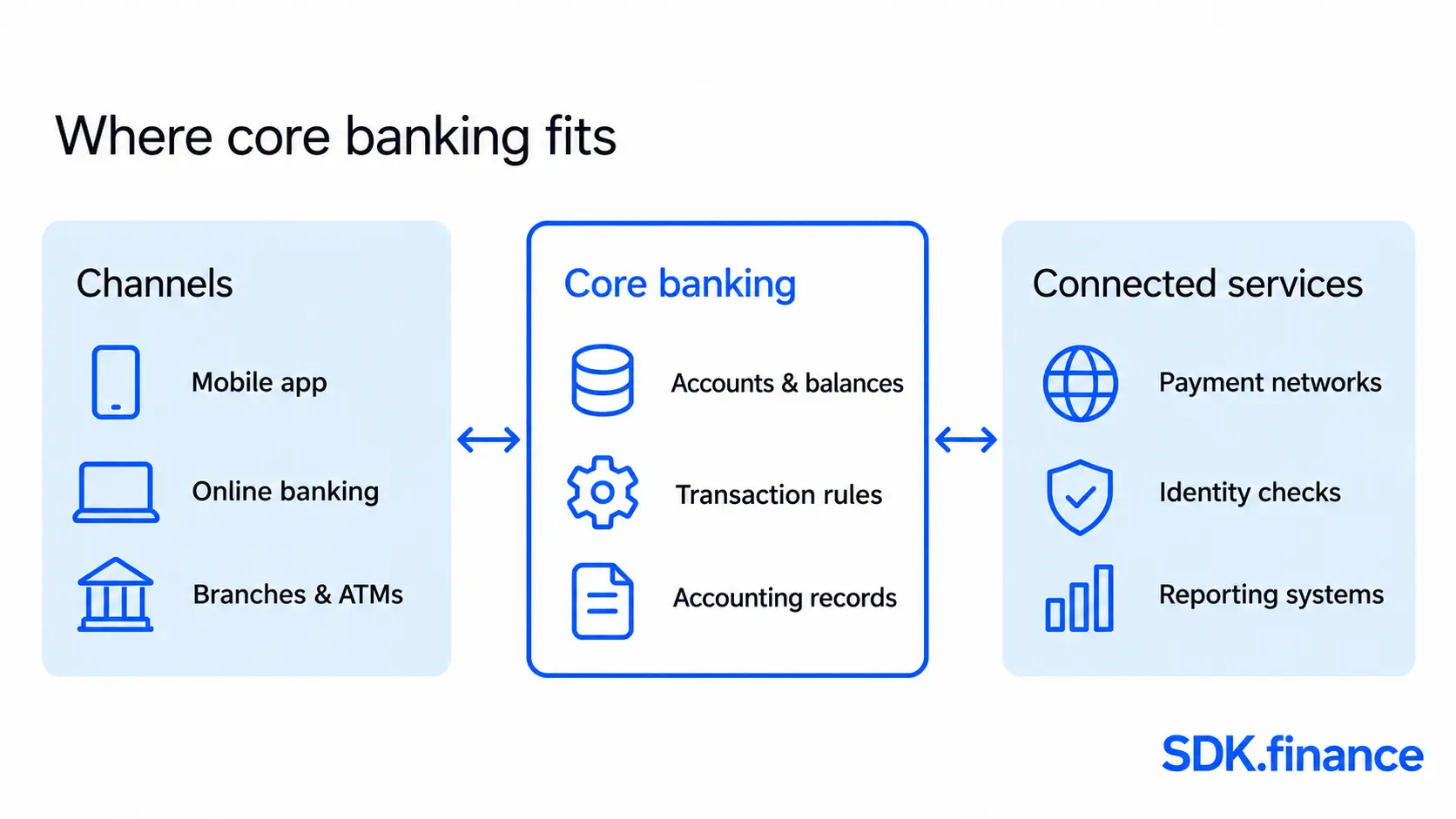
Core banking software is the backend system of record for a bank’s accounts, balances, and transactions across branches and digital channels. It connects to customer-facing applications and external services through interfaces, while supported banking products depend on the system.
What does core banking mean?
The term CORE is commonly expanded as Centralized Online Real-time Environment. This means that customers can experience the bank as a single entity, accessing their accounts and conducting transactions without being tied to the branch where they opened an account. Shared account records allow another branch, an ATM, or a connected digital channel to retrieve the information needed to process a request. For example, a customer can deposit money at one branch and view the updated balance through mobile banking once the transaction has been processed.
What are IT core banking services?
The key core banking services, which are integral to the banking infrastructure, include new account creation, account management, interest calculations, deposits and withdrawals processing, and loan issuing and servicing where supported. Customer relationship management and identity verification may be handled by connected systems.
Core banking software market size
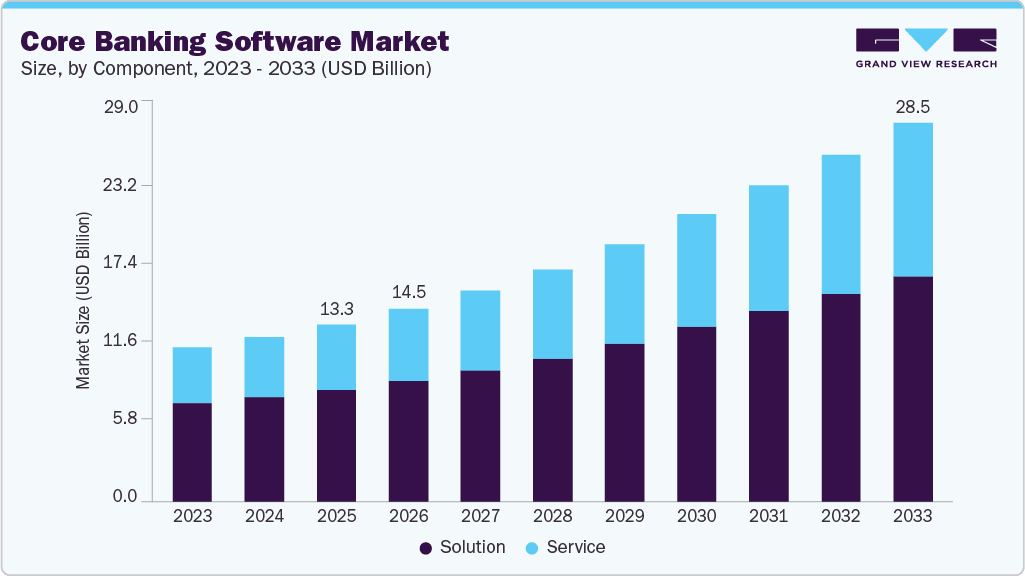
According to Grand View Research’s June 2026 report, the global core banking software market has the following characteristics:
- Market size: USD 13.3 billion in 2025, with an estimated USD 14.5 billion for 2026.
- Market forecast for 2033: USD 28.5 billion.
- Projected CAGR from 2026 to 2033: 10.2%.
- Software solutions’ share of market revenue in 2025: 63.1%; services accounted for the remainder.
- North America’s share of global revenue in 2025: 29.3%.
- Fastest-growing region forecast for 2026 to 2033: Asia Pacific.
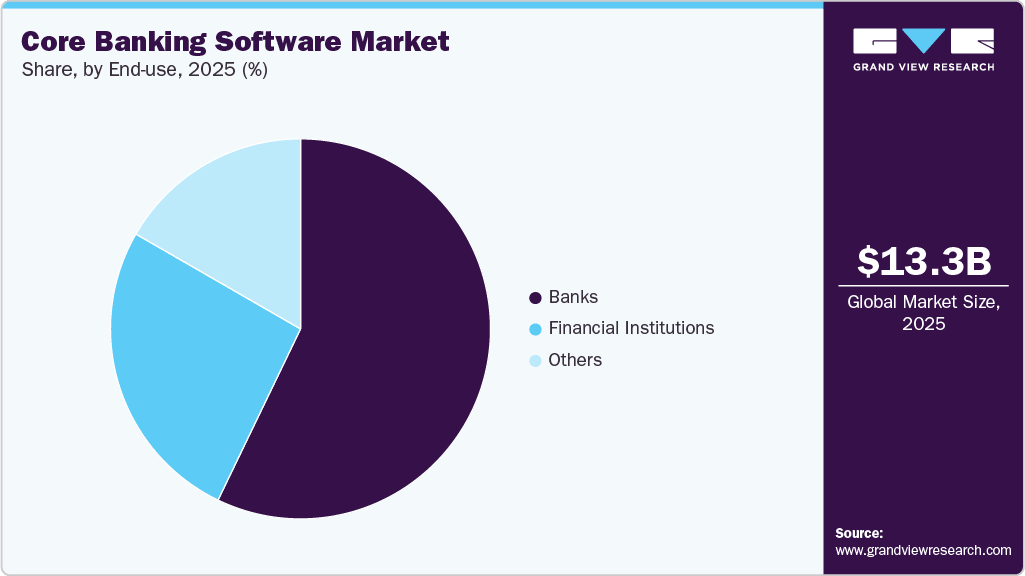
- Largest end-use segment in 2025: banks.
The forecast suggests continued investment in core banking, driven by digital services and infrastructure modernisation. This creates opportunities for new implementations and upgrades, although market growth does not indicate how many banks will replace their core.
The services component highlights the importance of integration, configuration, and implementation support. Buyers should assess these delivery requirements alongside software capabilities; providers need to help institutions adopt and connect the software as well as supply it.
The chart below shows the market by end-use: banks, financial institutions, and other users.
How does core banking work?
To understand how these systems support everyday banking, consider what happens when a customer withdraws money or transfers funds.
When a customer withdraws money from a branch or an ATM, the application sends a request to the centralized data center, which then processes the request and authenticates the operation. The system also checks available funds and limits, records the authorised withdrawal, updates the balance, and returns its status.
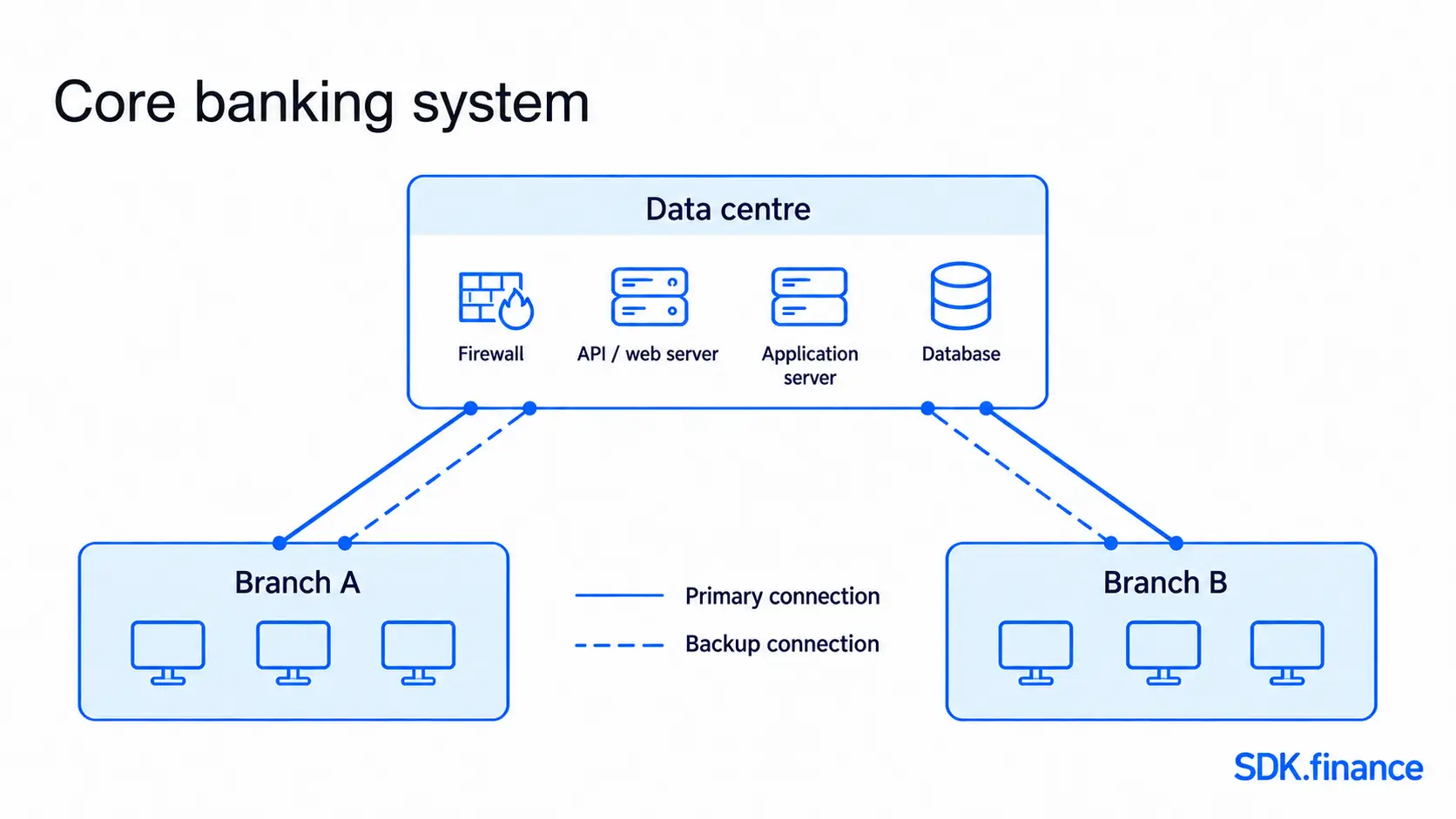
Illustrative core banking deployment: branches connect to shared backend infrastructure through primary and backup connections. The diagram is simplified and does not represent every component or deployment model.
An example of a core banking transaction is a £100 transfer between two eligible accounts within the same bank. The banking app submits the request; the backend checks the account status, available funds, limits, and applicable fees. The system records the transaction and updates the affected balances, then returns a status to the app. If a request fails or is repeated, the processing rules must prevent an unintended duplicate transfer. A payment to another bank also depends on external payment infrastructure, so an internal update does not necessarily mean that settlement is complete.
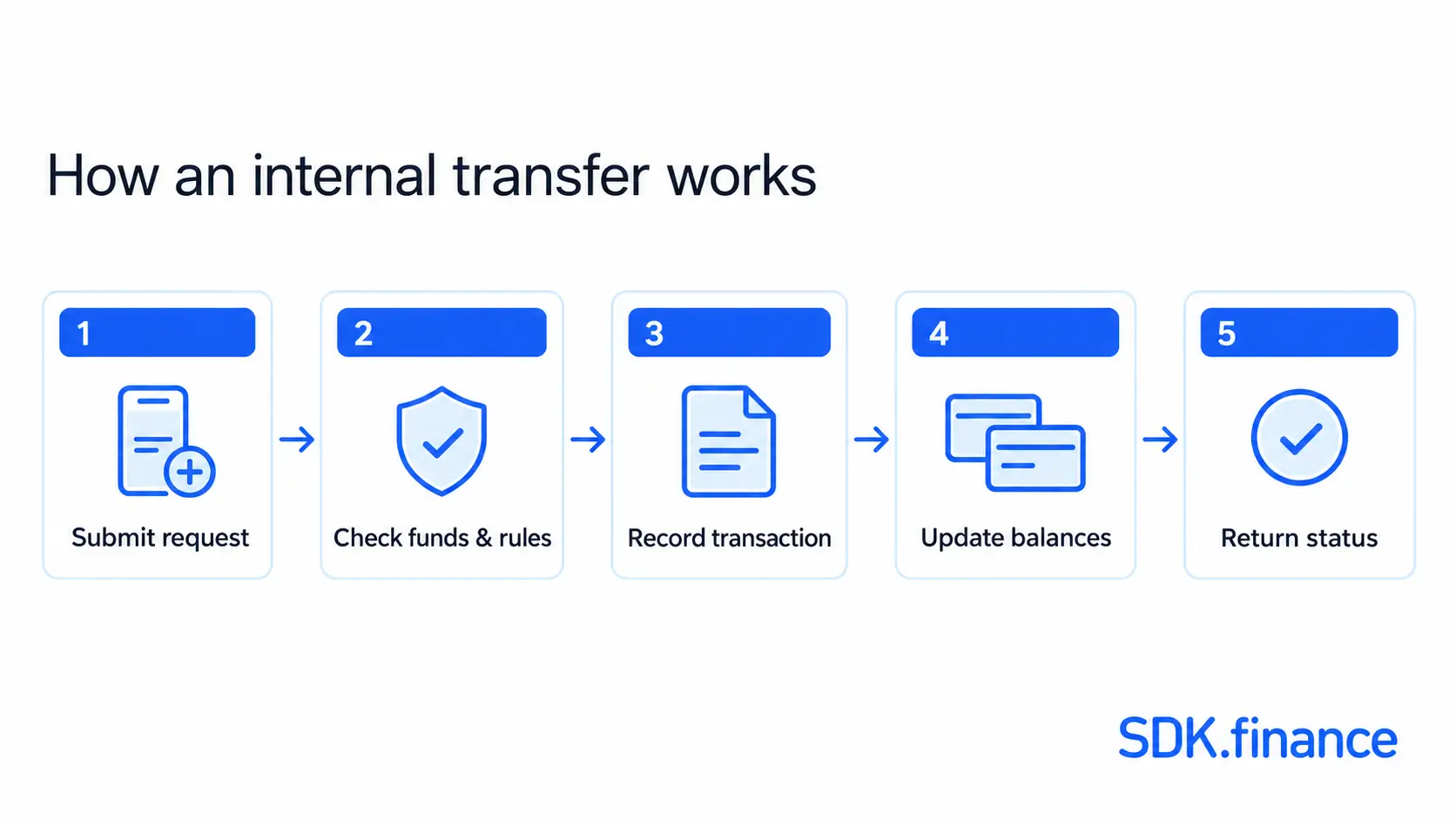
The same account records support both branch and digital journeys. A withdrawal at an ATM and a transfer in a mobile app may start in different channels, but both depend on consistent balances and transaction statuses. This shared view helps prevent one channel from acting on information that another has already changed.
Core banking system architecture
A core banking system architecture is designed to provide a scalable, secure, and efficient platform for managing daily banking transactions. The architecture typically consists of several layers, each playing a crucial role in the system’s overall functionality:
- Presentation Layer: This layer serves as the user interface, allowing customers and bank employees to interact with the core banking system. It includes web and mobile interfaces that facilitate account management, transaction processing, and customer support. Channels connect to the backend through APIs; customers and staff have separate role-based access.
- Application Layer: This layer handles the business logic of the core banking system. It manages account and transaction rules, fees, limits, and supported deposit or lending products.
- Data Access Layer: This layer connects the application logic to the database, handling requests to read and write customer, account, and transaction data.
- Database Layer: This layer stores customer information, account details, and transaction records.
- Infrastructure Layer: This layer provides the underlying infrastructure for the core banking system, including servers, storage, and network connectivity. It ensures that the system is scalable and can handle the increasing volume of daily banking transactions. Additionally, it supports the operational efficiency and security of the entire core banking platform.
External payment networks, identity providers, and reporting systems connect to the core through defined interfaces, each with its own responsibilities.
Core banking vs digital banking
Core banking maintains the records and rules behind financial operations. Digital banking is how customers access services through channels such as mobile apps and online banking. An app can request a transfer and display its status, while the core records the transaction and updates the relevant accounts.
What are the essential IT core banking features?
When comparing top core banking software vendors, separate the core functions from customer-facing features and connected services. The following capabilities are central to evaluating a system:
| Function | What the core handles | What channels or connected systems handle |
|---|---|---|
| Accounts and balances | Account records, balances, and transaction history. | Apps display balances and submit requests; staff interfaces provide role-based controls. |
| Account opening and onboarding | Account creation and product settings. | Customer-facing onboarding and identity verification, often through integrated KYC providers. Signing in is a separate step. |
| Loan management | Where supported: loan records, repayment schedules, interest rules, and payment status. | Loan applications, origination workflows, and customer-facing loan views may use separate systems. |
| Fees, interest, and product rules | Configured fees and interest rules for supported products. | Calculators provide estimates; recorded amounts follow the core’s product and accounting rules. |
| Transaction management | Validation, recording, status tracking, and permitted reversals; consistent balances and duplicate-request controls. | Channels initiate transactions and display results. External providers and payment networks support interbank flows. |
| Accounting and ledger integration | Generates accounting records through a built-in engine or an interface to a ledger. | A separate general ledger can map transaction events to debit and credit entries. |
| Reporting and reconciliation | Supplies traceable account, transaction, and accounting data. | Reporting and reconciliation tools, built in or connected, compare records with external statements and identify discrepancies. |
| Customer access and support | Applies account and transaction rules to requests received from channels. | Authentication protects interface access. Notifications, live chat, and contact lists support the customer experience. |
What are the types of core banking systems?
Core banking systems can be classified by architecture, deployment, and service model. These describe different choices and should not be treated as interchangeable categories.
Architecture: monolithic, service-oriented, and microservices
- Monolithic systems deploy closely connected components together, which can make selective changes difficult.
- Service-oriented architecture (SOA) exposes reusable business services for integration across applications.
- Microservices divide functions into independently deployable services, allowing selective updates and scaling but adding communication and operational complexity.
Modular design does not necessarily mean microservices, and neither age nor architecture alone determines reliability.
Deployment: on-premises and cloud
- On-premise solution. This system works on a locally-hosted infrastructure, providing the bank administration with several customization options.
- Cloud-based core banking software is hosted on the cloud. Cloud hosting does not automatically make software cloud-native or mean that the vendor manages application operations.
Service model: self-managed or managed
A bank may operate the software itself or contract for a managed service or SaaS offering. Compare responsibilities for upgrades, monitoring, backups, recovery, and support separately from the hosting location.
Benefits of core banking
With a better understanding of the working principle and features of the core banking platforms, let’s explore their key benefits:
Enhanced productivity
Shared, up-to-date account records reduce manual data entry and the need to pass information between branches. This helps staff process transactions and resolve account queries with fewer manual handoffs.
Improved security
Core banking systems use encryption to help protect sensitive data. On the client’s side, bio-verification and two-factor authentication also provide additional layers of security to the platform. Security and KYC controls support the institution’s compliance processes; they do not replace its responsibilities or guarantee protection from every attack.
24/7 access to banking services
In this era of contactless payments, access to round-the-clock bank services is vital. Availability depends on the deployment, maintenance, recovery arrangements, and connected services. Customer-support hours are a separate service decision.
Lower operational costs
Banks can rely on their core platforms to automate routine operations and reduce manual work. Actual cost savings depend on integration, infrastructure, licensing, and support costs.
Multiple currencies
Where multi-currency functionality is supported, the system can maintain balances and record transactions in different currencies. Currency conversion also requires exchange-rate rules, liquidity, and any necessary external services.
Support for new products
Configurable product rules and interfaces can help banks introduce or adapt services without rebuilding every component. Commercial results still depend on product demand, integration work, and the institution’s operating capabilities.
SDK.finance provides core banking infrastructure with ledger, payments, wallets, ready applications and flexible deployment options
Talk to Our Team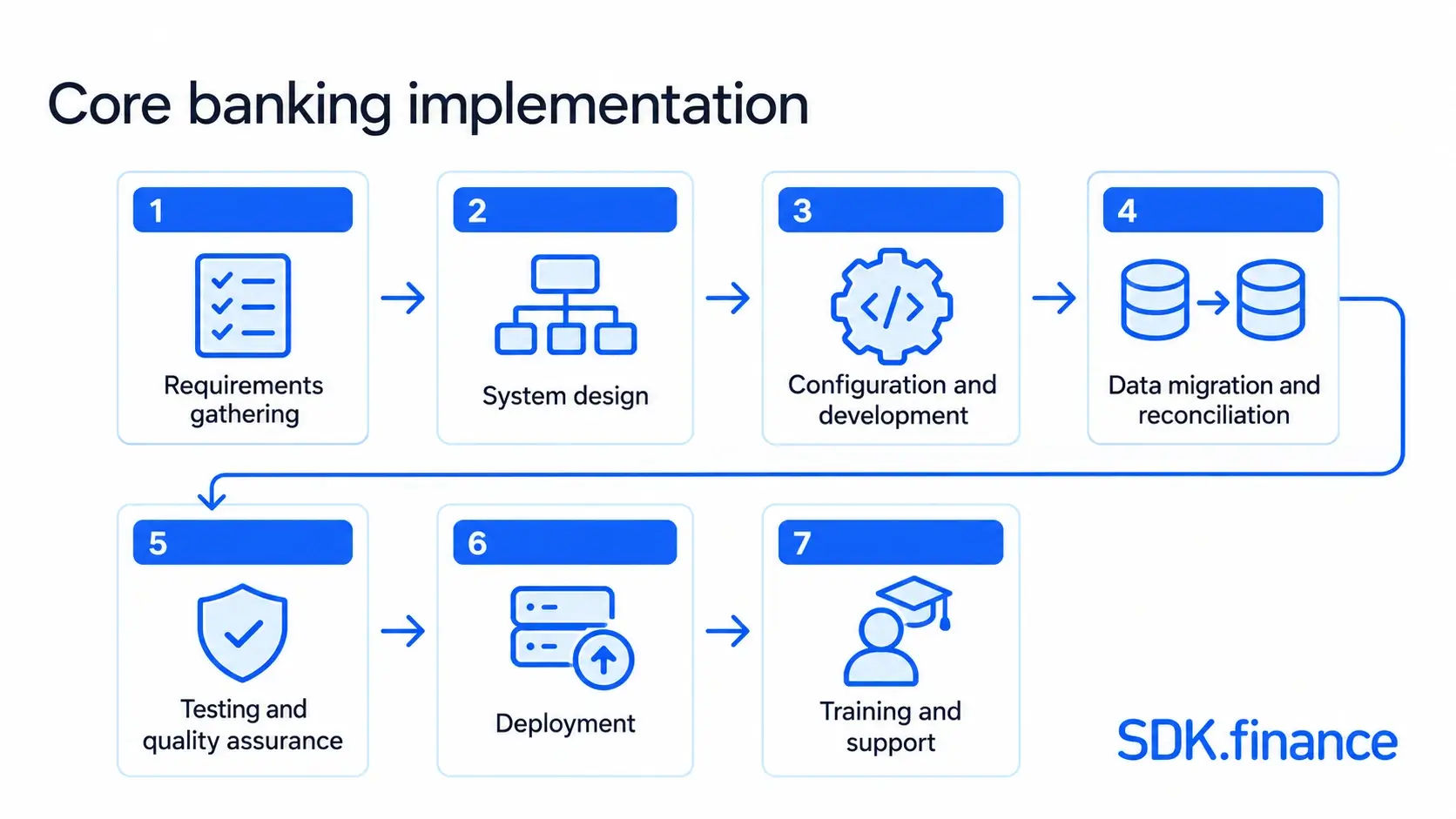
Core banking implementation
The modernisation approach depends on what the existing core can still support.
- Extending it with APIs or connected components can address specific gaps while retaining the core.
- A phased migration moves selected products or customer groups gradually, requiring coordination and reconciliation between systems.
- Full replacement may be considered when the existing core cannot meet essential requirements; it requires a broader migration and cutover plan.
Implementing a core banking system requires meticulous planning, execution, and testing. The implementation process typically involves the following steps:
- Requirements Gathering: The first step is to identify the business requirements of the financial institution. This involves understanding the specific needs and defining the scope of the core banking system implementation. Clear requirements help in designing a system that aligns with the institution’s goals.
- System Design: In this phase, the core banking system architecture is designed, and the technical requirements for the implementation are defined. This includes outlining the structure of the application layer, data access layer, and database layer to ensure seamless integration and functionality. Define API interfaces, data ownership, security controls, and recovery requirements.
- Configuration and development: Configure the selected software and build the required integrations or extensions. The development process depends on whether the bank is adopting an existing product, modernising selected components, or building its own system.
- Data migration and reconciliation: Map and validate customer, account, balance, and transaction data. Rehearse the migration and reconcile opening balances and records before switching production traffic.
- Testing and Quality Assurance: Before deployment, the core banking system undergoes rigorous testing to ensure it meets the business requirements. This phase includes functional testing, performance testing, and security testing. Include integration failures, duplicate requests, reversals, reconciliation, and recovery scenarios.
- Deployment: Once the system passes all tests, it is deployed in a production environment. This involves configuring the core banking system for use by bank employees and customers. Agree the cutover window, rollback criteria, monitoring, and operational responsibilities before switching production traffic.
- Training and Support: After deployment, training and support are provided to bank employees and customers. This ensures that all users are familiar with the core banking system and can utilize its features effectively. Ongoing support helps in addressing any issues that may arise post-implementation.
Limitations of IT core banking solutions
Core banking solutions also introduce costs and operational risks that need to be managed.
- Technical downtimes can disrupt regular banking operations, thereby frustrating clients.
- Using a core banking system can introduce a single point of failure that affects all branches simultaneously in the case of a cyberattack.
- Modern core banking systems can be expensive to buy and maintain, especially for small and medium-sized banks.
- Older systems can be difficult to integrate or change when documentation, skills, or vendor support are limited. The modernisation effort may require substantial investment and careful migration planning.
- Integration failures or inconsistent migrated data can disrupt balances, transaction processing, and reporting. Reconciliation, recovery planning, and clear ownership help manage these risks.
How to choose a core banking solution
A core banking solution should fit the institution’s products, transaction volumes, and operating model. Start by identifying what needs to change and whether the existing core can support it.
When choosing a core banking provider, financial institutions should consider scalability, security, integration, customisation, and support. Identify which products and account types the system must support, which existing systems will remain connected, and whether the team can operate and customise the software. Evaluate migration responsibilities and total cost, then test the required workflows and ask for evidence from comparable implementations.
Build your core banking system with SDK.finance
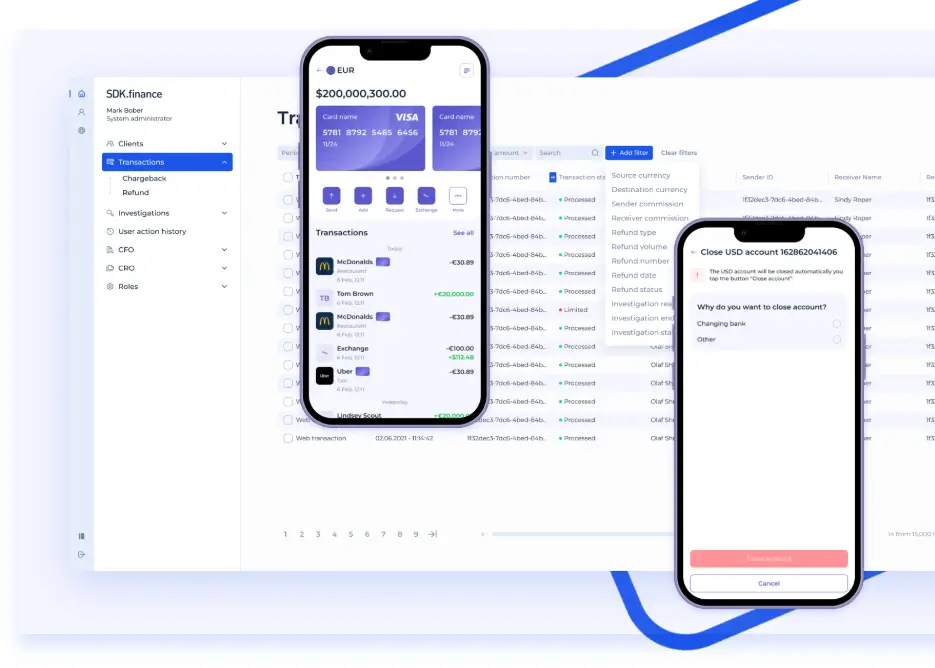
A ready-made software foundation lets your team build on existing account and payment capabilities while developing the products and integrations your business needs.
SDK.finance is a core banking software provider offering a modular Transaction Platform and a separate General Ledger. These products provide transaction and accounting capabilities that banks and FinTech teams can use when building or modernising their financial infrastructure.
Transaction Platform: accounts, balances, and transactions
The SDK.finance Transaction Platform is an API-first backend for account-based financial products. Its capabilities relevant to core banking include:
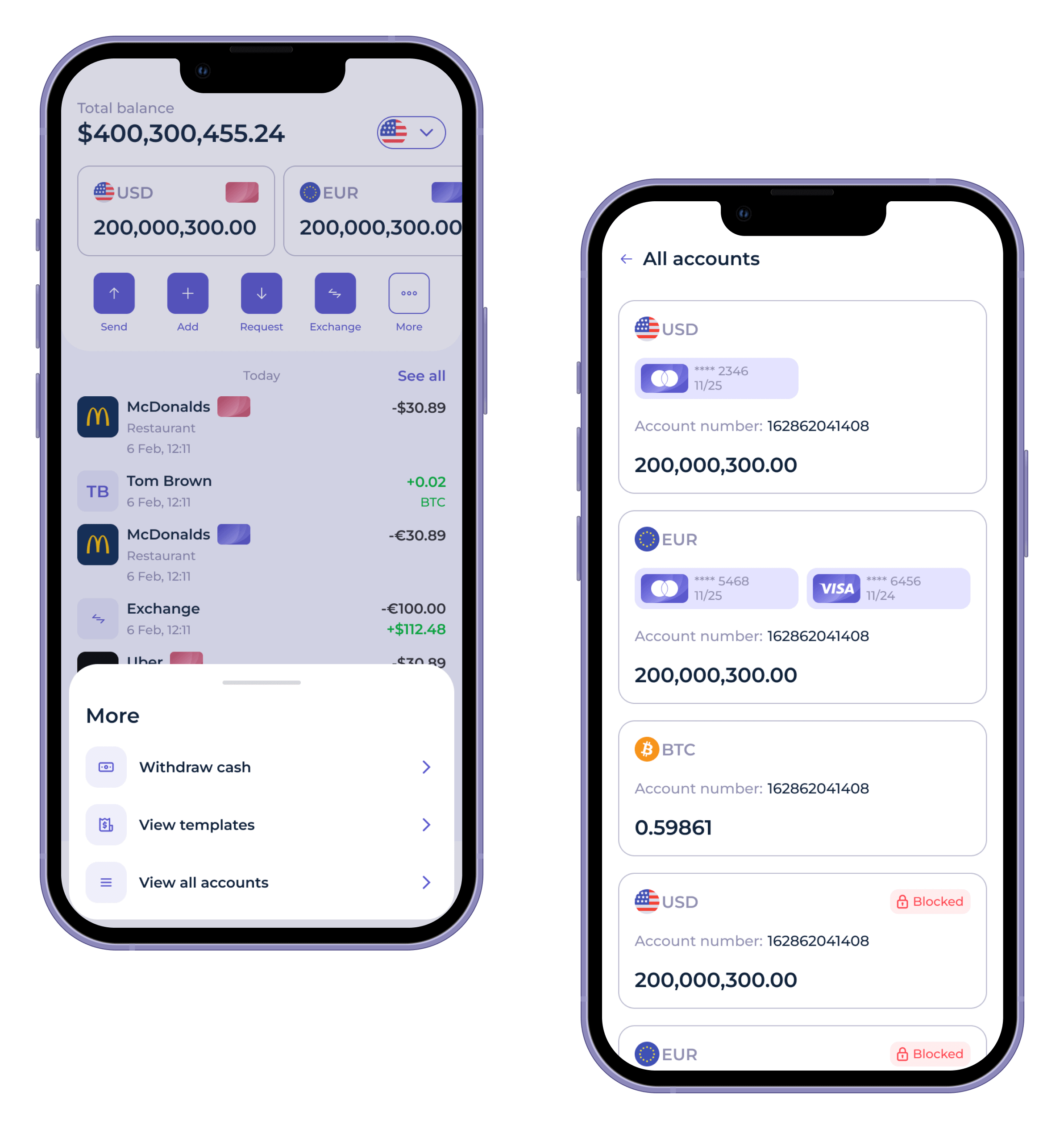
- Accounts and balances: manage client profiles, accounts, and wallets with multi-currency balances, including available and held amounts.
- Transaction processing: manage internal transfers, top-ups, withdrawals, and currency exchange, with status tracking and approval workflows where configured. External payment flows require the relevant provider integrations.
- Fees and limits: configure fixed, percentage-based, or combined fees and transaction limits by amount, count, or volume for different client contracts.
- Operational controls: give staff role-based backoffice access to manage clients and transactions, investigate operations, and review user-action histories.
- Reconciliation and reporting: compare internal records with uploaded transaction files, identify mismatches, and produce operational reports.
APIs connect the backend to customer-facing applications and external services. Onboarding and KYC/KYB workflows can use integrated verification providers, with configuration and responsibilities defined for each implementation.
General Ledger: configurable double-entry accounting
The Transaction Platform includes a built-in accounting engine. For more flexible accounting schemes, SDK.finance offers a separate General Ledger that can connect to the Platform or an existing transaction system through APIs or Kafka.
General Ledger converts business events into balanced debit and credit entries using a configurable chart of accounts and mapping rules. It provides account balances, turnover reports, and a history of posted entries. Posted entries cannot be edited or deleted; corrections use reversing entries, preserving the accounting trail.
Source code as a foundation for your own core banking system
SDK.finance’s source code provides the software core on which your team can build its own core banking system. It gives you an existing foundation for account management and transaction processing, so you can develop the banking products, workflows, and integrations your institution needs without building the underlying platform from scratch. A Source Code Licence gives your team access to extend this foundation and adapt its internal logic within the agreed licence terms.
Your team can deploy the software on its chosen infrastructure and control how it evolves. It also takes responsibility for hosting, maintenance, security, updates, and ongoing development.
Choosing the right foundation for core banking
Core banking provides the records and transaction logic behind everyday banking services. To assess a system, look at its account and product capabilities, architecture, integrations, and operational requirements. A suitable implementation can improve efficiency and support digital services, but reliability, security, and compliance depend on the wider technology and operating model.
SDK.finance provides core banking infrastructure with ledger, payments, wallets, ready applications and flexible deployment options
Talk to Our Team