What is Paytm?
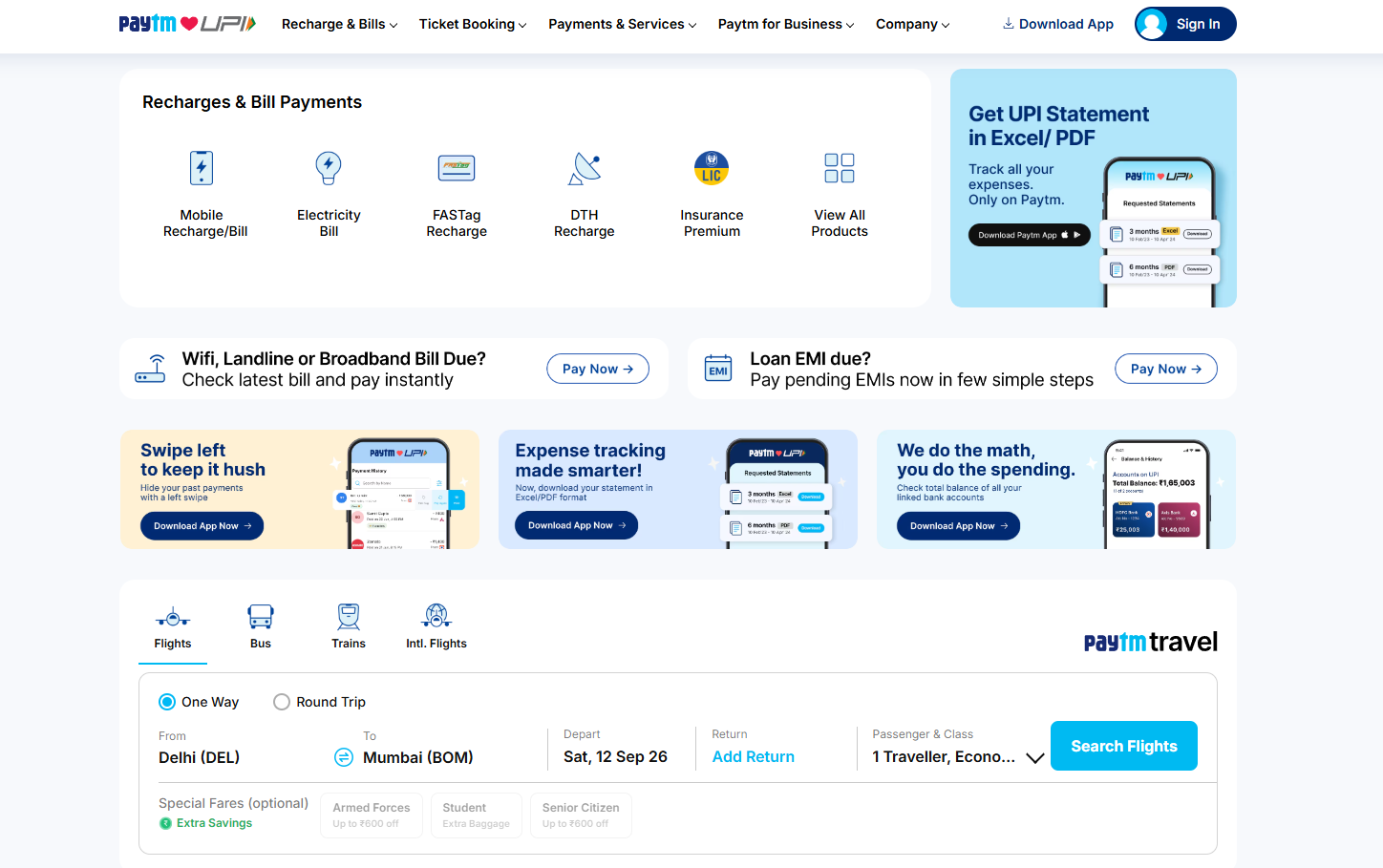
Paytm is a digital payments and financial-services distribution platform used by Indian consumers for UPI transfers, bill payments and recharges, and by merchants for payment acceptance and credit access. It is not a bank.
Its core payment business is licensed as a Payment Aggregator through Paytm Payments Services Limited, and it acts as a UPI Third-Party Application Provider (TPAP), routing transactions through four partner banks (Axis, HDFC, SBI and YES Bank) after its earlier banking affiliate, Paytm Payments Bank Limited, had its licence cancelled by the RBI in April 2026.
Paytm’s key numbers
In June 2026, the figures Paytm itself reports are (₹ converted to USD throughout this article at the September 2026 rate of ~₹95 per $1, per x-rates.com; treat USD figures as approximate):
- ₹2,448 crore (~$258 million): revenue from operations up 28% year on year
- ₹220 crore (~$23.2 million): net profit (PAT) up 79% year on year
- ₹203 crore (~$21.4 million): EBITDA up 182% year on year and 54% quarter on quarter
- 8.0 crore (80 million): average monthly transacting users (MTU), up from 7.4 crore a year earlier
- 1.57 crore (15.7 million): merchants paying a monthly subscription for Soundbox or POS hardware, up from 1.30 crore a year earlier
- ₹7.1 lakh crore (~$74.7 billion): gross merchandise value (GMV) processed up 31% year on year
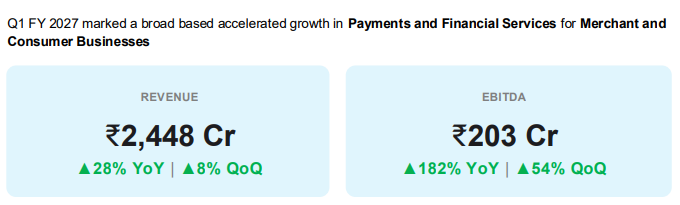
Source: Paytm Earning Release Q1 FY 2027
These figures measure different things and shouldn’t be added together: MTU counts distinct transacting customers, not downloads, and GMV is payment value moved through the platform, not Paytm’s own revenue. Together, they show a platform still growing on both sides of its network after real regulatory disruption – not popularity across every service under the Paytm brand.
How a Paytm-like payments super app makes money
Paytm’s quarterly disclosures show three distinct revenue streams:
- Payment Services generated ₹1,384 crore (~$145.7 million), up 33% year on year and representing 57% of revenue. However, processing costs reached ₹794 crore (~$83.6 million), alongside ₹90 crore (~$9.5 million) in cashback and incentives.
- Distribution of Financial Services contributed ₹814 crore (~$85.7 million), up 45%. Paytm uses its QR and Soundbox merchant network to originate financial products ultimately provided by partner banks and NBFCs.
- Marketing Services generated ₹239 crore (~$25.2 million), down 3%.
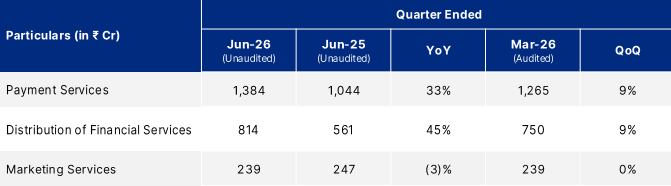
Source: Paytm Earning Release Q1 FY 2027
After direct costs, Paytm reported ₹1,350 crore in contribution profit at a 55% margin. The lesson for a Paytm-like product is straightforward: payments attract users and generate transaction data, but higher-margin adjacent services – particularly financial-services distribution – can be essential to the wider business model.
How Paytm built its consumer and merchant network
Four mechanisms explain most of Paytm’s growth, echoing patterns seen across other super apps.
- It solved a frequent problem. Paytm replaced physical mobile-recharge vouchers. During the 2016 demonetisation, which withdrew notes representing 86% of currency in circulation, its QR network helped small kirana shops adopt digital payments.
- It addressed merchant trust. Paytm Soundbox announces successful payments aloud, reducing reliance on screenshots while generating recurring subscription revenue.
- It built a two-sided network. More consumers attracted merchants, while wider merchant acceptance made the app more useful to consumers, reinforcing adoption on both sides.
- It supported lending distribution. With appropriate consent, merchant transaction data can help Paytm’s bank and NBFC partners assess cash flow and make credit decisions.
The lesson is narrower than “copy the app”. Hardware builds lock-in software alone cannot, but demands manufacturing and field support most teams underestimate. Diversifying banking rails from day one avoids the single-partner risk that forced Paytm’s 2024 restructuring. Its licensing status, four-bank network and merchant base took years to build; a new entrant should expect to win one segment first.
What makes a payments app a super app
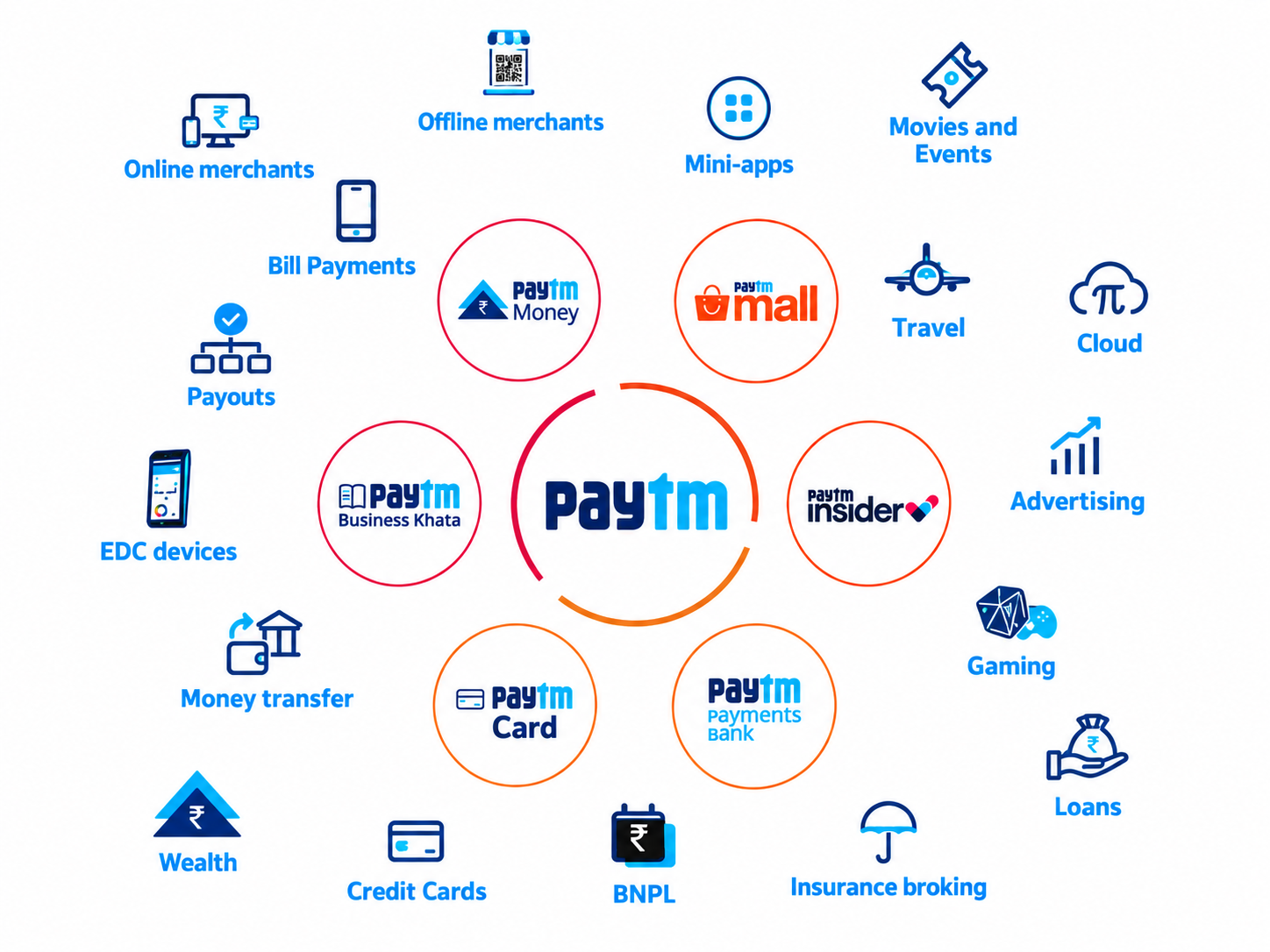
Not every payment app is a super app, and the distinction matters when scoping a build. A single-purpose payment app does one thing well: send money, pay a bill, accept a card. A super app bundles several of these behind one login, one balance view and one identity, so someone who opened it to pay an electricity bill can also send money, scan a merchant QR code or apply for a small loan without switching apps.
Three traits tend to separate a genuine super app from a payment app with extra menu items:
- A shared ledger and identity underneath. Every service – transfers, bill payments, merchant acceptance, lending – reads and writes to the same account and KYC record, not a separate silo per feature.
- One frequent, high-trust journey anchoring the rest. For Paytm that is UPI transfers and bill payments; a user who opens the app often enough absorbs a second or third service with little extra friction.
- Revenue spread across several regulated lines, not one fee. Payment processing alone is thin margin; lending, insurance distribution and merchant subscriptions typically carry more of it.
Building “all of Paytm” on day one gets this backwards. These traits describe what a mature super app looks like after years of expansion, not a checklist for a first release – the scope discipline for getting there starts below.
Define the payments super app proposition and launch scope
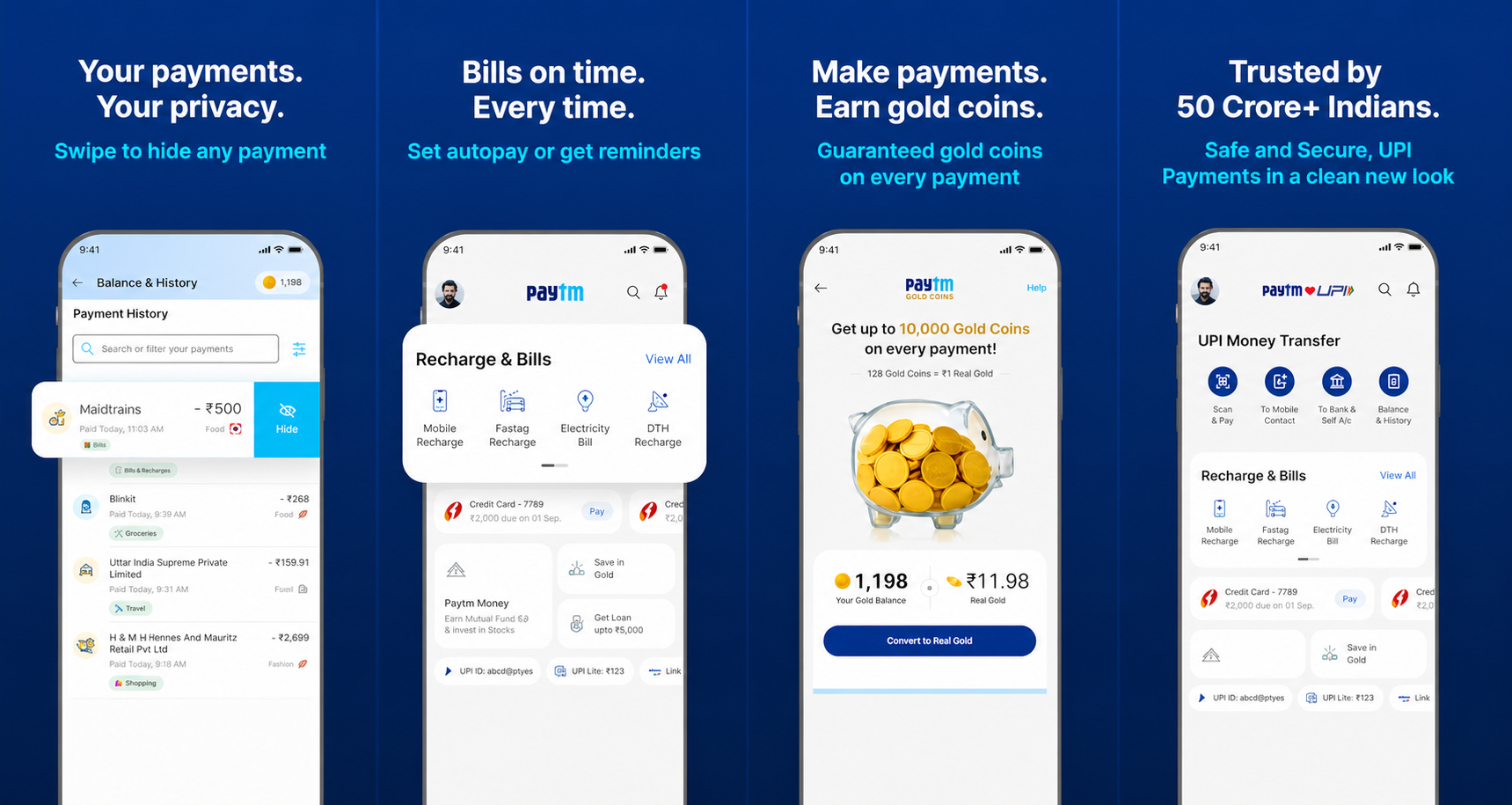
A workable first version should target one user group and one measurable outcome instead of copying Paytm’s full product range. For example, it could help small merchants in one city accept secure digital payments, or give consumers one app for UPI transfers and frequent bill payments. Serving both groups from launch would require substantially more time and investment.
Define the geography, customer type, channels, currency, funding methods and core transactions before development. Start with INR and one complete journey – such as UPI transfers or merchant QR acceptance – then add cards, bill payments, lending or wealth products as demand is proven.
Each choice changes the technology, partnerships and regulatory requirements. A stored-value wallet, for example, requires an authorised PPI issuer and appropriate escrow arrangements, while a bank-account-funded UPI product follows a different model. Confirm market demand, partner capacity and the need for hardware before finalising the scope.
Essential user journeys and features
UPI app development is not a mobile screen bolted onto a payment API. It is closer to an operating system for mobile payment and money movement: identity checks, a transaction core, a ledger, bank and network connections, and the back-office tooling that keeps the product running when something fails.
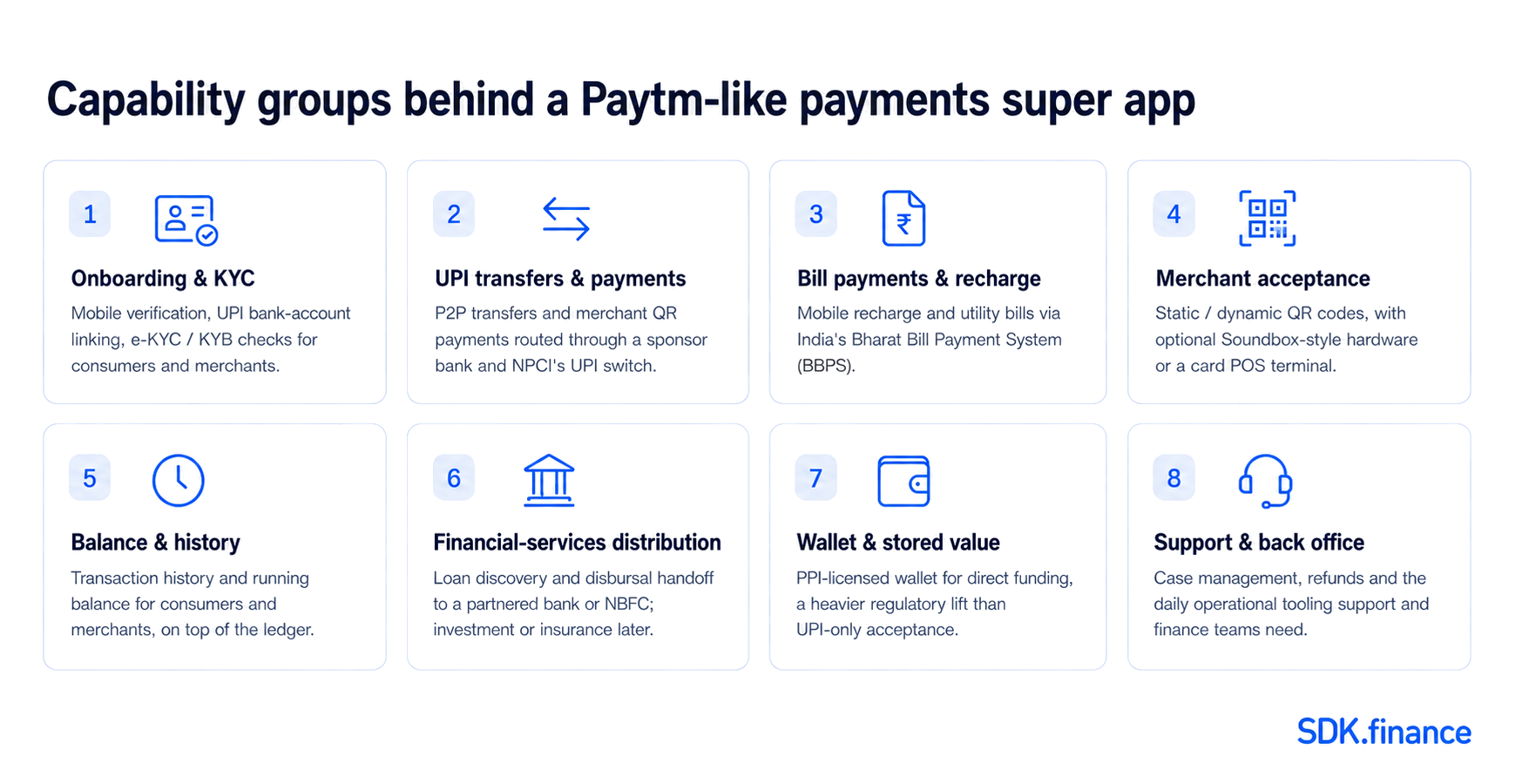
| Journey | MVP requirement | Later phase | External dependency |
|---|---|---|---|
| Onboarding & KYC | OTP signup; e-KYC; GST-based KYB for merchants | Video KYC; enhanced diligence | KYC/KYB verification provider |
| UPI transfers | P2P send/receive; balance and history | Multiple linked accounts | Sponsor bank(s); NPCI’s UPI switch |
| Bill payments & recharge | Core billers via a BBPS aggregator | Full biller catalogue; autopay | BBPS-certified aggregator |
| Merchant QR acceptance | Static/dynamic UPI QR with confirmation | Soundbox-style hardware | Acquiring bank or processor |
| Wallet (stored value) | Not included | PPI-licensed top-up and spend | RBI PPI licence; safeguarding bank |
| Lending distribution | Not included | Loan handoff; data sharing | NBFC or bank lending partner |
| Back office & disputes | Transaction search; dispute queue; reconciliation | Automated reconciliation | Sponsor bank and NPCI settlement reports |
A first release does not need every row above. It needs the onboarding, UPI transfer and merchant QR rows working correctly and reconciling accurately for one segment, before recharge, wallet or lending are added.
Request a consultation to explore how SDK.finance can maximize your platform’s revenue potential
Talk to Our TeamHow a payments super app works
This is what UPI app development looks like at the transaction level. In outline: consumer scans QR → app resolves amount and payee → risk and limit checks → PIN authorisation → sponsor bank → NPCI’s UPI switch → merchant’s bank → confirmation → ledger update → reconciliation. In twelve steps:
- Consumer scans the merchant’s QR code. A static code prompts for an amount; a dynamic code carries it already.
- The app resolves the payee’s virtual payment address (VPA) and the amount – UPI’s identifier instead of a full bank account number.
- The platform checks the daily UPI limit and risk status, stopping a blocked or over-limit account before any request reaches a bank.
- The consumer authorises with a UPI PIN, inside their linked bank app or the super app’s own UPI module.
- The request routes to the sponsor (remitter) bank, one of the partners the platform has an active TPAP relationship with.
- The remitter bank sends the instruction to NPCI’s UPI switch, the shared national infrastructure every UPI app and bank connects to.
- NPCI routes the instruction to the merchant’s beneficiary bank, which credits the merchant’s account.
- NPCI returns a success or failure response to the remitter bank and, from there, back to the platform.
- The platform records the transaction and updates both ledger balances, independently of the mobile screen.
- The merchant’s device or app shows, and if hardware is present reads out, the confirmation in real time.
- The platform reconciles against the settlement file the sponsor bank or NPCI provides, typically the same or next business day.
- A timeout, downtime or insufficient-funds response triggers an automatic status update and, where money already moved, a reversal.
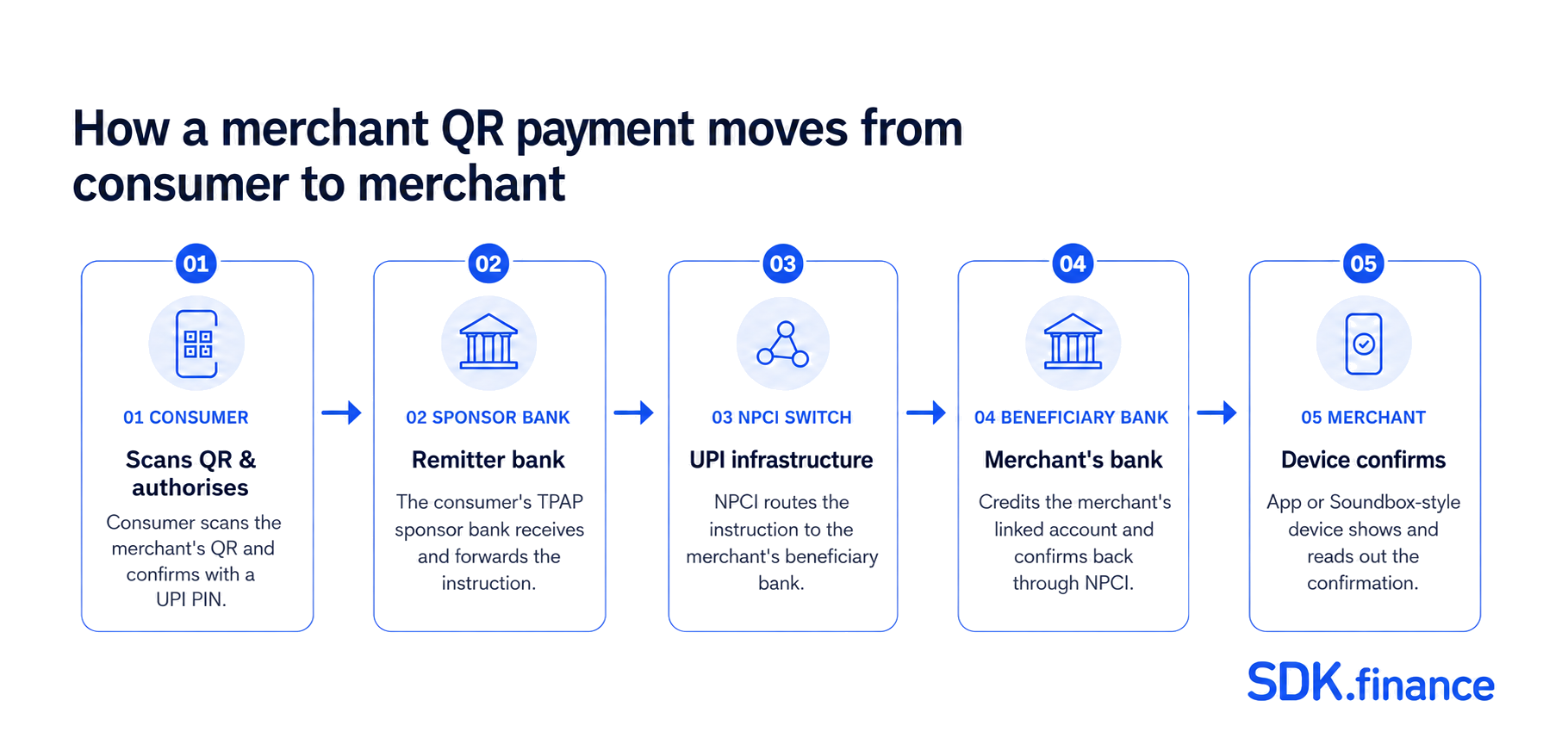
The exact path changes with funding method, transaction type, which sponsor bank is available, device connectivity, and risk outcome.
Regulatory partner and operating model
There is no single licence for a Paytm-like super app. The required model depends on its services, whether it handles funds, and which regulated partners execute transactions. This separation is also explained in our guide to building a Wise-like money transfer app.
UPI payments require an NPCI-approved Third-Party Application Provider relationship with PSP banks. Payment Aggregator authorisation may also be needed when the company collects payments and settles funds to merchants.
Bill payments can be offered through a Customer Operating Unit or Agent Institution within BBPS. A stored-value wallet requires PPI authorisation or a partnership with an authorised issuer. Lending, insurance and investment products must be provided through appropriately regulated institutions. These dependencies help explain why money-transfer products are complex and expensive to launch.
| Service | Regulatory or partner arrangement | Software responsibilities |
|---|---|---|
| UPI payments | NPCI-approved TPAP with PSP banks | Payment initiation, status tracking and support |
| Merchant acceptance | Payment Aggregator, where applicable | Merchant onboarding, refunds and reconciliation |
| Bill payments | BBPS Customer Operating Unit or Agent Institution | Biller access, payment journeys and complaints |
| Stored-value wallet | Authorised PPI issuer | Wallet balances, limits and transaction records |
| Lending and investments | Regulated bank, NBFC or product provider | Customer journey, consent and partner integration |
Before development, assign responsibility for holding funds, customer checks, settlement, complaints and regulatory reporting. Confirm the current requirements with qualified Indian legal and compliance advisers.
Architecture of a payments super app
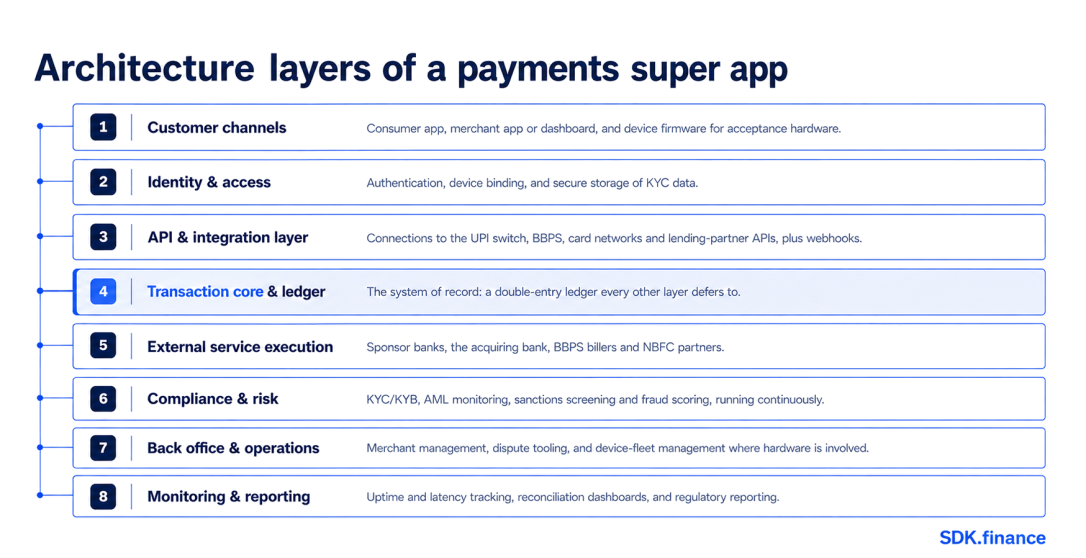
What follows is the vendor-neutral logical architecture behind UPI app development, not a reconstruction of Paytm’s confidential design. Eight layers, moving from the customer inward to the systems that keep the product running:
- Customer channels: consumer app, merchant app or dashboard, and device firmware for any physical acceptance hardware.
- Identity and access: authentication, device binding, and secure storage of KYC data.
- API and integration layer: connections to the UPI switch (via sponsor banks), BBPS, card networks and lending-partner APIs, plus webhooks for real-time status updates.
- Transaction core and ledger: the system of record – a double-entry ledger tracking every UPI transfer, bill payment, merchant settlement and, if offered, wallet balance, so every other layer defers to it for “whose money is this and what state is it in”.
- External service execution: sponsor banks, the acquiring bank, BBPS billers and NBFC partners the platform depends on but does not control.
- Compliance and risk: KYC/KYB checks, AML transaction monitoring, sanctions screening and fraud scoring, running continuously rather than only at signup.
- Back office and operations: merchant management, dispute tooling, and, where hardware is involved, device-fleet management for thousands of connected units.
- Monitoring and reporting: uptime and latency tracking, reconciliation dashboards, and the regulatory reporting a licensed entity has to produce.
Failure modes worth designing for from day one: a sponsor bank’s UPI service degrading at peak, a duplicate request from a retried call, a device losing connectivity mid-transaction, a BBPS biller timing out, and a ledger-to-settlement mismatch.
Data security and reliability requirements
A payments super app handles identity documents, bank-account references, UPI virtual payment addresses, transaction records and audit history. Encryption in transit and at rest, strict secrets management, strong authentication, scoped access control and complete audit logging are close to non-negotiable.
India adds a specific requirement worth planning for from the outset: the Reserve Bank of India’s data-localisation direction requires payment system data to be stored only in India, affecting hosting and vendor choices before infrastructure code is written. Retention periods and any cross-border data flows for support or analytics need to respect that, not work around it.
On the transaction side: idempotent processing so a retried request cannot duplicate a payment, real-time status wherever the rail supports it, monitoring that alerts on business-process failures (a spike in failed UPI requests, not only server downtime), and tested backups, disaster recovery and incident response.
Where the product touches card data, PCI DSS scope applies; the common approach is minimising it by keeping raw card data with a certified processor. A vendor’s own certification covers that vendor’s environment, not the customer’s entire service.
India-specific operations and customer protection
Beyond data localisation, three RBI frameworks must be built into daily operations.
- Failed transactions. RBI’s harmonised TAT rules require failed UPI transfers to reverse by T+1 and failed merchant payments by T+5. Delays attract automatic compensation of ₹100 per day.
- Unauthorised transactions. Under RBI’s framework for non-bank PPI issuers, customers generally have zero liability for qualifying third-party fraud reported within three working days; liability is capped when reported within four to seven days. Reliable reporting channels and timestamps are therefore essential.
- Complaints. Unresolved cases can escalate free of charge under the Reserve Bank – Integrated Ombudsman Scheme, 2021. Grievance handling, audit trails and compensation workflows should sit in the product backlog alongside KYC, ledger and reconciliation.
None of this shows up in a product requirements document by default. It belongs in the same backlog as the ledger and the KYC flow, not bolted on after a regulator asks why a compensation payment was late.
How to create a payments super app step by step
Ten steps, broadly in the order real teams build fintech app products of this scope.
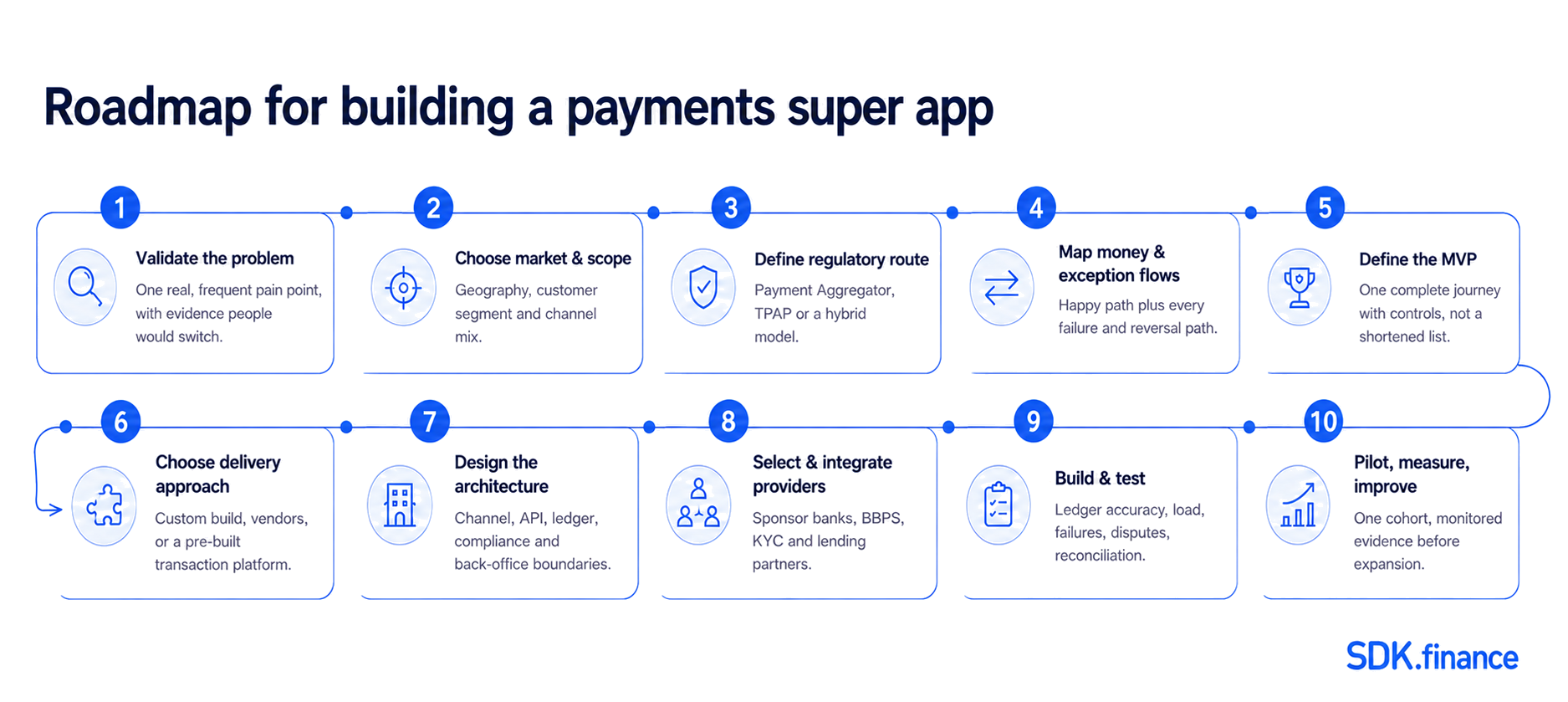
Step 1: Validate the user problem and value proposition
This is the first question behind how to create a fintech app of any kind: confirm one real, frequent pain point – merchants losing sales to payment fraud, or consumers juggling several bill-payment apps – before writing a feature list. Mistake to avoid: designing for “all of Paytm” instead of one wedge use case.
Step 2: Choose the market and operating scope
Decide geography (a city or state cluster before a national rollout), customer segment (consumer, merchant or both) and channel mix (UPI-only versus UPI plus cards plus hardware). Mistake to avoid: launching both sides of the marketplace at once without enough volume on either.
Step 3: Define the regulatory and partner route
Choose between direct Payment Aggregator authorisation, a UPI TPAP model through sponsor banks, or a hybrid, and start the regulatory conversation early, since it shapes account structures and app flows. Mistake to avoid: building the product before this decision, forcing a costly rebuild once the route is confirmed.
Step 4: Map customer, money, data and exception flows
Document the happy path for each core journey – UPI transfer, bill payment, QR acceptance – alongside every failure and reversal path, not just the successful case. Mistake to avoid: treating failure handling as a bug-fix exercise after launch.
Step 5: Define the MVP and roadmap
Scope one complete, defensible journey (typically merchant QR acceptance with UPI) with accurate records and mandatory controls, before adding recharge, wallet or lending. Mistake to avoid: an MVP that is a shortened feature list rather than one journey done completely.
Step 6: Choose the technology and delivery approach
Compare full custom development, several specialised vendors, and a pre-developed FinTech transaction platform, and decide where real differentiation needs to live. Mistake to avoid: rebuilding a ledger from zero when the differentiation is actually in distribution or pricing.
Step 7: Design the architecture and data model
Define the channel, API, transaction-core, ledger, compliance and back-office boundaries above, including device-management needs if hardware is planned. Mistake to avoid: treating the app as the product and the ledger as an afterthought.
Step 8: Select and integrate providers
Contract and test sponsor banks for UPI routing, a BBPS aggregator, a KYC/KYB provider, an NBFC lending partner if credit is in scope, and an acquiring bank for card acceptance (how to build a payment platform like Stripe covers acceptance for online and card-present merchants more broadly). Mistake to avoid: signing one sponsor bank only, recreating the risk behind Paytm’s own 2024 restructuring.
Step 9: Build and test the complete service
Test functional behaviour, ledger accuracy, load at realistic UPI peak volumes, provider failures and retries, disputes and reconciliation breaks, not only the happy path. Mistake to avoid: a sandbox that never simulates a bank outage or a duplicate request.
Step 10: Pilot launch, measure and improve
Release to one city or merchant cohort with monitored limits, track success rate, latency, support volume and reconciliation breaks, and expand only when evidence supports it. Mistake to avoid: expanding nationally on a fixed timeline instead of pilot evidence.
Build from scratch or use a pre-developed FinTech platform
| Approach | Advantages | Limitations | Best suited for |
|---|---|---|---|
| Full custom development | Complete control over ledger, product and roadmap | Longest timeline and cost; UPI/BBPS integrations and ledger built from zero | Well-funded teams with deep in-house India payments expertise |
| Multiple specialised vendors | Fast to adopt each point solution individually | Team owns integration and reconciliation across every vendor; several lock-in points | Teams with a clear architectural owner |
| Pre-developed FinTech transaction platform | Ledger, accounts, fees and back office exist day one, configured not written | Configuration still required; RBI, NPCI and BBPS licensing remain the company’s job | Teams differentiating on distribution or one merchant vertical |
Whether that work sits with an in-house team, a fintech app development company, or a licensed platform, the real question is where differentiation will live. If it genuinely sits in transaction logic or ledger design, building it makes sense. For most new entrants it sits in merchant relationships, a vertical, or distribution, in which case rebuilding the accounting core from scratch spends the budget in the wrong place.
Request a consultation to explore how SDK.finance can maximize your platform’s revenue potential
Talk to Our TeamHow long it takes to create a payments super app
Fintech application development timelines depend mainly on the delivery model, especially with a pre-built platform such as SDK.finance’s:
- SaaS: a few weeks. SDK.finance sets up the development instance while the customer configures accounts, fees and limits and connects UPI, BBPS and KYC providers.
- Source Code Licence: a few months. Requirements analysis, a code audit, code transfer, infrastructure setup, customisation, integrations and end-to-end testing.
These estimates cover software only. RBI authorisation, TPAP empanelment, BBPS certification and any PPI licensing routinely take longer than the build and should run in parallel with it, not after. A technically finished platform waiting on a pending bank empanelment is a common, expensive way to miss a launch date.
How much it costs to create a payments super app
A realistic budget depends heavily on scope – UPI transfers only cost far less than adding bill payments, QR hardware, a wallet and lending. The software cost drivers are discovery and requirements, the core platform (built, bought as vendor point solutions, or licensed), India-compliant infrastructure, provider integrations, security testing, legal work, ongoing compliance and, if hardware is included, manufacturing and field logistics – a different cost category entirely.
Regulatory capital is the concrete number most new entrants underestimate, and it sits outside the software budget entirely:
- Payment Aggregator authorisation: ₹15 crore / ~$1.6 million net worth at application, rising to ₹25 crore / ~$2.6 million within three years
- BBPS operating unit (BBPOU): ₹25 crore / ~$2.6 million net worth, reduced from ₹100 crore / ~$10.5 million in 2022
- PPI (wallet) licence: ₹5 crore / ~$530,000 rising to ₹15 crore / ~$1.6 million within three years
Provider fees from sponsor banks, BBPS aggregators and card processors sit on top of that and vary by volume and negotiation.
On the software side, SDK.finance’s Source Code and SaaS pricing pages carry current figures directly – an evergreen guide is the wrong place to quote a number that moves with commercial terms.
Build a payments super app with SDK.finance software
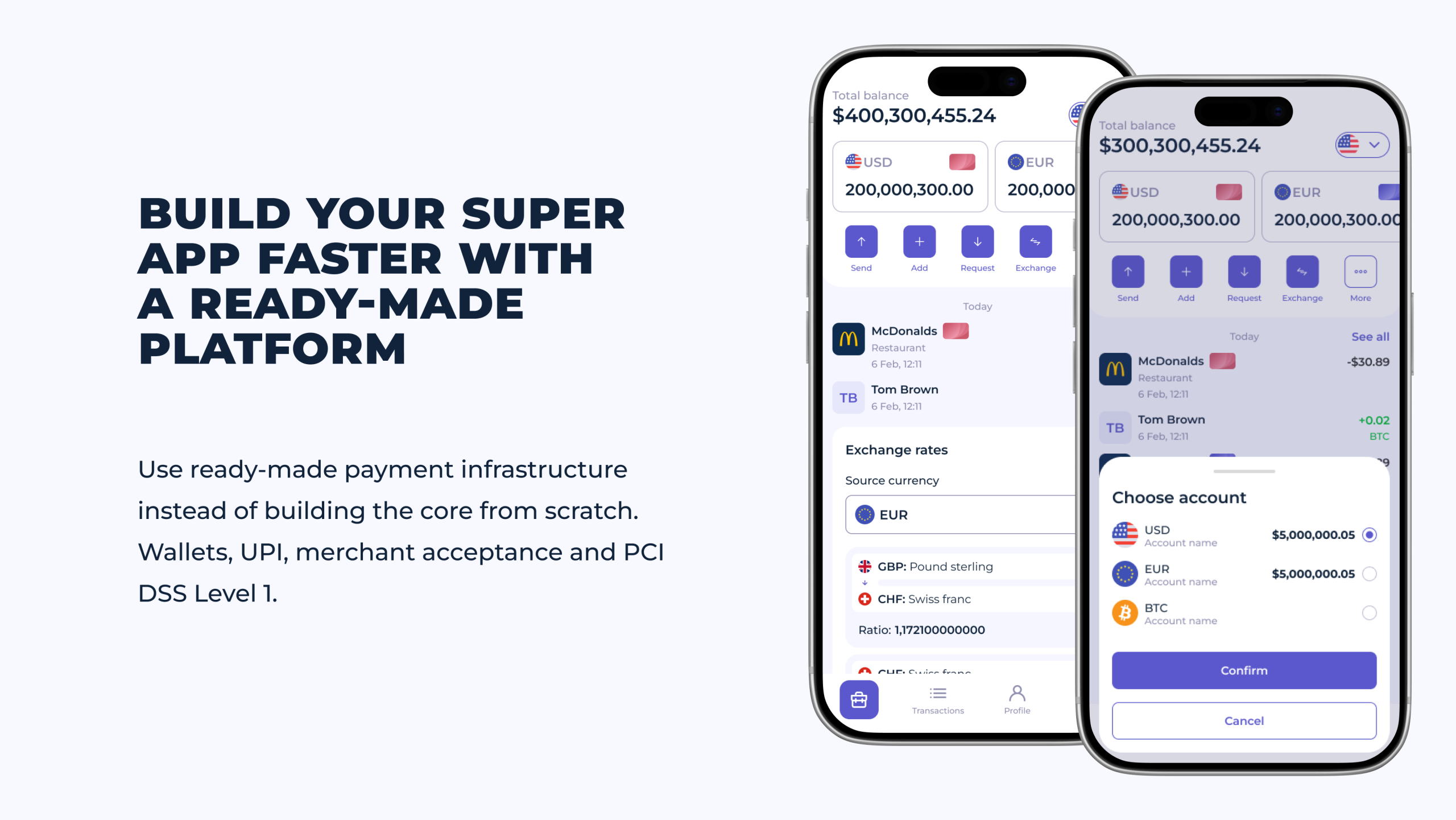
Building a product like this involves two separate challenges: the financial software managing balances, transaction rules, fees and records, and securing the licences, sponsor-bank relationships and regulated partners needed to move real money through UPI, BBPS and card rails. SDK.finance addresses the first; it does not replace the second.
SDK.finance’s super app solution provides a configurable software foundation for a multi-product payments app, rather than a ready clone of Paytm or a guarantee of matching feature parity. Capabilities most relevant to a Paytm-like product:
- Accounts and wallets. Structures for consumer and merchant balances, every balance-changing event recorded in a ledger-based system.
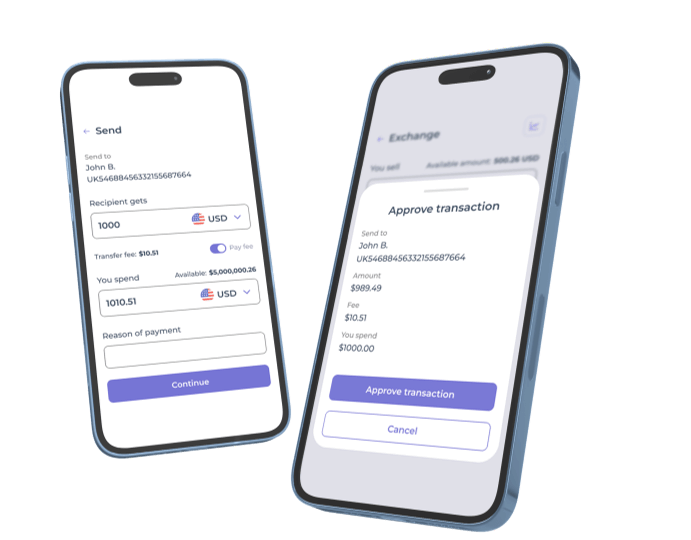
- Transaction workflows. Transfers, top-ups, bill-payment-style operations, merchant acceptance, refunds and history, configurable to the journeys needed.
- Fees, limits and commissions. Fixed or percentage-based fees and limits configurable by customer type or merchant category.
- Back-office operations. Tools for operations, finance and support teams to manage customers and investigate transactions.
- Reconciliation and reporting. Structured records built to compare against bank, BBPS and processor settlement files.
- Customer and merchant applications. Configurable web, iOS and Android interfaces, reducing how much is built from nothing.
- Integration layer. 650+ API endpoints and webhooks connecting banking partners, KYC providers and lending partners.
The platform is available through two delivery models: a hosted SaaS deployment for a faster, more standardised start, or a Source Code Licence for teams needing deeper customisation, private infrastructure and long-term roadmap control. The right choice depends on engineering capacity, infrastructure requirements and how quickly the first pilot needs to launch.
Instead of building its financial core from scratch, a company can use an existing transaction, wallet and back-office foundation. SaaS implementation typically takes 4–6 weeks and Source Code delivery 2–6 months, depending on customisation, integrations and technical readiness. These estimates exclude licensing, provider onboarding and regulatory approval.
SDK.finance has already supported a comparable build outside India. A multi-service super app operating across Algeria, Morocco and Tunisia, combining ride-hailing, food and grocery delivery with digital payments for more than 6 million users, licensed SDK.finance’s source code rather than build its wallet, KYC/KYB and payment infrastructure from scratch – avoiding an estimated 24-month build in the process.
The result: multi-currency digital wallets, PCI DSS-ready infrastructure for card processing and merchant settlement running on infrastructure the company hosts and controls itself, with no vendor lock-in as it expanded into France, Canada and Sub-Saharan Africa – the same trade-off a Paytm-like build makes: license the financial core, and keep the licensing, banking relationships and market-specific product decisions in-house.
Creating a payments super app: the bottom line
How to build a super app like Paytm starts with seeing the whole system, not just the app: a licensed entity, bank and network partnerships, an accurate ledger, and operations teams who handle what doesn’t go smoothly. Paytm’s own experience shows how much of that sits outside the app screen, and how fast a single-partner regulatory risk can force an expensive restructuring.
A realistic starting point mirrors the scope discipline throughout this guide: one customer segment, one city or region, one complete journey (most often merchant QR acceptance or UPI transfers), an early regulatory decision, provider contracting run in parallel with the build, and a ledger correct from the first transaction. Recharge, bill payments, a wallet, lending and national scale are additions earned by evidence, not features to launch with on day one.
Request a consultation to explore how SDK.finance can maximize your platform’s revenue potential
Talk to Our Team