A company launching a diaspora payments service wants personal accounts, artist-designed cards, multi-currency payments, and family transfers under one brand. It needs ready-made mobile and web applications, but also a way to connect account providers, card issuers, and payment partners into a service customers can actually use.
The challenge is turning that product vision into a workable launch: who can open an account, when money becomes available, how a card action is confirmed, and what happens when a family transfer gets stuck.
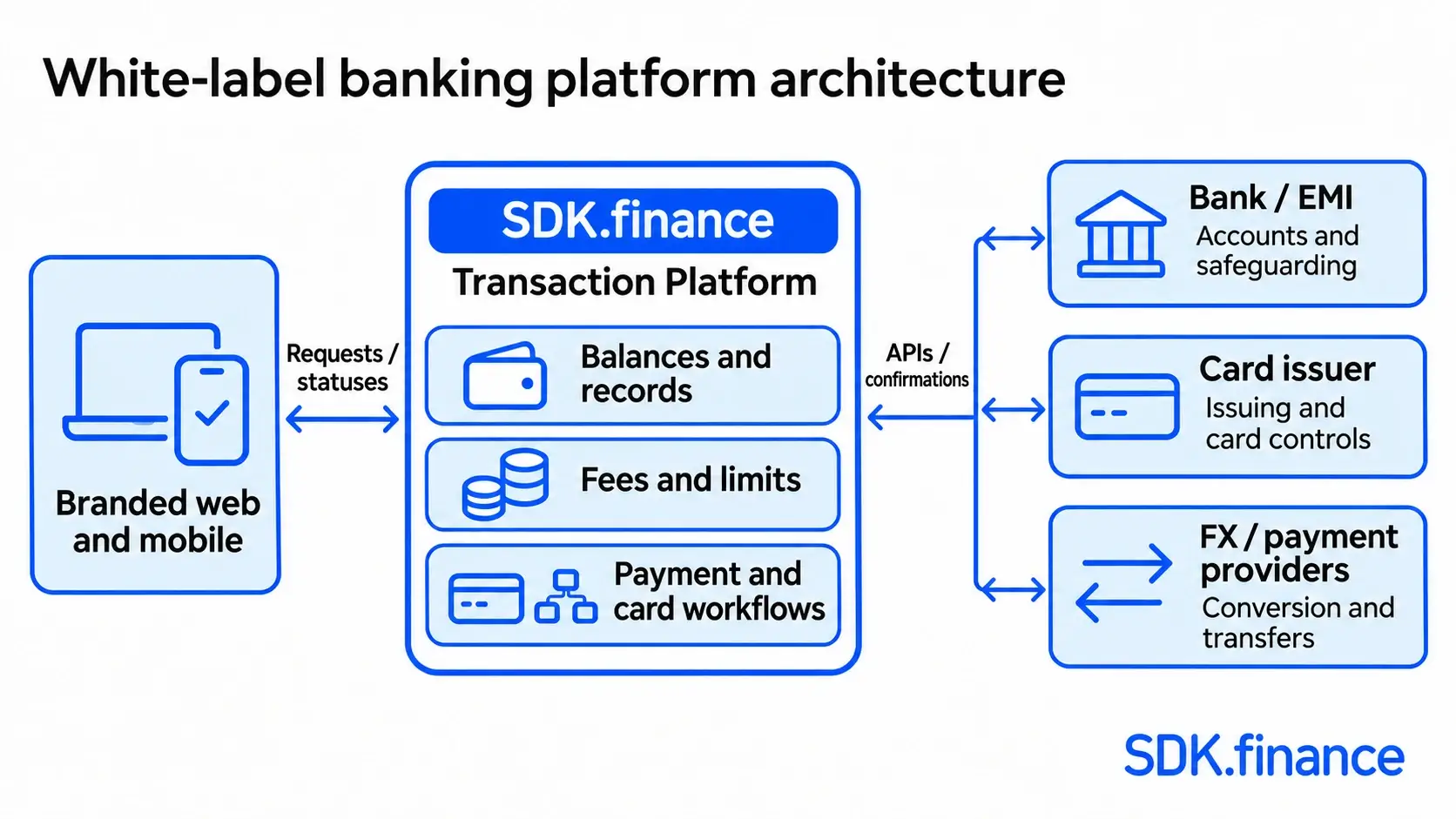
SDK.finance provides the software foundation for this model. Its white-label banking platform connects customer interfaces, transaction records, and operational workflows with external providers. Selected financial partners supply the regulated account, issuing, and payment services.
The first release should let customers:
- Open a personal account, complete identity checks, and access balances and statements.
- Fund the account, exchange money, and send transfers to family members.
- Order an artist-designed card, activate it, and manage supported card controls.
- Add eligible cards to Apple Pay or Google Pay.
- Manage these services through branded mobile and web interfaces.
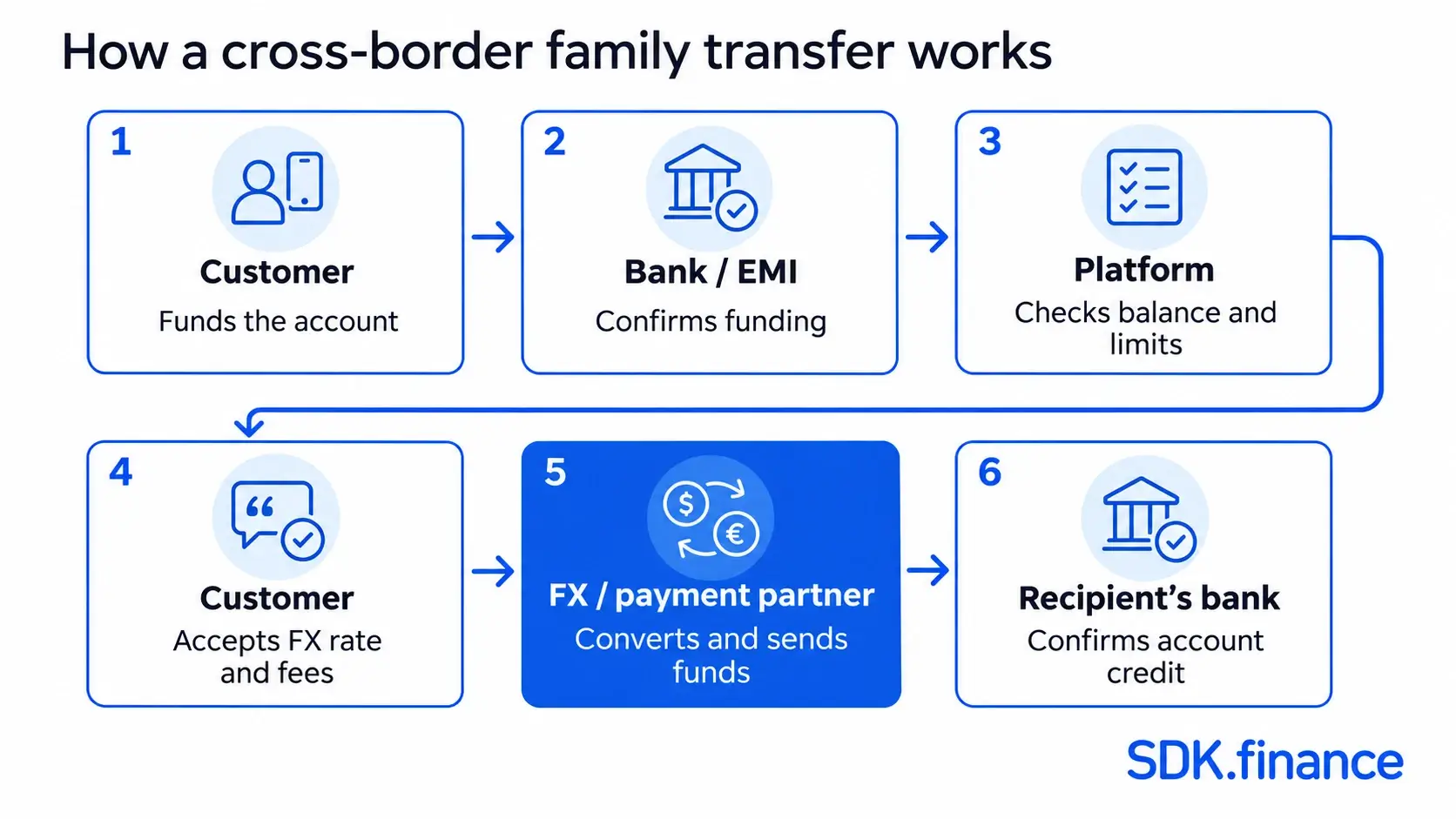
For launch planning, use one illustrative route: an eligible customer funds an account by bank transfer, uses the branded card, and sends money to a relative’s bank account abroad in a different currency. The company must validate this arrangement with its providers and connect eligibility, funding, card availability, FX, and payout confirmation.
Launch your digital bank in weeks, not years
Talk to Our TeamDefine the first residence market and transfer route
“Serving the diaspora” describes an audience, but it does not define a launch market. The customer and recipient in this example are in different countries. Account eligibility, card delivery, and payout coverage must therefore be checked separately.
Assess diaspora payment solutions alongside the coverage of BaaS providers and direct banking or payment partners:
- Who can register: supported residence countries, documents, and customer categories.
- What they receive: account arrangement, funding methods, currencies, and eligible card programme.
- Where they can send money: recipient country, payout currency, delivery method, limits, and required recipient information.
For the initial release, prove one complete route for a defined customer group. Account availability in the customer’s country of residence does not automatically establish payout coverage in the destination country or card eligibility.
Designing a diaspora payment platform
For a white-label digital banking service, the architecture must connect each customer action to an authoritative result. SDK.finance supplies the transaction software and interfaces; banks, electronic money institutions (EMIs), issuers, and payment providers supply their agreed financial services. Banking-as-a-Service (BaaS) is one way to arrange those connections.
For example, a funding confirmation should update the relevant internal balance, while a payout confirmation should update the transfer. Agree these event mappings and responsibilities before building the screens.
| Customer action | Responsibility to establish |
| Open and fund an account | Account partner confirms eligibility, provisioning, and funding; the implementation maps these results into SDK.finance. |
| Order and control a card | Issuer approves and services the card; SDK.finance workflows exchange supported requests and statuses through the integration. |
| Convert and send money | FX and payment partners execute; SDK.finance records the workflow, balances, fees, and provider results. |
| Track the transfer | Provider evidence establishes the outcome; the app presents the mapped status and operations investigates uncertainty. |
| Resolve a discrepancy | Operations compares internal and provider records using configured reconciliation, with an owner for each exception. |
A software account and a bank account are different records. Link the customer profile, internal account, external account reference, and provider operation IDs so support can follow the same journey across systems.
From customer onboarding to an active personal account
For the launch team, completing identity verification is only one step towards making a personal account usable. Design onboarding around the conditions that unlock each service:
- Check eligibility and collect the information required for the selected residence market.
- Complete identity verification, with a path for missing documents or manual review.
- Obtain any separate acceptance required by the account provider.
- Provision the account, store its external reference, and enable the approved services.
SDK.finance provides customer onboarding workflows and identity-verification integrations. The implementation must map verification and partner responses to account availability; a successful know your customer (KYC) check must not automatically imply that account provisioning has finished.
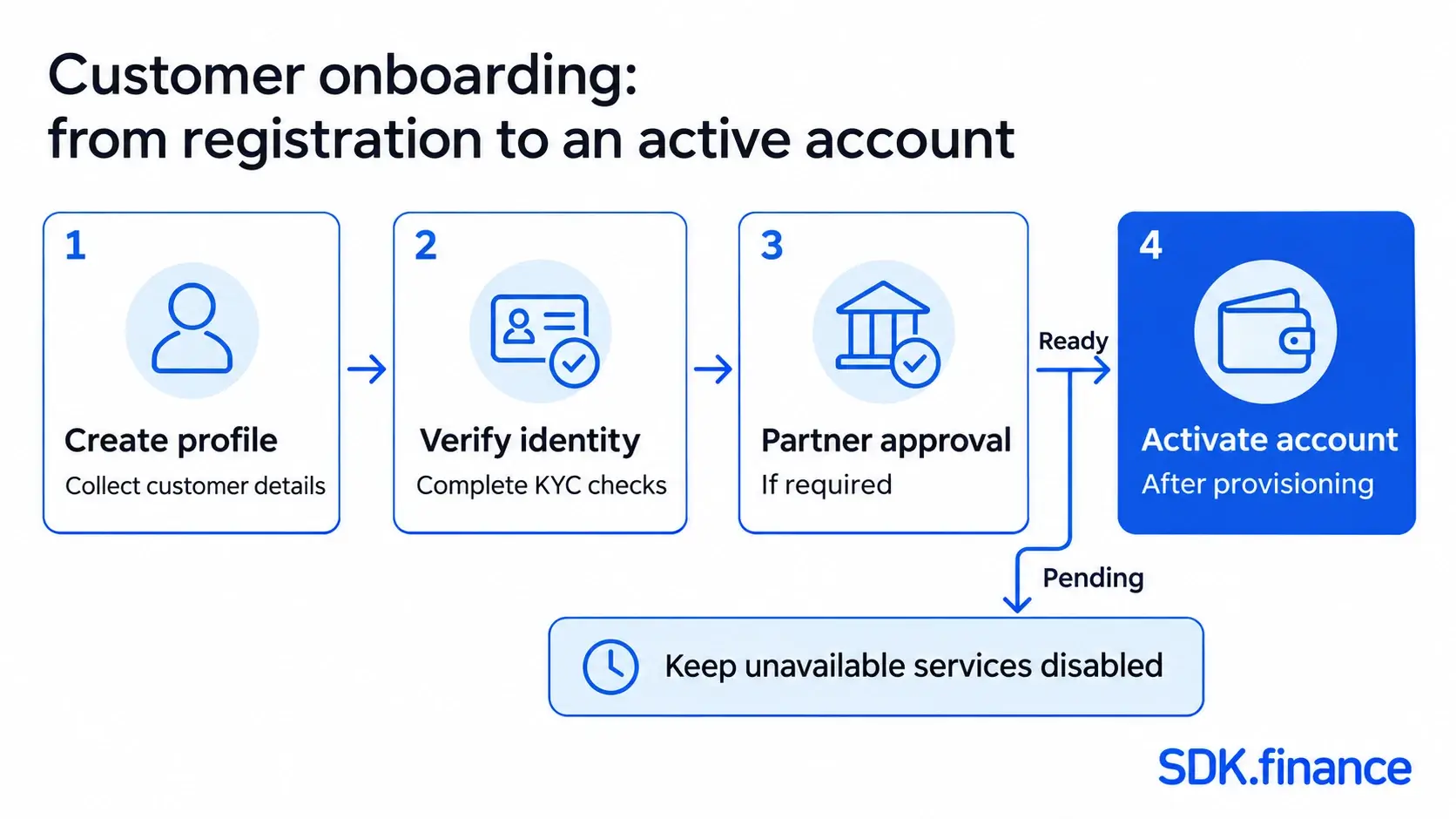
If verification passes but provisioning remains pending, show that distinction and keep unavailable funding or card functions disabled. Give support the outstanding step and provider reference so the customer does not have to restart.
The same rules should govern both mobile and web access. Otherwise, one interface might allow an action that the other correctly blocks.
Turn artist-designed cards into a servicing workflow
Artist-designed cards can express the community’s cultural identity. Their design also creates operational decisions: which artwork is approved for production, where cards can be delivered, and what happens when a customer needs a replacement.
Choose the issuing and servicing programme against the full lifecycle:
- Ordering: check account eligibility, the selected design, delivery details, and any fee before submitting the request.
- Activation: use the issuer’s supported activation process and retain the resulting card status.
- Controls: connect freezing and limit changes to confirmed issuer responses.
- Replacement: link the old and new cards, define any fee, and explain which credentials remain usable.
Card actions in a white-label mobile banking app must map to the issuer’s supported APIs. SDK.finance can connect these workflows through integration; define which operations are available and how confirmed results reach the app.
For example, tapping “freeze” sends a request. If the issuer times out, the app should show that confirmation is pending and offer the agreed support route. It must not display “frozen” solely because the request left the platform.
The operator needs one consistent view of funds available for card spending and transfers. Agree which system authorises spending and how authorisation holds, clearing, reversals, and expiry update that view.
For example, a €1,000 balance with a €200 card hold leaves €800 available. A €300 transfer plus an illustrative €5 fee leaves €495 available. The implementation must prevent both channels from spending the same funds; these figures illustrate balance rules, not product pricing.
Apple Pay and Google Pay require programme-specific issuer, card-scheme, and tokenisation support. Confirm eligibility and provisioning behaviour during issuer selection, including what happens after replacement. Branded app availability alone does not establish digital-wallet support.
Funding, FX, and payout for diaspora remittances
For the company, a diaspora money transfer service requires bank-transfer funding and bank-account payout in another currency. Define recipient details, the debit in the funding currency, and the provider evidence required to confirm credit to the recipient’s bank account.
The workflow needs five connected decisions:
- Confirm funding. Match the bank partner’s confirmed incoming transfer to the internal account using the external account identifier or payment reference, amount, and currency. Apply the agreed availability rules once; route unmatched receipts to operations instead of crediting a guessed account.
- Price the transfer. Show the debit amount, fees, exchange terms, and recipient amount where it can be established.
- Secure the conversion. Establish whether the FX provider offers an executable quote, how long it lasts, and when acceptance becomes binding.
- Submit the payout. Check the available balance, applicable limits, recipient details, and the payment provider’s execution conditions.
- Confirm the result. Map provider updates to the customer’s transfer status and retain references for investigation.
If the quote expires before acceptance, request fresh terms and obtain the necessary confirmation. If funding arrives late, apply the agreed expiry rule rather than silently using an outdated rate.
If conversion succeeds but payout fails, distinguish confirmed failure from confirmed return of funds. Define where funds remain, which provider event permits release or refund, and how the refund is calculated. Re-conversion can introduce a different rate and additional fees.
Customer funds and payout liquidity also need separate treatment. A balance in the funding currency does not prove that a provider has enough payout currency available. Where the arrangement requires prefunding, assign replenishment thresholds and an owner; if liquidity is unavailable, pause execution or present an accurate delay.
Within a remittance platform, the multi-currency wallet records the balances used in this workflow. SDK.finance supplies the transaction rules and records; selected providers execute conversion and payout. The implementation must map their results back to the appropriate currency balances.
Decide what “family-focused” means in the product
For the company’s diaspora banking proposition, the first release might offer saved recipients and recurring transfers, subject to implementation scope. Each scheduled payment still needs current eligibility, sufficient funds, limits, and an available route. Decide how customers approve FX terms and receive notifications when a payment cannot proceed.
A shared family experience is a different design task. If one person funds an account while another spends or approves payments, specify:
- Who owns each account and who may view its balance.
- Who may initiate, approve, or cancel a payment.
- Which limits apply to each person and how access is withdrawn.
These are account relationships and permission rules, not branding settings. Assess them with the software and financial partners before promising a Family Hub. SDK.finance’s existing capabilities provide a foundation; proprietary family workflows need a separate fit and development assessment.
Tracking diaspora payments and resolving exceptions
Cross-border payment software may record a transfer before the external payout is complete. For the operator, customer-facing statuses must distinguish these events, for example:
Request received → funds and terms validated → submitted to provider → delivery confirmed
Map “delivery confirmed” to the provider’s actual evidence. If the provider only confirms submission, the interface should not claim the relative has received the money.
For a timeout after submission, keep the result unresolved while querying the provider through its supported status mechanism. Retain the original operation reference. Retrying immediately could pay the relative twice; refunding immediately could return money for a payment that succeeded.
Provider notifications need equally clear rules:
- Verify authenticity and match the event to the expected operation.
- Process duplicate notifications without creating another credit or payout.
- Prevent late events from overwriting a newer confirmed state.
- Route unresolved outcomes to an owner with a defined investigation process.
Reconciliation then compares internal records with external statements. For this cross-currency transfer, retain the funding reference, conversion reference, payout ID, currency amounts, fees, and any return. This allows operations to distinguish a missing payout from a fee discrepancy or settlement delay.
SDK.finance’s reconciliation capabilities can support this comparison with configured provider data. The implementation still needs matching rules and a process for resolving exceptions. Reconciliation identifies differences; settlement concerns the movement of funds between parties.
Building a diaspora payments service with the SDK.finance white-label banking platform
SDK.finance’s white-label banking software combines Transaction Platform capabilities with web and mobile interfaces. For the launch team, selecting money transfer software means distinguishing the reusable foundation from provider-specific implementation and proprietary product development.
Divide implementation responsibilities into three parts:
- Available foundation: personal accounts, multi-currency balances, transaction history, configurable fees and limits, and web and mobile interfaces. Configure these for the initial product and confirm the selected delivery scope.
- Project implementation: connect account provisioning, bank-transfer matching, issuer confirmations, FX execution, payout statuses, and reconciliation. Define provider-specific event mappings and failure handling, then test the complete route.
- Separate assessment: proprietary family workflows beyond the supported product scope. Confirm the required development before committing them to the roadmap.
SDK.finance does not issue cards, hold customer funds, provide safeguarding or IBANs, or execute payment rails directly. Those responsibilities remain with the selected financial partners and their contractual arrangements.
If the design also requires a dedicated double-entry accounting layer across customer liabilities, provider positions, and adjustments, assess SDK.finance General Ledger as a distinct component. Specify its relationship to transaction processing rather than treating the two products as interchangeable.
The operator’s team or an implementation partner can build the integrations and adapt the interfaces.
Discover how the SDK.finance TPS can power high-speed, secure operations across banking, fintech, and retail
Talk to Our TeamChoose SaaS or Source Code against the required changes
A SaaS banking platform can support the first release when branded accounts, card controls, and transfers fit the supported scope. SDK.finance hosts the environment; SaaS does not include source-code access or direct modification of core transaction logic.
Apply the delivery-model decision to two stages of the business roadmap:
- Initial launch: validate the required account, card, and transfer journeys against the available interfaces and APIs. Confirm that provider connections can run through integrations without core changes.
- Product expansion: assess Source Code if the family proposition requires unsupported account relationships, proprietary approval logic, or deployment control beyond SaaS.
Use SDK.finance’s integration guidance to scope external connections. A new issuer integration alone does not require Source Code.
With the Source Code model, agree licence scope and assign responsibility for development, hosting, testing, maintenance, and updates. Compare that operating commitment with the control the roadmap actually needs.
Budget separately for implementation and external account, card, KYC, FX, and payment-provider charges.
Prove the complete journey before expanding
A controlled launch should demonstrate that the eligible customer can open the account, fund it, use the card, and complete the family transfer. Test interruptions with the same care as the successful path.
| Test | Expected behaviour to establish |
| KYC passes; account provisioning is pending | Funding and card functions remain unavailable where provisioning is required; support can identify the pending step. |
| The same funding event arrives twice | One balance credit, with a traceable duplicate-event record. |
| A card-freeze request times out | Pending confirmation and issuer-status investigation; no false frozen status. |
| A card authorisation and transfer compete for the same available balance | Across the platform and issuer integration, funds committed to either operation cannot be spent again by the other. |
| A payout times out after submission | Resolve the original operation before retrying or refunding. |
| A provider statement differs from internal records | Create an owned reconciliation exception and trace the related funding, FX, payout, and fee records. |
Also test quote expiry, insufficient payout liquidity, and a recurring transfer with insufficient funds. Agree whether each case pauses, requests new acceptance, or fails, and what the customer sees.
Use recorded results and recovery procedures as acceptance criteria. Include a full reconciliation cycle, customer statements, and a support investigation that follows the operation across providers.
Capacity tests should use expected payment submissions, simultaneous users, provider events, and backlogs. Customer totals and annual monetary turnover alone do not establish the processing workload.
Explore SDK.finance in a demo using this complete journey. Bring the first residence market, account and card requirements, transfer route, and family-permission roadmap. Use the session to identify available capabilities, integration work, and the delivery model that fits.
Launch your digital bank in weeks, not years
Talk to Our Team