FinTech in the USA connects consumer-facing apps with the banks, payment networks, and software behind them. The ecosystem spans payments, banking, lending, investing, insurance, and digital assets. According to KPMG, the US attracted US$80.8 billion across 933 FinTech deals in the first half of 2026, accounting for more than 75% of global investment across venture capital, private equity, and mergers and acquisitions.
For founders, payment service providers (PSPs), and product teams, understanding this landscape means knowing which parts of a financial product to build and which require partners. A customer need shapes the service; the flow of funds determines the payment routes, financial relationships, and software needed to deliver it.
This guide maps the main FinTech sectors and companies in the USA, compares ACH, cards, FedNow, and RTP, and explains the key decisions involved in choosing partners and software for a US financial product.
Launch your digital bank in weeks, not years
Talk to Our Team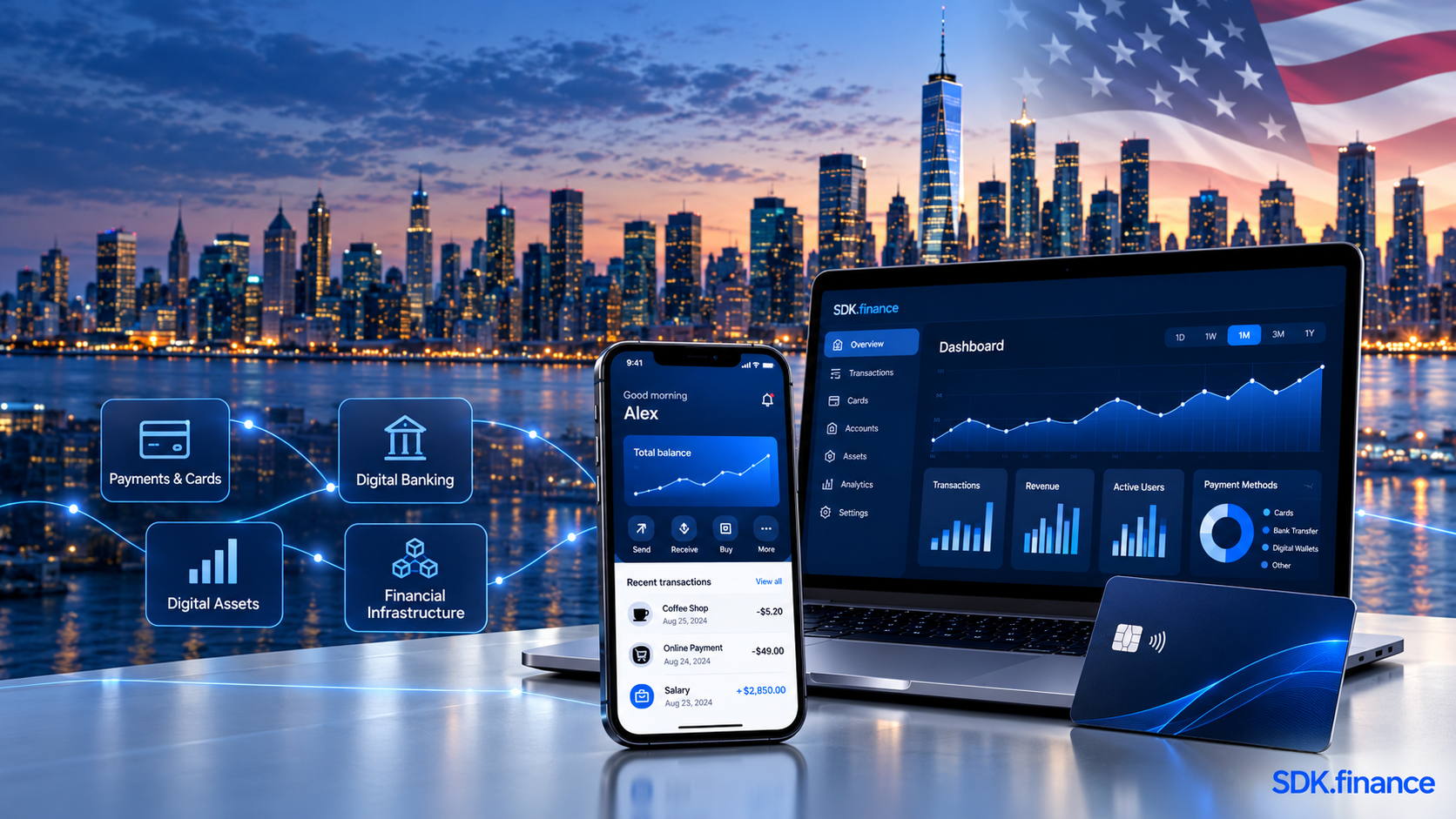
US FinTech market: size, growth and key figures
FinTech uses technology to deliver or support financial services. In the USA, that covers both familiar consumer apps and the infrastructure businesses use behind the scenes.
The main segments include:
- Payments and transfers: accepting purchases, paying suppliers, or sending money.
- Digital banking: account and card experiences delivered by banks or through banking partners.
- Lending and financing: access to credit and tools for managing borrowing.
- Investing: brokerage, investment management, and related services.
- Insurance: digital tools for buying cover and managing claims.
- RegTech and identity: tools for customer checks, fraud decisions, and risk review.
- Digital assets: services for accessing, trading, and managing cryptoassets.
- Financial infrastructure: data connections, card processing, transaction software, and accounting systems.
Use this sector map to identify the customer need your product will address before comparing individual providers.
US FinTech market statistics
Market size and growth outlook
- Market size: Mordor Intelligence estimates the US FinTech market at US$58.01 billion in 2025 and US$66.82 billion in 2026.
- Growth forecast: the same report projects US$135.42 billion by 2031, with a compound annual growth rate of 15.18% from 2026 to 2031.
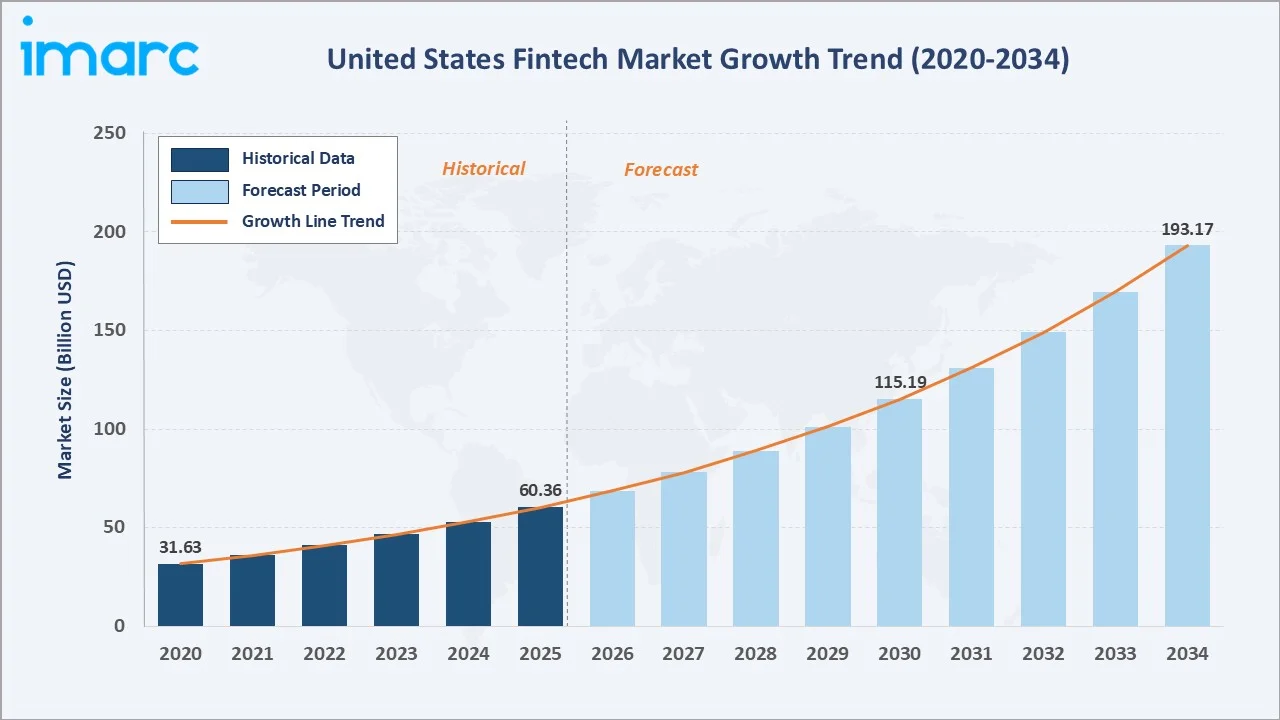
IMARC Group offers a separate growth series: US$31.63 billion in 2020, US$60.36 billion in 2025, and an estimated US$68.69 billion in 2026. Its forecast reaches US$115.19 billion in 2030 and US$193.17 billion in 2034, with a projected CAGR of 13.80% from 2026 to 2034. The chart below uses IMARC’s figures throughout; the estimates above are from Mordor Intelligence.
Investment and ecosystem scale
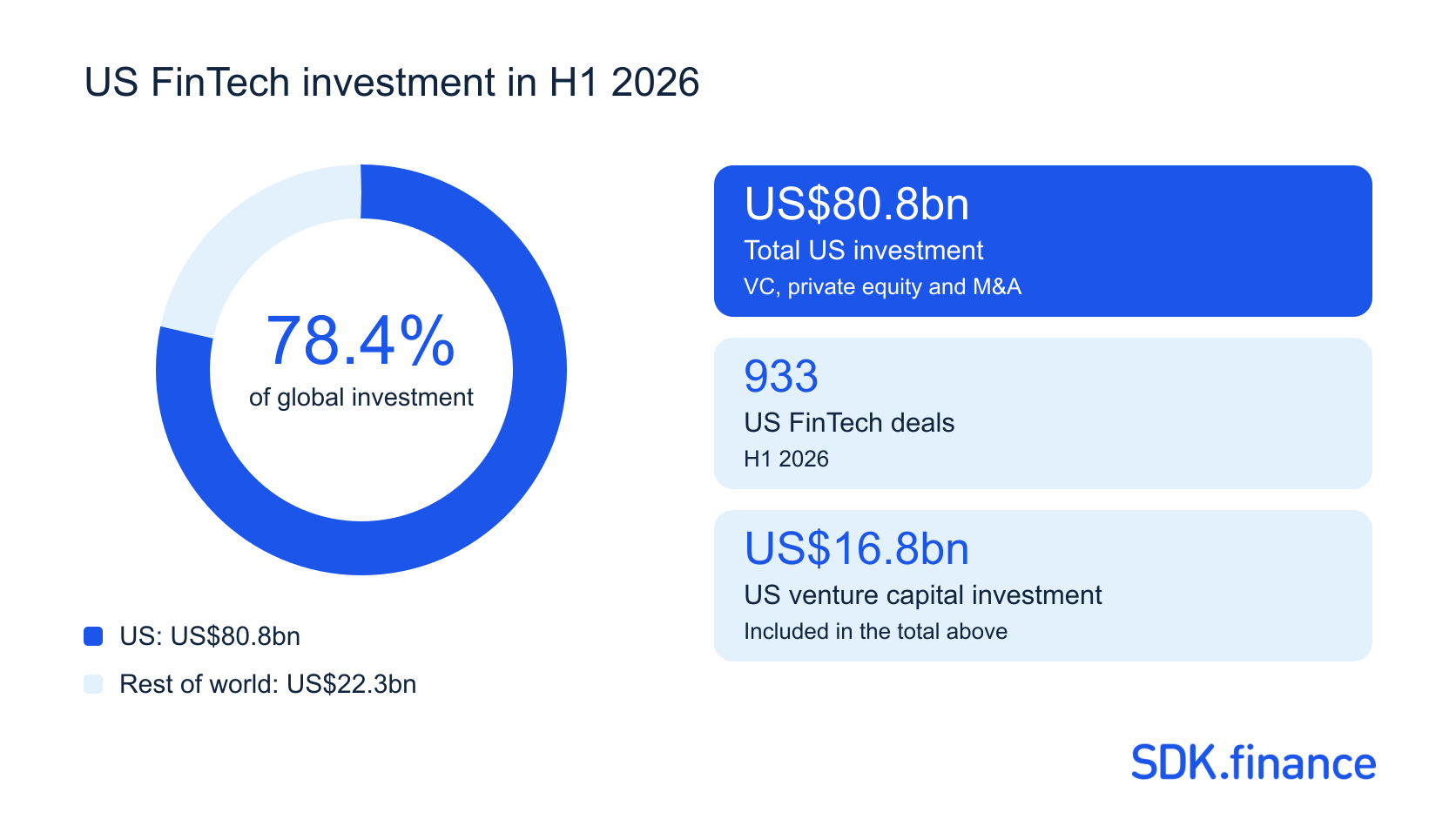
KPMG puts global FinTech investment at US$103.1 billion in H1 2026. The US received US$80.8 billion, or 78.4% of that total; the remaining US$22.3 billion went to other markets. These figures cover venture capital, private equity, and M&A.
- Deal activity: KPMG recorded 933 US FinTech deals in H1 2026, including US$16.8 billion in venture capital investment within the total investment figure above.
- Digital assets: US investment in this sector reached US$5.9 billion across 187 deals in H1 2026, according to the same KPMG report.
Crunchbase’s US FinTech directory lists 9,970 organisations, including startups and established companies, as checked in October 2026.
Payment volumes and faster transfers
According to Nacha, the ACH Network processed 35.2 billion payments worth US$93 trillion in 2025. Within that total:
- Same Day ACH handled 1.4 billion payments worth US$3.9 trillion, with payment volume up 16.7% year on year.
- Business-to-business ACH payments reached nearly 8.1 billion, growing almost 10% year on year.
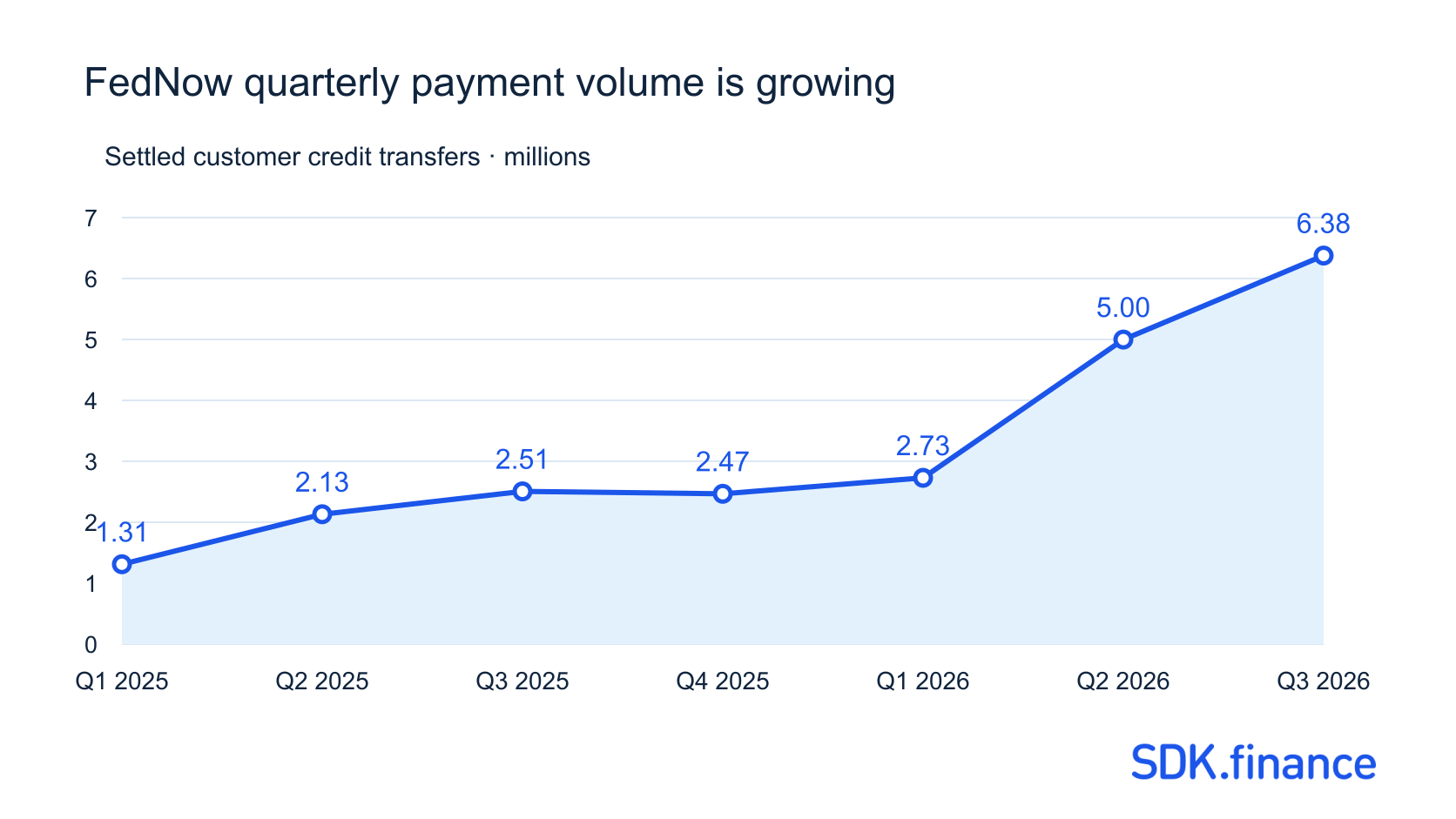
The Federal Reserve reports 6,376,467 settled customer credit transfers through FedNow in Q3 2026, up 27.6% from the previous quarter. The chart tracks quarterly volume from Q1 2025.
Access to bank accounts
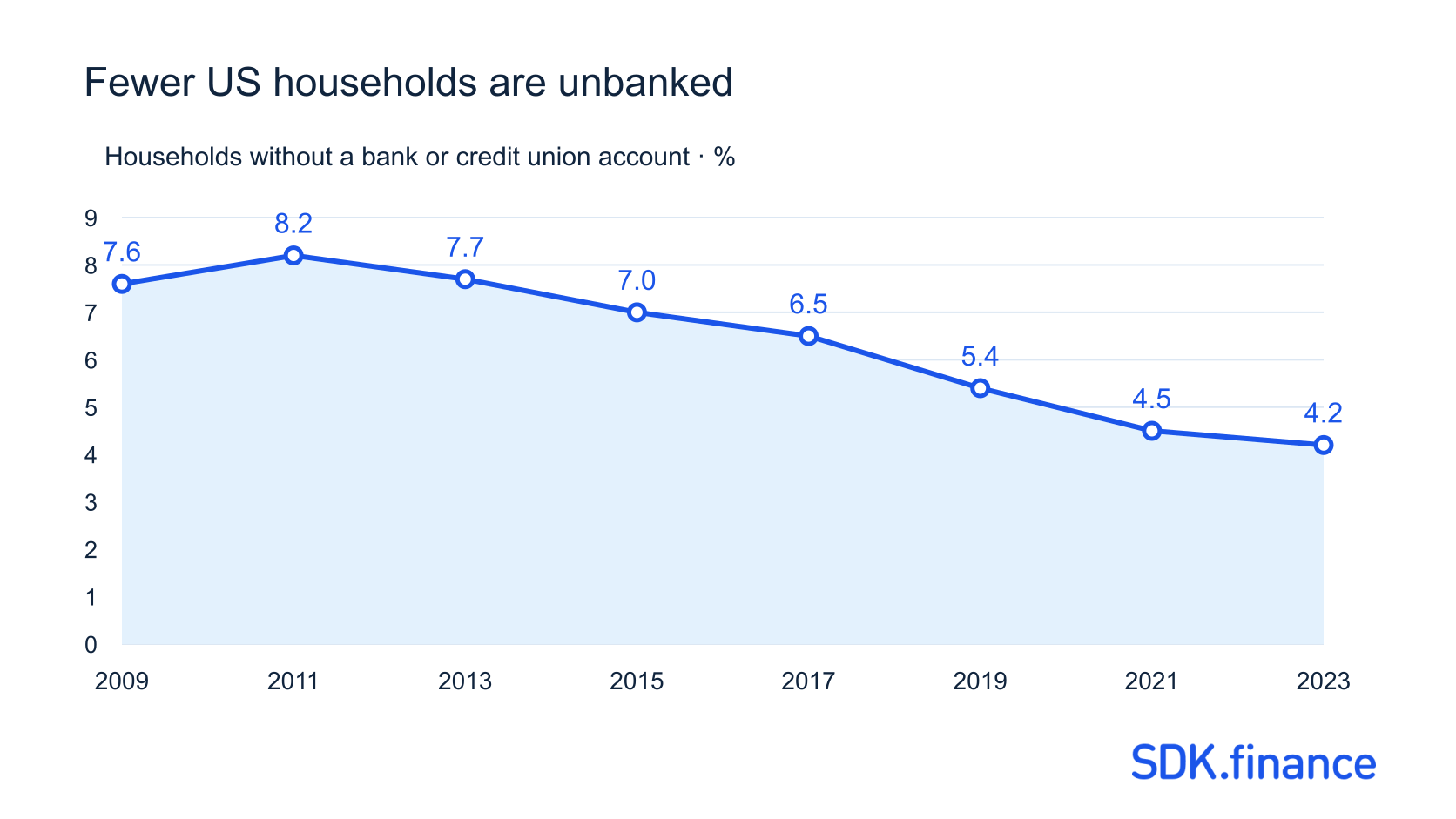
The FDIC’s 2023 household survey found that 4.2% of US households, about 5.6 million, had no bank or credit union account. This compares with 8.2% in 2011. The long-term decline still leaves millions of households without an account.
- Underbanked households: a further 14.2% of US households, about 19 million, had an account but also used nonbank transaction or credit services covered by the FDIC survey in 2023.
Digital adoption and customer demand
- Mobile banking: 48.3% of banked US households used mobile banking as their main way to access an account in 2023, according to the FDIC.
- Nonbank payment apps: 49.7% of US households used nonbank online payment services in 2023, up from 46.4% in 2021, according to the FDIC household survey.
- Payment frequency: US consumers made an average of 47 payments per month in 2025, including 16 credit card and 15 debit card payments, according to the Federal Reserve’s 2026 Diary of Consumer Payment Choice.
- Remote payments: 37% of consumer payments were made remotely in 2025, averaging 17 per month, according to the same Federal Reserve study.
- E-commerce: the US Census Bureau estimates US retail e-commerce sales at US$1,233.7 billion in 2025, up 5.4% year on year and representing 16.4% of retail sales. This indicates the scale of the online retail market served by payment providers.
For product teams, these figures highlight demand for business payments, faster access to funds, and affordable account services.
FinTech companies in the US
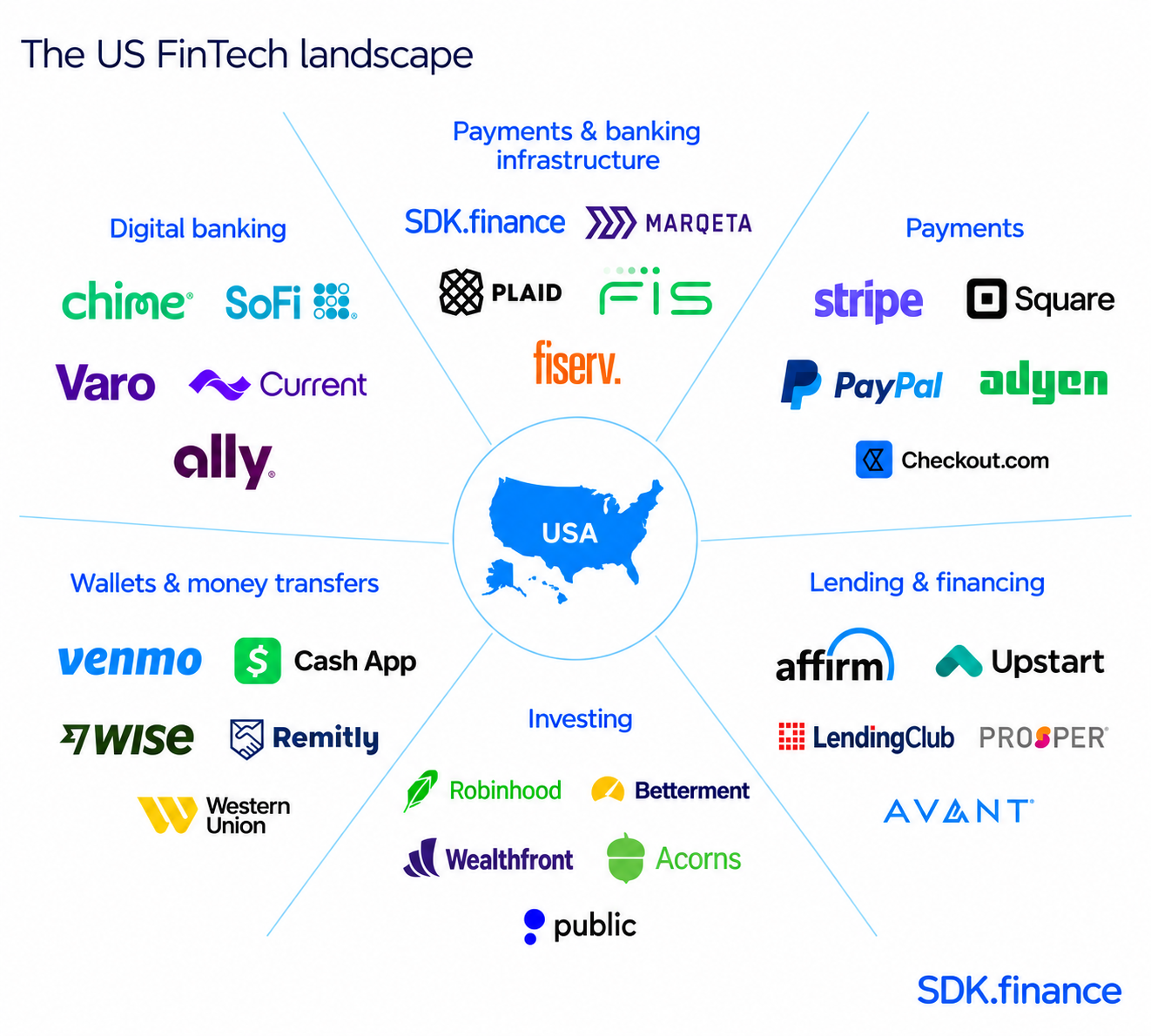
The map highlights providers across six areas of the US market. The table and profiles below examine eleven companies, also covering insurance, identity, and digital assets. Each profile explains who the company serves, what it offers, and a practical customer application.
| Entity | Category | Role and Example Use |
|---|---|---|
| SDK.finance | FinTech software provider | Provides a ready-made software foundation for developing digital banks, digital wallets, payment services, and other financial products for the US market. |
| Stripe | Payments and financial infrastructure provider | Accepts and manages payments; for example, recurring subscription charges. |
| Square | Merchant payments and business software provider | Combines point-of-sale payments and business tools; for example, café orders and payments. |
| Plaid | Financial data connectivity provider | Connects apps to financial accounts and data; for example, a budgeting app. |
| Chime | Consumer FinTech company | Provides a consumer account and card experience through partner banks. |
| Marqeta | Card issuing and processing technology provider | Supports card issuing and processing; for example, a business spending programme. |
| Affirm | Consumer financing provider | Offers pay-over-time financing; for example, eligible purchases at checkout. |
| Betterment | Digital wealth management provider | Offers automated investing and financial planning for longer-term financial goals. |
| Lemonade | Digital insurance provider | Connects insurance purchasing, policy servicing, and claims; for example, renters cover. |
| Alloy | Identity and fraud decisioning provider | Supports customer checks and risk-review workflows for banks and FinTech businesses. |
| Coinbase | Digital-asset services provider | Provides cryptoasset trading and infrastructure for individual and institutional customers. |
Payments, banking, and financial infrastructure

SDK.finance
SDK.finance provides the software foundation for launching FinTech and payment products or modernising the systems behind them. Its Transaction Platform brings together accounts, wallets, payment workflows, and back-office operations, while its standalone General Ledger adds real-time accounting to existing infrastructure. For teams building in the US market, this means starting with established financial software and focusing development on their customer experience, product workflows, and integrations with banking and payment partners.
Stripe
Stripe serves merchants and software platforms that need to accept and manage payments. It provides payment acceptance, billing, and services for platforms handling payments between multiple parties. A US subscription business can use its billing tools to collect recurring charges and manage customer payments within its service.

Square
Square serves retailers, restaurants, and service businesses managing in-person and online sales. It provides payment acceptance, point-of-sale systems, and tools for running merchant operations. A US retailer can connect a customer’s purchase with its payment and sales records, helping staff manage checkout and review daily business activity.

Plaid
Plaid serves FinTech companies and software businesses that need access to customers’ financial account data. It provides connections between financial accounts and applications, with customer permission. A US budgeting app can use transaction information from connected accounts to explain spending and help users understand their day-to-day finances.

Chime
Chime serves consumers who want an app-based way to manage everyday money. It provides an account and card experience, with banking services supplied by The Bancorp Bank, N.A. or Stride Bank, N.A., both FDIC members. A US customer can use the app to review account information and card activity.

Marqeta
Marqeta serves FinTech companies and businesses developing consumer or corporate card programmes. It provides card issuing technology and processing that connects card transactions with programme controls and records. A US business-spending product can use that technology to apply spending controls and record employee card activity within its service.
Lending, investing, insurance, identity, and digital assets
The following profiles show how investing, insurance, financing, identity checks, and cryptoasset services address different customer needs.

Betterment
Betterment serves individuals who want to invest towards longer-term financial goals. It provides automated investing and financial planning, connecting portfolio management with the customer’s investment plans. A US customer can use its digital wealth service to build an investment portfolio around a goal such as retirement.

Lemonade
Lemonade serves consumers who want to buy insurance and manage cover through digital channels. It offers insurance products including renters and homeowners cover, with digital processes for purchasing policies and handling claims. A US renter can use the service to arrange cover and submit a claim.

Affirm
Affirm serves shoppers seeking pay-over-time options and merchants offering financing during a purchase. It provides buy now, pay later (BNPL) services that bring financing into checkout, with eligibility and repayment terms presented to the shopper. A US retailer can offer customers financing options for an eligible purchase.

Alloy
Alloy serves banks and FinTech businesses that need to assess customers and investigate risk. It provides identity and fraud decisioning tools that support customer checks, risk assessment, and review workflows. A US financial business can use these tools to organise onboarding decisions and route cases for further review.

Coinbase
Coinbase serves individuals and institutions that want to access and manage cryptoassets. It provides cryptoasset trading and infrastructure services, supporting customer activity in the digital-asset market. A US customer can use its trading service to buy and sell cryptoassets as part of managing a digital-asset portfolio.
US FinTech startups: scale, funding, and growth segments
The US startup ecosystem spans consumer services and the software behind them. Recent funding announcements highlight business finance, stablecoin payments, digital assets, and automated risk decisions.
How many FinTech startups are there in the US?
RevenueBase’s US startup directory lists 909 matching companies, checked in October 2026. This is a database snapshot, not a national census. The broader Crunchbase count in the market overview also includes established companies, so the two figures measure different populations.
How is US FinTech funding changing?
- US funding is substantial but uneven. Tracxn recorded US$10.5 billion in H1 2025, 42% below H2 2024 but above H1 2024. Its report identified 17 funding rounds of US$100 million or more. Two private companies reached valuations of at least US$1 billion for the first time during this period.
- The US remains a major destination for venture capital. Crunchbase recorded US$15 billion flowing into US-based FinTech companies in H1 2026, more than 52% of its global total.
- Investors are concentrating their bets. In the same Crunchbase analysis, global FinTech funding increased 22.7% year on year, while the number of deals fell by more than 25%. This describes the global funding backdrop, not growth in the number of US startups.
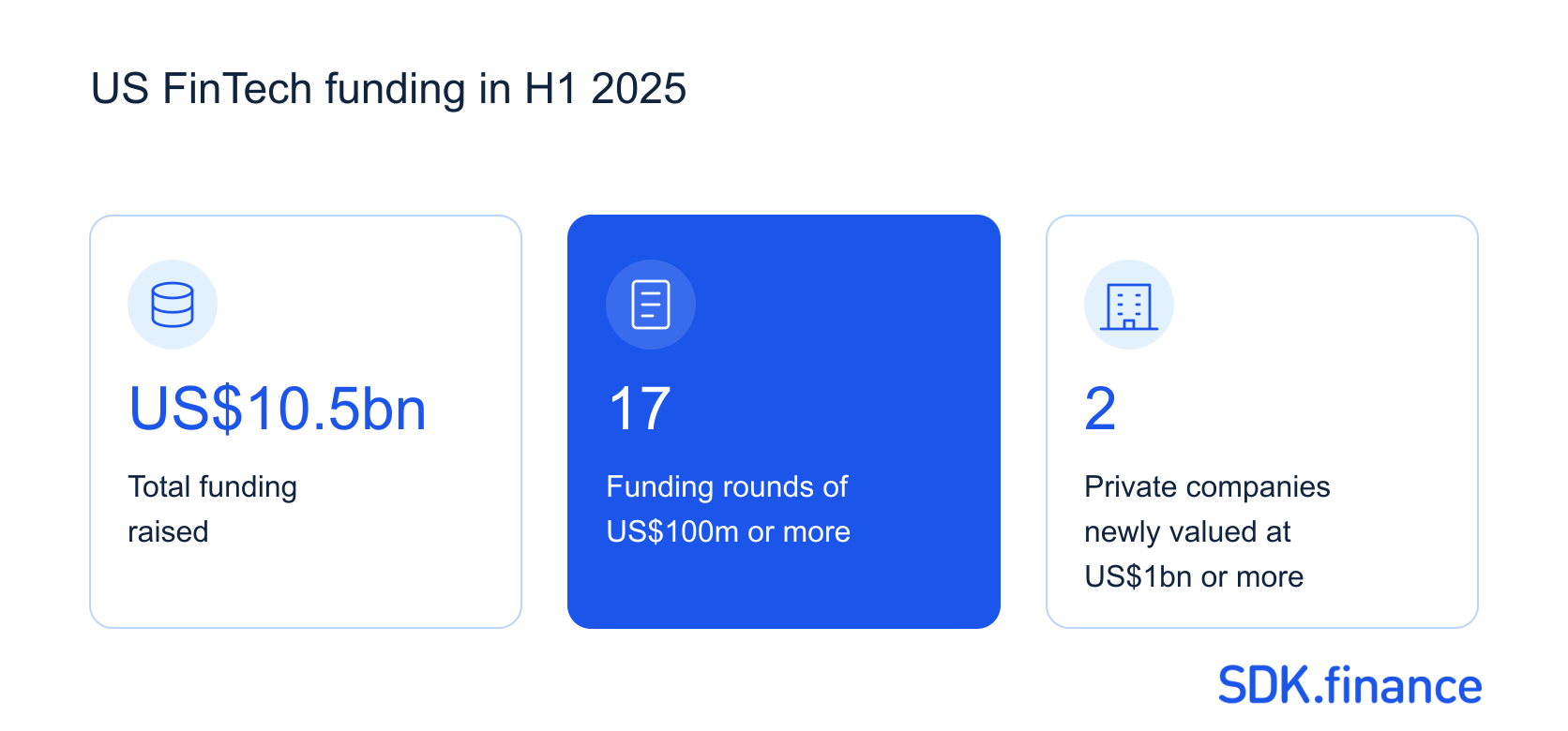
According to Tracxn’s H1 2025 US FinTech report.
Notable funding announcements in the past year
These selected US-based startups and scaleups announced funding between 21 October 2025 and 21 October 2026. They are ordered by the disclosed amount raised, rather than company valuation.

Ramp
US$1.85 billion, October 2026. Segment: business finance and spend management. It serves finance teams with corporate cards, expense management, and tools for automating financial operations.

Kraken
US$800 million across two financing tranches, November 2025. Segment: digital assets. It serves individual and institutional clients with trading, custody, and related financial infrastructure.

Rain
US$250 million Series C, January 2026. Segment: stablecoin payment infrastructure. It serves enterprises and financial platforms with infrastructure for stablecoin-powered cards, wallets, and payments.

Mercury
US$200 million Series D, May 2026. Segment: digital business banking. It serves startups and growing businesses with banking interfaces and financial management tools, with banking services provided through partner banks.

Taktile
US$110 million Series C, June 2026. Segment: AI-assisted risk decisions. It serves financial institutions with software for building and managing decisions across credit, fraud, and customer onboarding.
These examples show three areas of activity: managing business money, connecting digital assets to payment services, and improving financial decision-making. For a new product team, they offer useful reference points for choosing a specific customer problem and understanding the competition in that segment.
Launch your digital bank in weeks, not years
Talk to Our TeamThe US FinTech landscape: banks, platforms and infrastructure
Consumer brands, banks and infrastructure
Different providers perform different jobs behind the same product:
- Consumer-facing FinTech: owns the app, onboarding journey, notifications, and support.
- Chartered bank: provides banking services within its authorised scope.
- Processor: handles payment messages and related operations.
- Data network: connects financial information.
- Ledger vendor: supplies software for recording financial events.
Assign ownership of the customer experience, funds, processing, data, and financial records. Compare suppliers within each role using the same requirements.
Embedded finance in vertical software
Vertical software serves a particular industry, such as restaurants, property management, or professional services. Embedded finance adds financial functions inside that existing workflow. The value comes from connecting the payment to the job the customer is already doing.
Consider an illustrative marketplace for home services. Its responsibilities might be divided like this:
- Marketplace: owns booking, checkout, and the contractor dashboard.
- Payment provider: handles payment acceptance.
- Bank or other authorised participant: holds or moves funds under the agreed arrangement.
- Internal software: records contractor earnings, marketplace fees, and pending payouts.
Internal balances record what the marketplace owes each contractor. Connect those records to the financial partner’s collections and payouts.
Link cancelled bookings, refunds, and payout updates to the original order so support staff can trace the customer’s transaction.
Use the launch checklist later in this guide to turn this division of work into named owners and testable requirements.
ACH, cards, FedNow and RTP: choosing the payment route
Choose a route around the payment’s purpose, recipient reach, timing, and exception handling. A product can use several networks, but it needs a consistent explanation of what each transaction status means.
ACH, cards, FedNow and RTP compared
ACH supports bank-account credits and debits and is widely used for payroll, bills, and business payments. Standard and Same Day ACH operate through scheduled processing and settlement windows. Same-day processing is not the same as continuous instant settlement.
Cards connect merchant acceptance with issuing and acquiring participants. Authorisation can give a prompt checkout response, while capture, settlement, refunds, and disputes follow their own processes. The merchant’s payout timing also depends on its provider arrangement.
The FedNow Service and The Clearing House’s RTP network are separate instant payment infrastructures. Both support round-the-clock payments through participating financial institutions. A connection to one does not automatically provide reach through the other.
| Route | Common use | Timing and reach | Operating consideration |
|---|---|---|---|
| ACH | Payroll, bills, supplier payments | Broad US bank-account reach; scheduled windows | Authorisations, cut-offs, and ACH returns |
| Cards | Online and in-person purchases | Broad acceptance; authorisation differs from settlement | Capture, refunds, disputes, and merchant payouts |
| FedNow | Urgent transfers and payouts | Instant service, 24/7; participating institutions | Reachability, available funds, and continuous monitoring |
| RTP | Account transfers and disbursements | Instant service, 24/7; participating institutions | Final settlement, funding, and return-request handling |
Instant payment operating needs
Faster settlement extends operations beyond business hours. A Sunday payout needs recipient reach, funding, accurate records, and a support escalation path.
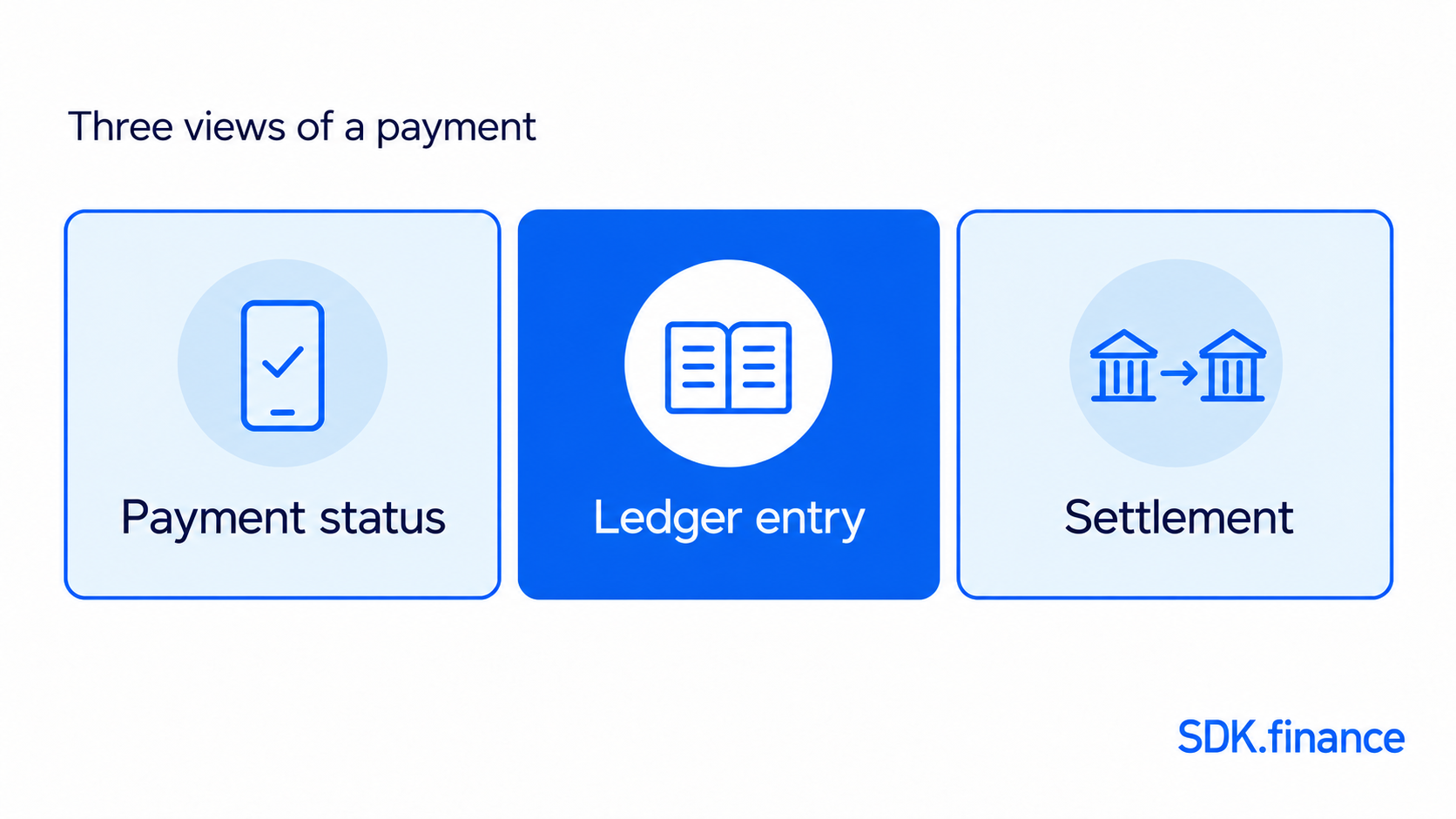
Keep three concepts separate:
- Payment status: what the application or provider reports about the operation.
- Ledger entry: the financial effect recorded under the product’s accounting rules.
- Settlement: the transfer of funds between the relevant financial participants.
For example, a card authorisation may appear successful before the merchant receives its payout. An internal balance can also change before external funds arrive, if the product deliberately permits that and manages the resulting risk. The interface should explain whether money is pending or available.
Exception handling also depends on the route:
- ACH return: connect the return to the original payment, update the balance and customer status correctly, and route any follow-up to the responsible team.
- Card dispute: retain the transaction evidence, track the response deadline, and make any balance adjustment traceable.
- RTP return request: asks for funds to be returned after final, irrevocable settlement. It is not a unilateral cancellation or a card chargeback.
Define these differences before launch. Agree which events change balances, how repeated messages avoid duplicate payments, and who investigates a mismatch. Reconciliation then compares internal records with provider and bank records, helping the team find missing or inconsistent events across routes.
US regulation, bank partnerships, and customer protection
Map the activities, funds flows, legal entities, and states involved in the service to identify the applicable US requirements.
Registration versus authorisation
FinCEN money services business registration is a federal requirement for businesses within its scope. Its guidance on MSB registration claims explains that registration does not confer an operating licence or government endorsement.
For a money-transmission service, assess state licensing requirements and relevant exemptions against the business model and target jurisdictions.
The CSBS Money Transmission Modernization Act provides common standards for state money-transmission frameworks. Assess how each target state has adopted and implemented those standards.
Involve qualified legal and compliance advisers while the operating model can still change. Show them:
- Who receives customer instructions.
- Who controls the funds.
- Which entities contract with users.
- Which services the partners perform.
Record these relationships in a funds-flow diagram.
Bank partnerships also require ongoing work. Federal banking agencies have highlighted risks in arrangements with third parties delivering deposit products. The programme needs clear responsibilities for records, customer support, monitoring, and access to information. Partner oversight is part of operating the service, not just an onboarding step.
Customer funds and data access
An app balance does not automatically mean the customer has an insured deposit. The FDIC’s guidance on banking with third-party apps explains that nonbank arrangements may qualify for pass-through deposit insurance only when the relevant conditions are met. Deposit insurance addresses an insured bank’s failure, not every loss or interruption involving a nonbank app.
Identify the banking relationship in customer communications and maintain records showing whose money is held, where it is held, and how customer balances match bank records.
As checked on 19 October 2026, the CFPB personal financial data rights updates report that a court stayed the rule’s compliance dates on 29 October 2025.
For customer data access, product teams should:
- Establish the basis for accessing data and manage user permissions.
- Build clear consent and disconnection journeys.
- Define retention practices and meet applicable privacy and security requirements.
- Review the current rule status before making launch commitments.
Fraud prevention and operational resilience
Use the NIST Cybersecurity Framework 2.0 to organise cybersecurity work around Govern, Identify, Protect, Detect, Respond, and Recover, with named owners for each area.
For a US financial product, use practical scenarios to test that plan:
- Account access: define authentication, staff permissions, and recovery checks so an account-recovery request does not bypass normal controls.
- Suspicious payments: agree which signals trigger review, who can pause an operation, and how the team contacts the customer. Confirm recipient-checking options with the payment provider.
- Provider outages: decide what users see, which operations must wait, and how support escalates the incident. Do not retry an uncertain payment blindly; first establish whether it was processed.
- Recovery: test restoration of records and reconcile transactions after service resumes. Assign responsibility for customer updates and for resolving any remaining differences.
US FinTech trends and opportunities for product teams
Mordor Intelligence’s US FinTech market report highlights three segments by market share and forecast growth:
- Digital payments: the largest segment, with an estimated 46.78% market share in 2025.
- Digital lending and financing: an estimated 26.92% market share in 2025.
- Neobanking: the fastest-growing segment in the forecast, with a projected compound annual growth rate of 21.05% for 2026–2031.
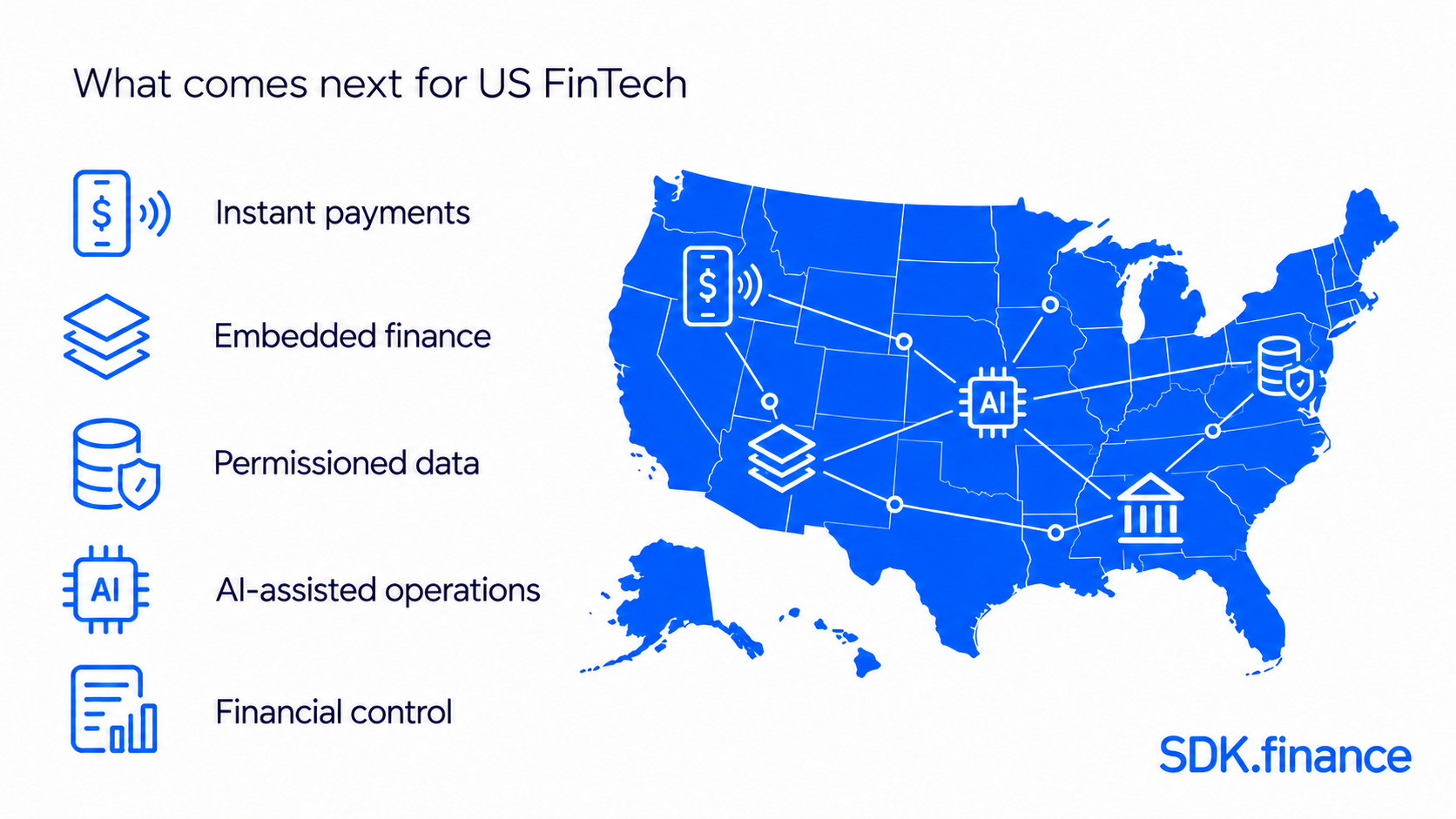
For product teams, these estimates point to opportunities in payments, credit, and digital account services. The map below connects these opportunities with five practical themes. Alongside instant payments and permissioned data access discussed above, teams can focus on three improvements:
- AI-assisted operations: help staff summarise support cases and investigate unusual activity, with restricted data access and human review of customer-impacting decisions.
- Embedded finance: connect financial services to industry workflows, such as linking a property payment to its tenancy, to reduce manual matching.
- Clearer financial control: give customers and staff a clear explanation of pending funds, fees, and exceptions.
How to choose a FinTech provider for a US product
Ask shortlisted providers to demonstrate the same customer workflow, including failed payments and reporting discrepancies. Use the checklist below to compare their responses.
| Launch check | Question for the team | Evidence to request |
|---|---|---|
| Customer and product | Whose task are we improving, and what belongs in the first release? | A tested workflow covering a payment, refund, and failure. |
| Partners and permissions | Who holds or moves money, contracts with users, and handles regulated activities? | A funds-flow diagram and named responsibilities agreed with the relevant partners and advisers. |
| Payment access | Do the selected routes reach the intended recipients at the required times? | Confirmed provider coverage, funding arrangements, cut-offs, and return procedures. |
| Records and integrations | How are statuses, balances, accounting entries, and provider reports connected? | Stable identifiers, event mappings, reconciliation rules, and tests for delayed or duplicate events. |
| Operations and continuity | Who investigates incidents, supports customers, and handles an outage or provider change? | Escalation owners, support hours, access controls, and a tested data-export or recovery process. |
| Cost and delivery | Does the same activity forecast produce an affordable operating model? | Implementation costs, subscriptions, transaction fees, minimums, support, and exit costs. |
Run a limited pilot before committing to a wider rollout. Use payment testing to check a successful payment, a return, a duplicate event, and a reporting mismatch. These cases show whether the product is manageable when something goes wrong.
Build and modernise US financial products with SDK.finance
Launching a financial product in the US brings together software, banking relationships, and payment infrastructure. SDK.finance provides the software foundation, helping founders, PSPs, and development teams build on established transaction capabilities and focus development on their customer experience, financial workflows, and partner integrations.
Whether you are launching a wallet or payment service, or adding accounting capabilities to an existing business, SDK.finance offers two distinct starting points: the Transaction Platform and the standalone General Ledger.
Launch on a ready-made Transaction Platform
The SDK.finance Transaction Platform brings accounts, wallets, payment workflows, and back-office operations together. Teams can use this foundation to develop branded financial products without building every core function from scratch.
- Accounts and wallets: organise customer and business balances for your product’s supported currencies.
- Fees and limits: configure transaction charges and limits to reflect your commercial model and operating policies.
- Payment workflows: support internal transfers, top-ups, and withdrawals, connecting external providers where funds enter or leave the platform.
- Back-office operations: give authorised teams access to customer accounts, transaction records, and operational controls.
- 650+ APIs: connect customer interfaces, external services, and existing systems around the platform.
For a US product, payment access depends on the selected financial providers. SDK.finance supports pre-built and custom integrations; the implementation scope should establish which connections are available, which require development, and how they support your intended ACH, card, or instant-payment flows.
Add real-time accounting to your existing infrastructure
The standalone SDK.finance General Ledger converts business events into double-entry journal entries using configured accounting rules. It can work alongside the Transaction Platform or an existing system, allowing a business to add an accounting layer while retaining its transaction infrastructure.
For a payment business, this means defining how collections, fees, refunds, and payouts affect the relevant accounts. Finance teams can use the resulting records when comparing internal activity with bank and provider reports and investigating discrepancies.
Choose the control your team needs
SaaS provides a managed platform with application hosting and platform updates handled by SDK.finance. Your team focuses on product configuration, customer experience, and service integrations, with infrastructure and data responsibilities defined during implementation.
Source Code Licence gives your engineering team access to customise and extend the licensed software, deploy it on your infrastructure, and manage your own development and release cycle. This suits businesses that need deeper control over workflows, integrations, and the operating environment.
Security credentials and industry recognition
SDK.finance is a PCI DSS Level 1 compliant service provider and ISO/IEC 27001:2022 certified, providing security credentials for teams evaluating the software behind their financial products.
Evaluate SDK.finance against your actual payment flow
Bring your customer journey, USD funds-flow diagram, and proposed banking and payment providers to a requirements discussion. Use them to identify what is available as standard, what needs configuration, and where integration or custom development is required.
Talk to the SDK.finance team about the software and integration scope for your US financial product.
Turn the US market opportunity into a workable product
A workable US FinTech product brings together a clear customer need, suitable financial partners, and software that supports daily operations.
Start with a focused release and use customer feedback and operational results to guide expansion. Clear information and traceable records are central to developing a product customers can understand.
Explore how to build your financial product on a ready-made software core.
Launch your digital bank in weeks, not years
Talk to Our Team