FinTech in the UAE spans digital payments, banking, lending, investment services and the technology behind them. Dubai and Abu Dhabi are important centres for companies, investors and financial partners, while products serve customers and businesses across the country.
The opportunity extends from everyday merchant payments to business cash management and cross-border transfers. To understand this market, it helps to distinguish customer-facing services, the infrastructure they use and the software on which teams build their products.
In this guide, you will find an overview of the UAE’s FinTech companies, payment infrastructure, regulation, market growth and product opportunities. You will also learn how SDK.finance, a FinTech software provider, supports businesses building financial products for the UAE market.
Key takeaways
- The UAE FinTech market brings together customer-facing financial services, payment infrastructure, and software providers. Their roles differ, even when they support the same product.
- Aani supports instant account-to-account payments, Jaywan is the domestic card scheme, and Open Finance enables consent-based access to financial data and services.
- The regulatory route depends on the activity, jurisdiction, and customers served. Company registration, financial authorisation, and testing permission are separate steps.
- Before choosing software, define the first customer journey, confirm partner responsibilities, and test how payments, refunds, and payouts will be recorded and supported.
Discover how the SDK.finance TPS can power high-speed, secure operations across banking, fintech, and retail
Talk to Our Team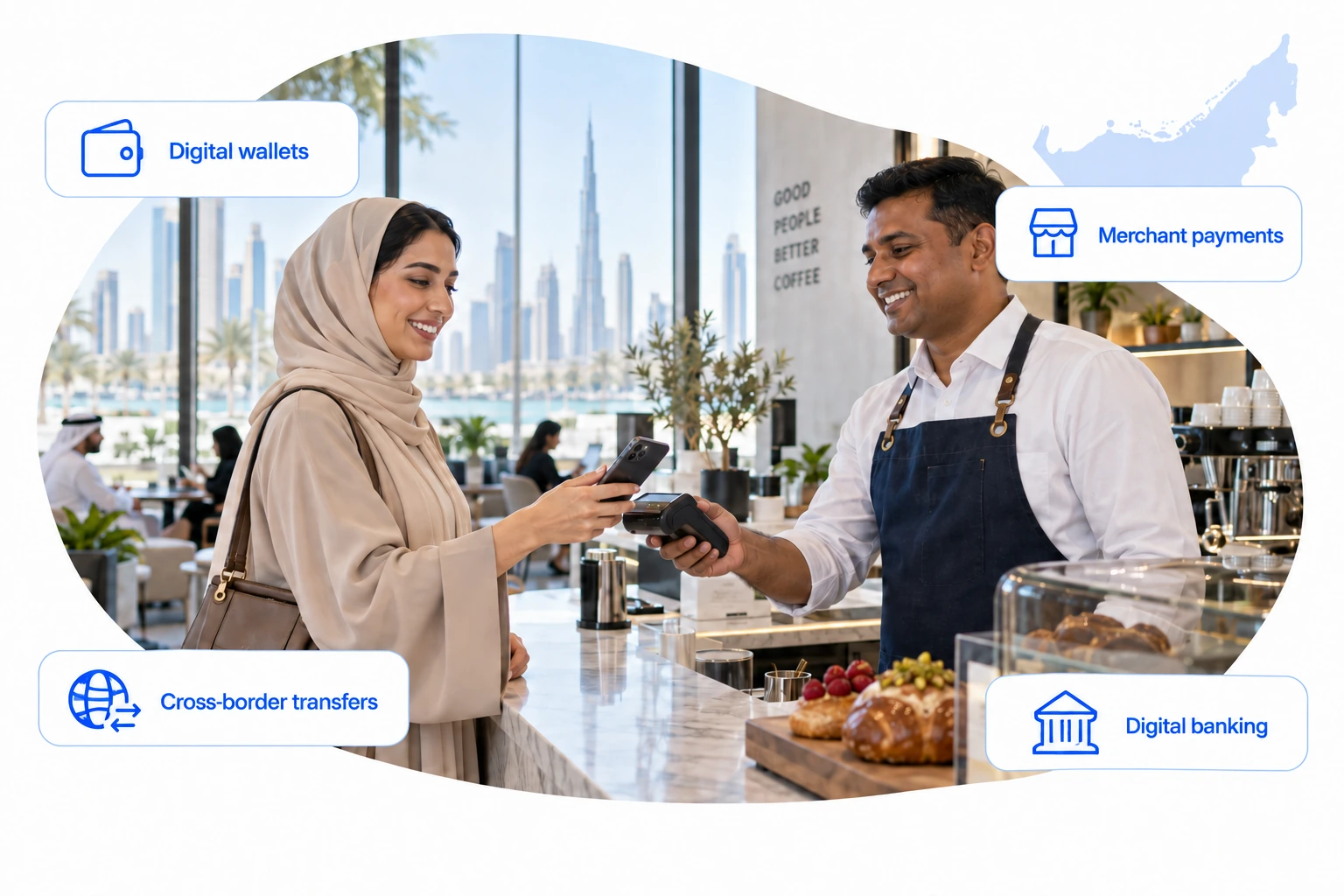
The UAE FinTech market in numbers
Financial centres, payment infrastructure and links between banks and technology businesses support the UAE’s FinTech sector. The figures below cover the Dubai International Financial Centre (DIFC) ecosystem and startup investment, with their geography and reporting period stated separately.
The scale of the financial and technology ecosystem
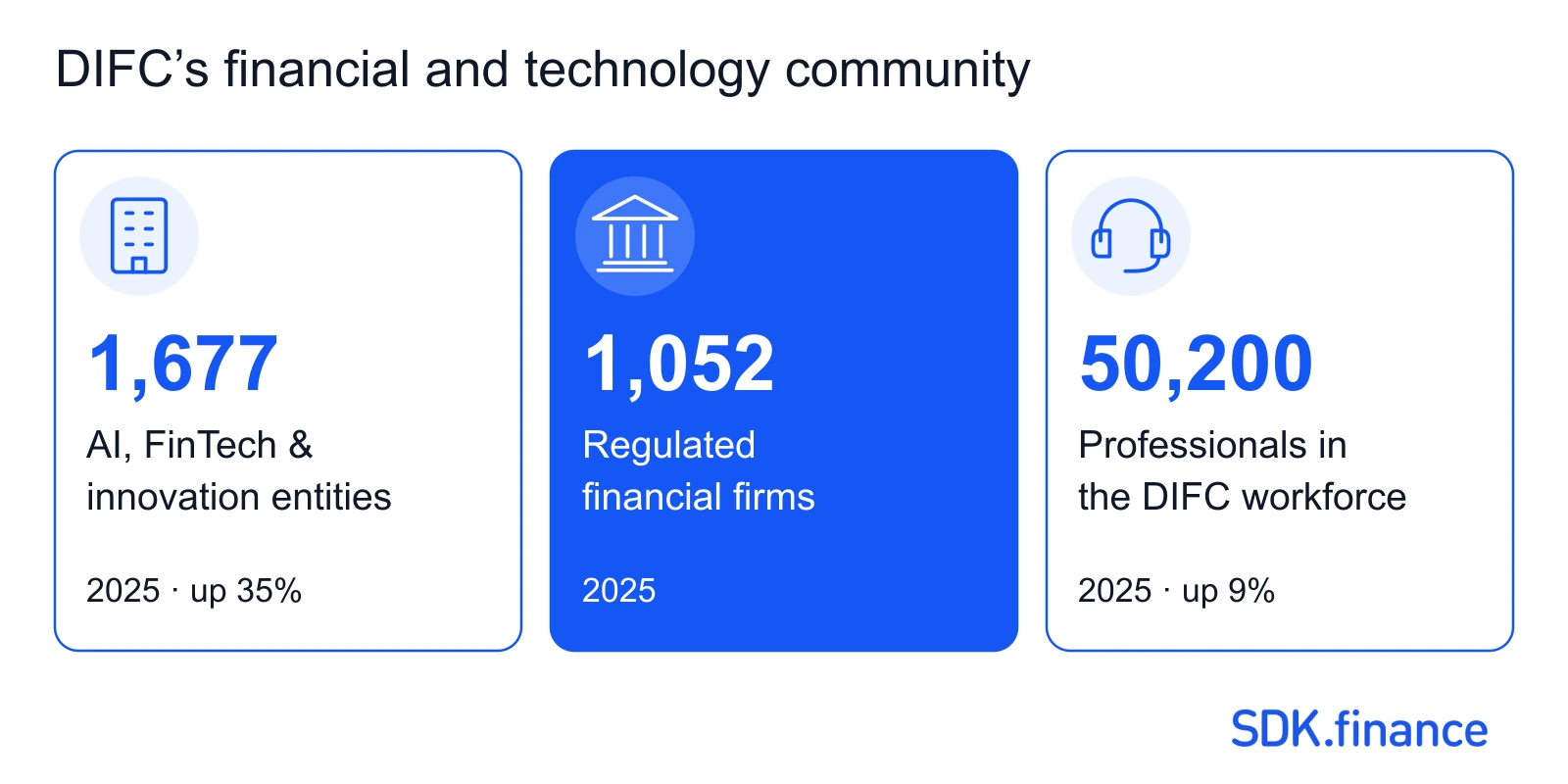
DIFC’s 2025 annual results provide a useful snapshot of Dubai’s financial centre:
- 1,677 AI, FinTech, and innovation entities, an increase of 35% year on year. This combined category includes more than FinTech alone.
- 1,052 regulated financial firms, showing the scale of the financial-services community alongside the technology ecosystem.
- 50,200 professionals across DIFC’s workforce, up 9% in 2025. This is a measure of the wider financial centre, not FinTech employment alone.
These DIFC categories can overlap and should not be added together. For founders, they indicate a concentration of potential clients, specialist talent and financial partners.
Investment in the UAE and the regional picture
The Emirates NBD/PwC 2025 report records US$265 million raised by UAE FinTech startups in 2024, around one-third of the country’s total startup funding. This national, full-year figure provides historical context for the newer regional data below.
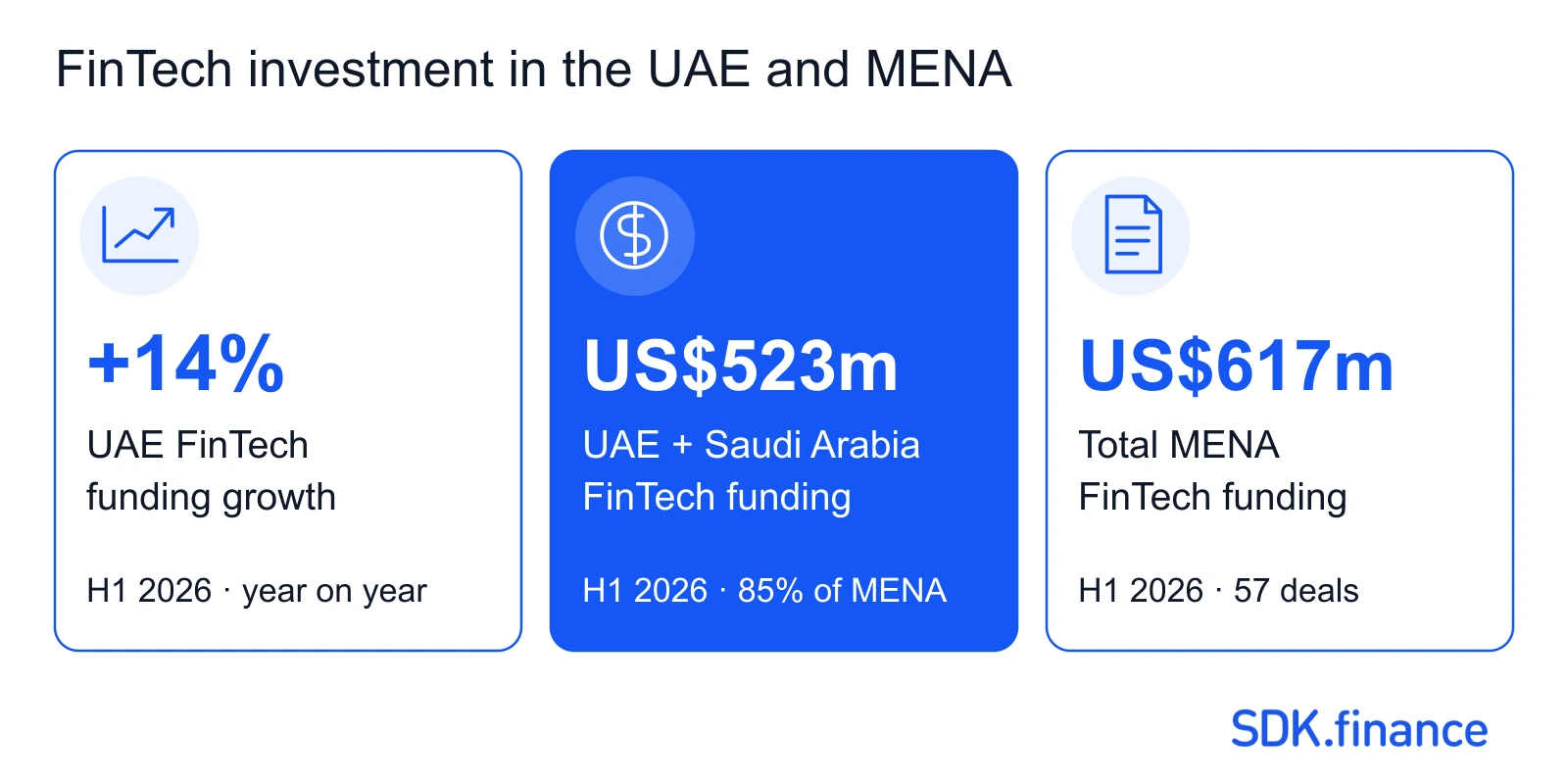
MAGNiTT’s H1 2026 review adds a separate view of venture investment:
- UAE FinTech funding grew 14% compared with H1 2025, even as total MENA FinTech funding fell 9%.
- The UAE and Saudi Arabia together attracted US$523 million, accounting for 85% of MENA FinTech funding during the half-year. This is a combined figure for the two countries.
- Across MENA, US$617 million was invested through 57 transactions. The number of transactions fell 50% year on year, indicating that capital was concentrated in fewer deals.
How consumers use digital payments
Visa’s Where Cash Hides research, published in January 2026, reports the following UAE findings:
- 80% of payments were made digitally.
- 21% of transactions used mobile payments.
These are survey findings, not a count of all UAE transactions. The study surveyed 1,200 people across the GCC in 2025; the percentages above refer to its UAE findings. Mobile payments are part of the digital total, so the figures should not be added together.
FinTech companies and providers in the UAE
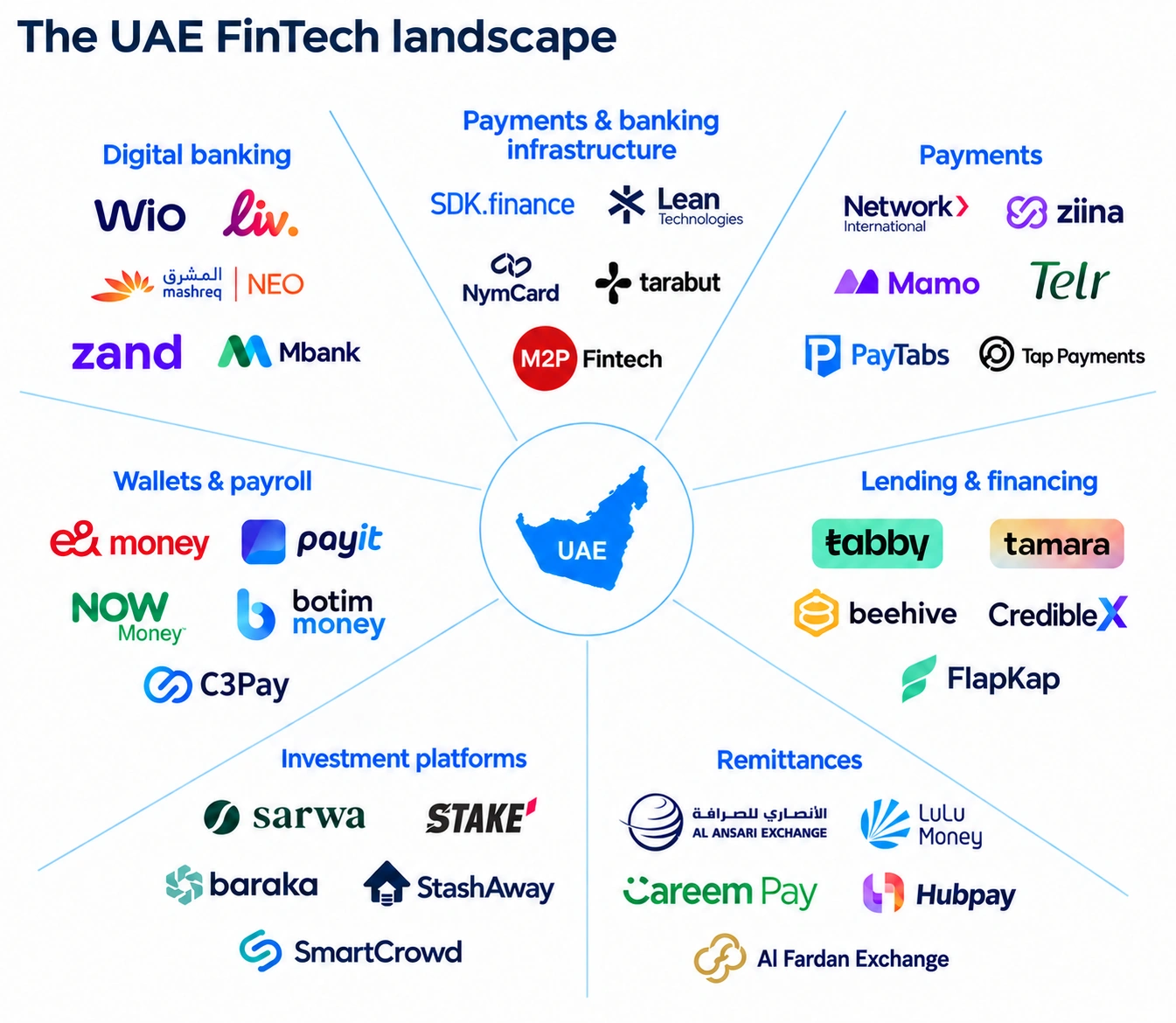
The UAE’s FinTech landscape spans several connected segments:
- Payments and wallets: collecting money, making transfers and managing everyday payment balances.
- Digital banking: accounts and tools for personal or business finances.
- Lending and buy now, pay later: credit and instalment products for eligible customers.
- Wealth and investment: digital access to investments and portfolio services.
- Financial infrastructure and software: the systems behind accounts, payments, cards and financial data.
The table shows representative providers by role, rather than a ranking. It includes businesses with a relevant UAE offering and software providers for teams building products in this market; not all are headquartered in the UAE.
| Provider | Entity or category | Role and example use |
|---|---|---|
| SDK.finance | FinTech software provider | Software for building wallets and payment products; a separate General Ledger for accounting records. |
| Wio | Digital bank | Business banking with payments, invoicing, expenses, and team access. |
| Network International | Payment acceptance and processing | Online and in-store payment acceptance for merchants; processing for financial institutions. |
| Ziina | Business and personal payments | Payment links, an online gateway, and contactless acceptance on supported mobile devices. |
| botim money | Payment services | Merchant collections through gateways, links, invoices, and QR-code payments. |
| Tabby | Consumer finance | Instalment payments for eligible shoppers under the provider’s terms. |
| Sarwa | Digital investment services | Digital access to trading and managed investing. |
| Stake | Property investment platform | Digital access to property investments, with asset-specific costs and exit conditions. |
| Lean Technologies | Financial infrastructure | Bank-account verification, financial data access and Pay by Bank connections for account funding and merchant checkout. |
| NymCard | Card and payment infrastructure | Card issuing and processing infrastructure for businesses launching card programmes and managing card transactions. |
Dubai, Abu Dhabi and the wider UAE ecosystem
Dubai and the DIFC ecosystem
Dubai brings together financial institutions, technology companies, investors and advisers, with DIFC forming a major part of this network. For founders, the practical value is access to potential customers, financial partners and specialist talent. Choose contacts around a specific business need, rather than assuming a Dubai address indicates which services a provider can support.
Abu Dhabi and ADGM
Abu Dhabi’s ecosystem centres on Abu Dhabi Global Market (ADGM) and a wider technology community, offering founders access to financial businesses, investors and potential partners.
The wider UAE also matters because customers and merchants are not confined to either financial centre. Compare locations against your business activity, customer base, hiring needs, and partner model. The regulatory roles of the financial centres are explained separately below.
Where startups can find partners and support
- DIFC Innovation Hub offers accelerator programmes, co-working options, and a community that includes technology businesses and investors. Review the current programmes to see whether their sector focus and stage of development match your product.
- Hub71, based in Abu Dhabi, provides startup programmes and access to a network of mentors, investors, and corporate partners. Its startup, investor, and partner directories can help founders identify relevant organisations before approaching them.
- ADGM Digital Lab provides a shared environment where financial institutions and technology firms can develop and test solutions. It is particularly relevant when an idea needs to be explored with other participants rather than demonstrated as a standalone app.
Use these resources to answer a specific question: who could test the product, provide a missing service, or help validate the business model? Check application criteria, commitments, and current availability directly. Programme participation does not guarantee investment or a commercial partnership.
The infrastructure shaping financial products in the UAE
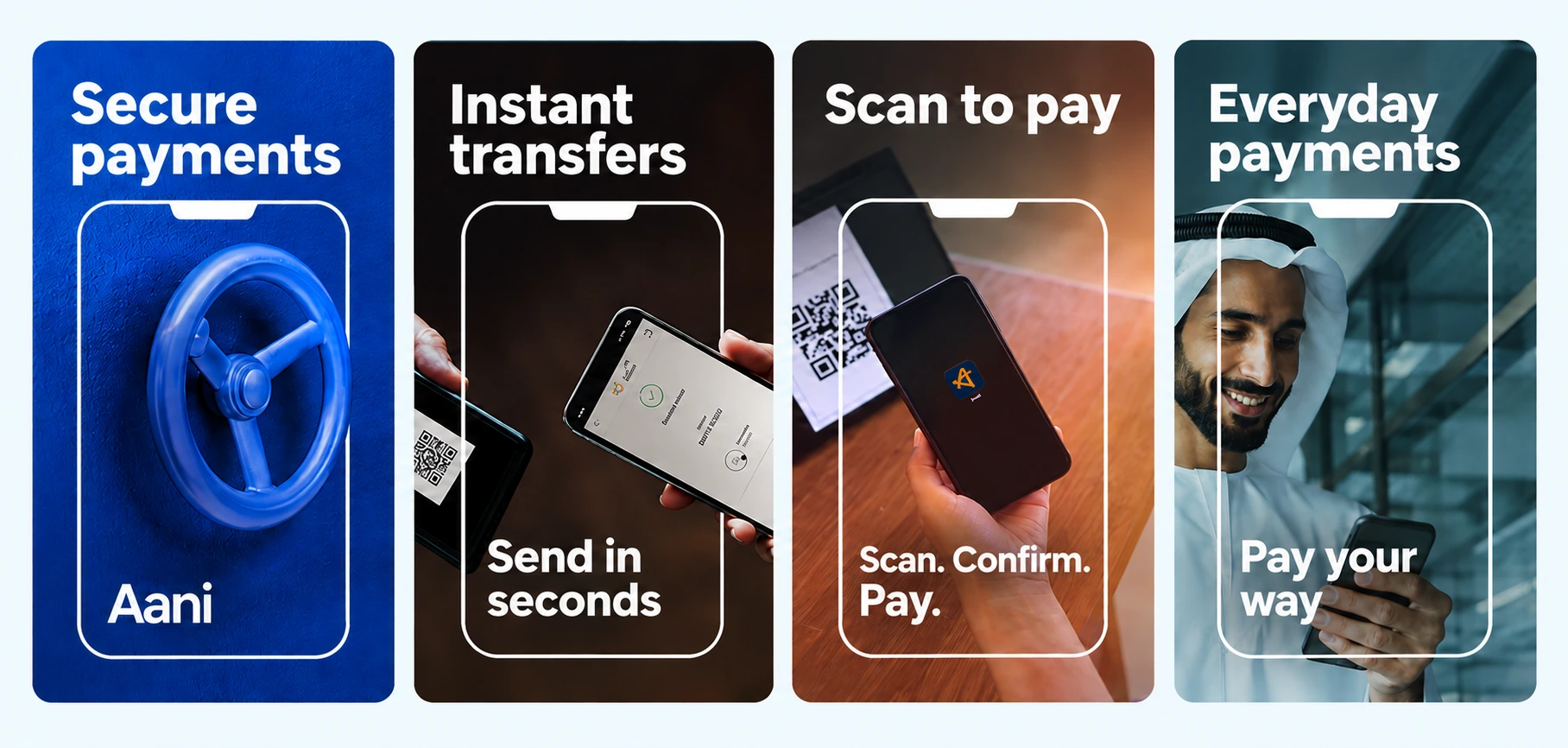
Aani and instant account-to-account payments
Aani instant payments allow customers of participating financial institutions and payment service providers to transfer money within the UAE. Supported journeys include payments using a mobile number, an email address, or a QR code. The service operates around the clock.
For a product team, this can change how a payment is requested and confirmed. A customer may not need to type a full bank account number. A merchant may use a QR-based journey. However, the exact service available to your product depends on the participating provider and its integration offer.
Show customers a clear status when confirmation is delayed, and give support staff a payment reference linked to the customer’s order or request.
Jaywan and domestic card payments
The UAE’s domestic card scheme, Jaywan, serves the card-payment part of the ecosystem. A card scheme provides the framework through which participating organisations issue and accept cards. It has a different role from an ewallet or a service for sharing account data.
For businesses considering card products or merchant acceptance, Jaywan belongs in discussions with issuers, processors, and acquiring partners. An acquirer is the financial provider that enables a merchant to accept card payments. Ask which cards and channels the proposed arrangement supports, how transactions are processed, and what the commercial terms cover.
Open Finance and consent-based financial data
The UAE’s Open Finance framework supports financial institutions opening their systems to accredited third parties, with customers’ consent. This creates a basis for products that use financial information to help people and businesses understand or manage their money.
Open Banking focuses on banking data and services; Open Finance extends this approach to a wider range of financial products. Access depends on customer consent, the relevant permissions and available connections.
Potential uses include a dashboard showing several accounts and a payment journey that lets an eligible customer pay from a bank account. Before building either, confirm:
- Which institutions, data, and services are available.
- How customers grant and withdraw consent.
- Which permissions and provider agreements your product needs.
These infrastructure layers solve different problems. Aani concerns instant payments, Jaywan concerns cards, and Open Finance concerns permitted access to financial data and services. A product may use more than one, through different partners.
Discover how the SDK.finance TPS can power high-speed, secure operations across banking, fintech, and retail
Talk to Our Team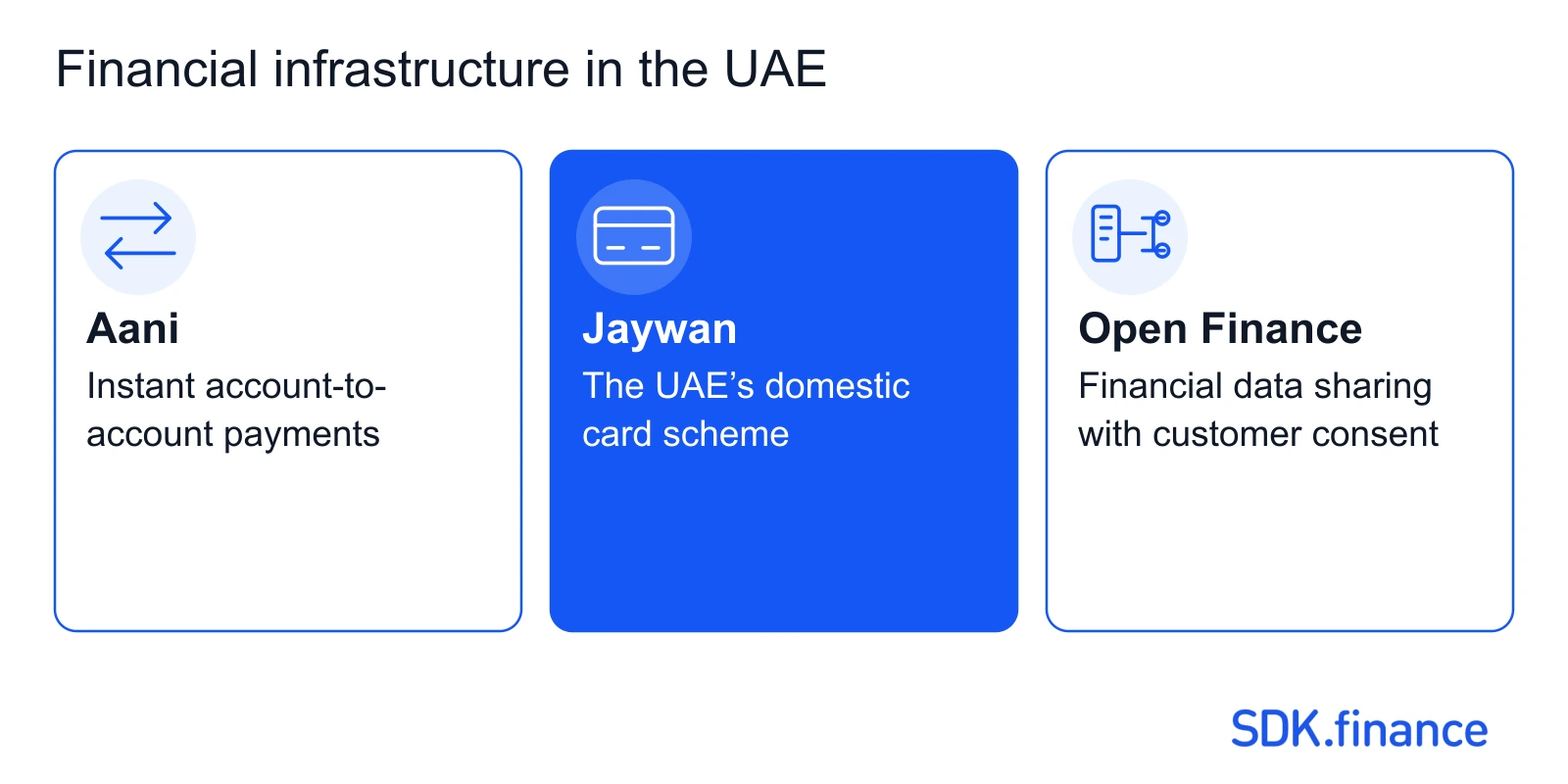
Understanding the UAE’s regulatory landscape
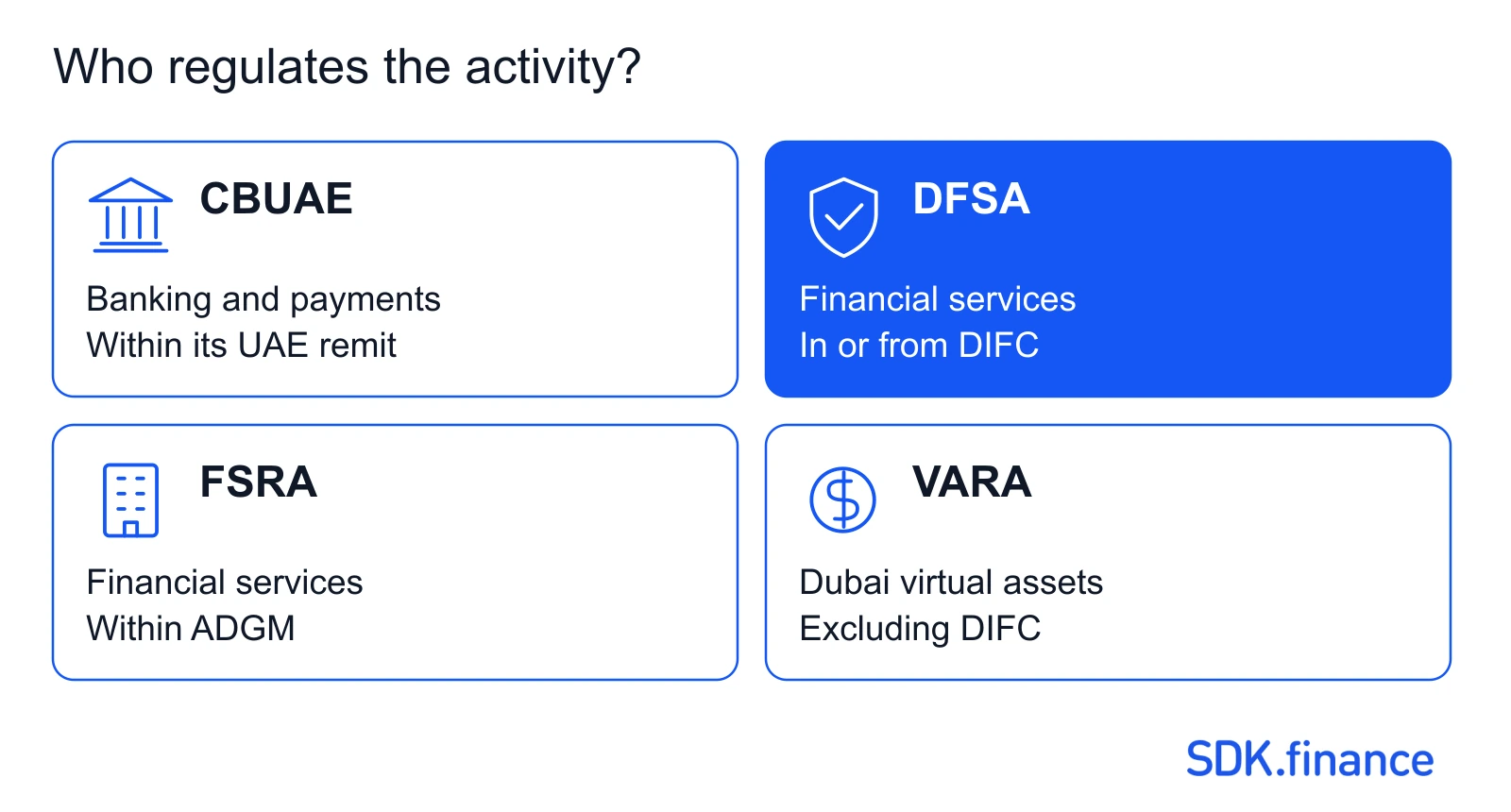
The regulatory route depends on what the business does, where it operates, and whom it serves. Start with the activity: holding funds, moving payments, providing investment services, and supplying software raise different questions. Describing all of them as “FinTech” does not establish which permission is needed.
| Authority | Activities / jurisdiction |
|---|---|
| Central Bank of the United Arab Emirates (CBUAE) | Relevant banking, payment, and Open Finance activities |
| Dubai Financial Services Authority (DFSA) | Financial services in or from DIFC |
| Financial Services Regulatory Authority (FSRA) | Financial services within ADGM |
| Virtual Assets Regulatory Authority (VARA) | Virtual assets in Dubai, excluding DIFC |
Use the table to identify where to investigate your proposed activity. The CBUAE retail payment services requirements, ADGM’s financial-services framework and VARA’s licensing guidance provide starting points for their respective areas. An authorisation under one framework should not be assumed to cover every UAE activity.
Registration, authorisation and testing are different steps
These steps answer different questions:
- Incorporation establishes the legal entity. Its commercial licence identifies the business activities it can undertake under that registration.
- Financial authorisation determines whether that entity may provide a specified regulated financial service under the applicable rules.
- Testing permission allows a defined trial under restrictions. For example, the DFSA’s Innovation Testing Licence supports testing in a controlled setting, not an unrestricted commercial rollout.
Before choosing a route, write down the money flow and identify who:
- Contracts with the customer and holds the funds.
- Executes payments and keeps the financial records.
- Handles complaints and resolves payment problems.
Take this description to the relevant regulator and qualified advisers to clarify the applicable requirements.
Customer needs and product opportunities in the UAE
Start with the task a customer needs to complete. Merchants want sales linked to receipts, SMEs need a clear cash position, and cross-border customers need predictable costs and arrival times. The examples below connect those needs to possible products and their dependencies; they are opportunities to validate, not forecasts of demand.
Local payment habits help explain these opportunities. In Visa’s 2025 remittance research, nearly two-thirds of UAE respondents preferred digital apps for sending money abroad, while 32% cited high sending fees as a pain point. The study surveyed remittance senders and receivers, rather than the whole population. These findings suggest a practical area to test: transfers that clearly show the fee, currency conversion and amount the recipient will receive.
| Customer need | Possible product | Key dependencies |
|---|---|---|
| A clearer cash position | An SME dashboard using customer-approved account data to show collections, expenses and expected payouts. | Available bank connections, customer consent, current account data, and a clear distinction between available and pending funds. |
| Less manual payment matching | A merchant view connecting online and in-store sales to receipts. | Order references, provider reports, refund records, and settlement information showing when funds arrive. |
| Predictable international transfers | A transfer service for one defined route, with a clear price and status. | Receiving partners, currency conversion, required checks, and handling of failed transfers. |
| Payouts within an existing service | A marketplace portal where sellers can request and track payouts. This is an example of embedded finance. | An agreed partner model, seller checks, and responsibility for holding funds and supporting sellers. |
Illustrative example: a UAE marketplace seller
A seller checks which customer payments have arrived, which funds are awaiting payout and what fees apply to each order. The marketplace’s finance team matches the provider’s payout report to those orders and investigates differences. A useful first product could bring these views together, with the payment partner handling external money movement. This is a product scenario to validate, not a reported customer case.
Design for the customer group you intend to serve
Validate local requirements with the people who will use the product:
- Language and support: test onboarding and help journeys in the languages your customers use, including Arabic and English where relevant.
- Eligibility and documents: explain who can apply and what information they need before they start.
- Price transparency: show payment fees, currency-conversion costs and expected arrival times before confirmation.
- Business roles: distinguish the permissions of an owner, an employee making payments and a finance team reviewing records.
Planning a FinTech launch in the UAE
Check the full operating process before choosing a provider
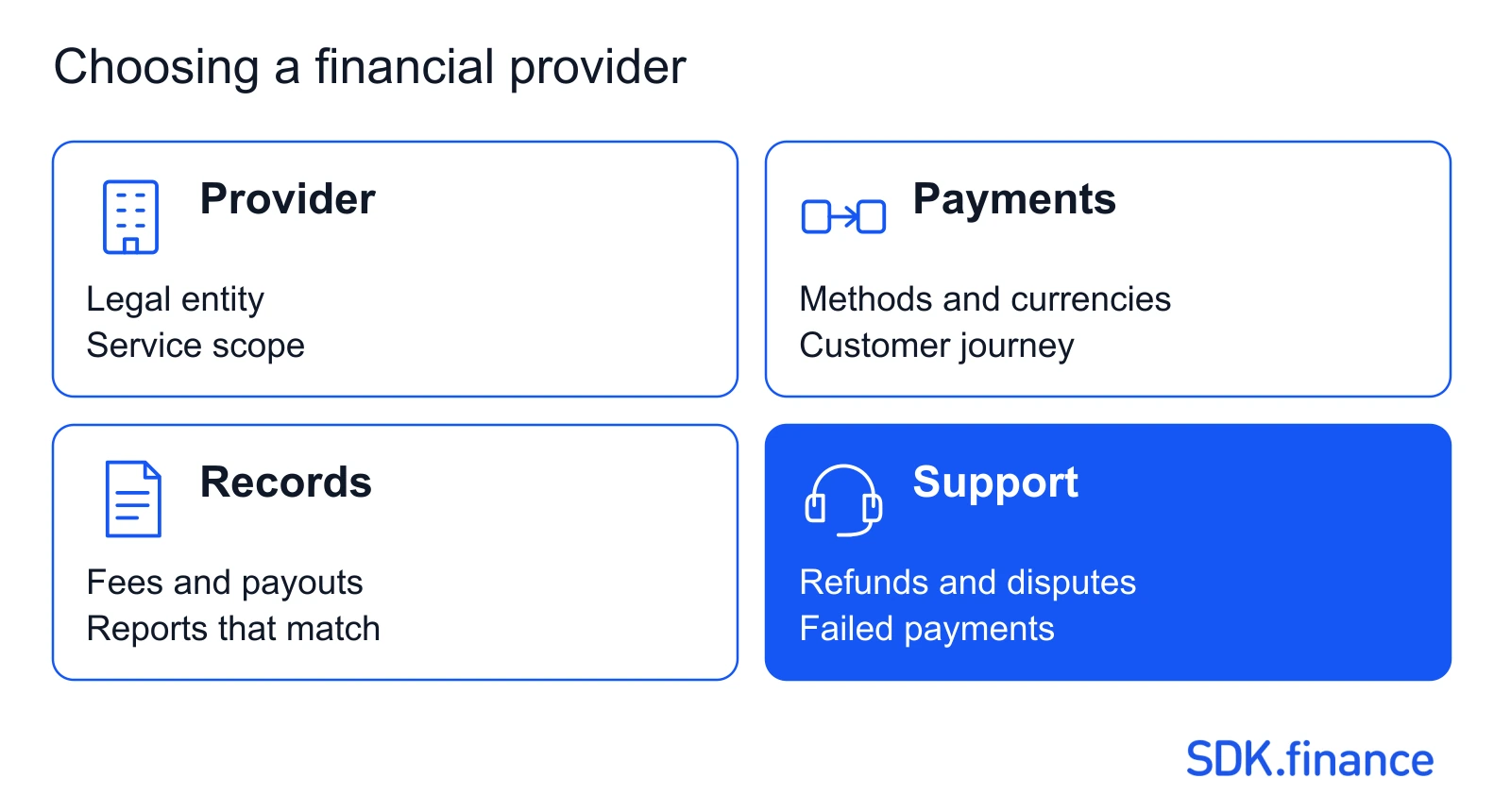
When comparing payment service providers in the UAE, request the following evidence and record any unresolved questions before choosing a partner:
- Service scope: Obtain written confirmation of the contracting entity, eligible customers, supported payment methods, currencies, and routes for your UAE product. Request integration documentation and access to a testing environment, and distinguish services available now from planned capabilities.
- Money and timing: Request the fee schedule and settlement timetable, including cut-off times and any conditions that delay access to funds. Model a payment, refund, and payout using those terms, then add the costs of customer checks, support, manual reviews, and integration maintenance.
- Reports: Obtain sample payment and settlement reports. Check that transaction references let your team link each payment to its fees, refunds, and final payout, and confirm how amounts, currencies, statuses, and reporting periods are recorded.
- Exceptions and support: Document who investigates delayed confirmations, failed payments, refunds, disputes, and outages. Agree response times, escalation contacts, the evidence required for an investigation, and responsibility for integration changes.
Reconciliation means comparing your records with a bank or provider’s records to find differences. Test the sample reports against a realistic transaction so staff can follow the numbers without guessing.
Practical example: checking a provider report
The scenarios below are illustrative. The amounts are hypothetical and do not represent provider pricing or an acceptable discrepancy threshold.
| Internal record | Provider report | What to check |
|---|---|---|
| Payment marked successful. | No matching payment in the report. | Check the transaction reference, reporting period, time zone, and report cut-off before treating the payment as missing. |
| Expected payout of AED 100. | Net payout of AED 97. | Check whether an agreed AED 3 fee explains the difference. If it does, record the fee separately; otherwise, investigate the mismatch. |
| Refund request recorded. | No completed refund in the report. | Check whether the provider accepted and completed the refund, then compare its reference and processing date with the report period. |
Keep each unresolved difference assigned to an owner, with the supporting records and next action. Correct confirmed errors through a traceable adjustment rather than overwriting the original transaction history.
From a product idea to a tested launch
- Define the first customer journey. Choose one customer group and a task they need to complete. Draw the movement of money and information from start to finish, including the point at which the customer considers the task complete.
- Clarify the legal roles. Use that description to establish which activities your business will perform and which belong to financial partners. Resolve the applicable permissions before committing to a service model.
- Agree the partner scope and costs. Confirm the services, customer eligibility, commercial terms, and support responsibilities. Estimate the cost of the complete journey, including failed transactions and manual work, rather than comparing transaction fees alone.
- Build the necessary connections. Decide what your team will build, buy, or integrate. Connect customer actions to transaction records and staff tools so the product can explain what happened to each payment.
- Test a limited release. Include successful payments, failures, repeated requests, refunds, and delays. Check that customers can finish the task and staff can resolve exceptions. Expand only when the first journeys work reliably and the required permissions are in place.
Software development companies and systems integrators have a distinct role here. They translate the operating model into interfaces, connections, and tested workflows. For a closer look at implementation choices, see software development for FinTech businesses in the UAE.
Build your UAE financial product with SDK.finance
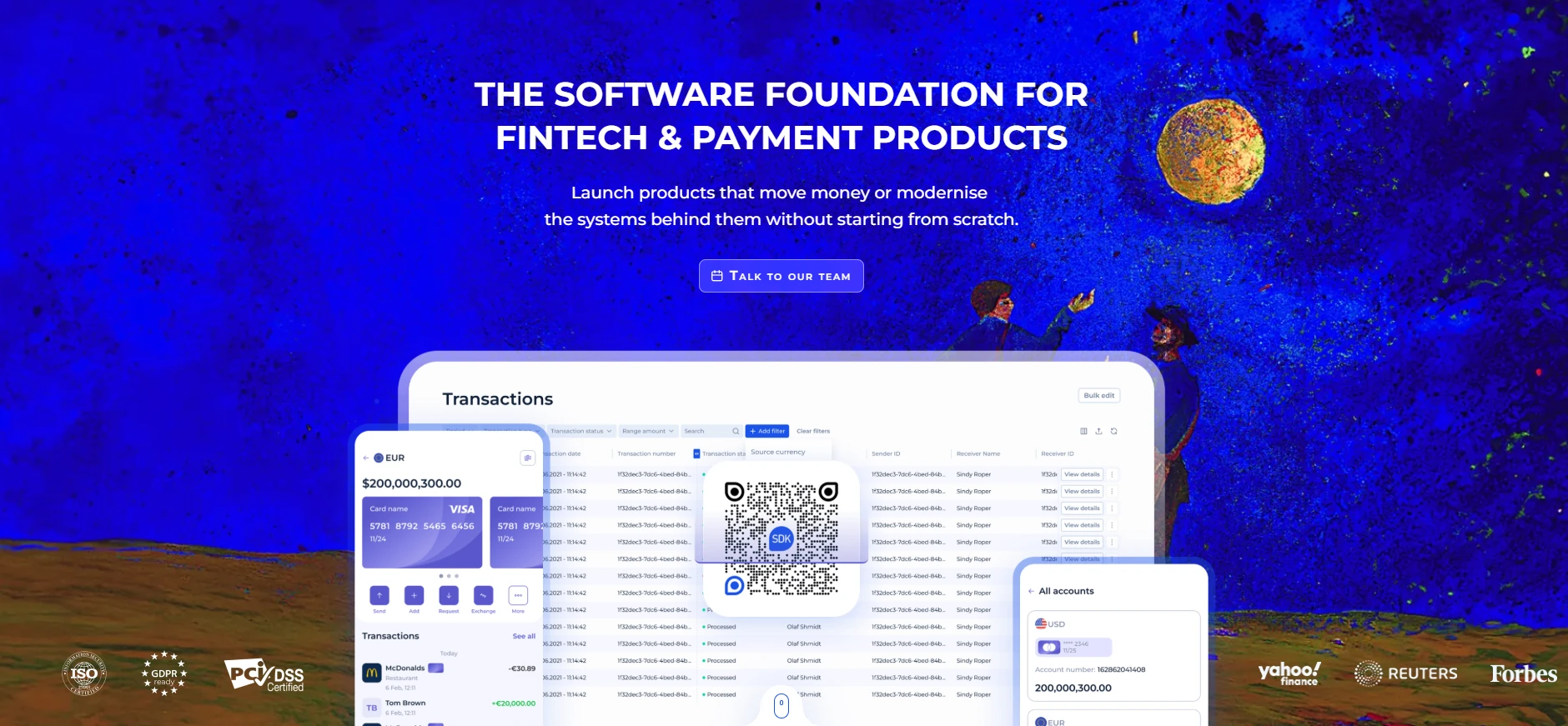
A merchant wallet, a business payment service or a consumer finance app needs reliable software behind the customer experience. The SDK.finance Transaction Platform gives UAE teams a starting point for managing accounts, transactions and daily operations, with rules they can configure around their business model.
Key capabilities include:
- Customer and business wallets. Use the SDK.finance digital wallet solution to build products with balances, transaction history and transfers between users. For a UAE marketplace, this could give sellers a clear record of funds received and payouts requested.
- Payment workflows and status tracking. Manage top-ups, withdrawals and merchant payments, with external money movement handled through connected financial providers. Operations staff can review transaction statuses and investigate payments that need attention.
- Flexible fees and limits. Configure charges and transaction limits for different customer groups or services. This allows a team to apply different rules to an individual wallet and a higher-volume business account.
- Reconciliation and accounting records. Compare internal transactions with provider reports to identify differences. The separate SDK.finance General Ledger adds double-entry accounting through real-time ledger software, turning financial events into balanced entries using configured rules.
- Connections to financial partners. Use APIs to connect the banks and payment providers chosen for your UAE product. Each route needs confirmed provider access, an agreed integration scope and testing before launch.
- Backoffice roles and permissions. Give support, finance and operations staff access appropriate to their responsibilities, with user-action history to help trace changes and investigate issues.
The delivery model determines how much of the technology your team will run and change:
- SaaS provides subscription access to the Platform without direct access to its backend code. SDK.finance manages application hosting and scheduled software updates, while your team manages the databases and integrations. It suits a UAE launch that fits the available features, configuration options and API-based extensions. Custom development and new integrations are not included in the subscription.
- A Source Code Licence gives your team the software foundation to build its own FinTech product. Start with a ready-made core for accounts, wallets and payment workflows, then develop the features, integrations and customer experience your UAE business needs. Your developers or implementation partner can adapt the code and deploy the product on your chosen infrastructure, taking responsibility for testing, security and ongoing maintenance.
For either model, financial licences, partner approvals and access to UAE payment infrastructure remain separate from the software.
Geidea: connecting merchant payments to settlement
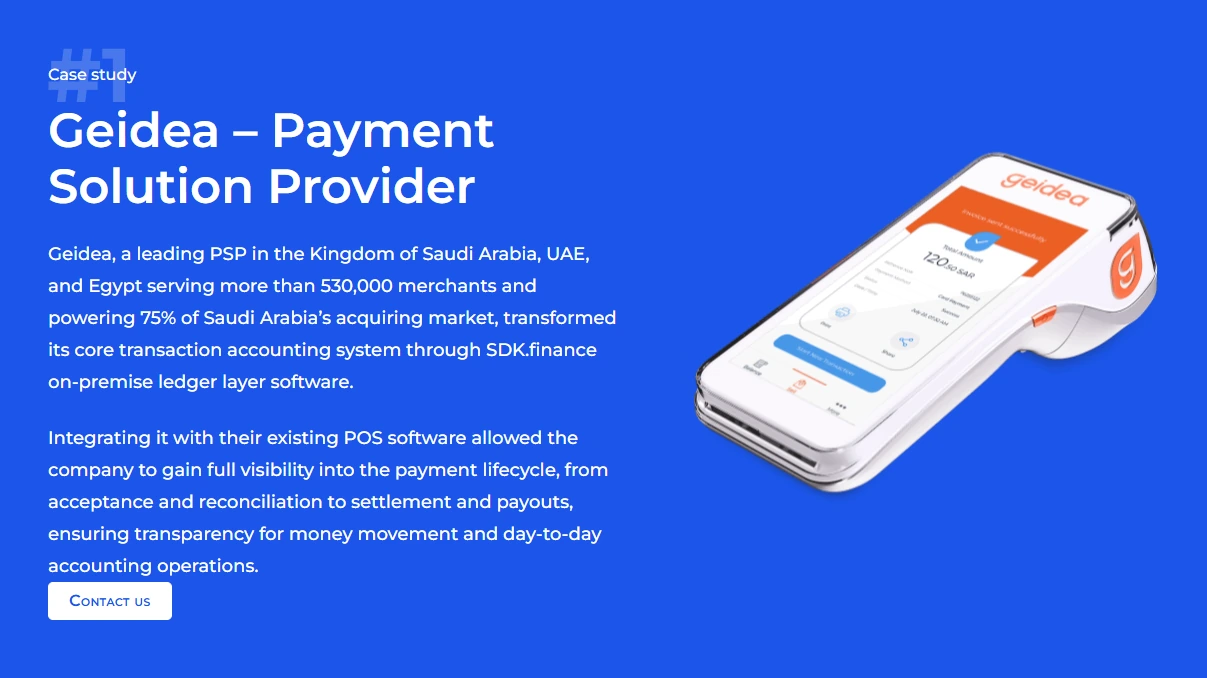
Geidea, a payment provider serving Saudi Arabia, the UAE and Egypt, used SDK.finance to replace its legacy transaction accounting system. Its team needed clearer merchant balances, less manual reconciliation and the ability to work with additional acquiring banks.
Using SDK.finance software under a source code licence as the foundation, the project team built a customised accounting layer connected to Geidea’s existing point-of-sale (POS) systems. The implementation included:
- Linking each POS payment to the relevant merchant account and tracking it through settlement and payout.
- Automating reconciliation and giving merchants access to balances, transaction history and payout reports.
- Configuring fees without redeploying the software, alongside integrations with additional banks and Mastercard Payment Gateway Services.
For teams building payment products in the UAE, the case illustrates how transaction records, merchant visibility and financial-provider connections can work together. These capabilities were delivered through a tailored implementation. Read the Geidea case study.
Turning UAE FinTech opportunities into a focused product
The strongest UAE FinTech opportunities start with a specific customer problem. Choose a focused first product, confirm the financial partners and infrastructure it needs, and test the full payment journey before expanding. This gives founders a practical basis for deciding what to build and where to invest next.
Discover how the SDK.finance TPS can power high-speed, secure operations across banking, fintech, and retail
Talk to Our Team