A digital payment transfers value electronically instead of in physical cash. Card payments, bank transfers, mobile wallets, peer-to-peer transfers and QR-initiated payments are all digital payments. What differs is the method the payer chooses, the technology that initiates and secures the payment, and the system or rail that carries the message and moves the money.
This guide covers the types of digital payments with examples, how a payment moves from initiation to settlement, the technologies behind it, the trends worth watching, and what a business needs to offer them.
What are digital payments?
Digital payments refer to electronic financial transactions conducted over the Internet or other electronic devices, allowing individuals and businesses to send and receive money without the need for physical currency.
These transactions are facilitated through various online platforms, mobile apps, and electronic payment systems.
Three things are often used interchangeably and are worth separating:
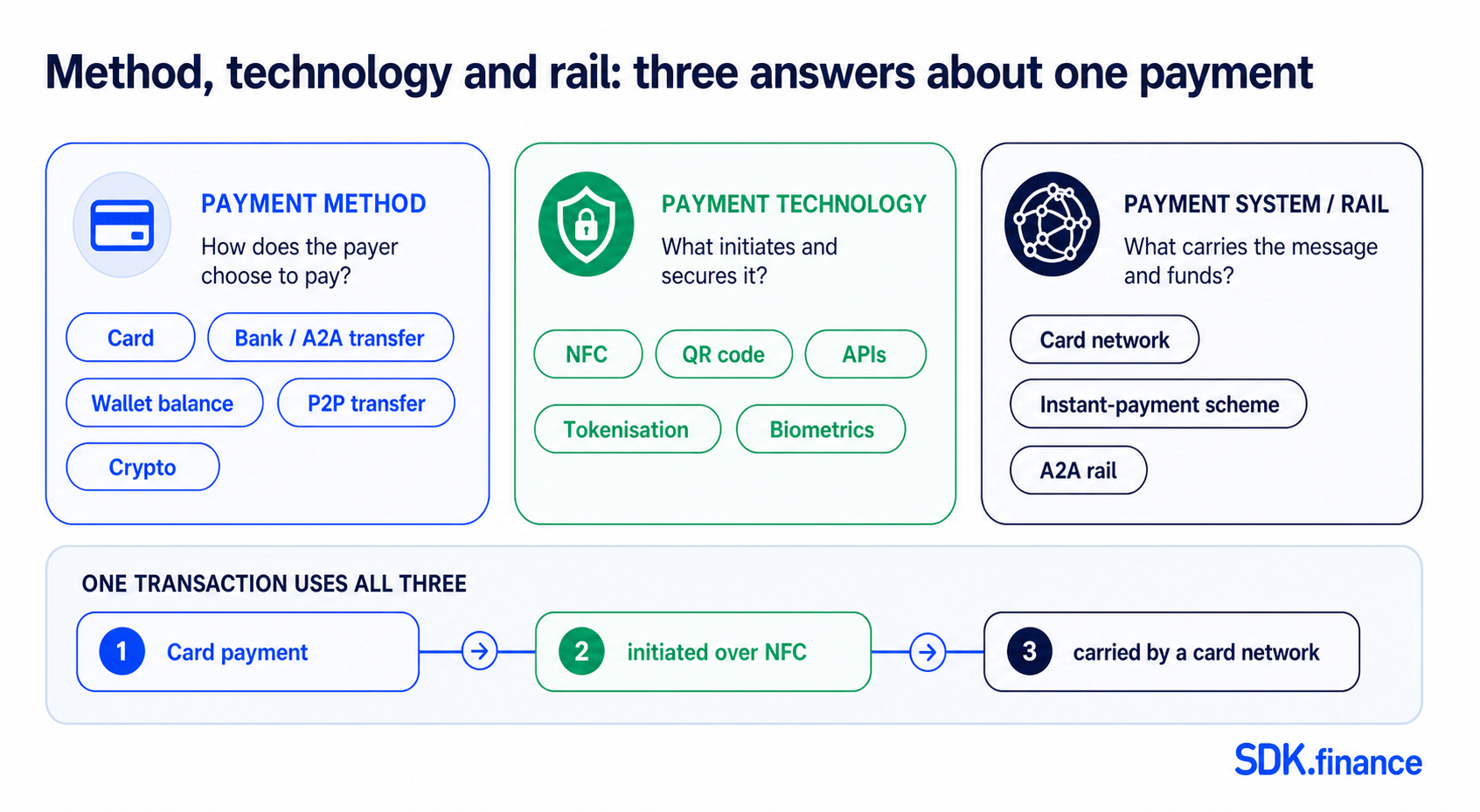
- A payment method is how the payer chooses to pay – a debit card, a bank transfer, a wallet balance.
- A payment technology is what initiates or secures the payment – NFC, a QR code, an API call, tokenisation, biometric authentication.
- A payment system or rail is what carries the message and the funds – a card network, a domestic instant-payment scheme, an account-to-account rail.
One transaction uses all three: tapping a phone at a terminal is a card payment (method) initiated over NFC (technology) and carried by a card network (rail). Cost, speed and risk follow the method and the rail, not the technology.
SDK.finance payment Platform is designed to support multiple digital payment options through its comprehensive set of features and functionalities. The Platform utilizes an API-driven architecture that streamlines integrating with multiple payment providers, making it easier for businesses to offer a wide range of payment options to their customers.
Ready backend, APIs, and integrations
Talk to Our TeamTypes of digital payments
The most common types of digital payments are card payments, bank and account-to-account transfers, mobile and digital wallets, peer-to-peer transfers, and cryptocurrency payments. QR codes and contactless taps are ways of initiating these payments, not separate funding sources.
| Type | How it works | Example |
|---|---|---|
| Credit and debit cards | Card details, or a token standing in for them, reach the issuer through a card network for authorisation. | Paying online at checkout; tapping at a terminal. |
| Bank and account-to-account (A2A) transfers | Funds move directly between bank accounts over a transfer scheme, with no card network involved. | Online banking transfers; open banking payments. |
| Mobile and digital wallets | A stored balance, or stored card and account credentials, pays from an app or device. | Paying from a wallet balance; a card tokenised into a phone wallet. |
| Peer-to-peer (P2P) transfers | One person pays another by phone number, handle or account reference, funded from a wallet, card or bank account. | Splitting a bill in an app; sending a remittance. |
| Cryptocurrency payments | Value moves on a blockchain network, usually with a provider converting to or from fiat currency. | Paying a merchant through a crypto payment provider. |
Contactless cards, QR code payments and in-app checkouts sit across this table rather than beside it: each initiates one of the methods above. A digital wallet shows why that matters – it can hold a stored balance, tokenised cards and loyalty credentials at once, so one app may fund a payment in several ways.
How do digital payments work?
A digital payment is a sequence of messages between a payer, a merchant and the institutions holding the money: the request is initiated, authorised by the account-holding institution, captured, then cleared and settled. Confirmation to the customer usually arrives before settlement is complete.
Key participants in digital payment systems
- The consumer (the payer) – holds the account or instrument the money comes from.
- The merchant – requests the payment and receives the funds.
- The issuer bank (the consumer’s bank that issues their credit or debit card) – the party that authorises or declines the payment, based on the account, the instrument’s status and its own risk controls.
- The acquirer bank (the merchant’s bank that receives the funds from digital transactions), usually working with a payment processor that routes the request to the right network.
- The payment gateway – securely captures and transmits payment data from the checkout to the processor. It does not verify the customer’s balance or credit limit; the issuer does.
- The card network or payment rail – carries the authorisation, clearing and settlement messages between the two institutions.
The process of making a card payment
When making a digital payment, the process typically involves the following steps. A card payment is the clearest example; bank-transfer and wallet flows differ, as the note below explains.
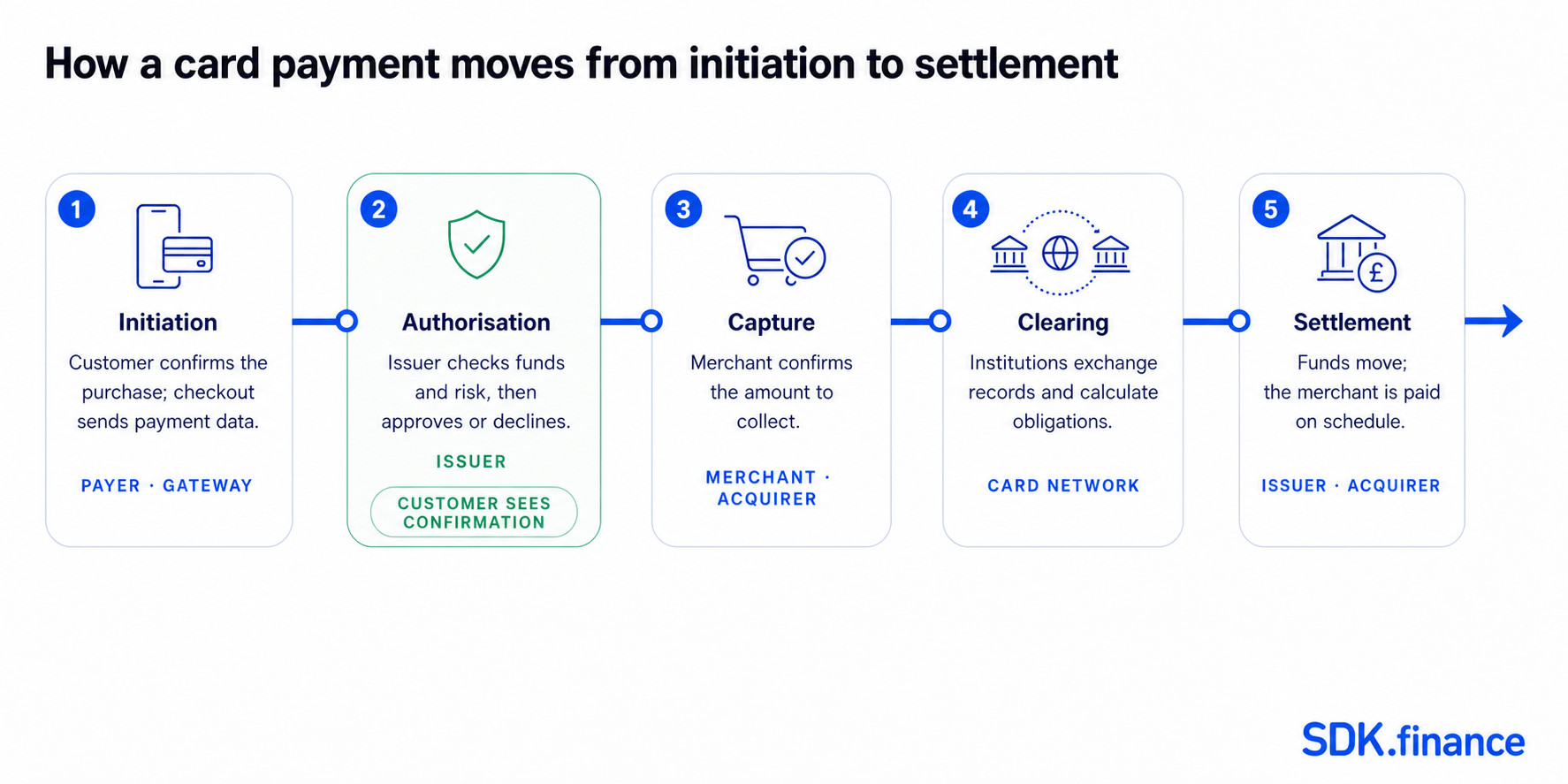
- Initiation: the payment process begins when a customer initiates a transaction and selects a digital payment method, such as a card or a mobile wallet.
- Authorisation: once the transaction is initiated, the payment information is securely transmitted to the payment processor or acquiring bank, and on to the issuer through the card network. The issuer checks the account, the instrument and its risk rules, then approves or declines and, on approval, holds the amount.
- Capture. The merchant confirms the amount to collect – immediately at a retail checkout, or later where the final amount is not known at authorisation, as with a hotel booking.
- Clearing. The institutions exchange transaction records through the network and calculate what they owe each other.
- Settlement. Funds move between the issuer and the acquirer, and the acquirer credits the merchant on its payout schedule.
Customer and merchant see confirmation at authorisation, before settlement completes – which is why merchants reconcile their records against provider settlement reports rather than treating an approval as money received. That reconciliation sits at the centre of any payment processing system architecture.
Digital payment technologies: what makes them work
The technologies behind digital payments do three jobs: they initiate the payment, they protect the data in transit and at rest, and they assess risk before the payment is approved.
NFC (Near Field Communication)
NFC enables secure communication between devices in close proximity, that facilitates contactless transactions, allowing devices to communicate seamlessly. For example, using NFC, a customer can effortlessly pay for their coffee by simply tapping their smartphone against the cafe’s point-of-sale terminal, securely transmitting payment information and completing the transaction without the need for any physical credit cards or cash.
APIs
APIs connect the parts of a payment: a checkout to a gateway, a platform to an acquirer, an app to a bank under open banking rules. They also carry status back – approval, decline, refund, settlement report – which is what makes real-time status and automated reconciliation possible.
For a device-initiated use case, see how machine-to-machine payments connect a service event to an authorised payment.
Encryption and tokenisation
Encryption protects payment data in transit and at rest. Tokenisation replaces a card number with a substitute value that is useless outside its intended context – which is what lets a card sit in a phone wallet, or be saved for repeat purchases, without the merchant storing the real number.
Authentication
Fingerprint and facial recognition, device checks and one-time codes confirm the person initiating the payment is entitled to use the instrument. In the EU and the UK this is not a product choice: strong customer authentication has been required since September 2019 when a customer initiates an electronic payment or accesses an account online, unless an exemption applies.
Machine learning and artificial intelligence
Machine Learning algorithms allow companies to monitor transaction patterns and potential fraudulent activities, while AI-driven systems enhance user experience by understanding spending behaviors. These tools support fraud detection; they do not eliminate fraud, and their output depends on the data and thresholds behind them. They belong inside a wider payment fraud prevention programme.
When AI moves from analysing a transaction to choosing and initiating a payment, the control requirements change. Explore agentic payments and their risks.
Trends shaping digital payments
Four developments are changing how digital payments are built and priced: instant payments, account-to-account payments enabled by open banking, embedded finance, and central bank digital currencies.
Real-time payments
Real-time payments allow for immediate fund transfers 24/7, thereby redefining traditional banking norms. Scheme rules make that concrete: under the European instant-payment scheme, funds must be made available in the payee’s account within ten seconds, 24 hours a day, 365 days a year. This presents an opportunity for businesses to optimize cash flow management, simplify administrative processes, and create a more seamless customer experience.
A2A (account-to-account) payments
Account-to-account payments move funds directly between bank accounts, and open banking APIs have made them practical to initiate at a merchant checkout. With no card network involved, the cost structure differs from card acceptance and confirmation can be near-instant on an instant-payment scheme. They remove some card-specific risks, such as stolen card numbers and chargebacks, but are not fraud-proof: authorised push payment fraud and account takeover remain live concerns.
Embedded finance
Embedded finance refers to the integration of financial services into non-financial platforms and experiences, such as e-commerce websites, ride-sharing and mobile payment apps, and social media platforms. This trend enables contextually relevant payments within existing digital ecosystems, blurring the lines between banking and other industries.
Central Bank Digital Currencies (CBDCs)
Central Bank Digital Currencies (CBDCs) have emerged as a significant trend in the realm of digital payments. A CBDC is a digital form of a country’s national currency, issued and regulated by the central bank. Unlike cryptocurrencies such as Bitcoin, CBDCs are centralized and are considered legal tender. Central banks set out their own aims for them: the ECB frames a digital euro as an electronic means of payment accepted across the euro area and less dependent on international card schemes.
Cross-border transactions
Cross-border transactions involve financial transactions between two or more countries, presenting unique challenges and complexities. Specialized payment solutions are required to facilitate smooth and secure cross-border payments. Some of the key challenges include:
- Currency exchange: fluctuating exchange rates can make it challenging to determine the exact amount to exchange, impacting the overall cost of transactions.
- Regulatory compliance: cross-border transactions are subject to various regulations and laws, so businesses must navigate different legal frameworks and adhere to international standards.
- Security: cross-border transactions are vulnerable to threats such as hacking and identity theft, and cross more systems and parties than a domestic payment.
What businesses need to offer digital payments
Offering digital payments takes five layers: a customer interface, a transaction platform that applies the business rules, a ledger that records every movement, integrations to external providers, and a regulated partner or payment rail that actually holds and moves the funds.
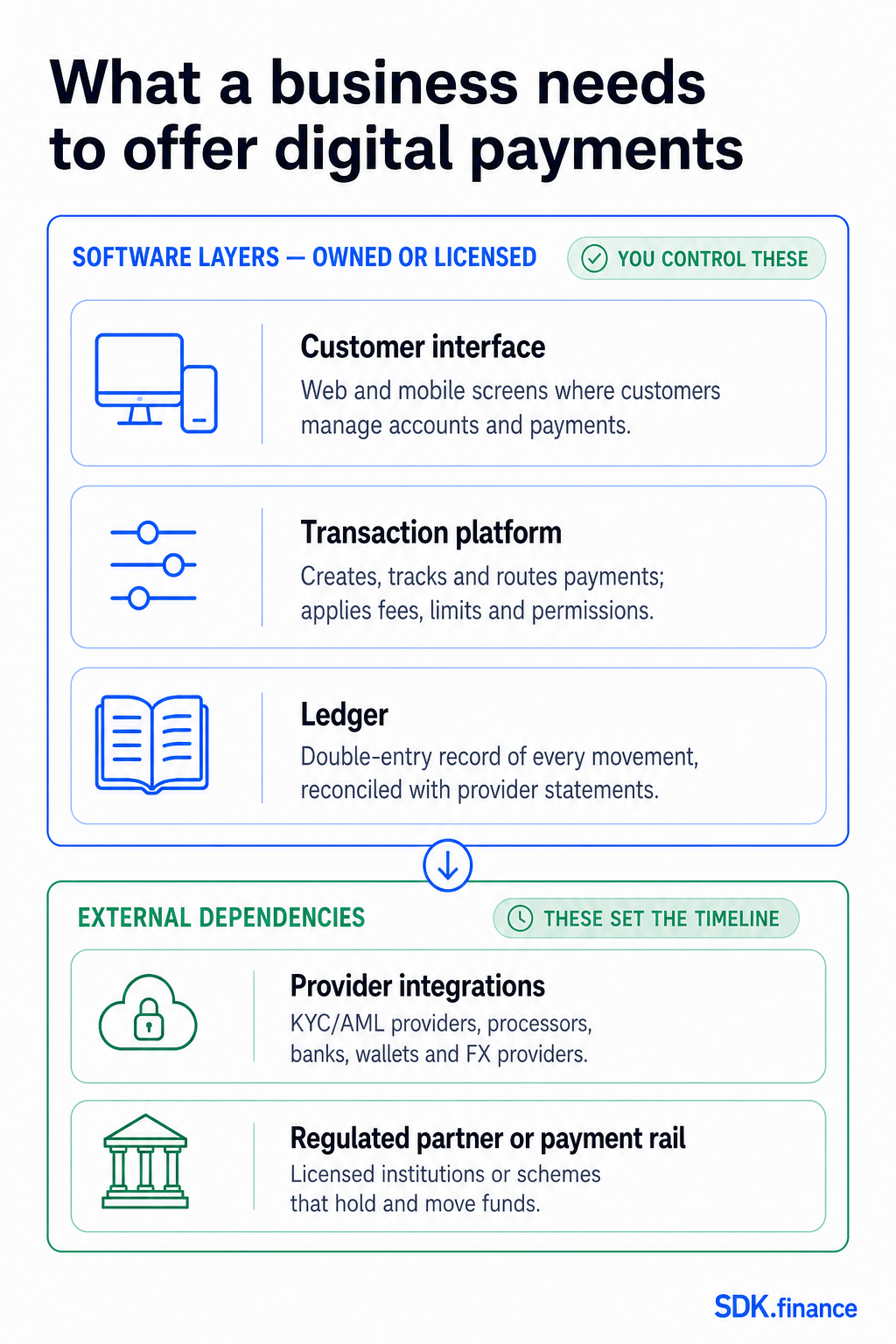
- Customer interface. Where a customer holds an account, initiates a payment and sees its status.
- Transaction platform. Creates and tracks the payment, applies fees and limits, and routes the request to the right provider.
- Ledger. A double-entry record of every movement, reconciled against provider statements.
- Provider integrations. Connections to KYC and AML providers, card issuers or processors, banks, wallet and FX providers.
- Regulated partner or payment rail. The licensed bank, EMI, payment institution or scheme that holds and moves the funds.
The first three are software a business can own or license; the last two are third-party dependencies that usually set the launch timeline. SDK.finance’s guide to how to start a payment processing company works through that sequence.
How SDK.finance fits into digital payments
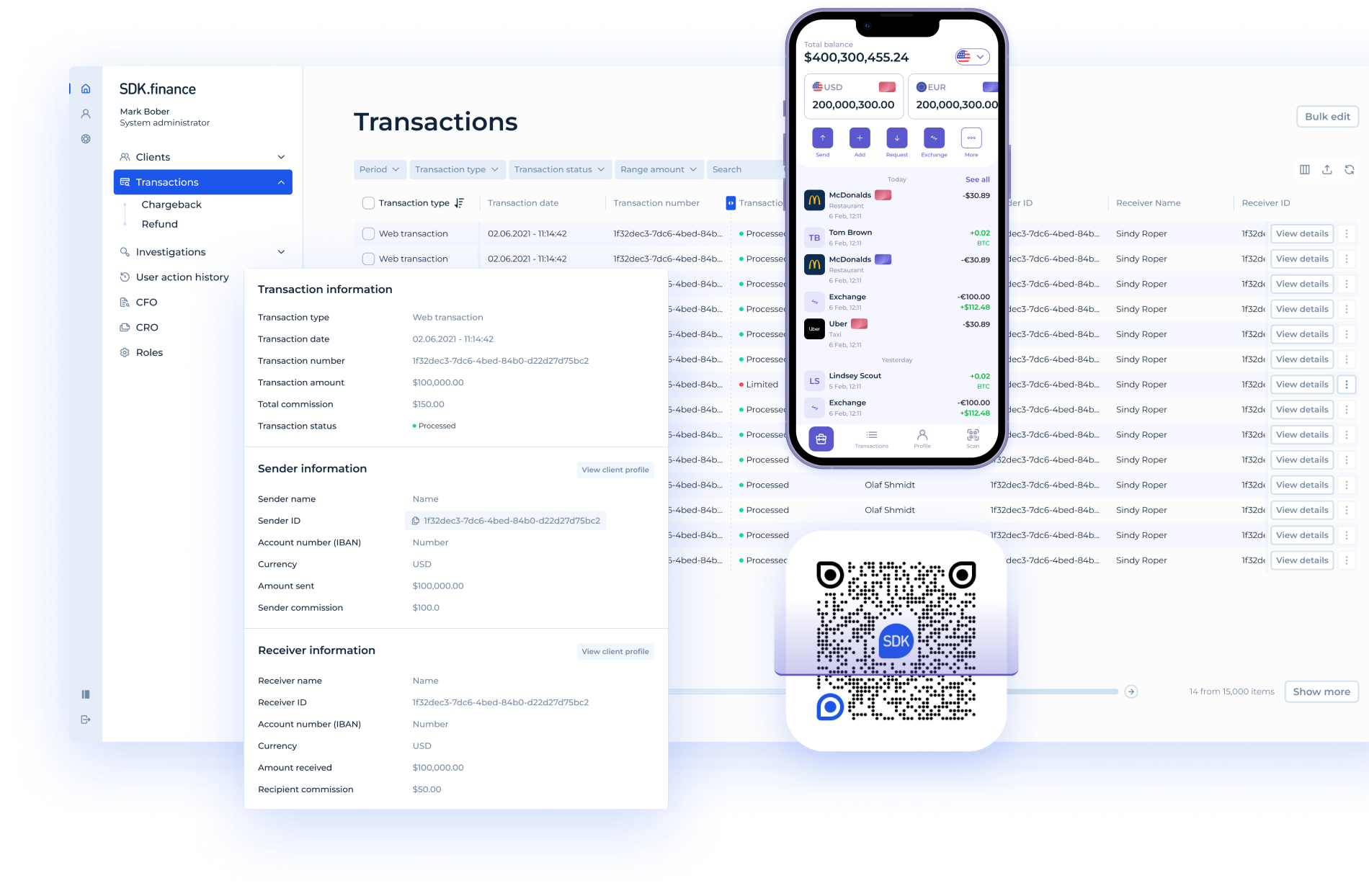
SDK.finance is a digital payments software provider that offers a modular, API-first foundation for the first three layers above – the customer interface, transaction platform and ledger – and connects the product to the providers and rails that make up the last two. It is not a bank, acquirer, payment gateway or card scheme. External regulated providers hold and move funds and authorise payments, depending on the setup selected by the business.
The capabilities most relevant to a digital payment product:
- Multi-currency accounts and wallets. Accounts for individuals and businesses, holding balances in several currencies.
- Transaction processing and workflows. Payments, transfers, top-ups, payouts and refunds, each with a tracked status.
- Real-time double-entry ledger. Every movement recorded on both sides and reconciled against provider statements.
- Payment links and QR code payments. Request-to-pay flows a customer completes by link or by scanning a code.
- Configurable fees, limits and commissions. Set per product, channel, role or transaction type, without code changes.
- 650+ APIs, webhooks and pre-built integrations. Connect KYC and AML, card, banking and FX providers, with real-time status events – plus back office, roles and permissions, and brandable web and mobile apps.
In practice, the SDK.finance Transaction Platform holds the transaction record, the accounts, the fee logic and the reconciliation, and reaches the regulated parts of the payment through its pre-built integrations. Licensing, authorisation and settlement stay with the bank, EMI, payment institution or scheme.
Digital payments: the bottom line
A digital payment looks like a single action to the customer and is a sequence of stages underneath: a method, a technology that initiates it, a rail that carries it, and authorisation, capture, clearing and settlement in that order. For a business, the methods it offers determine the providers and rails it needs, and those choices set its costs, its settlement timing and much of its build.
Explore the SDK.finance digital wallet solution to see how those layers fit together in a live product.
Ready backend, APIs, and integrations
Talk to Our Team