To start a payment processing company, first choose the merchants you want to serve and the role your business will play. Then establish the required partner relationships, assess regulatory and security obligations, plan your costs, and build or configure the technology before piloting it with merchants.
This guide explains the main business models, launch steps, payment processing components, and cost drivers. It also shows where a FinTech software provider, like SDK.finance, can reduce development work by providing the software platform needed to launch a payment processing business.
Choose your payment processing business model
Choose the role your business will perform before choosing software. A payment service provider (PSP) is a broad category: it may combine gateway, processing and merchant-service functions.
| Business model | What you sell and control | Partners and launch responsibilities |
|---|---|---|
| Agent or reseller | Best for a sales-led launch. Sell and support an existing provider’s merchant services; pricing and branding follow your agreement. | Work through an ISO or processing partner. Confirm commissions, portfolio rights and support duties before recruiting merchants. |
| Registered ISO | Best for a merchant-services business seeking a formal sponsored relationship. Sell and service merchant accounts within the agreed scope. | Secure a sponsoring acquirer and the registrations required for your role. Agree underwriting, pricing, portfolio rights and support responsibilities. |
| Payment gateway | Best for a technology-led business. Operate the connection between merchant checkout and processing providers. | Processor or acquirer connections. Define security scope, integration testing, availability and support responsibilities. |
| Payment facilitator (PayFac) | Best for teams seeking control of merchant onboarding and payment services through a sub-merchant model. | Work with an acquiring partner. Agree underwriting, monitoring, settlement, disputes and loss responsibility before setting the launch scope. |
| Payment processor | Best for teams building processing infrastructure. Operate payment messages and support clearing and settlement. | Bank and network connectivity, technical acceptance and ongoing operations. This route carries substantial engineering and operational responsibilities. |
A company may combine these roles. Permissions depend on its activities, funds flow, contracts and jurisdiction; software does not supply a financial licence. For a merchant services business focused on sales, evaluate an agent or ISO route before committing to processing infrastructure.
For more detail on the sales-led route, see Stripe’s explanation of payment processors and ISOs.
How to start a payment processing company: step-by-step
A payment business needs more than a working checkout. Use the following sequence to connect your commercial plan with the financial partners, technology, and operations required for launch.
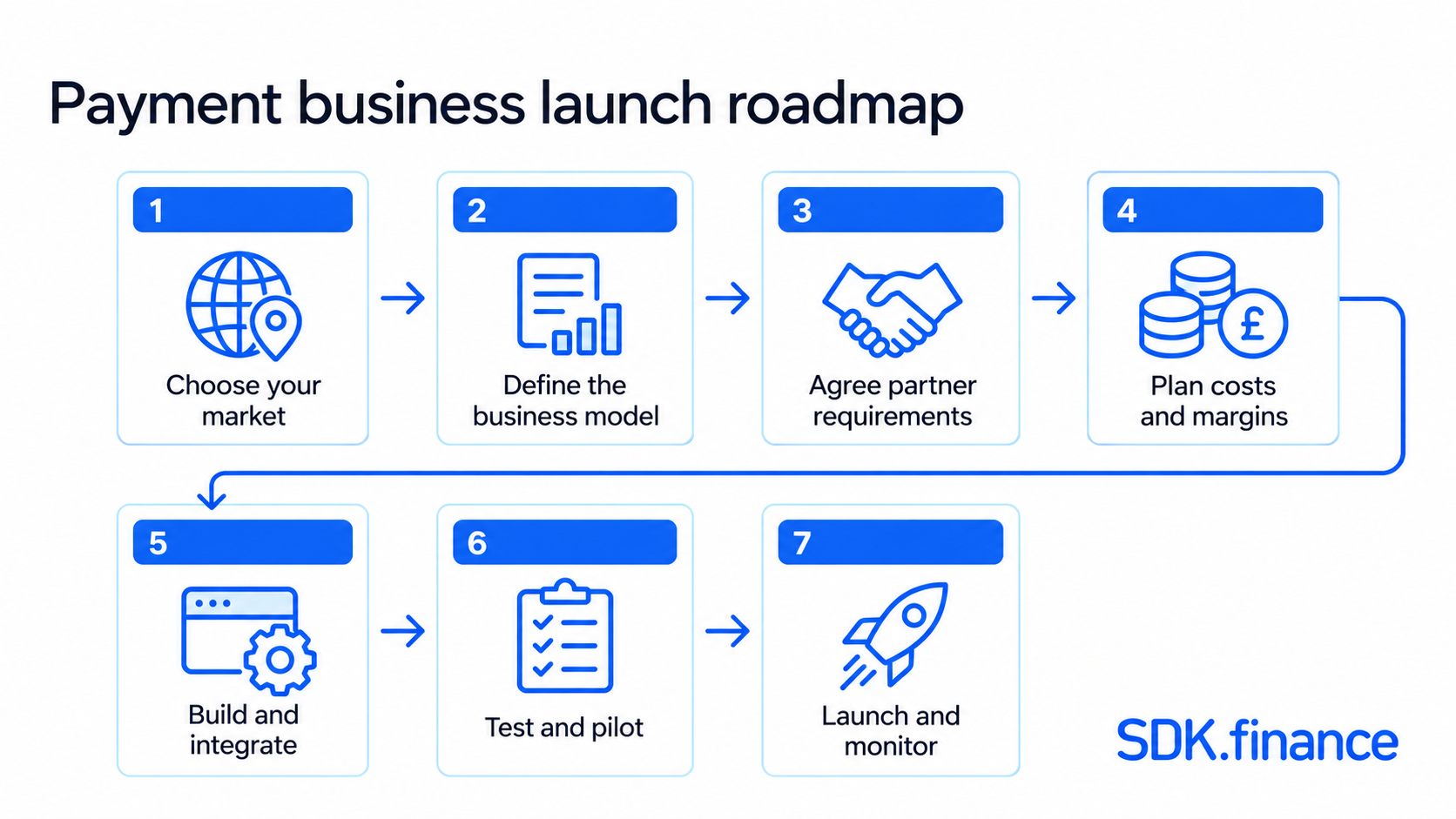
1. Choose your market and merchant segment
Define the countries, merchant industries, payment methods, currencies, and sales channels you will support first. Estimate transaction volumes and average transaction values. A focused launch scope makes partner selection, pricing, and technical requirements easier to evaluate.
Validate a specific problem with prospective merchants, such as failed subscription payments or unreliable POS reporting. The result should be a launch brief defining your first merchant segment, payment methods, countries and service proposition.
2. Define your service and responsibilities
Translate your chosen model into a responsibility map: who signs merchants, approves applications, handles funds, manages risk and resolves disputes. Assign each activity to your business or a named partner so gaps are visible before implementation.
Walk through a practical scenario, such as a merchant asking about a delayed payout. Define who answers the merchant, which records they check and when the issue moves to a partner. Use the same approach for refunds and disputes.
3. Choose acquiring and processing partners
Prepare a partner brief covering your target merchants, expected volumes, ownership structure, funds flow, and risk controls. Discuss acquiring, processing, settlement, and onboarding requirements with prospective providers. Obtain jurisdiction-specific advice on the permissions your planned activities require before committing to a launch date.
Compare prospective partners against the same merchant profile and transaction assumptions. Ask for written answers to the following questions before selecting a provider:
- Market fit: Which countries, currencies, payment methods and merchant categories can the partner support? Which activities are restricted?
- Merchant onboarding: Who contracts with the merchant, approves the application and handles KYB checks? What information must you collect?
- Commercial terms: What are the transaction charges, minimum fees, setup costs and revenue-share rules? Who can change pricing?
- Settlement and risk: When are funds paid out, what reserves or prefunding may be required, and who bears losses or handles disputes?
- Technology and service: Are sandbox access, API documentation, transaction reports and support escalation available? What testing is required before production access?
- Exit terms: Who owns the merchant relationship and data? What happens to commissions, contracts and migration if the partnership ends?
The result should be a selected partner, agreed commercial terms and a written list of onboarding and production-access requirements. Record unresolved approvals and who owns each action.
4. Plan costs, pricing, and margins
Use the budget framework below to forecast first-year funding and contribution per merchant. Compare your expected growth with a lower-volume scenario. The result should show the cash needed before launch, the operating runway and the assumptions required to break even.
Separate what you charge merchants from what you pay partners. Test how the margin changes for merchants with smaller transactions, lower activity or higher support needs. Include merchant acquisition and onboarding costs when assessing whether an account is commercially viable.
5. Build or configure the technology
Decide which components to build, configure or obtain from providers. The result should be a payment-flow design, an integration list and acceptance criteria for successful payments, declines, refunds and provider outages. Assign an owner to each component.
Start with one complete merchant journey, from registration to payment acceptance, reporting and refunds. Prioritise the components needed to deliver that journey, then identify gaps requiring custom development. Agree how your team will monitor failures and maintain each integration after launch.
6. Test the full payment lifecycle and run a pilot
Agree pilot criteria before onboarding merchants: acceptable payment reliability, reconciled financial records, support response targets and unresolved issues that would block expansion. Complete required partner testing and assessments. The result is a documented decision to proceed, fix specific issues or narrow the launch scope.
Choose a small group of merchants representative of your target segment and set a clear pilot scope. Test everyday operations as well as exceptions, including duplicate requests, delayed provider responses and refunds. Record issues, assign owners and retest fixes before expanding.
7. Acquire your first merchants and launch with operating controls
Build a focused offer for your chosen niche: the payment problem you solve, supported channels, transparent fees, onboarding requirements and support arrangements. Select an initial acquisition channel, such as direct outreach, referrals or a partnership with software used by that segment.
Prepare a demonstration, an onboarding journey and a comparison of the merchant’s current and proposed service. Explain the improvement in payment experience or operating workload, alongside pricing.
Track payment success, reconciliation exceptions, merchant activity and contribution after costs. Assign owners to investigate failures and use the findings to improve daily operations.
Measure the journey from qualified lead to active merchant, including onboarding drop-off and time to first payment. The result should be a repeatable acquisition process supported by retention and contribution data.
What determines your launch timeline?
The schedule depends on your business model and the slowest external dependency. An agent route uses an existing service; a gateway or PayFac launch adds integration, operational and partner-approval work. Direct processing infrastructure adds further connectivity and acceptance requirements.
Plan around four milestones: agree the business and partner scope; configure or build the service; complete technical and operational acceptance; then run the merchant pilot. Assign an owner, target date and completion criteria to each milestone.
Merchant research, financial planning and product design can run in parallel. Integration testing needs provider access; live payments need the relevant approvals and production credentials. Confirm these dependencies with partners before announcing a launch date.
Who needs to be on your launch team?
Cover merchant acquisition and onboarding, technical implementation, risk and verification, financial operations, and customer support. Roles may be combined or delivered by partners, but each needs an accountable owner. Record who approves merchants, investigates reconciliation differences, handles disputes and responds to incidents. Team size should follow the operating model and service hours.
How much does it cost to start a payment processing company?
Indicative market estimates for a 2026 launch vary by model. The amounts below cover entry, setup or development as specified; they are not complete first-year budgets or SDK.finance prices.
- Agent or reseller: $0–$1,000 for programme entry, plus sales, administration and support.
- Registered ISO: setup from around $10,000; sponsor onboarding, legal work and sales infrastructure can raise this to tens of thousands.
- Payment gateway: approximately $35,000–$75,000 for a scoped integration or $120,000–$250,000+ for custom development.
- PSP: ready-made software requires a quote for setup, integrations and licensing. Custom white-label platform development can cost $280,000–$500,000+.
- Registered PayFac: initial setup from around $250,000, rising with technology, risk and operational scope.
- Own processing infrastructure: technology and certification work can exceed $1 million, before continuous operations and working capital.
Calculate total first-year funding as setup + 12 months of operating costs + separate reserves or prefunding. Include hosting, maintenance, staff, partner fees and merchant acquisition. Avoid counting services already included in supplier fees twice.
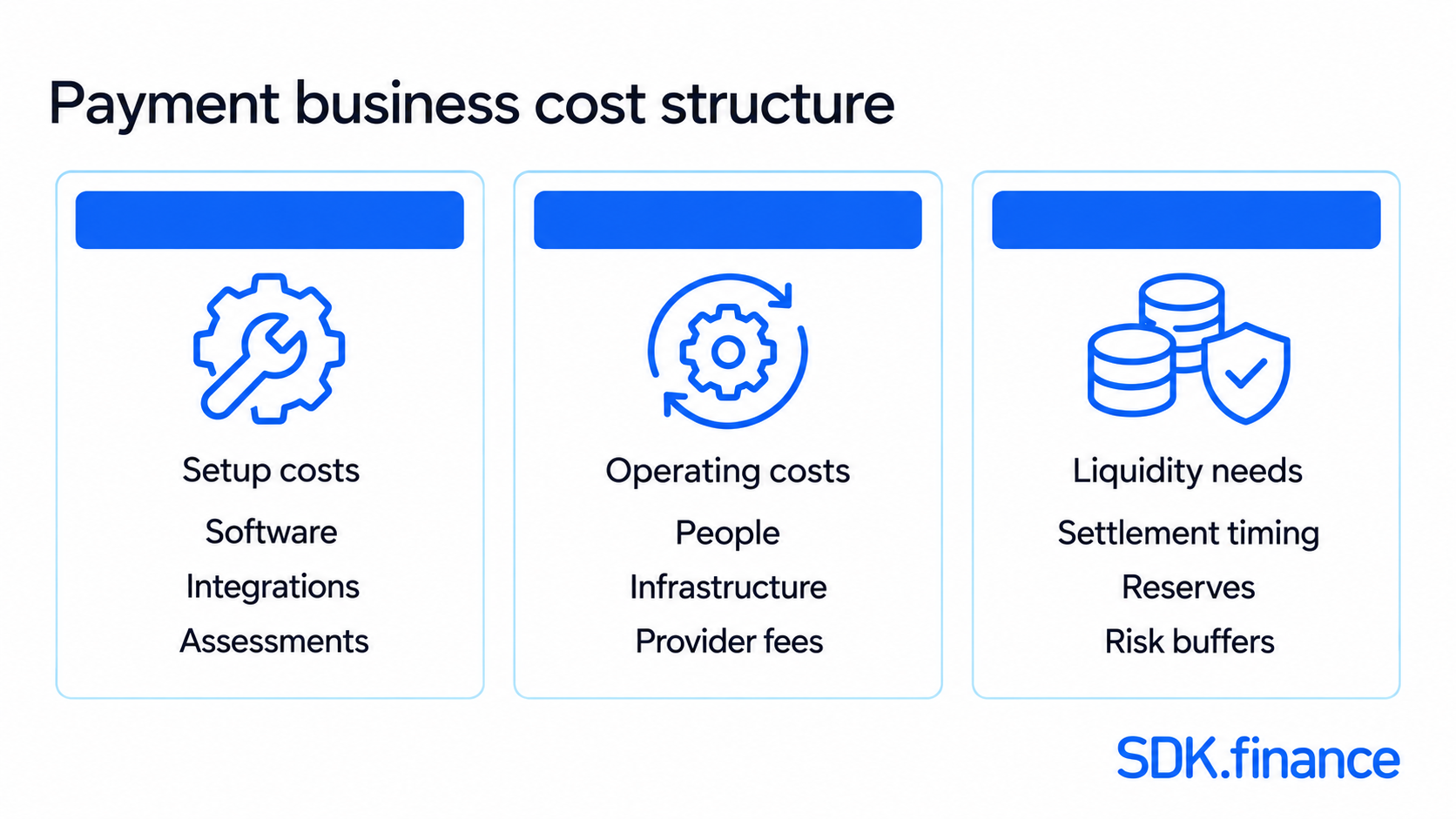
Factors affecting the cost of starting a payment processing business
| Budget category | What to include | What determines the amount |
|---|---|---|
| Initial setup | Software, customisation, integrations, legal work, assessments, and partner testing. | Business model, markets, payment methods, and the scope of existing software. |
| Ongoing operations | Infrastructure, maintenance, provider fees, support, risk operations, and merchant acquisition. | Transaction volume, service levels, staffing, and commercial terms. |
| Liquidity and risk buffers | Funding gaps caused by settlement timing and any contractually required reserves or prefunding. | Funds flow, settlement terms, merchant risk, and responsibility for losses. |
Ask suppliers to price the same merchant profile, markets, payment methods and transaction volumes. Separate fixed commitments from usage-based charges and include minimum fees in the low-volume scenario. Keep reserves and prefunding outside operating expenses: they affect the cash required even when they are not a fee.
How do payment processing companies make money?
Payment businesses earn revenue through several channels, depending on their role and partner agreements:
- Transaction fees: a fixed fee, a percentage of payment value, or both.
- Subscriptions: recurring charges for access to the service or an agreed package.
- Additional services: fees for optional services such as terminal rental or premium reporting, where these form part of your offer and merchant agreement.
Agents and resellers may instead receive an agreed commission or share of processing revenue. The amount charged to a merchant is not all profit: deduct upstream charges, operating costs and any losses borne by the business. If revenue is already recorded net of upstream charges, do not deduct them again.
Illustrative monthly margin calculation
Assume 100 merchants each generate $40 in retained monthly revenue after upstream charges: $4,000 in total. Subtract $1,200 in variable costs and $2,500 in fixed overheads to leave $300 before tax and other excluded costs. Break-even is 90 active merchants under these assumptions. This is a hypothetical example; acquisition costs, financing and additional losses must be included in your own forecast.
Build your payment processing technology: in-house or ready-made
Building payment processing software from scratch gives your team control over the design, but it also requires engineering capacity, security expertise, testing, and ongoing maintenance. Estimate the effort for integrations and operations as well as the core transaction flow.
For a ready-made solution, compare supported workflows, customisation, delivery model and integration scope with your launch requirements. Budget for gaps and ongoing maintenance as well as initial implementation.
Map the payment flow before choosing components
Authorisation can happen within seconds, but it is not the same as settlement. The processor coordinates transaction messages; clearing and the movement of funds follow the relevant payment method, provider, and settlement schedule.
A typical online card payment follows these stages:
- The customer enters payment details through the merchant’s checkout.
- The gateway securely sends the payment request to the processor or acquirer.
- The request passes through the card network to the issuing bank.
- The issuer checks the request and returns an approval or decline.
- The response travels back to the merchant so the checkout can show the result.
- For a captured payment, clearing and settlement follow. The merchant receives funds according to its provider agreement.
Define the components you need
Start with a system design that separates the merchant experience from payment connectivity and financial records. Building a payment processor is not just implementing an API that accepts a payment request.
- Merchant layer: registration, verification workflows, pricing, permissions, and a portal for payment activity.
- Payment connectivity: gateway, processor, or acquirer integrations, authentication flows, and reliable handling of provider responses.
- Transaction and financial records: payment states, fees, balances where applicable, and auditable records that can be reconciled with external reports.
- Operations: refunds, dispute handling, settlement reporting, monitoring, incident response, and support.
For each component, record whether it is native to your chosen software, configured for your use case, integrated from a provider, or custom-built. Confirm API behaviour and production access with the relevant provider before treating an integration as launch-ready.
Use the same scope when choosing software for payment service providers or assessing an in-house build: workflow coverage, custom development, integrations, data access, deployment responsibilities and future changes. Confirm how records remain consistent when requests fail or arrive more than once.
SDK.finance software for a payment processing business
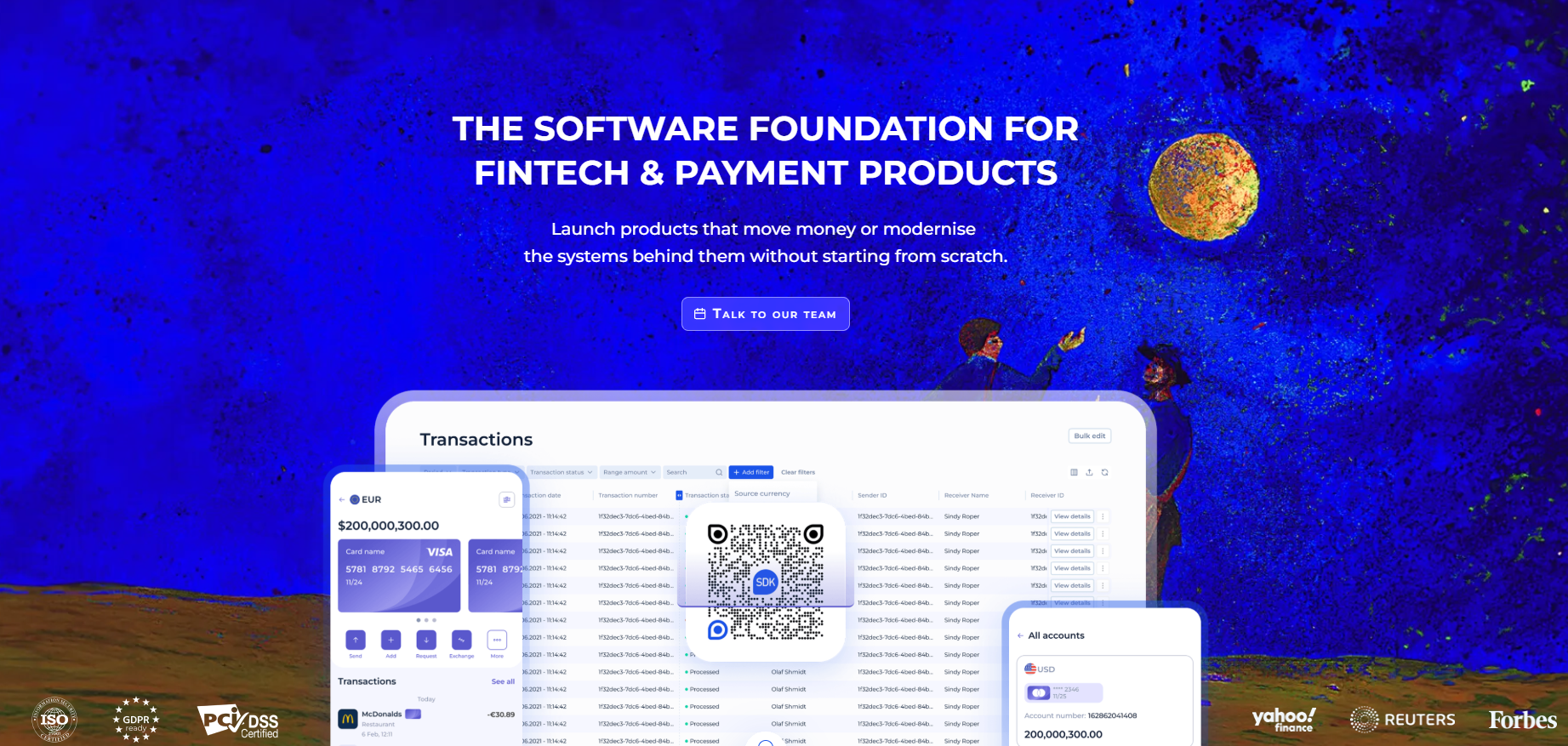
SDK.finance’s merchant payment processing solution combines the Transaction Platform with merchant-facing components and provider integrations. Configure it around your merchant offer, with acquiring agreements and permissions arranged separately.
Security is another consideration when choosing the software behind your payment processing business. SDK.finance is a PCI DSS Level 1 compliant service provider and ISO/IEC 27001:2022 certified, with its PCI DSS assessment covering software development services and related security controls. Your company remains responsible for the security and compliance requirements of its own operations and deployment.
For a payment processing company, the relevant capabilities include:
- Merchant onboarding: company profiles, document collection and manual or provider-assisted KYC/KYB checks.
- Payment acceptance: online POS registration and configurable checkout connected to payment providers.
- Payment requests and refunds: invoice, payment-link and QR journeys, plus refund workflows supported by the connected provider.
- Merchant pricing: fixed, percentage or combined fees, provider commission settings and transaction limits.
- Merchant reporting: access to balances, payment history and transaction details through merchant-facing interfaces.
- Transaction reconciliation: comparison of uploaded bank or provider records with Platform transactions and investigation of discrepancies.
- Operational controls: staff permissions, transaction views and user-action history for support, verification and finance teams.
- Provider connectivity: APIs, webhooks and available connectors for payment gateways and verification services.
The available payment methods and external checks depend on the connected providers and implementation scope.
Turn these capabilities into your merchant service through the following implementation stages.
Choose SaaS or a Source Code Licence
With Software as a Service (SaaS), SDK.finance manages application hosting and scheduled updates. Configure the product and connect services through APIs, webhooks or middleware without backend source-code access. Confirm responsibility for client-managed databases and backups.
A Source Code Licence lets your team modify core logic and deploy on its own cloud or on-premises infrastructure. Your team manages infrastructure and maintenance, with support and updates defined by the licence. Keep test environments separate from live operations.
Configure merchant onboarding, pricing and access
Build onboarding around company records, document uploads and KYC/KYB statuses. Define the review process and connect specialised verification providers where required.
Use contracts to configure merchant fees and transaction limits, keeping provider charges separate from merchant-facing pricing. Assign permissions for verification, support and finance, then test that each merchant receives the intended access and tariffs.
Connect providers and build payment journeys
Identify available SDK.finance connectors and any custom integration work. Obtain provider credentials and approval, then map responses and identifiers to Platform records. The Mastercard Payment Gateway Services integration provides a foundation for Hosted Checkout and card top-ups; confirm coverage of the operations your service needs.
Use merchant portal and checkout components to build the supported payment journeys. Associate POS records with merchants, configure connection credentials and link refunds to the original payment. Physical terminals require separate arrangements. Add product catalogues or recurring-payment workflows only where needed and supported.
Set up accounting, reconciliation and reporting
Configure accounts and accounting rules for payments, fees, refunds and external payouts. Map bank or provider file formats for reconciliation against Platform operations, and assign responsibility for unmatched records.
Give merchants and staff the transaction views and reports they need. Use user-action history to investigate changes, and define data mapping and update frequency for any external accounting or analytics tools.
For example, configure a merchant payment workflow to record the payment and its fee under the merchant’s contract. Once the reporting period closes, upload the provider’s transaction file in the agreed format and reconcile it against Platform records. Staff investigate discrepancies, while the merchant can view payment details and fees through the configured portal.
Validate the service with pilot merchants
Test registration, payment acceptance, fees, refunds and reconciliation end to end. Include declines, duplicate requests, delayed responses and permission checks. Compare Platform records with provider reports and settlement outcomes, resolving exceptions against the pilot criteria before expanding.
Geidea: modernising an established payment business
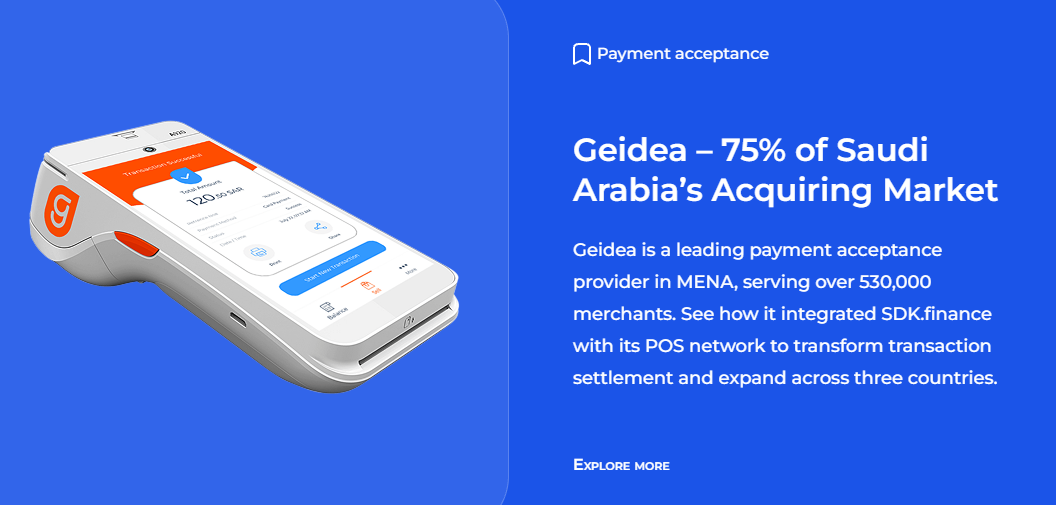
Geidea used SDK.finance to replace its legacy transaction accounting system and improve visibility into merchant balances and settlement. This was a modernisation project for an existing PSP, with custom development around its operating model.
The implementation connected POS transactions to merchant accounts, tracked bank settlement and supported automated reconciliation and payouts. Merchants gained access to balances, transaction history and payout reports. Configurable commissions allowed Geidea to separate bank charges from its own fees and change pricing without redeploying code.
The result was clearer tracking of payments, payouts and financial results, alongside connections to additional acquiring banks. Mastercard Payment Gateway Services integration also enabled online payment acceptance. The Geidea case study shows how SDK.finance software was adapted to support an established payment operation.
From business plan to a working payment service
Starting a payment processing company means bringing together a clear merchant proposition, viable pricing, the right financial partners and reliable technology. Your chosen business model determines how much of the payment lifecycle you manage and which responsibilities remain with external providers.
SDK.finance brings account management, payment workflows and back-office tools into the implementation plan. The business case depends on how well you combine that foundation with your merchant offer, partner arrangements and operating team. Use the pilot to validate service quality and economics before expanding.
To discuss how SDK.finance could support your payment processing business, share your requirements through the SDK.finance contact form.