


Most FinTech engineering teams discover the ledger problem the same way: somewhere between the first wallet feature and the first reconciliation failure. Building out stored balances feels straightforward until you hit the accounting constraints – atomic writes, double-entry correctness, idempotency under retry, audit-grade history – and realize you’re not building a feature, you’re building financial infrastructure.
Ledger-as-a-Service (LaaS) is the category that emerged to solve this. Rather than building a transactional ledger in-house, organizations adopt a managed, API-accessible system that handles posting, balance computation, audit trails, and reconciliation as a service. The product team gets what they need; the engineering team doesn’t spend six months on accounting primitives.
SDK.finance offers Ledger-as-a-Service through a standalone SaaS model, providing real-time, double-entry ledger infrastructure for banks, PSPs, EMIs, and FinTechs. It can be adopted as a standalone ledger layer or used as part of a broader financial infrastructure stack – depending on how much of the surrounding platform an organization wants to bring along.
This article covers what LaaS actually is, how it operates, and when it’s the right architectural choice.
What Is Ledger-as-a-Service?
Ledger-as-a-Service (LaaS) is a managed, API-accessible operational ledger delivered through SaaS instead of built in-house.
A ledger is a system of record for financial balances. Every wallet balance, virtual account, and tracked payment flow depends on a ledger maintaining that state correctly – posting entries, computing balances, and preserving a history that can survive audits, disputes, and reconciliation runs.
In modern FinTech architecture, the operational ledger sits between the product layer (wallets, cards, loans, treasury accounts) and the payment rails and bank accounts beneath it. It is the source from which user-facing and operator-facing balances are derived. Not copied from a spreadsheet, not approximated from transaction logs – derived from a correctly maintained double-entry system.
This is also where a common confusion is worth clearing up: LaaS is not general ledger software. A general ledger is what your finance team uses for statutory reporting – P&L, balance sheets, tax filings. A Ledger-as-a-Service platform is an operational ledger, tracking live product balances in real time, enforcing accounting rules at the transaction level, and producing the records your reconciliation and compliance workflows consume. Many organizations run both; they are not substitutes for each other.
The LaaS category has been formally named as a distinct infrastructure layer – separate from payment orchestration, treasury APIs, and core banking platforms – in part because the engineering requirements for a reliable operational ledger are specific enough that a dedicated solution category makes sense.
How Ledger-as-a-Service Works
Understanding the flow inside a LaaS platform explains why it behaves differently from a general-purpose database or a manually maintained accounting table.
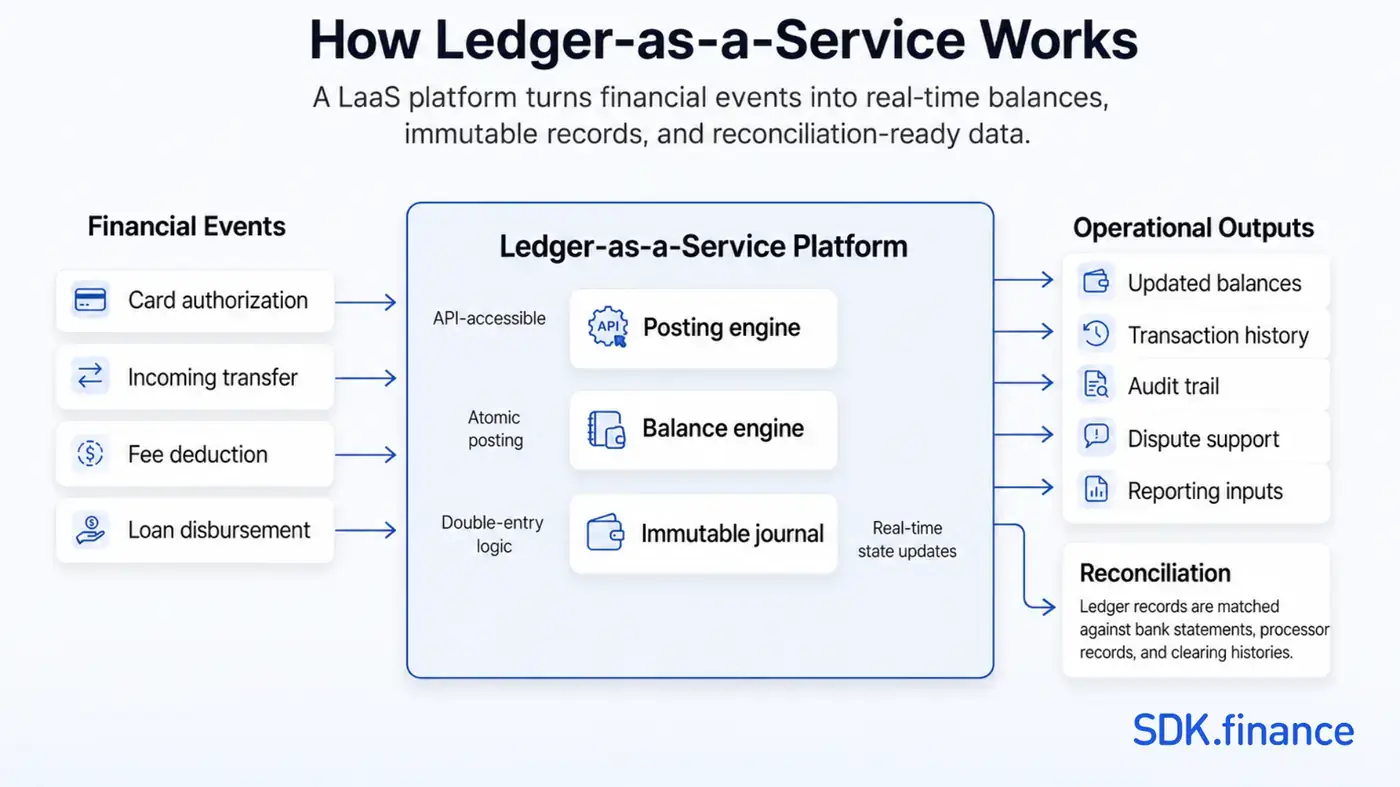
When a financial event occurs – a card authorization, an incoming transfer, a fee deduction, a loan disbursement – the product layer sends it to the ledger via API. The posting engine validates and commits it as an atomic unit. Double-entry constraints apply: value moves between accounts, never appears or disappears, and if any validation fails, the entire transaction is rejected. There is no partial post.
Once committed, the balance engine updates account state immediately – not on a batch cycle. The transaction is simultaneously written to an immutable journal recording what posted, when, and against which accounts. That history feeds dispute resolution, audit inquiries, and downstream reporting.
Reconciliation runs alongside this. The ledger exposes its state so teams can match internal entries against bank statements, card processor records, and clearing histories. A well-designed LaaS platform produces records structured for external verification, not just internal consistency.
Why Teams Use Ledger-as-a-Service Instead of Building a Ledger From Scratch
The honest answer is that building a ledger is harder than it looks, and the cost of getting it wrong is high. It is not a general software engineering problem – it requires financial engineering expertise: correct accounting model design, concurrency controls that prevent balance inconsistency under load, idempotency that survives retried API calls, and an audit trail that holds up to regulatory scrutiny.
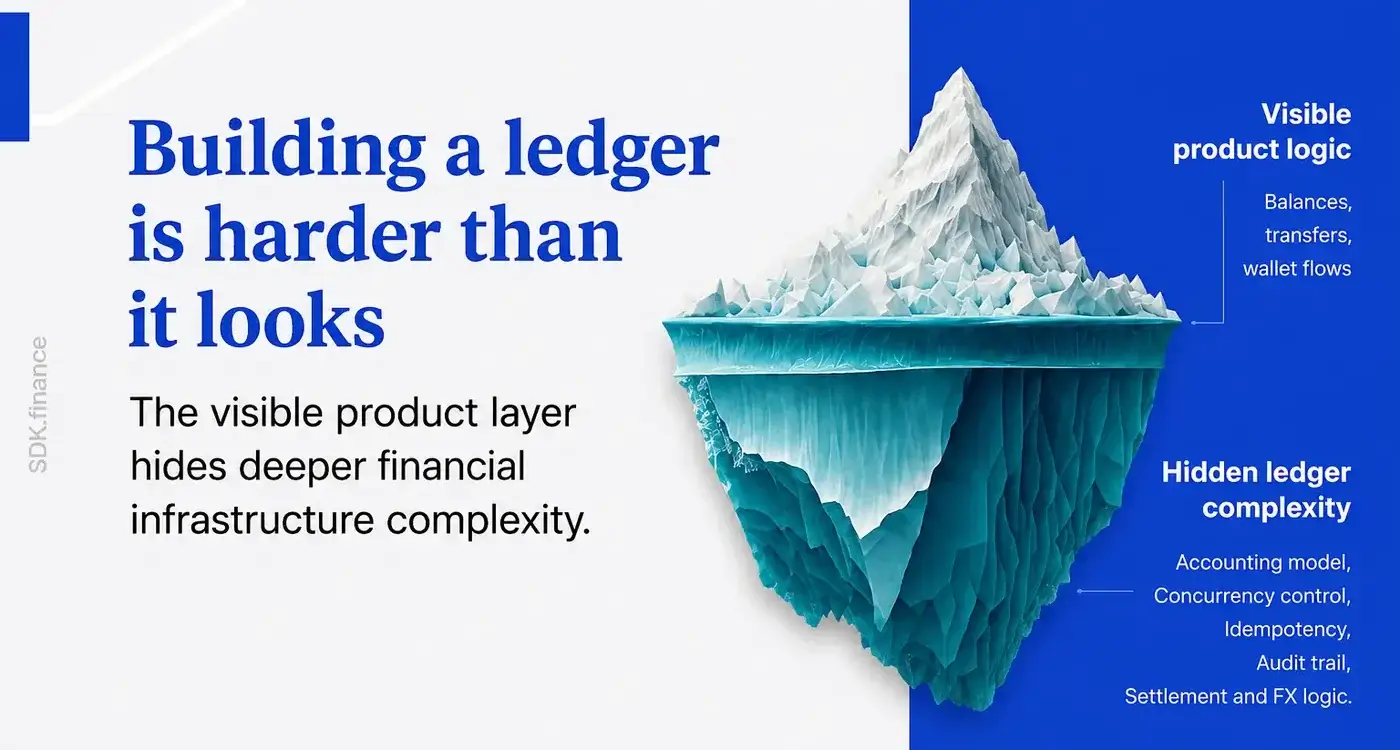
Most teams building their first financial product underestimate this. They build something that works at low volume and breaks under load, or something that handles the happy path and fails on settlement delays, chargebacks, or FX postings. By the time the gaps become visible, they’ve often already shipped to customers.
LaaS addresses this by delivering the solved version of that infrastructure. The practical advantages break down into a few distinct areas:
- A LaaS platform can be operational within weeks. Building and validating a custom ledger takes months – and that’s before ongoing maintenance.
- Reduced engineering burden. The constraints that make a ledger reliable – atomic writes, balance caching, idempotency, immutable history – are handled by the provider. Your team builds the product, not the accounting engine.
- Operational simplicity. Uptime, consistency under write load, and data integrity become the provider’s problem. You don’t need specialized ledger operations expertise on staff.
- Immediate access to mature capability. LaaS platforms expose ledger functionality through documented APIs – wallet balances, multi-currency accounts, reconciliation flows, audit trails – without requiring you to build the engine underneath it.
Ledger-as-a-Service vs Building Your Own Ledger
The build-vs-buy question for ledger infrastructure doesn’t have a universal answer. It depends on your product complexity, transaction volume, available engineering capacity, and how quickly you need to move. What’s worth being clear about is what you’re actually trading off.
- LaaS is faster to production by a significant margin. A well-scoped custom ledger takes months of careful engineering; a LaaS integration can be running in weeks.
- Building in-house gives you full ownership of the schema and behavior. Some LaaS providers – including SDK.finance – offer a Source Code option for organizations that need deeper control without starting from zero.
- Custom ledgers can be shaped to any data model. LaaS platforms are configurable, and their API surfaces cover most operational needs without custom code – but they do have edges.
- Dependency risk. LaaS means relying on a third-party provider. That warrants evaluating SLAs, support, data portability, and provider stability before committing – as you would with any critical infrastructure vendor.
- Ongoing maintenance. Custom ledgers don’t stay built. Schema migrations, concurrency tuning, reconciliation logic updates, and audit tooling improvements accumulate over time. LaaS offloads most of that to the provider.
Ledger-as-a-Service vs Ledger API vs Broader Ledger Platform
These terms get used loosely, and the differences matter when you’re evaluating what you actually need.
- A ledger API is an interface – it’s how you interact with ledger functionality. The API itself isn’t the service; plenty of products expose ledger-adjacent endpoints without delivering the full operational infrastructure that LaaS implies. When someone says “we have a ledger API,” that tells you about the integration surface, not about what’s running underneath.
- Ledger-as-a-Service is the delivered capability: the posting engine, accounting model, balance engine, journal store, reconciliation support, and the operational infrastructure that keeps it running. The API is one of the ways you access it. The service is what you’re actually buying.
- A broader ledger platform bundles ledger infrastructure with adjacent capabilities – wallet management, payment execution, account onboarding, compliance tooling, or reporting layers. These make sense for organizations that want to consolidate vendors, or that need capabilities beyond the ledger itself without stitching together multiple point solutions.
SDK.finance covers this range. Its standalone SaaS model delivers LaaS directly – real-time, double-entry ledger infrastructure with 570+ REST APIs. For organizations that need more surrounding platform capability, it can also be used as part of a broader financial infrastructure stack.
Who Uses Ledger-as-a-Service?
LaaS adoption is concentrated in organizations that manage financial balances at scale – where balance correctness isn’t a nice-to-have, it’s a regulatory and operational requirement.
- Banks and neobanks. Institutions issuing accounts or payment instruments need a ledger that handles real-time posting, balance computation, and the audit trail required by regulators.
- Payment service providers (PSPs). High-volume payment operations involve settlement timing gaps, processor reconciliation, and balance state that must stay consistent across a large number of concurrent events.
- E-money institutions (EMIs). EMIs operating digital wallets need multi-entity subaccount support, reconciliation workflows, and the kind of audit trail that payment regulators expect to inspect FinTech products with stored value, virtual accounts, or multi-currency balances need a ledger that scales correctly – not one held together by application-layer workarounds.
How to Evaluate a Ledger-as-a-Service Provider
Not every managed ledger platform is equivalent. A few criteria tend to separate production-grade LaaS from lighter alternatives:
- Real-time posting. Balances should reflect current state immediately. If the platform processes entries in scheduled batches, it isn’t suited for financial products where users and operators expect live balance accuracy.
- Double-entry enforcement. Every transaction should be balanced at the platform level. Double-entry constraints are what prevent value from appearing or disappearing unexpectedly – they’re the foundation of a reliable audit trail.
- Multi-currency support. If you’re operating across jurisdictions or building multi-currency financial products, the ledger needs to track balances per currency and handle FX-related postings without you engineering that logic separately.
- Audit trail. The platform must maintain an immutable, queryable history for every posting. This is required for disputes, regulatory inquiries, and any forensic review of account activity.
- Reconciliation-ready records. The ledger’s records need to be matchable against bank statements and processor clearing data. In regulated environments, reconciliation isn’t an afterthought – it’s a core operational requirement.
- API coverage. Broad, well-documented API coverage matters for integration – with your product layer, reporting tools, and any external systems that need to read or act on ledger state.
- Scalability under write load. Ledgers are write-heavy by nature. Validate that the platform has been tested at the volumes your product will reach – and ask what happens to consistency guarantees when load spikes.
- Deployment flexibility. Consider how the platform can be adopted: standalone SaaS, as part of a broader stack, or with access to source code for organizations with specialized infrastructure or control requirements.
Is SDK.finance a Ledger-as-a-Service Provider?
Yes. SDK.finance offers Ledger-as-a-Service through a standalone SaaS model.
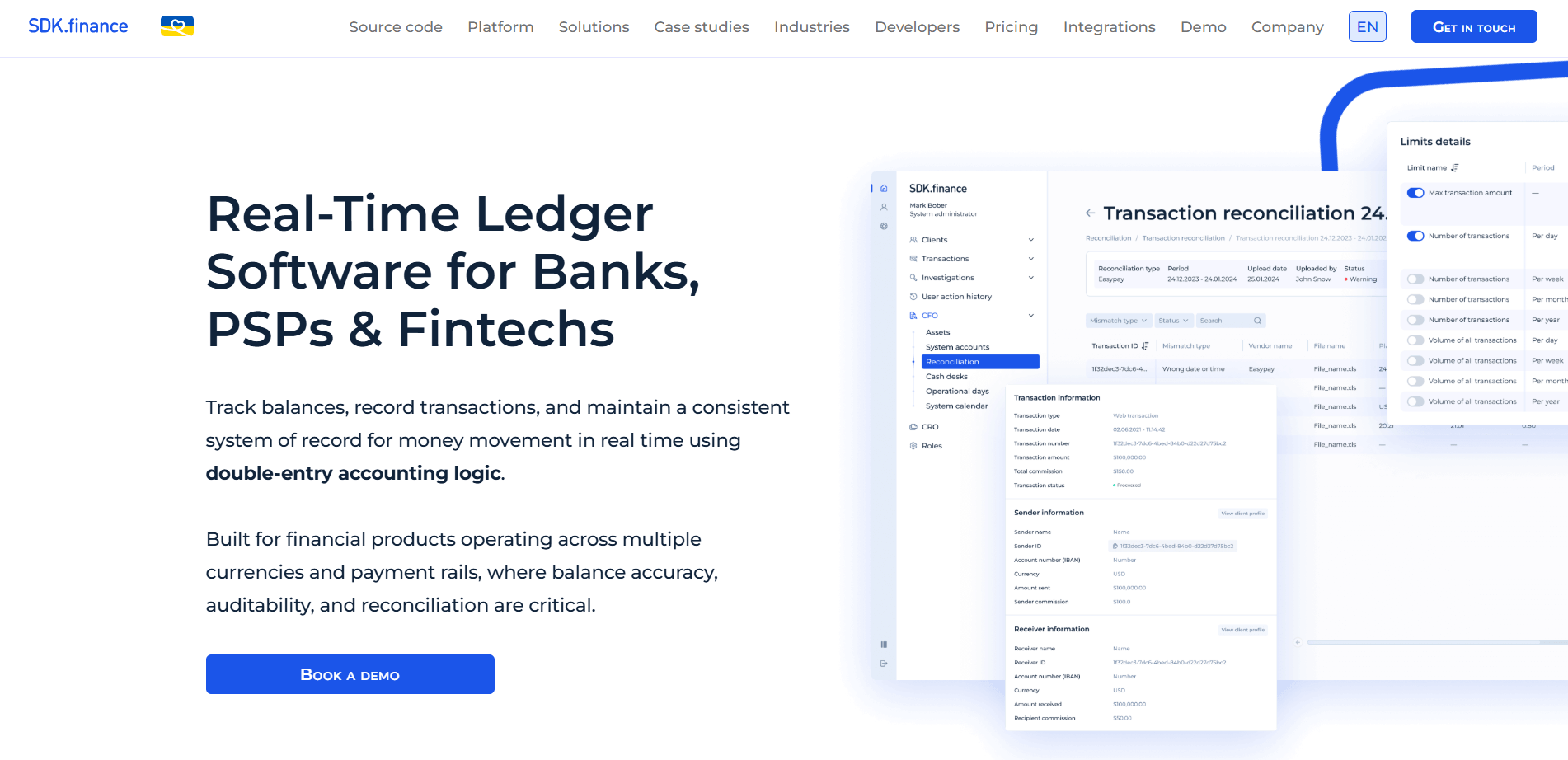
SDK.finance offers Ledger-as-a-Service through a standalone SaaS model, providing real-time, double-entry ledger infrastructure for banks, PSPs, EMIs, and FinTechs. It can be adopted as a standalone ledger layer or used as part of a broader financial infrastructure stack.
In terms of what the platform actually delivers: real-time posting without batch delays, double-entry accounting enforced at the platform level, multi-currency support for products operating across jurisdictions, reconciliation capabilities for matching internal records against external financial systems, multi-entity subaccounts for platforms managing balances across many customers or entities, and 570+ REST APIs covering the integration surface most financial product teams need.
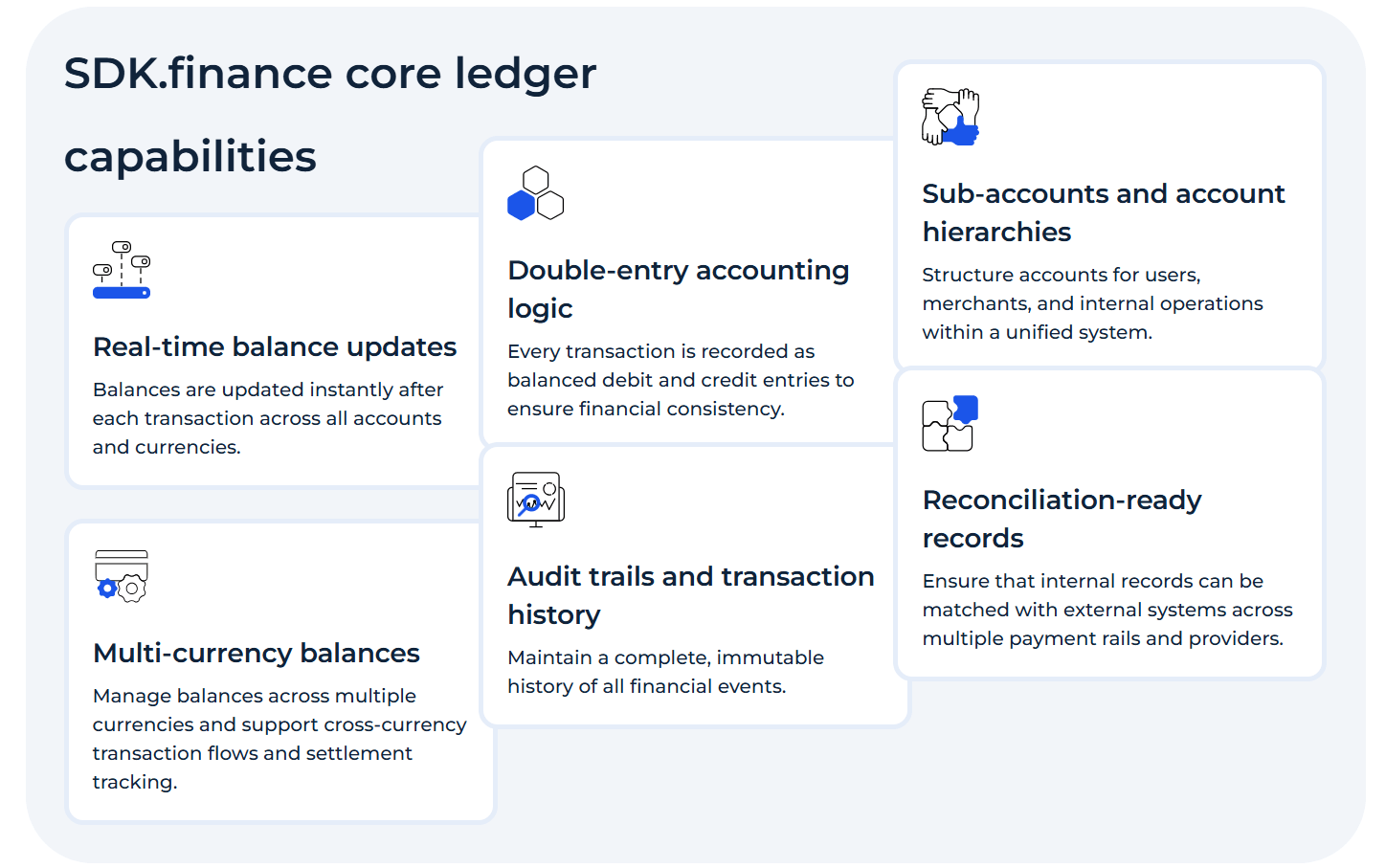
For organizations that need more control over their infrastructure, SDK.finance also offers a Source Code option – giving teams deeper access to the ledger layer without requiring them to build the accounting engine from scratch.
When Ledger-as-a-Service Is a Strong Fit
LaaS makes the most sense in a few recurring scenarios. These aren’t edge cases – they describe most of the teams evaluating this category.
- You’re launching a financial product and need to move quickly. Starting with LaaS is significantly faster than building ledger infrastructure in-house, particularly for products that include stored balances, virtual accounts, or tracked payment flows.
- Your product operates across multiple currencies. Multi-currency balance management is one of the areas where building in-house is most likely to produce correctness problems under real transaction loads. A LaaS platform with native multi-currency support handles this without custom logic.
- You operate in a regulated environment. Banks, PSPs, and EMIs need transaction records that support reconciliation, audit, and regulatory examination. LaaS platforms produce those records as part of normal operation – not as a separate compliance project.
- Your engineering team’s capacity is better spent on the product. Ledger infrastructure is a significant ongoing commitment, not a one-time build. If that time is better invested in product development, LaaS shifts the maintenance burden to a specialist provider.
- You’re managing balances across many accounts or entities. Multi-entity subaccount support – needed for platforms managing balances across customers, sub-merchants, or organizational units – is a standard LaaS capability rather than something you’d have to build and maintain separately.
Conclusion
Ledger-as-a-Service has become a practical infrastructure decision for organizations that need reliable, real-time ledger capability but can’t justify – or don’t want to absorb – the engineering and operational cost of building it themselves. The category exists because the requirements for a production-grade financial ledger are specific and demanding, and the build-from-scratch approach has proven consistently underestimated.
LaaS is not general ledger software, and calling something a “ledger API” doesn’t make it a full service. The distinction matters when you’re choosing infrastructure that transaction accuracy and audit compliance will depend on.
SDK.finance offers Ledger-as-a-Service through a standalone SaaS model – real-time, double-entry ledger infrastructure with multi-currency support, reconciliation capabilities, and 570+ REST APIs – available as a standalone ledger layer or as part of a broader financial infrastructure stack.


